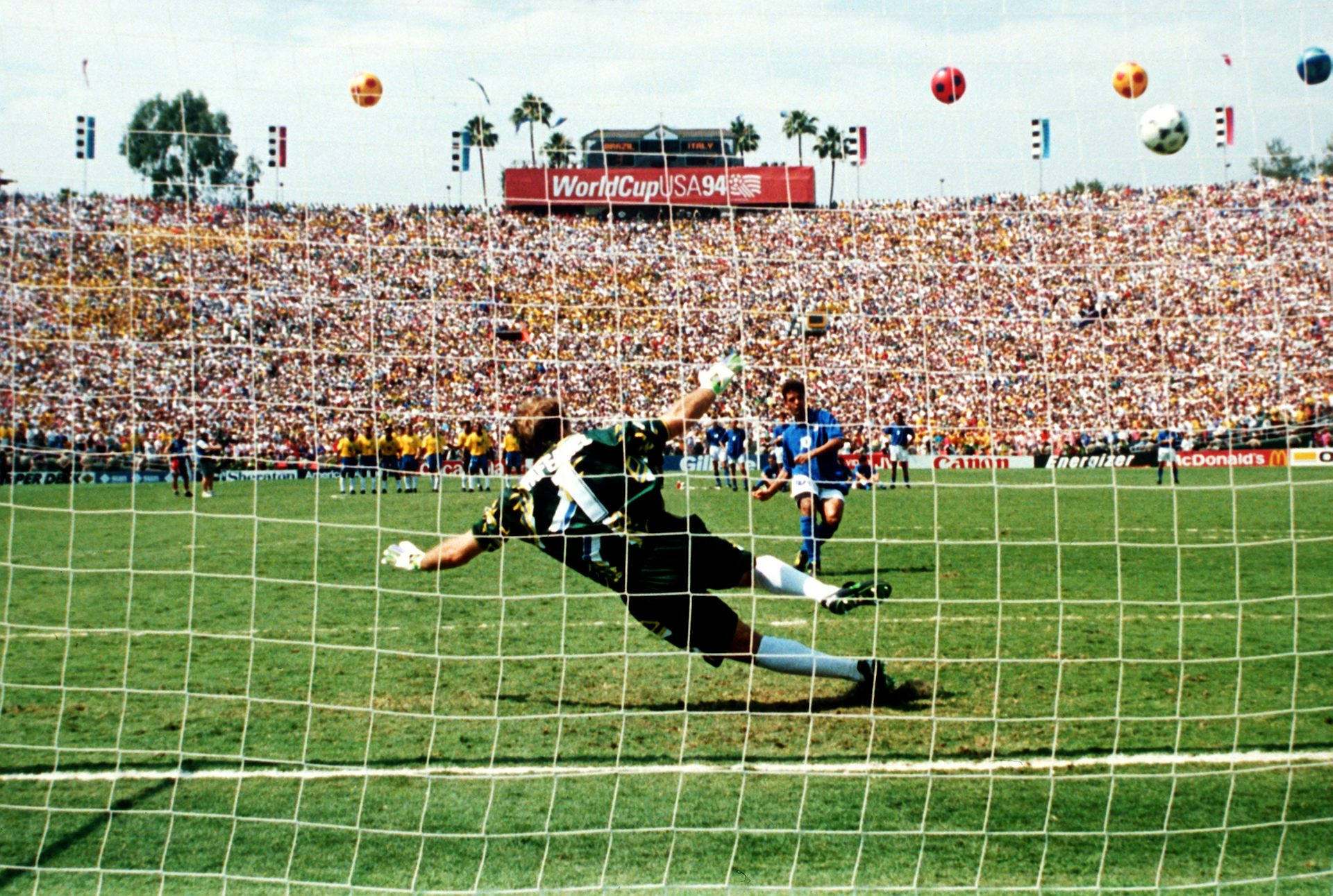
A Copa do Mundo de 1994 ajudou a resgatar ‘o belo jogo’ da mediocridade. No seu retorno aos EUA, espere mais dessa beleza.
The 1994 World Cup helped rescue ‘the beautiful game’ from mediocrity. On its return to the US, expect more of that beauty
Global soccer was in the doldrums in the early 1990s – with poor ethics and boring defensive tactics. Then FIFA set about changing the game.
O futebol mundial estava em baixa no início dos anos 90 – com má ética e táticas defensivas entediantes. Foi então que a FIFA se propôs a mudar o jogo.
Ahead of the 1994 World Cup – the first staged in the United States – players were asked to do something they never had before: sign a fair play declaration. The document, in which the soccer stars of the day pledged to respect the rules and opponents, was part of a plan by governing body FIFA to restore soccer’s reputation as “the beautiful game.” And expectations ran high before kickoff.
Antes da Copa do Mundo de 1994 – a primeira realizada nos Estados Unidos – os jogadores foram solicitados a fazer algo que nunca haviam feito antes: assinar uma declaração de fair play. O documento, no qual as estrelas do futebol da época prometiam respeitar as regras e os adversários, fazia parte de um plano da FIFA para restaurar a reputação do futebol como “o belo jogo”. E as expectativas estavam altíssimas antes do apito inicial.
After all, it could not be as bad as the previous edition of the tournament, held in Italy four years earlier. That dour affair left a sour taste in the soccer world. Noting that it had the lowest goals per game in World Cup history, Eduardo Galeano, known as the game’s global poet laureate, wrote that Italia’90 consisted of “boring soccer without a drop of audacity or beauty.”
Afinal, não poderia ser tão ruim quanto a edição anterior do torneio, realizada na Itália quatro anos antes. Aquele evento monótono deixou um gosto amargo no mundo do futebol. Observando que ela tinha o menor número de gols por jogo na história da Copa do Mundo, Eduardo Galeano, conhecido como o poeta laureado global do jogo, escreveu que a Itália’90 consistia em “futebol entediante, sem uma gota de audácia ou beleza”.
The remarks not only referred to the aesthetics of the game – tedious matches devoid of skillful merit that were unpleasing to watch. They also pointed to its ethics – questionable behaviors and strategies that belittled soccer and its practitioners. This was an era in which wasting time, intentional fouling, theatrics and defensive schemes predominated.
Os comentários não se referiam apenas à estética do jogo – partidas tediosas desprovidas de mérito técnico que eram desagradáveis de assistir. Eles também apontavam para sua ética – comportamentos e estratégias questionáveis que desmereciam o futebol e seus praticantes. Era uma era em que perder tempo, faltas intencionais, teatralidade e esquemas defensivos predominavam.
The state of soccer after Italia’90 required a holistic approach to understanding and improving the game.
O estado do futebol após a Itália’90 exigia uma abordagem holística para entender e melhorar o jogo.
For almost 30 years, I have been studying the ethics and aesthetics of soccer as both a philosopher of sport and an aficionado of the beautiful game. In that time I have seen how thoughtful changes to the rules shaped the game for the better. It has left me hopeful that, borrowing from Galeano, soccer is not “condemned to mediocrity.”
Há quase 30 anos, tenho estudado a ética e a estética do futebol como filósofo do esporte e aficionado pelo belo jogo. Nesse tempo, vi como mudanças ponderadas nas regras moldaram o jogo para melhor. Isso me deixou esperançoso de que, seguindo Galeano, o futebol não está “condenado à mediocridade”.
FIFA’s response to an ugly tournament
Resposta da FIFA a um torneio feio
Reviewing Italia’90, Los Angeles Times sportswriter Grahame Jones urged that something had to be done to increase goal-scoring and put an end to “the cynical, don’t-lose-at-any-cost approach” that dominated the game.
Ao revisar a Itália’90, o jornalista esportivo do Los Angeles Times, Grahame Jones, defendeu que era preciso fazer algo para aumentar o número de gols e acabar com a “abordagem cínica de não perder a qualquer custo” que dominava o jogo.
FIFA was not oblivious to such criticism. This was strikingly evident in the governing body’s technical report of the tournament, which described the final between Argentina and West Germany – an ugly 1-0 victory for the latter – as “a dreadful advertisement for the game of football.”
A FIFA não estava alheia a tais críticas. Isso foi notavelmente evidente no relatório técnico do órgão governante sobre o torneio, que descreveu a final entre Argentina e Alemanha Ocidental – uma vitória feia de 1 a 0 para esta última – como “um anúncio terrível para o jogo de futebol.”
The report was not wrong. Looking back, the final is marked out by intentional fouling, the first red card in a World Cup final and plenty of simulation, including diving – a ploy players use to deceive referees and get a favorable call. Indeed, the incident resulting in the penalty from which West Germany scored is widely seen as a case of diving. That match illustrated the unimaginative and negative soccer played throughout the tournament.
O relatório não estava errado. Olhando para trás, a final é marcada por faltas intencionais, o primeiro cartão vermelho em uma final de Copa do Mundo e muita simulação, incluindo mergulhos – um artifício que os jogadores usam para enganar os árbitros e conseguir uma decisão favorável. De fato, o incidente que resultou do pênalti pelo qual a Alemanha Ocidental marcou é amplamente visto como um caso de mergulho. Aquele jogo ilustrou o futebol pouco imaginativo e negativo jogado durante todo o torneio.
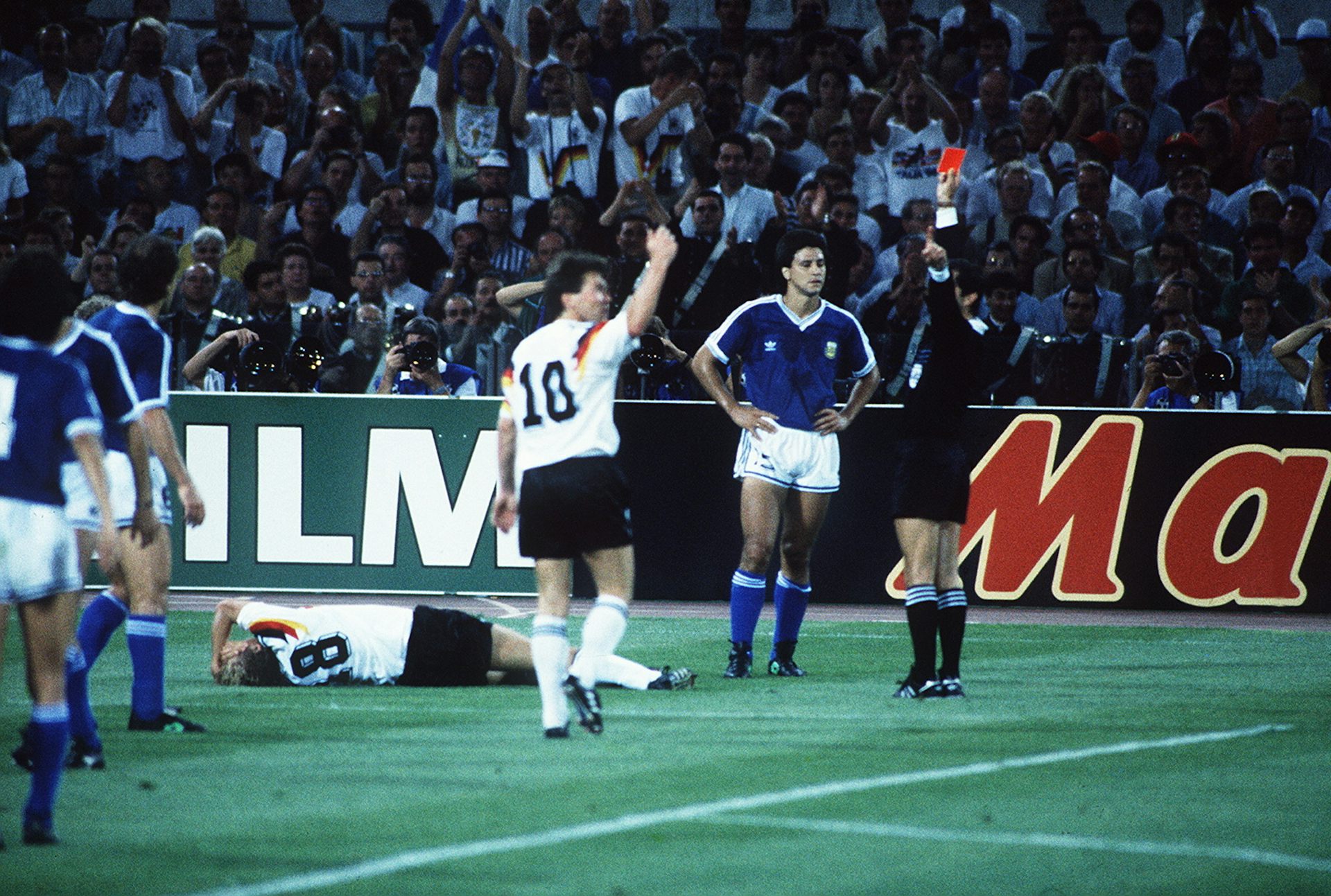
Sepp Blatter, then FIFA’s general secretary and later its reproved president, concluded that “something is wrong with this game.” His main concerns, shared with many within the soccer community, were the time-wasting, intentional fouling and theatrics that were extensive in Italia’90.
Sepp Blatter, então secretário-geral da FIFA e mais tarde seu presidente reprovado, concluiu que “algo está errado com este jogo.” Suas principais preocupações, compartilhadas por muitos na comunidade do futebol, eram o desperdício de tempo, as faltas intencionais e o teatro que foram extensos na Itália’90.
To address these concerns and improve the game, FIFA established a commission composed mainly of former players and coaches. Largely based on the observations of this group shortly after the 1990 World Cup, FIFA and the International Football Association Board, the body that oversees the game’s rules, decided to implement changes.
Para abordar essas preocupações e melhorar o jogo, a FIFA estabeleceu uma comissão composta principalmente por ex-jogadores e treinadores. Baseado em grande parte nas observações deste grupo pouco tempo após a Copa do Mundo de 1990, a FIFA e o Conselho Internacional de Futebol, o órgão que supervisiona as regras do jogo, decidiram implementar mudanças.
One key change was the adoption of a three-point system for wins during the group phase of the 1994 World Cup instead of two. This meant that teams were rewarded more for winning, encouraging imaginative and positive play over unimaginative and negative play aimed at sneaking a win or grinding out a draw.
Uma mudança fundamental foi a adoção de um sistema de três pontos por vitória durante a fase de grupos da Copa do Mundo de 1994, em vez de dois. Isso significou que os times foram mais recompensados por vencer, incentivando um jogo imaginativo e positivo em vez de um jogo pouco imaginativo e negativo visando conseguir uma vitória ou um empate.
Another change was the refinement of the offside rule to make it less restrictive for forwards trying to score. In addition, referees were instructed to apply the rules regarding fouls and misconducts more strictly – a move meant to protect players and their inventiveness.
Outra mudança foi o refinamento da regra do impedimento para torná-la menos restritiva para os atacantes que tentavam marcar. Além disso, os árbitros foram instruídos a aplicar as regras sobre faltas e má conduta de forma mais rigorosa – uma medida destinada a proteger os jogadores e sua inventividade.
However, the most momentous change was the introduction of the backpass rule, which would eventually revolutionize the game. This rule prohibited goalkeepers from receiving the ball with their hands if a teammate deliberately kicked it to them. It was planned to curb typical time-wasting that was orchestrated by goalkeepers and defenders and was painful to watch.
No entanto, a mudança mais importante foi a introdução da regra do toque de costas, que acabaria por revolucionar o jogo. Esta regra proibia os goleiros de receber a bola com as mãos se um companheiro de equipe a chutasse deliberadamente para eles. Planejava-se conter o típico desperdício de tempo orquestrado por goleiros e defensores, o que era doloroso de assistir.
As a whole, the aspirations of these changes were to improve the aesthetics of the game, by promoting matches with plenty of forward-looking and creative play that was pleasurable to watch, as well as its ethics, by discouraging and sanctioning behaviors and strategies that disrespected soccer’s defining skills and opponents.
No geral, as aspirações dessas mudanças eram melhorar a estética do jogo, promovendo partidas com muito jogo criativo e voltado para o ataque que fosse prazeroso de assistir, bem como sua ética, desencorajando e sancionando comportamentos e estratégias que desrespeitassem as habilidades e os adversários definidores do futebol.
All four of these changes were in place by the time 24 nations competed in the nine U.S. venues during the 1994 World Cup.
Todas essas quatro mudanças estavam em vigor quando 24 nações competiram nos nove locais dos EUA durante a Copa do Mundo de 1994.
So, too, was FIFA’s requirement that players sign its fair play declaration. Although the latter was largely a symbolic gesture intended to emphasize desired behaviors and strategies and minimize skulduggery, the tournament was nonetheless an improved spectacle.
Assim também foi a exigência da FIFA de que os jogadores assinassem sua declaração de fair play. Embora esta última fosse em grande parte um gesto simbólico destinado a enfatizar os comportamentos e estratégias desejados e minimizar a trapaça, o torneio foi, no entanto, um espetáculo melhorado.
In its technical report of the tournament, FIFA proclaimed that “USA’94 was much better than Italia’90,” with “more goals, fewer fouls, more attacking play and almost no ugly incidents between players.”
Em seu relatório técnico do torneio, a FIFA proclamou que “os EUA’94 foram muito melhores que a Itália’90,” com “mais gols, menos faltas, mais jogo ofensivo e quase nenhum incidente feio entre os jogadores.”
While for FIFA it was “most encouraging to see that the new measures … were so successful,” it admitted that the final between Brazil and Italy, won by the former in a penalty kick shootout, “did not live up to expectations,” with “few highlights in terms of pure skills.”
Embora para a FIFA fosse “mais encorajador ver que as novas medidas … foram tão bem-sucedidas,” admitiu que a final entre Brasil e Itália, vencida pelo primeiro em uma disputa de pênaltis, “não correspondeu às expectativas,” com “poucos destaques em termos de pura habilidade.”
A mediocre final aside, USA’94 was seen favorably. George Vecsey, reporting for The New York Times, spoke for many when he said, “It was a very good World Cup.”
Apesar de uma final medíocre, o EUA de ’94 foi visto favoravelmente. George Vecsey, reportando para The New York Times, falou por muitos quando disse: “Foi uma Copa do Mundo muito boa.”
What to expect in Canada/Mexico/USA’26?
O que esperar do Canadá/México/EUA em 2026?
Much has shifted in soccer since USA’94. But the game has definitely benefited from the changes introduced ahead of that tournament and some that came after.
Muito mudou no futebol desde os EUA em 94. Mas o jogo definitivamente se beneficiou das mudanças introduzidas antes daquele torneio e de algumas que vieram depois.
In 1998, for instance, FIFA introduced the six-second rule, which prohibits goalkeepers from controlling the ball with their hands for more than six seconds. Eventually, new sanctions for actions such as diving along with the use of video assistance for referees were also brought in. Other developments have helped advance the game, from better training methods and medical care to innovative tactics and skill improvement, expanded youth talent identification and development, and data-driven match plans.
Em 1998, por exemplo, a FIFA introduziu a regra dos seis segundos, que proíbe os goleiros de controlar a bola com as mãos por mais de seis segundos. Eventualmente, novas sanções para ações como o mergulho, juntamente com o uso de assistência por vídeo para os árbitros, também foram implementadas. Outros desenvolvimentos ajudaram a avançar o jogo, desde melhores métodos de treinamento e cuidados médicos até táticas inovadoras e melhoria de habilidades, identificação e desenvolvimento expandidos de talentos juvenis e planos de jogo baseados em dados.
Clearly, the level of the game has been elevated. FIFA considered the last World Cup, held in Qatar in 2022, to have “produced arguably some of the most intricate and entertaining technical and tactical football that the World Cup has ever seen,” culminating in “a scintillating game” that many consider as “one of the best FIFA World Cup final matches ever witnessed.”
Claramente, o nível do jogo foi elevado. A FIFA considerou a última Copa do Mundo, realizada no Catar em 2022, como tendo “produzido indiscutivelmente um dos futebolistas técnicos e táticos mais intrincados e divertidos que a Copa do Mundo já viu,” culminando em “um jogo cintilante” que muitos consideram “um dos melhores jogos finais da Copa do Mundo da FIFA já testemunhados.”
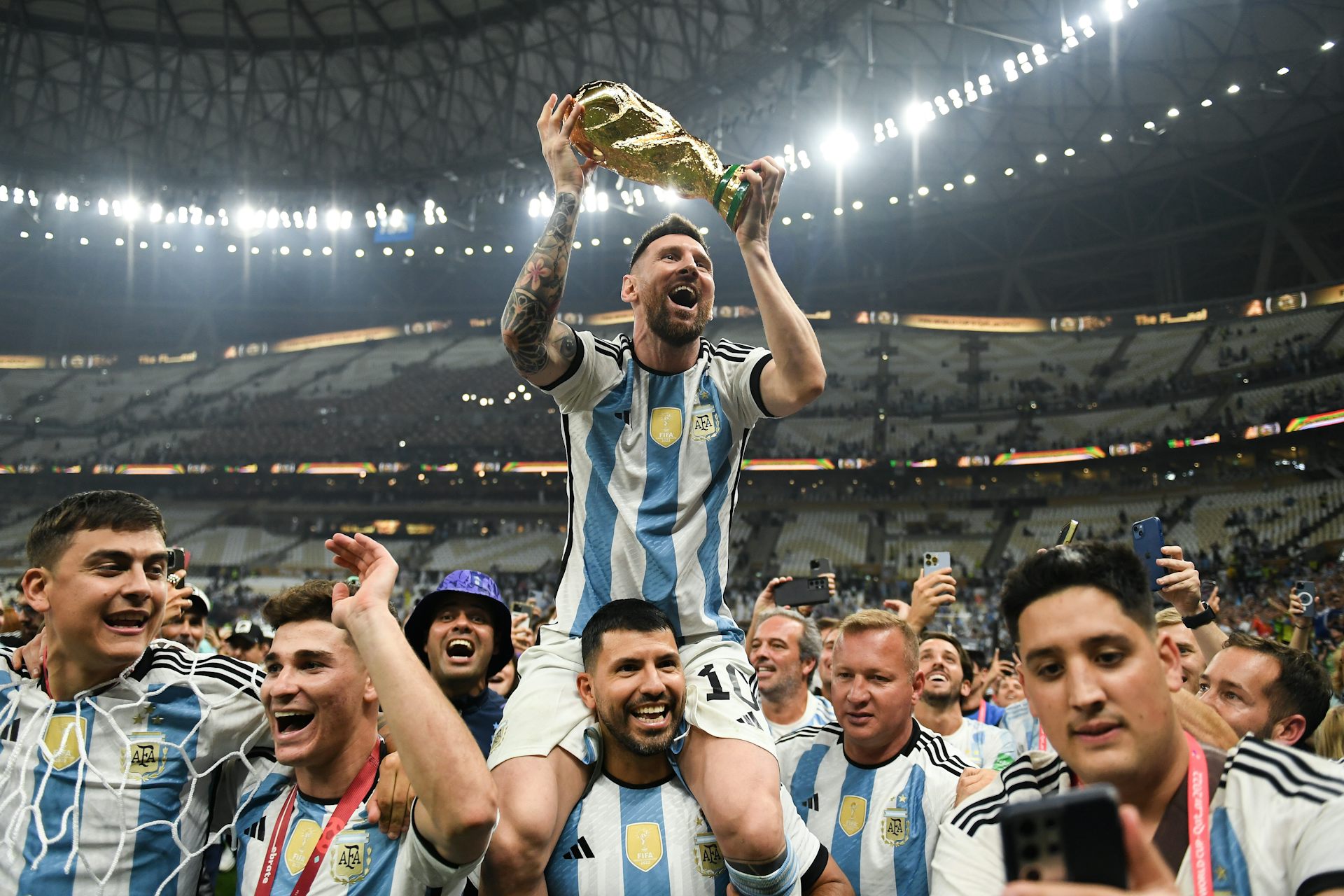
Given the current state of the game, it is reasonable to expect exciting, enjoyable-to-watch soccer at the upcoming World Cup, co-hosted by Canada, Mexico and the United States. This does not mean that time-wasting, intentional fouling and theatrics – as well as occasionally prosaic play – will not rear their ugly heads. Such tactics have not been, and probably will never be, eradicated from the game. Consider, too, relatively new forms of trickery, such as manipulating substitution procedures or spying on rivals.
Dado o estado atual do jogo, é razoável esperar um futebol emocionante e agradável de assistir na próxima Copa do Mundo, coparticipada pelo Canadá, México e Estados Unidos. Isso não significa que o desperdício de tempo, faltas intencionais e teatralidades – bem como jogadas ocasionalmente prosaicas – não aparecerão. Tais táticas não foram, e provavelmente nunca serão, erradicadas do jogo. Considere também formas relativamente novas de truques, como manipular procedimentos de substituição ou espionar rivais.
Yet, while there are still some who embrace the “dark arts” of soccer, such practices do not seem to have the favor they once had. Indeed, there is a widespread belief that soccer is experiencing another golden age. And even though soccer has many ethical and aesthetic flaws, both on and off the pitch, the beautiful game seems to have been largely restored.
No entanto, embora ainda haja alguns que abraçam as “artes obscuras” do futebol, tais práticas não parecem ter o favor que já tiveram. De fato, há uma crença generalizada de que o futebol está vivenciando outra era de ouro. E mesmo que o futebol tenha muitos defeitos éticos e estéticos, tanto dentro quanto fora de campo, o belo jogo parece ter sido amplamente restaurado.
Cesar R. Torres is also Distinguished Professor Emeritus of Kinesiology, Sport Studies, and Physical Education, The College at Brockport, State University of New York
Cesar R. Torres é também Professor Emérito Distinto de Cinesiologia, Estudos Esportivos e Educação Física, The College at Brockport, State University of New York
Read more
-
Manteiga ou margarina? Um cientista dos alimentos descreve seus sutis desvios químicos e como eles podem afetar seus produtos assados
Butter or margarine? A food scientist describes their subtle chemical deviations and how they can affect your baked goods
-

Árvores e vegetação podem resfriar cidades em até 18°C – mas apenas se forem do tipo certo
Trees and greenery can cool cities by as much as 18°C – but only if they’re the right type