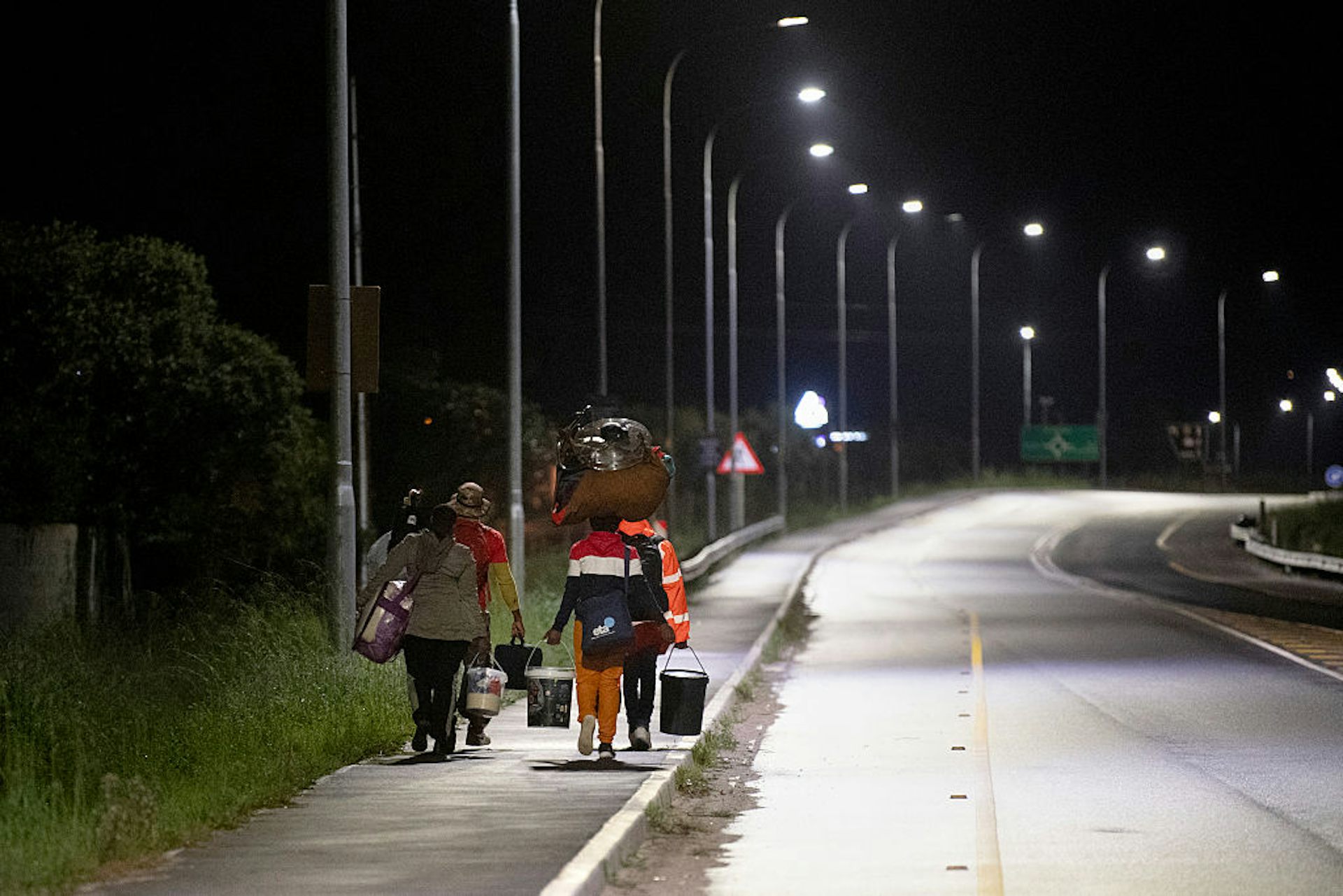
Les violences anti-étrangers en Afrique du Sud sont facilement déclenchées : ce qui n’a pas été fait pour y faire face
Anti-foreigner violence in South Africa is easily sparked: what hasn’t been done to deal with it
Several key actions that could help are not yet on the table, including mobilising other political parties as well as civic society to fight anti-foreigner hysteria.
Plusieurs mesures clés qui pourraient aider ne sont pas encore sur la table, y compris la mobilisation d’autres partis politiques ainsi que de la société civile pour combattre l’hystérie anti-étrangère.
Threats and deadly conflict over migration are spreading fast in South Africa. This is hugely worrying and could result in widespread injury and killings, as it has in the past.
Les menaces et les conflits mortels liés à la migration se propagent rapidement en Afrique du Sud. C’est extrêmement préoccupant et pourrait entraîner des blessures et des meurtres généralisés, comme cela a déjà été le cas par le passé.
The region’s investment prospects could be dimmed too, due to perceptions of political instability.
Les perspectives d’investissement de la région pourraient également être ternies en raison des perceptions d’instabilité politique.
The need for effective responses is real and urgent. The death toll, while disputed, is rising, and reports of marches, threats, sacking of dwellings and violence are widespread across South Africa.
Le besoin de réponses efficaces est réel et urgent. Le bilan des morts, bien que contesté, augmente, et les rapports de marches, de menaces, de pillages de logements et de violences sont répandus dans toute l’Afrique du Sud.
Anti-foreigner hysteria is being driven by online campaigns which appear to be highly organised. They include the use of faked information and graphics.
L’hystérie anti-étranger est alimentée par des campagnes en ligne qui semblent être hautement organisées. Elles comprennent l’utilisation d’informations et de graphiques falsifiés.
It is also being driven by campaign leaders and by politicians who support campaigns to root out foreigners, either actively or simply by justifying the arguments used by the more dangerous activists. The UN secretary general, Amnesty International and several foreign governments, including those of Mozambique, Nigeria and Ghana, have berated South Africa for not responding appropriately to anti-migrant mobilisation.
Elle est également alimentée par les leaders de campagne et par des politiciens qui soutiennent des campagnes visant à éradiquer les étrangers, que ce soit activement ou simplement en justifiant les arguments utilisés par les militants plus dangereux. Le secrétaire général de l’ONU, Amnesty International et plusieurs gouvernements étrangers, y compris ceux du Mozambique, du Nigeria et du Ghana, ont vivement critiqué l’Afrique du Sud pour ne pas avoir répondu de manière appropriée à la mobilisation anti-migrants.
In a televised address on Sunday 7 May 2026, the country’s president, Cyril Ramaphosa, outlined various initiatives to lessen the conflicts over migration. But was this a coherent response, or a missed opportunity to make real progress?
Lors d’un discours télévisé le dimanche 7 mai 2026, le président du pays, Cyril Ramaphosa, a présenté diverses initiatives visant à atténuer les conflits liés à la migration. Mais s’agissait-il d’une réponse cohérente ou d’une occasion manquée de réaliser des progrès réels?
The core of the response was the five-point plan agreed to by a special cabinet committee meeting last week. The points included a law enforcement crackdown (including intensifying deportations) , establishing dedicated immigration courts, rooting out employment of undocumented workers, securing borders, and tackling corruption (including a reform of identity systems.)
Le cœur de la réponse était le plan quinquepartite adopté par un comité spécial du cabinet la semaine dernière. Les points comprenaient une répression des forces de l’ordre (y compris l’intensification des déportations) , l’établissement de tribunaux d’immigration dédiés, l’éradication de l’emploi des travailleurs sans papiers, le sécurisation des frontières et la lutte contre la corruption (y compris une réforme des systèmes d’identité) .
Ramaphosa admitted that economic conditions and the poor state of many public services explained why people were desperate and that grievances, including grievances about the influx of undocumented migrants, were “real”. Some have interpreted his stance as justifying the association of foreigners with the grievances that poor South Africans have.
Ramaphosa a admis que les conditions économiques et le mauvais état de nombreux services publics expliquaient pourquoi les gens étaient désespérés et que les griefs, y compris ceux concernant l’afflux de migrants sans papiers, étaient « réels ». Certains ont interprété sa position comme justifiant l’association des étrangers aux griefs des Sud-Africains pauvres.
Based on my work as a political economist in migration governance over the past decade, I know that virtually all the specific actions mentioned in the five parts of the plan had already been announced by the South African government, though not as a concerted platform to address the current crisis. Yet implementation has been painfully slow.
D’après mon travail en tant qu’économiste politique dans la gouvernance migratoire au cours de la dernière décennie, je sais que pratiquement toutes les actions spécifiques mentionnées dans les cinq points du plan avaient déjà été annoncées par le gouvernement sud-africain, bien que non pas comme une plateforme concertée pour faire face à la crise actuelle. Pourtant, la mise en œuvre a été douloureusement lente.
Clearly, there needs to be urgent and visible follow-through on these commitments. This should include the promise to clamp down on anti-foreigner agitators and those who have wounded or killed people they believed to be foreign. To my knowledge, very few agitators and attackers have been arrested, let alone charged. None of the leaders inciting dangerous actions have been arrested, or even called out by political leaders.
Il est clair qu’il doit y avoir un suivi urgent et visible de ces engagements. Cela devrait inclure la promesse de réprimer les agitateurs anti-étrangers et ceux qui ont blessé ou tué des personnes qu’ils croyaient être étrangères. À ma connaissance, très peu d’agitateurs et d’assaillants ont été arrêtés, sans parler inculpés. Aucun des leaders incitant à des actions dangereuses n’a été arrêté, ni même dénoncé par les dirigeants politiques.
To help reduce the violence and the perception of risk, a number of additional steps need to be taken. Firstly, the forging of a collective political front of parties in the country against anti-foreigner activities. Secondly, the mobilisation of civic and religious institutions to fight against irresponsible politicking. Third, a renegotiation of colonial-era bilateral labour agreements with South Africa’s five neighbouring countries. And finally, addressing the country’s acute unemployment crisis.
Pour aider à réduire la violence et la perception du risque, un certain nombre d’étapes supplémentaires doivent être prises. Premièrement, la formation d’un front politique collectif de partis dans le pays contre les activités anti-étrangers. Deuxièmement, la mobilisation des institutions civiques et religieuses pour lutter contre le politiquisme irresponsable. Troisièmement, une renégociation des accords bilatéraux de l’ère coloniale avec les cinq pays voisins de l’Afrique du Sud. Et enfin, aborder la crise aiguë du chômage du pays.
Four steps that could make a difference
Quatre étapes qui pourraient faire la différence
Firstly, the head of state – or the head of his political party – should bring together the leaders of all the significant political parties in a forum which commits to agreeing not to incite anti-foreigner sentiment, and also, as a group, condemns such behaviour.
Premièrement, le chef de l’État – ou le chef de son parti politique – devrait réunir les dirigeants de tous les partis politiques majeurs dans un forum qui s’engage à ne pas inciter au sentiment anti-étranger et qui condamne également, en tant que groupe, un tel comportement.
Secondly, leaders of civic and religious institution could be encouraged to do the same – to warn against irresponsible politicking. Further than that, religious and community groupings could be encouraged and even assisted by government to drive programmes to include foreigners into the mainstream of South African society in a constructive way.
Deuxièmement, les dirigeants des institutions civiques et religieuses pourraient être encouragés à faire de même – à mettre en garde contre le politiquement irresponsable. En outre, les groupes religieux et communautaires pourraient être encouragés, voire assistés par le gouvernement, à mener des programmes visant à intégrer les étrangers dans le courant dominant de la société sud-africaine de manière constructive.
There are examples of how to do this in other parts of the world in developed and developing countries. These include South America and other African countries.
Il existe des exemples de la manière de faire cela dans d’autres régions du monde, tant dans les pays développés que dans les pays en développement. Ceux-ci comprennent l’Amérique du Sud et d’autres pays africains.
National, provincial and local governments could also drive initiatives to include foreigners into the national community. These could be standalone programmes or in cooperation with civil society institutions.
Les gouvernements nationaux, provinciaux et locaux pourraient également impulser des initiatives pour inclure les étrangers dans la communauté nationale. Celles-ci pourraient être des programmes autonomes ou en coopération avec des institutions de la société civile.
Thirdly, there should be a renegotiation of bilateral labour agreements with five neighbouring countries. In a white paper released in 2025 the government committed to establishing employment quotas for South Africans in various sectors of industry. It also committed to the renegotiation of the bilateral deals. The existing agreements are colonial in origin and form. They withhold virtually all labour and social rights from migrant labourers. And they don’t accommodate long-term labour migration contracts, now common in other parts of the world.
Troisièmement, il devrait y avoir une renégociation des accords bilatéraux de travail avec cinq pays voisins. Dans un livre blanc publié en 2025, le gouvernement s’est engagé à établir des quotas d’emploi pour les Sud-Africains dans divers secteurs de l’industrie. Il s’est également engagé à la renégociation des accords bilatéraux. Les accords existants sont d’origine et de forme coloniales. Ils privent pratiquement tous les droits du travail et sociaux des travailleurs migrants. Et ils n’accommodent pas de contrats de migration de main-d’œuvre à long terme, désormais courants dans d’autres parties du monde.
Such reforms could create more manageable as well as fair and equitable systems of migrant labour. South Africa could address its labour needs in a workable way. And the temptation to bypass the system should be lower, with fewer undocumented migrant workers.
De telles réformes pourraient créer des systèmes de travail des migrants plus gérables, ainsi que justes et équitables. L’Afrique du Sud pourrait satisfaire ses besoins en main-d’œuvre de manière viable. Et la tentation de contourner le système devrait être moindre, avec moins de travailleurs migrants sans papiers.
It’s not realistic yet to do away with regional labour migration, but it could be far better managed.
Il n’est pas encore réaliste de supprimer les migrations de travail régionales, mais elles pourraient être beaucoup mieux gérées.
Finally, Ramaphosa said he’d be sending out envoys “to seek to find sustainable solutions to these challenges”. But this has already been done, more than 20 years ago. South Africa and some of its neighbours agreed to a protocol on the facilitation of the movement of persons in the southern African region. This initiative was negotiated in the Southern African Development Community.
Enfin, Ramaphosa a déclaré qu’il enverrait des émissaires « pour chercher à trouver des solutions durables à ces défis ». Mais cela avait déjà été fait, il y a plus de 20 ans. L’Afrique du Sud et certains de ses voisins ont approuvé un protocole sur la facilitation des mouvements de personnes dans la région australe africaine. Cette initiative a été négociée au sein de la Communauté de développement de l’Afrique australe.
But since the protocol was signed by several heads of state in the region in 2005, there has been no progress. South Africa, its partners and the Southern African Development Community itself are guilty of negligence and should accept that they could have and can do more to avoid crises such as the present one.
Mais depuis que le protocole a été signé par plusieurs chefs d’État de la région en 2005, il n’y a eu aucun progrès. L’Afrique du Sud, ses partenaires et la Communauté de développement d’Afrique australe elle-même sont coupables de négligence et devraient accepter qu’ils auraient pu et peuvent faire plus pour éviter des crises comme celle présente.
Poorer South Africans are vulnerable to anti-foreigner mobilisation because of their dire economic circumstances: 32.7% unemployment; 37.8% of people classified as very poor. And public services are often very bad.
Les Sud-Africains plus pauvres sont vulnérables aux mobilisations anti-étrangers en raison de leurs circonstances économiques désastreuses: 32,7 % de chômage; 37,8 % de personnes classées comme très pauvres. Et les services publics sont souvent très mauvais.
More growth and more jobs must dampen the powder-keg that is so easily sparked.
Plus de croissance et plus d’emplois doivent atténuer le baril de poudre qui est si facilement allumé.
But even before that is achieved, there is a great deal that could be done to eliminate the spark itself – tensions over migration.
Mais même avant que cela ne soit réalisé, il y a beaucoup de choses qui pourraient être faites pour éliminer l’étincelle elle-même: les tensions liées à la migration.
Alan Hirsch receives research funding from the New South Institute.
Alan Hirsch reçoit un financement de recherche de l’Institut New South.
Read more
-
L’Ukraine contre l’impact de la guerre en Iran en attaquant des installations énergétiques russes
Ukraine is countering the impact of the war in Iran by attacking Russian energy facilities
-
Qu’y a-t-il dans l’accord de paix entre les États-Unis et l’Iran ? Beaucoup de concessions et de promesses creuses de la part de Trump, en échange de peu.
What’s in the US-Iran peace deal? A lot of concessions and empty promises from Trump, in return for little