
Como a música cativante é impulsionada por padrões rítmicos
How ‘catchy’ music is driven by rhythmic patterns
Catchy rhythms like the tresillo are examples of how our musical perception and preference negotiate between simplicity and complexity.
Ritmos cativantes como o tresillo são exemplos de como nossa percepção e preferência musical negociam entre simplicidade e complexidade.
Puerto Rican icon Bad Bunny, a superstar rapper, has recently risen to global prominence as demonstrated by the 2026 Super Bowl halftime show.
O ícone porto-riquenho Bad Bunny, um rapper superestrela, ascendeu recentemente à proeminência global, como demonstrado pelo show do meio-tempo do Super Bowl de 2026.
Bad Bunny’s success is not only down to his charismatic performances or engagement in social activism for Puerto Rico, but also his catchy use of rhythm.
O sucesso de Bad Bunny não se deve apenas suas performances carismáticas ou seu envolvimento no ativismo social por Porto Rico, mas também seu uso marcante do ritmo.
He infuses the characteristic rhythms of reggaeton into Latin trap, creating his signature sound.
Ele infunde os ritmos característicos do reggaeton no Latin trap, criando seu som de assinatura.
Rhythm can be defined as the musical duration or timing properties of music. Many rhythms derive from human speech patterns and are also linked to movement, including dance (as suggested by numerous studies on embodiment) .
Ritmo pode ser definido pelas propriedades de duração ou temporização da música. Muitos ritmos derivam dos padrões de fala humana e também estão ligados ao movimento, incluindo a dança (como sugerem numerosos estudos sobre corporeidade) .
The “catchiness” of a rhythm has the potential to make or break a song. And it’s not just in recent pop songs, but across classical, jazz and throughout global musical styles.
O “cativante” de um ritmo tem o potencial de fazer ou estragar uma música. E não está apenas nas músicas pop recentes, mas em toda a música clássica, jazz e por diversos estilos musicais globais.
Rhythm in music
Ritmo na música
Rhythm is one of the key parameters of music alongside pitch and timbre, which is the quality of auditory sensations produced by the tone of a sound wave.
O ritmo é um dos parâmetros chave da música, juntamente com o tom e o timbre, que é a qualidade das sensações auditivas produzidas pelo som de uma onda sonora.
As 20th-century composer Igor Stravinsky scribbled on his sketches of his rhythmic masterpiece, The Rite of Spring: “there is music wherever there is rhythm, as there is life wherever there beats a pulse.”
O compositor do século XX Igor Stravinsky rabiscou em seus esboços de sua obra-prima rítmica, “A Primavera” (The Rite of Spring): “há música onde há ritmo, assim como há vida onde bate um pulso.”
What makes a rhythm distinctive or catchy? The answer lies in the pattern that underlies the structure. Much of human creativity beyond rhythm and music is also shaped by the math underneath the patterns.
O que torna um ritmo distintivo ou cativante? A resposta reside no padrão que sustenta a estrutura. Grande parte da criatividade humana além do ritmo e da música também é moldada pela matemática por trás dos padrões.
The tresillo
O tresillo
Bad Bunny’s characteristic reggaeton rhythms are derived from what is called the tresillo, a distinctive pattern created by two groups of three beats followed by a group of two beats. It’s especially associated with African and Caribbean music.
Os ritmos característicos de Bad Bunny no reggaeton são derivados do que é chamado de tresillo, um padrão distinto criado por dois grupos de três batidas seguidos por um grupo de duas batidas. É especialmente associado à música africana e caribenha.
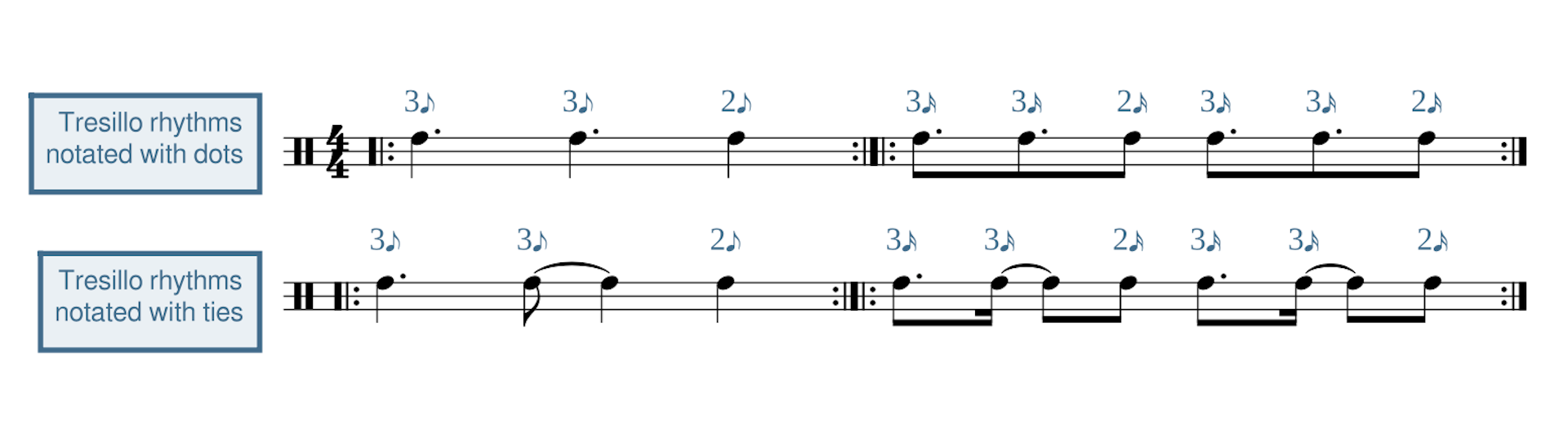
The tresillo is found across an array of music from all over the globe including tango, jazz, reggaeton and bossa nova.
O tresillo é encontrado em uma variedade de músicas de todo o mundo, incluindo tango, jazz, reggaeton e bossa nova.
The tresillo was first made famous through the West in a song from an 1875 opera, Georges Bizet’s Carmen, “L’amour est un oiseau rebelle” (“Love is a rebellious bird”) , usually called “The Habanera.” And it has since been widely circulated in varied ways through popular culture.
O tresillo foi primeiro tornado famoso no Ocidente em uma canção de uma ópera de 1875, Carmen de Georges Bizet, “L’amour est un oiseau rebelle” (“Amor é um pássaro rebelde”) , geralmente chamada de “The Habanera.” E desde então tem sido amplamente circulado de várias maneiras pela cultura popular.
Carmen was set in what dominant French society at the time viewed as an “exotic” and culturally distant south of Spain. To emphasize this cultural difference, Bizet was keen to introduce what scholars have termed “local colour” through the use of an apparent folk tune, which became “The Habanera.”
Carmen foi ambientada em um sul da Espanha que a sociedade francesa dominante na época via como “exótico” e culturalmente distante. Para enfatizar essa diferença cultural, Bizet estava ansioso para introduzir o que os estudiosos chamaram de “cor local” através do uso de uma aparente melodia folclórica, que se tornou “The Habanera.”
However, little did the composer know that “The Habanera” was not a folk tune and was actually a recent popular song by Spanish composer Sebastián Yradier. Certainly, this use of the tresillo was part of what made Bizet’s aria, and Yradier’s song, so catchy.
No entanto, o compositor não sabia que “The Habanera” não era uma melodia folclórica e era na verdade uma canção popular recente do compositor espanhol Sebastián Yradier. Certamente, este uso do tresillo fez parte do que tornou o ária de Bizet e a canção de Yradier tão cativantes.
“The Habanera” is not only the name of this composition but also of a genre of a musical dance. It first appeared in 1700s-era Cuba, where it grew out of an English country dance that was then infused with elements from French, Spanish and African traditions, which eventually led to the dance being characterized by the tresillo rhythm.
“The Habanera” não é apenas o nome desta composição, mas também de um gênero de dança musical. Apareceu pela primeira vez em Cuba no século XVIII (1700s) , onde surgiu de uma dança country inglesa que foi então infundida com elementos das tradições francesa, espanhola e africana, o que eventualmente levou a dança a ser caracterizada pelo ritmo tresillo.
This shows how the tresillo is a product of cross-cultural transfer.
Isso mostra como o tresillo é um produto de transferência intercultural.
‘Maximal evenness’
‘Uniformidade Máxima’
The tresillo consists of a “three-three-two” pattern across eight beats. The three attacks are distributed evenly across those eight beats, but not perfectly so.
O tresillo consiste em um padrão de “três-três-dois” ao longo de oito tempos. Os três ataques são distribuídos uniformemente por esses oito tempos, mas não perfeitamente.
The tresillo is a classic example of a larger class of “maximally even” rhythms. An arrangement is “maximally even” if the elements are spread out as much as possible in a given unit. With the tresillo, the “imperfect” arrangement often makes these “maximally even” rhythms sounds both simple yet catchy.
O tresillo é um exemplo clássico de uma classe maior de ritmos “máximamente uniformes.” Um arranjo é “máximamente uniforme” se os elementos estiverem espalhados o máximo possível em uma determinada unidade. Com o tresillo, o arranjo “imperfeito” frequentemente faz com que esses ritmos “máximamente uniformes” soem simples e cativantes ao mesmo tempo.
Many other maximally even rhythms are constructed in similar manner with alternating rhythmic durations that are spread out as much possible in the space that they have.
Muitos outros ritmos maximamente uniformes são construídos de maneira semelhante, com durações rítmicas alternadas que são espalhadas o máximo possível no espaço que ocupam.
This is usually achieved by having two and three beats grouped together that alternate and create a somewhat irregular feel, but is widely popular and found across the globe in many musical genres and cultures including jazz, African drumming patterns, Indian classical music and more recent western classical music.
Isso é geralmente alcançado tendo dois e três tempos agrupados que se alternam e criam uma sensação um tanto irregular, mas que é amplamente popular e encontrada em todo o mundo em muitos gêneros musicais e culturas, incluindo jazz, padrões de percussão africana, música clássica indiana e música clássica ocidental mais recente.
In addition to Bad Bunny’s tresillos, another well-known example of maximally even rhythms appears in Radiohead’s “Pyramid Song” from their album Amnesiac (2001) . The title alludes to the ambiguous, much debated yet mesmerizing rhythms created through irregular beats that reference the geometric structure of a pyramid.
Além dos tresillos de Bad Bunny, outro exemplo bem conhecido de ritmos maximamente uniformes aparece em “Pyramid Song” do Radiohead, do álbum Amnesiac (2001) . O título alude aos ritmos ambíguos, muito debatidos e, no entanto, fascinantes, criados através de tempos irregulares que fazem referência à estrutura geométrica de uma pirâmide.
Radiohead had already used this rhythm in their earlier 2000 hit “Everything in its right place,” making maximally even rhythms a key part of their signature sound.
O Radiohead já havia usado esse ritmo em seu sucesso de 2000, “Everything in its right place”, tornando os ritmos maximamente uniformes uma parte fundamental do seu som característico.
Maximally even arrangements also appear in nature — for example in the arrangement of magnetic particles in physics.
Arranjos maximamente uniformes também aparecem na natureza — por exemplo, no arranjo de partículas magnéticas na física.
Perceiving rhythm
Percebendo o ritmo
The concept of maximal evenness also affects how our brains perceive rhythms. When hearing a rhythm, the human mind is sensitive to the relations of time intervals between notes (for example, the hits of a drum) within the rhythm.
O conceito de máxima uniformidade também afeta como nossos cérebros percebem ritmos. Ao ouvir um ritmo, a mente humana é sensível às relações dos intervalos de tempo entre as notas (por exemplo, os toques de um tambor) dentro do ritmo.
Specifically, our brains try to find a repeating pattern of regularities to organize the rhythm at different time scales. Regular, simple rhythmic patterns are more likely to be remembered.
Especificamente, nossos cérebros tentam encontrar um padrão repetitivo de regularidades para organizar o ritmo em diferentes escalas de tempo. Padrões rítmicos regulares e simples são mais propensos a serem lembrados.
Early research on rhythm perception has found that study participants memorized and reproduced rhythms more accurately when the time intervals between notes have simple relations such as two to one, or one to one.
Pesquisas iniciais sobre a percepção de ritmo descobriram que os participantes do estudo memorizaram e reproduziram ritmos com mais precisão quando os intervalos de tempo entre as notas tinham relações simples, como dois para um ou um para um.
For more complex patterns where the intervals are related by other ratios larger or smaller than two to one, participants often reproduced these patterns as though they were closer to two to one (or one to one) .
Para padrões mais complexos, onde os intervalos são relacionados por outras razões maiores ou menores que dois para um, os participantes frequentemente reproduziram esses padrões como se estivessem mais próximos de dois para um (ou um para um) .
More recent research also found similar advantage for rhythms with simpler ratios of time intervals between notes to be more easily remembered and reproduced by people. Researchers found this “rhythmic bias” for simple ratios exists across different cultures, though the exact ratio people prefer varies across cultural groups.
Pesquisas mais recentes também encontraram uma vantagem semelhante para ritmos com razões mais simples de intervalos de tempo entre as notas serem mais facilmente lembrados e reproduzidos pelas pessoas. Os pesquisadores descobriram que esse “viés rítmico” por razões simples existe em diferentes culturas, embora a razão exata preferida varie entre os grupos culturais.
As we have seen, catchy rhythms like the tresillo could be explained by principles such as “maximal evenness” and human perception.
Como vimos, ritmos cativantes como o tresillo podem ser explicados por princípios como a “máxima uniformidade” e a percepção humana.
From Bad Bunny to Bizet, Radiohead and far beyond, artists appeal to these shared principles and patterns, and these catchy rhythms connect people across cultures, languages and generations.
De Bad Bunny a Bizet, Radiohead e muito além, os artistas apelam para esses princípios e padrões compartilhados, e esses ritmos cativantes conectam pessoas através de culturas, idiomas e gerações.
Catchy rhythms like the tresillo are examples of how our musical perception and preference negotiate between simplicity and complexity, between predictability and unpredictability.
Ritmos cativantes como o tresillo são exemplos de como nossa percepção e preferência musicais negociam entre simplicidade e complexidade, entre previsibilidade e imprevisibilidade.
Aidan McGartland receives funding from The Ramsay Centre for Western Civilisation, McGill University and the Fonds de Recherche du Québec.
Aidan McGartland recebe financiamento do The Ramsay Centre for Western Civilisation, da McGill University e do Fonds de Recherche du Québec.
Linglan Zhu receives funding from McGill University and Fonds de recherche du Québec (FRQ) .
Linglan Zhu recebe financiamento da McGill University e do Fonds de recherche du Québec (FRQ) .
Matthew Anthony Ludwig receives funding from Boston University.
Matthew Anthony Ludwig recebe financiamento da Boston University.
Read more
-

A guerra da Ucrânia agora é mais longa que a Primeira Guerra Mundial – mas as semelhanças são perturbadoras
Ukraine war now longer than the first world war – but the similarities are unsettling
-

Encontramos centenas de enormes sepulturas antigas escondidas no deserto do Saara
We found hundreds of huge ancient mass graves hidden in the Sahara desert