
Bagaimana musik yang ‘mudah diingat’ didorong oleh pola ritmis
How ‘catchy’ music is driven by rhythmic patterns
Catchy rhythms like the tresillo are examples of how our musical perception and preference negotiate between simplicity and complexity.
Ritme yang mudah diingat seperti tresillo adalah contoh bagaimana persepsi dan preferensi musikal kita bernegosiasi antara kesederhanaan dan kompleksitas.
Puerto Rican icon Bad Bunny, a superstar rapper, has recently risen to global prominence as demonstrated by the 2026 Super Bowl halftime show.
Ikon Puerto Riko Bad Bunny, seorang rapper superstar, baru-baru ini mencapai ketenaran global seperti yang ditunjukkan oleh pertunjukan paruh waktu Super Bowl 2026.
Bad Bunny’s success is not only down to his charismatic performances or engagement in social activism for Puerto Rico, but also his catchy use of rhythm.
Kesuksesan Bad Bunny tidak hanya disebabkan oleh penampilan karismatiknya atau keterlibatannya dalam aktivisme sosial untuk Puerto Riko, tetapi juga penggunaan ritme-nya yang menarik.
He infuses the characteristic rhythms of reggaeton into Latin trap, creating his signature sound.
Dia memasukkan ritme khas reggaeton ke dalam Latin trap, menciptakan suara khasnya.
Rhythm can be defined as the musical duration or timing properties of music. Many rhythms derive from human speech patterns and are also linked to movement, including dance (as suggested by numerous studies on embodiment) .
Ritme dapat didefinisikan sebagai durasi musikal atau properti waktu musik. Banyak ritme berasal dari pola bicara manusia dan juga terkait dengan gerakan, termasuk tarian (seperti yang disarankan oleh banyak penelitian tentang penjelmaan) .
The “catchiness” of a rhythm has the potential to make or break a song. And it’s not just in recent pop songs, but across classical, jazz and throughout global musical styles.
“Daya tarik” sebuah ritme memiliki potensi untuk membuat atau menghancurkan sebuah lagu. Dan ini tidak hanya dalam lagu pop terbaru, tetapi juga di seluruh gaya musik klasik, jazz, dan global.
Rhythm in music
Irama dalam musik
Rhythm is one of the key parameters of music alongside pitch and timbre, which is the quality of auditory sensations produced by the tone of a sound wave.
Ritme adalah salah satu parameter kunci musik di samping nada dan timbre, yang merupakan kualitas sensasi auditori yang dihasilkan oleh nada gelombang suara.
As 20th-century composer Igor Stravinsky scribbled on his sketches of his rhythmic masterpiece, The Rite of Spring: “there is music wherever there is rhythm, as there is life wherever there beats a pulse.”
Seperti yang ditulis komposer abad ke-20 Igor Stravinsky pada sketsa mahakarya ritmisnya, The Rite of Spring: “ada musik di mana pun ada irama, seperti ada kehidupan di mana pun berdetaknya denyut nadi.”
What makes a rhythm distinctive or catchy? The answer lies in the pattern that underlies the structure. Much of human creativity beyond rhythm and music is also shaped by the math underneath the patterns.
Apa yang membuat sebuah ritme khas atau menarik? Jawabannya terletak pada pola yang mendasari struktur. Banyak kreativitas manusia selain ritme dan musik juga dibentuk oleh matematika di balik pola-pola tersebut.
The tresillo
Tresillo
Bad Bunny’s characteristic reggaeton rhythms are derived from what is called the tresillo, a distinctive pattern created by two groups of three beats followed by a group of two beats. It’s especially associated with African and Caribbean music.
Ritme reggaeton khas Bad Bunny berasal dari apa yang disebut tresillo, sebuah pola khas yang diciptakan oleh dua kelompok tiga ketukan diikuti oleh satu kelompok dua ketukan. Pola ini sangat terkait dengan musik Afrika dan Karibia.
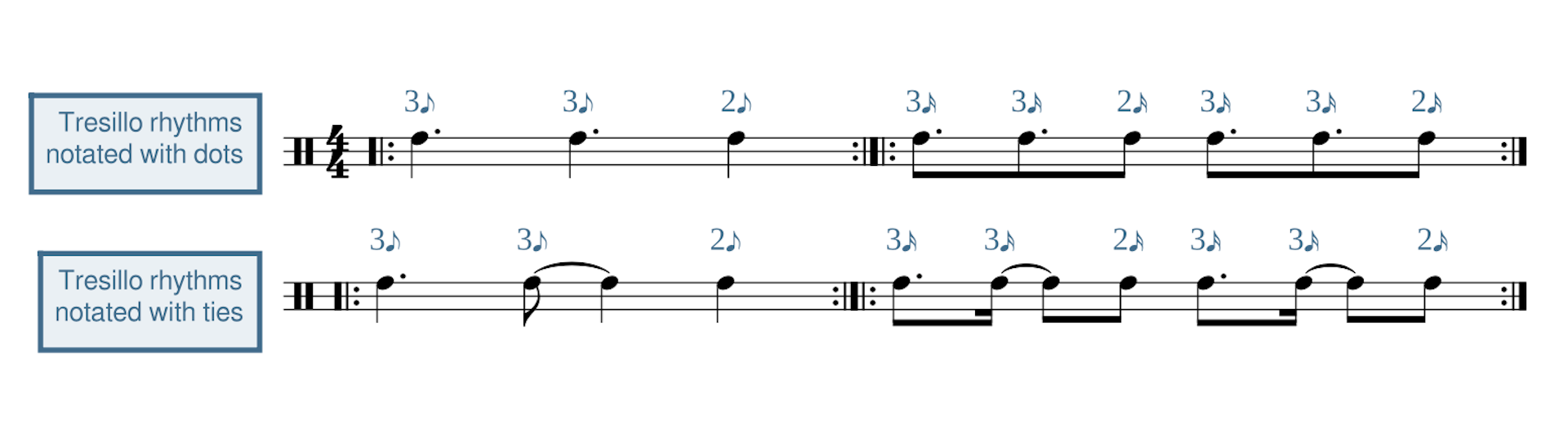
The tresillo is found across an array of music from all over the globe including tango, jazz, reggaeton and bossa nova.
Tresillo ditemukan dalam berbagai jenis musik dari seluruh dunia termasuk tango, jazz, reggaeton, dan bossa nova.
The tresillo was first made famous through the West in a song from an 1875 opera, Georges Bizet’s Carmen, “L’amour est un oiseau rebelle” (“Love is a rebellious bird”) , usually called “The Habanera.” And it has since been widely circulated in varied ways through popular culture.
Tresillo pertama kali menjadi terkenal di Barat melalui sebuah lagu dari opera tahun 1875, Carmen karya Georges Bizet, “L’amour est un oiseau rebelle” (“Cinta adalah burung pemberontak”) , yang biasanya disebut “The Habanera.” Sejak saat itu, ia telah disebarkan secara luas dengan berbagai cara melalui budaya populer.
Carmen was set in what dominant French society at the time viewed as an “exotic” and culturally distant south of Spain. To emphasize this cultural difference, Bizet was keen to introduce what scholars have termed “local colour” through the use of an apparent folk tune, which became “The Habanera.”
Carmen berlatar di bagian selatan Spanyol yang pada masa itu dipandang oleh masyarakat Prancis dominan sebagai tempat yang “eksotis” dan jauh secara budaya. Untuk menekankan perbedaan budaya ini, Bizet ingin memperkenalkan apa yang disebut para sarjana sebagai “warna lokal” melalui penggunaan melodi rakyat yang tampak, yang kemudian menjadi “The Habanera.”
However, little did the composer know that “The Habanera” was not a folk tune and was actually a recent popular song by Spanish composer Sebastián Yradier. Certainly, this use of the tresillo was part of what made Bizet’s aria, and Yradier’s song, so catchy.
Namun, sedikit yang diketahui komposer bahwa “The Habanera” bukanlah lagu rakyat dan sebenarnya adalah lagu populer baru oleh komposer Spanyol Sebastián Yradier. Tentu saja, penggunaan tresillo ini adalah bagian dari apa yang membuat aria Bizet, dan lagu Yradier, begitu menarik.
“The Habanera” is not only the name of this composition but also of a genre of a musical dance. It first appeared in 1700s-era Cuba, where it grew out of an English country dance that was then infused with elements from French, Spanish and African traditions, which eventually led to the dance being characterized by the tresillo rhythm.
“The Habanera” bukan hanya nama komposisi ini tetapi juga genre tarian musik. Ia pertama kali muncul di Kuba era 1700-an, di mana ia berkembang dari tarian pedesaan Inggris yang kemudian disuntikkan dengan elemen-elemen dari tradisi Prancis, Spanyol, dan Afrika, yang akhirnya menyebabkan tarian tersebut dicirikan oleh ritme tresillo.
This shows how the tresillo is a product of cross-cultural transfer.
Ini menunjukkan bagaimana tresillo adalah produk transfer lintas budaya.
‘Maximal evenness’
‘Keseragaman Maksimal’
The tresillo consists of a “three-three-two” pattern across eight beats. The three attacks are distributed evenly across those eight beats, but not perfectly so.
Tresillo terdiri dari pola “tiga-tiga-dua” di sepanjang delapan ketukan. Tiga serangan tersebut didistribusikan secara merata di seluruh delapan ketukan itu, tetapi tidak sempurna.
The tresillo is a classic example of a larger class of “maximally even” rhythms. An arrangement is “maximally even” if the elements are spread out as much as possible in a given unit. With the tresillo, the “imperfect” arrangement often makes these “maximally even” rhythms sounds both simple yet catchy.
Tresillo adalah contoh klasik dari kelas ritme yang lebih besar, yaitu ritme “keseragaman maksimal.” Sebuah aransemen disebut “keseragaman maksimal” jika elemen-elemennya tersebar sebanyak mungkin dalam unit tertentu. Dengan tresillo, susunan yang “tidak sempurna” ini sering membuat ritme “keseragaman maksimal” terdengar sederhana namun menarik.
Many other maximally even rhythms are constructed in similar manner with alternating rhythmic durations that are spread out as much possible in the space that they have.
Banyak ritme keseragaman maksimal lainnya dibangun dengan cara serupa, dengan durasi ritmis bergantian yang tersebar sebanyak mungkin dalam ruang yang dimilikinya.
This is usually achieved by having two and three beats grouped together that alternate and create a somewhat irregular feel, but is widely popular and found across the globe in many musical genres and cultures including jazz, African drumming patterns, Indian classical music and more recent western classical music.
Ini biasanya dicapai dengan menggabungkan dua dan tiga ketukan yang bergantian dan menciptakan nuansa yang agak tidak teratur, tetapi sangat populer dan ditemukan di seluruh dunia dalam banyak genre musik dan budaya termasuk jazz, pola drum Afrika, musik klasik India, dan musik klasik Barat yang lebih baru.
In addition to Bad Bunny’s tresillos, another well-known example of maximally even rhythms appears in Radiohead’s “Pyramid Song” from their album Amnesiac (2001) . The title alludes to the ambiguous, much debated yet mesmerizing rhythms created through irregular beats that reference the geometric structure of a pyramid.
Selain tresillo Bad Bunny, contoh lain ritme keseragaman maksimal yang terkenal muncul dalam lagu “Pyramid Song” dari album Amnesiac (2001) milik Radiohead. Judul ini merujuk pada ritme yang ambigu, banyak diperdebatkan namun mempesona, yang diciptakan melalui ketukan tidak teratur yang mengacu pada struktur geometris piramida.
Radiohead had already used this rhythm in their earlier 2000 hit “Everything in its right place,” making maximally even rhythms a key part of their signature sound.
Radiohead sudah menggunakan ritme ini dalam lagu hits mereka tahun 2000 sebelumnya, “Everything in its right place,” menjadikan ritme keseragaman maksimal sebagai bagian kunci dari suara khas mereka.
Maximally even arrangements also appear in nature — for example in the arrangement of magnetic particles in physics.
Aransemen keseragaman maksimal juga muncul di alam—misalnya dalam susunan partikel magnetik dalam fisika.
Perceiving rhythm
Mempersepsikan ritme
The concept of maximal evenness also affects how our brains perceive rhythms. When hearing a rhythm, the human mind is sensitive to the relations of time intervals between notes (for example, the hits of a drum) within the rhythm.
Konsep keevenan maksimal juga memengaruhi cara otak kita mempersepsikan ritme. Saat mendengar ritme, pikiran manusia sensitif terhadap hubungan interval waktu antar nada (misalnya, pukulan drum) di dalam ritme tersebut.
Specifically, our brains try to find a repeating pattern of regularities to organize the rhythm at different time scales. Regular, simple rhythmic patterns are more likely to be remembered.
Secara khusus, otak kita mencoba menemukan pola berulang dari keteraturan untuk mengatur ritme pada skala waktu yang berbeda. Pola ritmis yang teratur dan sederhana lebih mungkin diingat.
Early research on rhythm perception has found that study participants memorized and reproduced rhythms more accurately when the time intervals between notes have simple relations such as two to one, or one to one.
Penelitian awal tentang persepsi ritme menemukan bahwa peserta studi menghafal dan mereproduksi ritme lebih akurat ketika interval waktu antar nada memiliki hubungan sederhana seperti dua banding satu, atau satu banding satu.
For more complex patterns where the intervals are related by other ratios larger or smaller than two to one, participants often reproduced these patterns as though they were closer to two to one (or one to one) .
Untuk pola yang lebih kompleks di mana interval berhubungan dengan rasio lain yang lebih besar atau lebih kecil dari dua banding satu, peserta sering mereproduksi pola-pola ini seolah-olah mereka lebih dekat ke dua banding satu (atau satu banding satu) .
More recent research also found similar advantage for rhythms with simpler ratios of time intervals between notes to be more easily remembered and reproduced by people. Researchers found this “rhythmic bias” for simple ratios exists across different cultures, though the exact ratio people prefer varies across cultural groups.
Penelitian yang lebih baru juga menemukan keuntungan serupa bahwa ritme dengan rasio interval waktu antar nada yang lebih sederhana lebih mudah diingat dan direproduksi oleh orang. Para peneliti menemukan bahwa “bias ritmis” untuk rasio sederhana ini ada di berbagai budaya, meskipun rasio persis yang disukai orang bervariasi di antara kelompok budaya.
As we have seen, catchy rhythms like the tresillo could be explained by principles such as “maximal evenness” and human perception.
Seperti yang telah kita lihat, ritme menarik seperti tresillo dapat dijelaskan oleh prinsip-prinsip seperti “keevenan maksimal” dan persepsi manusia.
From Bad Bunny to Bizet, Radiohead and far beyond, artists appeal to these shared principles and patterns, and these catchy rhythms connect people across cultures, languages and generations.
Dari Bad Bunny hingga Bizet, Radiohead, dan jauh melampaui itu, para seniman menarik prinsip dan pola bersama ini, dan ritme yang menarik ini menghubungkan orang di berbagai budaya, bahasa, dan generasi.
Catchy rhythms like the tresillo are examples of how our musical perception and preference negotiate between simplicity and complexity, between predictability and unpredictability.
Ritme menarik seperti tresillo adalah contoh bagaimana persepsi dan preferensi musik kita bernegosiasi antara kesederhanaan dan kompleksitas, antara prediktabilitas dan ketidakpastian.
Aidan McGartland receives funding from The Ramsay Centre for Western Civilisation, McGill University and the Fonds de Recherche du Québec.
Aidan McGartland menerima dana dari The Ramsay Centre for Western Civilisation, McGill University, dan Fonds de Recherche du Québec.
Linglan Zhu receives funding from McGill University and Fonds de recherche du Québec (FRQ) .
Linglan Zhu menerima dana dari McGill University dan Fonds de recherche du Québec (FRQ) .
Matthew Anthony Ludwig receives funding from Boston University.
Matthew Anthony Ludwig menerima dana dari Boston University.
Read more
-

Apa itu ‘sinkronisasi siklus’, dan bagaimana hal itu dapat memengaruhi menstruasi?
What is ‘cycle syncing’, and how might it affect menstruation?
-

Bagaimana Iran menggunakan papan reklame sebagai propaganda perang – kami memilih 5 untuk menjelaskan artinya
How Iran uses billboards as wartime propaganda – we selected 5 to explain what they mean