
Cómo la música «pegadiza» está impulsada por patrones rítmicos
How ‘catchy’ music is driven by rhythmic patterns
Catchy rhythms like the tresillo are examples of how our musical perception and preference negotiate between simplicity and complexity.
Ritmos pegadizos como el tresillo son ejemplos de cómo nuestra percepción y preferencia musical negocian entre la simplicidad y la complejidad.
Puerto Rican icon Bad Bunny, a superstar rapper, has recently risen to global prominence as demonstrated by the 2026 Super Bowl halftime show.
El ícono puertorriqueño Bad Bunny, un superestrella del rap, ha ascendido recientemente a la prominencia global, como lo demuestra el espectáculo de medio tiempo del Super Bowl 2026.
Bad Bunny’s success is not only down to his charismatic performances or engagement in social activism for Puerto Rico, but also his catchy use of rhythm.
El éxito de Bad Bunny no se debe solo a sus carismáticas actuaciones o su participación en activismo social por Puerto Rico, sino también a su uso pegadizo del ritmo.
He infuses the characteristic rhythms of reggaeton into Latin trap, creating his signature sound.
Infunde los ritmos característicos del reggaetón al trap latino, creando su sonido distintivo.
Rhythm can be defined as the musical duration or timing properties of music. Many rhythms derive from human speech patterns and are also linked to movement, including dance (as suggested by numerous studies on embodiment) .
El ritmo puede definirse como la duración musical o las propiedades temporales de la música. Muchos ritmos derivan de patrones del habla humana y también están vinculados al movimiento, incluido el baile (como sugieren numerosos estudios sobre la encarnación) .
The “catchiness” of a rhythm has the potential to make or break a song. And it’s not just in recent pop songs, but across classical, jazz and throughout global musical styles.
La «pegajosidad» de un ritmo tiene el potencial de hacer o deshacer una canción. Y no solo en las canciones pop recientes, sino a lo largo de los estilos musicales clásicos, jazz y globales.
Rhythm in music
Ritmo en la música
Rhythm is one of the key parameters of music alongside pitch and timbre, which is the quality of auditory sensations produced by the tone of a sound wave.
El ritmo es uno de los parámetros clave de la música, junto con el tono y el timbre, que es la calidad de las sensaciones auditivas producidas por el sonido de una onda sonora.
As 20th-century composer Igor Stravinsky scribbled on his sketches of his rhythmic masterpiece, The Rite of Spring: “there is music wherever there is rhythm, as there is life wherever there beats a pulse.”
Como escribió el compositor del siglo XX Igor Stravinsky en sus bocetos de su obra maestra rítmica, La consagración de la primavera: «hay música dondequiera que haya ritmo, así como hay vida dondequiera que late un pulso.»
What makes a rhythm distinctive or catchy? The answer lies in the pattern that underlies the structure. Much of human creativity beyond rhythm and music is also shaped by the math underneath the patterns.
¿Qué hace que un ritmo sea distintivo o pegadizo? La respuesta reside en el patrón que subyace a la estructura. Gran parte de la creatividad humana, más allá del ritmo y la música, también está moldeada por las matemáticas que están debajo de los patrones.
The tresillo
El tresillo
Bad Bunny’s characteristic reggaeton rhythms are derived from what is called the tresillo, a distinctive pattern created by two groups of three beats followed by a group of two beats. It’s especially associated with African and Caribbean music.
Los ritmos característicos de Bad Bunny son derivados de lo que se llama el tresillo, un patrón distintivo creado por dos grupos de tres tiempos seguidos de un grupo de dos tiempos. Está especialmente asociado con la música africana y caribeña.
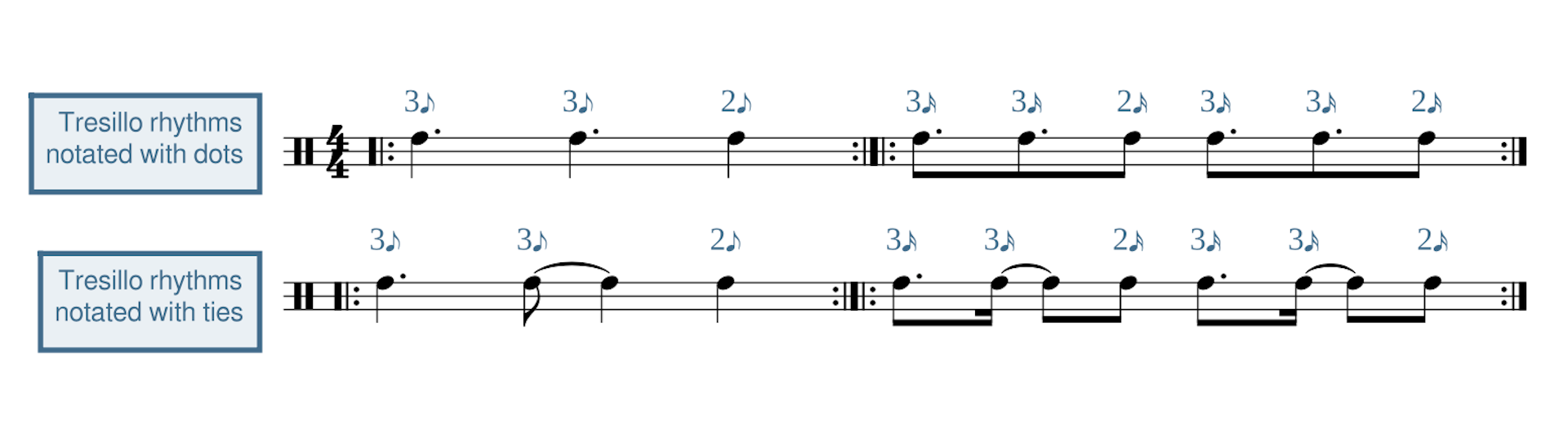
The tresillo is found across an array of music from all over the globe including tango, jazz, reggaeton and bossa nova.
El tresillo se encuentra en una variedad de músicas de todo el mundo, incluyendo tango, jazz, reggaetón y bossa nova.
The tresillo was first made famous through the West in a song from an 1875 opera, Georges Bizet’s Carmen, “L’amour est un oiseau rebelle” (“Love is a rebellious bird”) , usually called “The Habanera.” And it has since been widely circulated in varied ways through popular culture.
El tresillo alcanzó fama por primera vez en Occidente con una canción de la ópera de 1875, Carmen de Georges Bizet, “L’amour est un oiseau rebelle” (“El amor es un pájaro rebelde”) , generalmente llamada “La Habanera”. Desde entonces ha circulado ampliamente de diversas maneras a través de la cultura popular.
Carmen was set in what dominant French society at the time viewed as an “exotic” and culturally distant south of Spain. To emphasize this cultural difference, Bizet was keen to introduce what scholars have termed “local colour” through the use of an apparent folk tune, which became “The Habanera.”
Carmen se ambientó en lo que la sociedad francesa dominante de la época consideraba el sur de España, «exótico» y culturalmente distante. Para enfatizar esta diferencia cultural, Bizet estaba interesado en introducir lo que los académicos han denominado «color local» mediante el uso de una aparente melodía folclórica, que se convirtió en “La Habanera”.
However, little did the composer know that “The Habanera” was not a folk tune and was actually a recent popular song by Spanish composer Sebastián Yradier. Certainly, this use of the tresillo was part of what made Bizet’s aria, and Yradier’s song, so catchy.
Sin embargo, el compositor no sabía que “La Habanera” no era una melodía folclórica y que en realidad era una canción popular reciente del compositor español Sebastián Yradier. Ciertamente, este uso del tresillo fue parte de lo que hizo tan pegadiza la aria de Bizet y la canción de Yradier.
“The Habanera” is not only the name of this composition but also of a genre of a musical dance. It first appeared in 1700s-era Cuba, where it grew out of an English country dance that was then infused with elements from French, Spanish and African traditions, which eventually led to the dance being characterized by the tresillo rhythm.
“La Habanera” no es solo el nombre de esta composición, sino también de un género de baile musical. Apareció por primera vez en Cuba en la era de los años 1700, donde surgió de un baile campestre inglés que luego se infundió con elementos de las tradiciones francesa, española y africana, lo que finalmente llevó a que el baile fuera caracterizado por el ritmo tresillo.
This shows how the tresillo is a product of cross-cultural transfer.
Esto muestra cómo el tresillo es un producto de la transferencia transcultural.
‘Maximal evenness’
‘Uniformidad máxima’
The tresillo consists of a “three-three-two” pattern across eight beats. The three attacks are distributed evenly across those eight beats, but not perfectly so.
El tresillo consta de un patrón de «tres-tres-dos» a lo largo de ocho pulsos. Los tres ataques se distribuyen uniformemente en esos ocho pulsos, pero no de manera perfecta.
The tresillo is a classic example of a larger class of “maximally even” rhythms. An arrangement is “maximally even” if the elements are spread out as much as possible in a given unit. With the tresillo, the “imperfect” arrangement often makes these “maximally even” rhythms sounds both simple yet catchy.
El tresillo es un ejemplo clásico de una clase más grande de ritmos «máximamente uniformes.» Un arreglo es «máximamente uniforme» si sus elementos están distribuidos lo máximo posible en una unidad dada. Con el tresillo, la disposición «imperfecta» a menudo hace que estos ritmos «máximamente uniformes» suenen a la vez simples y pegadizos.
Many other maximally even rhythms are constructed in similar manner with alternating rhythmic durations that are spread out as much possible in the space that they have.
Muchos otros ritmos máximamente uniformes se construyen de manera similar con duraciones rítmicas alternas que están distribuidas lo máximo posible en el espacio que tienen.
This is usually achieved by having two and three beats grouped together that alternate and create a somewhat irregular feel, but is widely popular and found across the globe in many musical genres and cultures including jazz, African drumming patterns, Indian classical music and more recent western classical music.
Esto se logra generalmente agrupando dos y tres pulsos que alternan y crean una sensación algo irregular, pero es muy popular y se encuentra en todo el mundo en muchos géneros musicales y culturas, incluyendo el jazz, patrones de tambores africanos, música clásica india y la música clásica occidental más reciente.
In addition to Bad Bunny’s tresillos, another well-known example of maximally even rhythms appears in Radiohead’s “Pyramid Song” from their album Amnesiac (2001) . The title alludes to the ambiguous, much debated yet mesmerizing rhythms created through irregular beats that reference the geometric structure of a pyramid.
Además de los tresillos de Bad Bunny, otro ejemplo bien conocido de ritmos máximamente uniformes aparece en «Pyramid Song» de Radiohead, de su álbum Amnesiac (2001) . El título alude a los ritmos ambiguos, muy debatidos y sin embargo fascinantes creados mediante pulsos irregulares que hacen referencia a la estructura geométrica de una pirámide.
Radiohead had already used this rhythm in their earlier 2000 hit “Everything in its right place,” making maximally even rhythms a key part of their signature sound.
Radiohead ya había utilizado este ritmo en su éxito anterior de 2000, «Everything in its right place», lo que convirtió a los ritmos máximamente uniformes en una parte clave de su sonido característico.
Maximally even arrangements also appear in nature — for example in the arrangement of magnetic particles in physics.
Los arreglos máximamente uniformes también aparecen en la naturaleza, por ejemplo, en la disposición de partículas magnéticas en física.
Perceiving rhythm
Percibir el ritmo
The concept of maximal evenness also affects how our brains perceive rhythms. When hearing a rhythm, the human mind is sensitive to the relations of time intervals between notes (for example, the hits of a drum) within the rhythm.
El concepto de máxima uniformidad también afecta cómo nuestro cerebro percibe los ritmos. Al escuchar un ritmo, la mente humana es sensible a las relaciones de intervalos de tiempo entre notas (por ejemplo, los golpes de un tambor) dentro del ritmo.
Specifically, our brains try to find a repeating pattern of regularities to organize the rhythm at different time scales. Regular, simple rhythmic patterns are more likely to be remembered.
Específicamente, nuestros cerebros intentan encontrar un patrón repetitivo de regularidades para organizar el ritmo en diferentes escalas de tiempo. Los patrones rítmicos regulares y simples son más propensos a ser recordados.
Early research on rhythm perception has found that study participants memorized and reproduced rhythms more accurately when the time intervals between notes have simple relations such as two to one, or one to one.
Las primeras investigaciones sobre la percepción del ritmo han encontrado que los participantes de los estudios memorizaron y reprodujeron ritmos con mayor precisión cuando los intervalos de tiempo entre notas tenían relaciones simples como dos a uno o uno a uno.
For more complex patterns where the intervals are related by other ratios larger or smaller than two to one, participants often reproduced these patterns as though they were closer to two to one (or one to one) .
Para patrones más complejos donde los intervalos están relacionados por otras proporciones mayores o menores que dos a uno, los participantes a menudo reprodujeron estos patrones como si estuvieran más cerca de dos a uno (o uno a uno) .
More recent research also found similar advantage for rhythms with simpler ratios of time intervals between notes to be more easily remembered and reproduced by people. Researchers found this “rhythmic bias” for simple ratios exists across different cultures, though the exact ratio people prefer varies across cultural groups.
Investigaciones más recientes también encontraron una ventaja similar para los ritmos con proporciones más simples de intervalos de tiempo entre notas, que son más fáciles de recordar y reproducir por las personas. Los investigadores encontraron que este «sesgo rítmico» por proporciones simples existe en diferentes culturas, aunque la proporción exacta que prefiere la gente varía según el grupo cultural.
As we have seen, catchy rhythms like the tresillo could be explained by principles such as “maximal evenness” and human perception.
Como hemos visto, ritmos pegadizos como el tresillo podrían explicarse por principios como la «máxima uniformidad» y la percepción humana.
From Bad Bunny to Bizet, Radiohead and far beyond, artists appeal to these shared principles and patterns, and these catchy rhythms connect people across cultures, languages and generations.
Desde Bad Bunny hasta Bizet, Radiohead y mucho más allá, los artistas apelan a estos principios y patrones compartidos, y estos ritmos pegadizos conectan a las personas a través de culturas, idiomas y generaciones.
Catchy rhythms like the tresillo are examples of how our musical perception and preference negotiate between simplicity and complexity, between predictability and unpredictability.
Ritmos pegadizos como el tresillo son ejemplos de cómo nuestra percepción y preferencia musical negocian entre la simplicidad y la complejidad, entre la predictibilidad y la imprevisibilidad.
Aidan McGartland receives funding from The Ramsay Centre for Western Civilisation, McGill University and the Fonds de Recherche du Québec.
Aidan McGartland recibe financiación del The Ramsay Centre for Western Civilisation, la Universidad McGill y el Fonds de Recherche du Québec.
Linglan Zhu receives funding from McGill University and Fonds de recherche du Québec (FRQ) .
Linglan Zhu recibe financiación de la Universidad McGill y el Fonds de recherche du Québec (FRQ) .
Matthew Anthony Ludwig receives funding from Boston University.
Matthew Anthony Ludwig recibe financiación de la Universidad de Boston.
Read more
-

El nuevo presidente de Colombia, ‘El Tigre’, promete una mano de hierro, pero eso puede que no resuelva la violencia que ha heredado
Colombia’s new president ‘El Tigre’ promises an iron fist – but that may not solve the violence he has inherited
-
Las seis mejores adaptaciones de Shakespeare que no están en inglés
The six best Shakespeare adaptations that aren’t in English