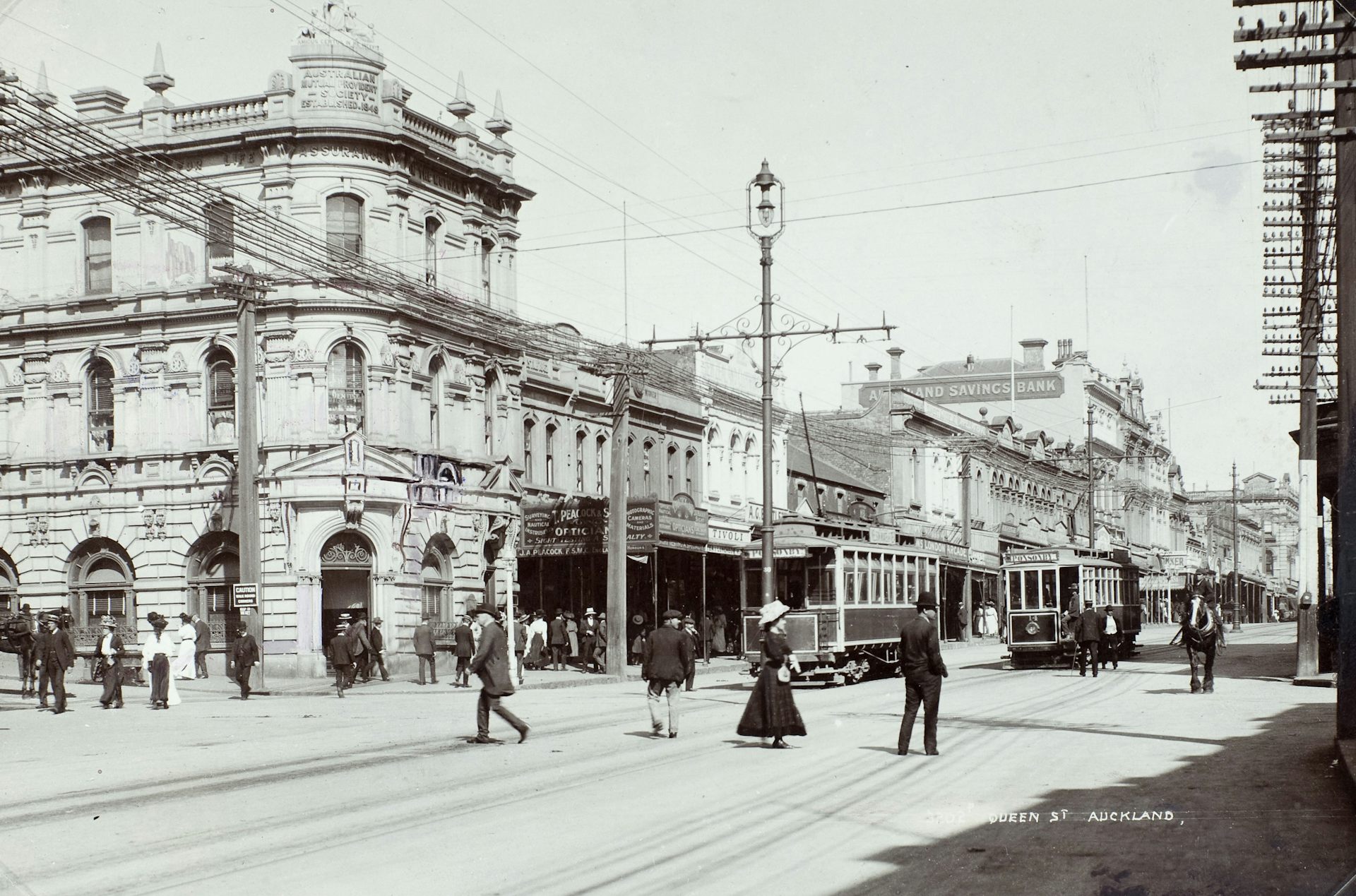
Foi Auckland o berço do sotaque Kiwi? Uma teoria antiga ganha nova atenção
Was Auckland the cradle of the Kiwi accent? An old theory gets a new hearing
A rediscovered academic paper from 1921 suggests New Zealand’s classic ‘fush and chups’ vowel sounds may have emerged fastest in Auckland’s colonial melting pot.
Um artigo acadêmico redescoberto de 1921 sugere que os clássicos sons vocálicos ‘fush and chups’ da Nova Zelândia podem ter surgido mais rapidamente no caldeirão colonial de Auckland.
If you’re a New Zealander who has spent time overseas, you’ve probably had someone comment on the way you speak: that swallowed e and flat i, the whole fush and chups thing … the rest of the world thinks we pronounce our vowels a bit funny.
Se você é neozelandês e passou algum tempo no exterior, provavelmente já teve alguém comentando sobre o seu jeito de falar: aquele ‘e’ engolido e o ‘i’ plano, o negócio todo do ‘fush’ e ‘chups’… o resto do mundo acha que nós pronunciamos nossas vogais de um jeito engraçado.
Even as a researcher of the Kiwi accent, it took me a while to wrap my head around the fact that “here” and “hair” aren’t supposed to rhyme.
Mesmo como pesquisador do sotaque Kiwi, levei um tempo para entender o fato de que “here” e “hair” não deveriam rimar.
So where did this local form of spoken English originate, and how did we come to pronounce our vowels in such a unique way?
Então, de onde veio essa forma local de inglês falado, e como chegamos a pronunciar nossas vogais de uma maneira tão única?
It’s clearly a question many people have asked, given the interest in my public talk on the subject in Auckland this week, part of a project using oral history recordings of Aucklanders born around the turn of the 20th century.
É claramente uma pergunta que muitas pessoas fizeram, dado o interesse na minha palestra pública sobre o assunto em Auckland esta semana, parte de um projeto que usa gravações de história oral de moradores de Auckland nascidos por volta do início do século XX.
These recordings, now housed in the Auckland Libraries sound archives, let us listen back in time. When we compare them with modern recordings, we can trace how our accent has developed across generations.
Essas gravações, agora guardadas nos arquivos de som da Auckland Libraries, nos permitem ouvir o passado. Quando as comparamos com gravações modernas, podemos rastrear como nosso sotaque se desenvolveu ao longo das gerações.
This means going back to when large numbers of English-speaking settlers arrived in Aotearoa New Zealand from the mid-19th century. Because they came from different parts of Britain – largely the South of England, Scotland and Ireland – they didn’t all speak the same kind of English and brought their regional accents with them.
Isso significa voltar ao período em que grandes números de colonos falantes de inglês chegaram em Aotearoa Nova Zelândia a partir de meados do século XIX. Como vieram de diferentes partes da Grã-Bretanha – principalmente do Sul da Inglaterra, Escócia e Irlanda – eles não falavam todos o mesmo tipo de inglês e trouxeram seus sotaques regionais com eles.
Despite the protests of educational authorities and elocution teachers of the time, what followed wasn’t the adoption of a single “correct” way of speaking the “Queen’s English”.
Apesar dos protestos das autoridades educacionais e professores de elocução da época, o que se seguiu não foi a adoção de uma única maneira “correta” de falar o “Inglês da Rainha.”
Instead, these various accents came into contact, mixed together and gradually levelled out to something new – not quite British, not quite anything else. New Zealand linguists have known this part of the story for a while. What we don’t know are some of the specifics.
Em vez disso, esses vários sotaques entraram em contato, misturaram-se e gradualmente se nivelaram para algo novo – nem totalmente britânico, nem totalmente outra coisa. Linguistas neozelandeses conhecem essa parte da história há algum tempo. O que não sabemos são alguns dos detalhes específicos.
Why, for example, does our accent have relatively little regional variation (other than Southlanders and their rolled Rs) , despite many early centres such as Christchurch and Dunedin having distinct cultural identities?
Por que, por exemplo, nosso sotaque tem relativamente pouca variação regional (exceto os do Sul e seus ‘R’ enrolados) , apesar de muitos centros iniciais como Christchurch e Dunedin terem identidades culturais distintas?
We also don’t know if the accent developed fastest in certain places. Often, accents change quickly in cities and then spread. But so far, most of our historical research comes from recordings of speakers born in small towns.
Também não sabemos se o sotaque se desenvolveu mais rapidamente em certos lugares. Muitas vezes, os sotaques mudam rapidamente nas cidades e depois se espalham. Mas, até agora, a maior parte de nossa pesquisa histórica vem de gravações de falantes nascidos em pequenas cidades.
A former professor of linguistics discusses the origins of the New Zealand accent. RNZ 6.11 MB (download)
Um ex-professor de linguística discute as origens do sotaque neozelandês. RNZ 6.11 MB (download)
A rediscovered theory
Uma teoria redescoberta
This is where a piece of information that was almost lost provided some surprising inspiration.
Foi aqui que um pedaço de informação que estava quase perdido forneceu uma inspiração surpreendente.
In 1921, a professor at Otago University, George Edward Thompson, completed a thesis on the emerging New Zealand accent. This work was only rediscovered in the Hocken Collections by one of our team members in 2022.
Em 1921, um professor da Universidade de Otago, George Edward Thompson, concluiu uma tese sobre o acento neozelandês emergente. Este trabalho só foi redescoberto nas Hocken Collections por um dos membros da nossa equipe em 2022.
Thompson’s work provides one of the earliest and most comprehensive first hand descriptions of how early New Zealanders spoke. One of the things that stood out was a suggestion the accent was developing most strongly in the North Island, particularly in Auckland.
O trabalho de Thompson fornece uma das descrições mais antigas e mais completas em primeira mão de como os neozelandeses do início falavam. Uma das coisas que chamou a atenção foi a sugestão de que o acento estava se desenvolvendo mais fortemente na Ilha Norte, particularmente em Auckland.
This got us thinking, because Auckland’s history looks quite different to many of New Zealand’s early districts.
Isso nos fez pensar, porque a história de Auckland parece bem diferente de muitos dos distritos iniciais da Nova Zelândia.
For one, the city has always been comparatively cosmopolitan, with people arriving from all over Britain rather than one dominant region. Secondly, its population grew steadily over time, unlike many other districts which saw booms and stagnation. Both these factors make a good environment for an accent to develop.
Por um lado, a cidade sempre foi comparativamente cosmopolita, com pessoas chegando de toda a Grã-Bretanha em vez de de uma região dominante. Em segundo lugar, sua população cresceu de forma constante ao longo do tempo, ao contrário de muitos outros distritos que viram booms e estagnação. Ambos os fatores criam um bom ambiente para o desenvolvimento de um sotaque.
We still need to do the proper technical analysis to test whether Thompson was right, which is where the Auckland Libraries recordings are useful. They come from Aucklanders who would have been teenagers and young adults around the time Thompson was writing.
Ainda precisamos fazer a análise técnica adequada para testar se Thompson estava certo, e é aí que as gravações da Biblioteca de Auckland são úteis. Elas vêm de aucklandenses que teriam sido adolescentes e jovens adultos por volta do tempo em que Thompson estava escrevendo.
When you listen to these recordings, the voices sound familiar – recognisably New Zealand but not quite how we speak today. Sometimes there’s a slight British or Australian quality, and speakers often shift between pronunciations.
Quando você ouve essas gravações, as vozes soam familiares – inconfundivelmente neozelandesas, mas não exatamente como falamos hoje. Às vezes há um leve toque britânico ou australiano, e os falantes frequentemente mudam entre pronúncias.
But the features of the New Zealand accent we know are all there – maybe more than we expected.
Mas as características do sotaque neozelandês que conhecemos estão todas lá – talvez até mais do que esperávamos.
Auckland English
Inglês de Auckland
If our hunch is correct, we may not only solve some mysteries about the accent, but also challenge ideas about how it was formed and who contributed.
Se nossa intuição estiver correta, podemos não apenas resolver alguns mistérios sobre o sotaque, mas também desafiar ideias sobre como ele foi formado e quem contribuiu.
For example, past research has often treated similarities between the Australian and New Zealand accents as coincidental, and assumed Māori had little influence on vowel pronunciation. This was largely because the research focused on the South Island where contact with Māori and Australia was more limited.
Por exemplo, pesquisas anteriores frequentemente trataram as semelhanças entre os sotaques australiano e neozelandês como coincidência, e assumiram que o Māori tinha pouca influência na pronúncia das vogais. Isso ocorreu em grande parte porque a pesquisa se concentrou na Ilha do Sul, onde o contato com o Māori e a Austrália era mais limitado.
But that’s not necessarily true for Auckland, which had close trade connections with both Australia and local Māori from its inception. If Auckland was integral to the formation of our accent, those influences may need to be reconsidered.
Mas isso não é necessariamente verdade para Auckland, que teve fortes laços comerciais tanto com a Austrália quanto com o Māori local desde o seu início. Se Auckland foi integral para a formação do nosso sotaque, essas influências podem precisar ser reconsideradas.
Like all accents, New Zealand English continues to evolve, and Auckland is at the forefront of changes to the modern accent. Young Aucklanders are keeping their iconic “fush and chups” vowels, but may have an easier time buying “seven eggs” as they aim to be better understood in an increasingly linguistically diverse city.
Como todos os sotaques, o inglês neozelandês continua a evoluir, e Auckland está na vanguarda das mudanças no sotaque moderno. Os jovens de Auckland mantêm suas vogais icônicas de “fush and chups”, mas podem ter mais facilidade ao comprar “seven eggs” à medida que buscam ser melhor compreendidos em uma cidade cada vez mais linguisticamente diversa.
Combined with Thompson’s historical commentary, this raises a big question: how long has Auckland been shaping the way New Zealanders sound? If Thompson was right, it might have been longer than we thought.
Combinado com o comentário histórico de Thompson, isso levanta uma grande questão: há quanto tempo Auckland tem moldado o jeito de falar dos neozelandeses? Se Thompson estava certo, pode ter sido mais tempo do que pensávamos.
Dr Brooke Ross works for the University of Auckland. This project is funded by the Marsden Fund Council, managed by Royal Society Te Apārangi.
A Dra. Brooke Ross trabalha na Universidade de Auckland. Este projeto é financiado pelo Marsden Fund Council, administrado pela Royal Society Te Apārangi.
Read more
-
A obsessão por ‘tokenmaxxing’ de IA do Vale do Silício tem um grande problema – e os filósofos previram isso
Silicon Valley’s AI ‘tokenmaxxing’ obsession has a big problem – and philosophers saw it coming
-

Trump dá as boas-vindas a Colombo à Casa Branca – e reacende as guerras históricas da América
Trump welcomes Columbus to the White House – and reignites America’s history wars