海豚和鲸鱼体内的“永久性化学物质”水平正在全球范围内上升
Levels of ‘forever chemicals’ in dolphins and whales ar…
Nowhere is safe from forever chemical pollution – not even the middle of the ocean. PFAS levels are on the rise in the world’s whales and dolphins.
没有地方能逃脱永久性化学污染——甚至连海洋中央也一样。世界各地的鲸鱼和海豚体内PFAS水平正在上升。
Whales and dolphins inhabit some of the largest and seemingly most pristine environments on Earth, from tropical coastlines to Antarctic waters. Yet even they cannot escape PFAS – persistent “forever chemicals” that leak from our homes, factories and waterways into the sea.
鲸鱼和海豚栖息在地球上一些最大、看似最原始的环境中,从热带海岸到南极水域。然而,即使它们也无法逃脱PFAS——一种持续存在的“永久化学品”,它从我们的家庭、工厂和水道泄漏进入海洋。
Forever chemicals are the secret ingredients in our non-stick pans, waterproof jackets and stain-resistant carpets. These chemicals belong to a group of more than 1,400 compounds known as PFAS (per- and polyfluoroalkyl substances) . They enter the environment through manufacturing waste, industrial runoff, wastewater treatment plants and firefighting foams. But once these chemicals escape our homes and factories, they become almost impossible to get rid of. Washed into waterways, they make their way to the sea.
永久化学品是我们不粘锅、防水夹克和防污地毯中的秘密成分。这些化学物质属于一类超过1400种化合物,被称为全氟和多氟烷基物质(PFAS)。它们通过制造废料、工业径流、污水处理厂和消防泡沫进入环境。但一旦这些化学品逃出我们的家庭和工厂,几乎就无法清除。它们随着水流进入水道,最终到达海洋。
Small organisms absorb them from the water, fish eat those organisms and larger predators eat the fish. At each step, the chemical load increases. As top predators, whales and dolphins can end up with very high levels in their bodies. Not even deep-diving species living and feeding far from humans are safe.
小型生物从水中吸收它们,鱼类吃掉这些生物,大型捕食者则吃鱼。每一步,化学负荷都会增加。作为顶级捕食者,鲸鱼和海豚体内可能会积累极高的浓度。甚至生活在远离人类、深潜觅食的物种也无法幸免。
In our new research, we found PFAS concentrations in cetaceans have increased globally since 2000. Animals in the Pacific Ocean were the most contaminated, with humpback dolphins showing the highest PFAS concentrations.
在我们新的研究中,我们发现自2000年以来,鲸类体内的PFAS浓度在全球范围内都有所增加。太平洋地区的动物污染最严重,其中座头海豚表现出最高的PFAS浓度。
These mammals are sentinels of ocean health. They sit high in the food web, live for many years and are exposed to pollution across large areas of the ocean. When whales and dolphins show signs of chemical exposure, it tells us something is wrong in the wider marine ecosystem.
这些哺乳动物是海洋健康的“哨兵”。它们处于食物链的高端,寿命长,并且暴露于大片海洋的污染物中。当鲸鱼和海豚显示出化学暴露的迹象时,这告诉我们更广阔的海洋生态系统出现了问题。
Why are we worried about forever chemicals?
我们为何担心“永久化学品”?
Many of these chemicals have been in use for decades. Their sheer durability and ability to resist heat, oil and water make them very useful.
这些化学物质中许多已经使用了几十年。它们极高的耐用性以及抵抗热、油和水的能力,使得它们非常有用。
Scientists have grown increasingly concerned about them because they persist for decades and build up over time in our own bodies, as well as in wildlife and the broader environment.
科学家们对它们越来越担忧,因为它们可以持续数十年,并会随着时间在我们自身体内、野生动物乃至整个环境中积累下来。
The key concern is what these chemicals may be doing to the animals that accumulate them.
主要的担忧在于这些化学物质可能对那些积累了它们的动物造成什么影响。
Research in humans and laboratory animals links PFAS to immune suppression, hormonal changes, reproductive problems and developmental effects. But we don’t yet have enough research to understand how different PFAS compounds and levels of exposure affect health.
人类和实验室动物的研究将PFAS与免疫抑制、激素变化、生殖问题和发育不良等症状联系起来。但我们目前还没有足够的研究来了解不同PFAS化合物和暴露水平如何影响健康。
Understanding these impacts in whales and dolphins is harder still. Marine mammals are long-lived, highly mobile and exposed to many human-made problems at once, from climate change to noise pollution to other contaminants.
在鲸鱼和海豚身上理解这些影响更困难。海洋哺乳动物寿命长、活动范围广,同时暴露于许多人为问题中,从气候变化到噪音污染再到其他污染物。
Even so, there are warning signs. Some dolphin studies have reported changes in immune-related markers associated with PFAS exposure.
即便如此,也存在一些警告信号。一些关于海豚的研究报告了与PFAS暴露相关的免疫指标的变化。
How do you test a whale for forever chemicals?
如何检测鲸鱼体内的永久性化学物质?
For humans, testing PFAS levels is usually done with a blood test. It is not as simple for whales and dolphins.
对于人类来说,测试PFAS水平通常通过验血完成。但对于鲸鱼和海豚来说,情况并不那么简单。
It is extremely difficult to take blood samples from large marine mammals in the wild. Scientists often rely on tissue samples from dead animals, particularly from the liver and kidney where many PFAS compounds tend to accumulate. These samples are analysed in specialised laboratories capable of detecting tiny concentrations of individual PFAS compounds.
在野外从大型海洋哺乳动物身上采集血液样本极其困难。科学家们通常依赖于死动物的组织样本,特别是肝脏和肾脏,因为许多PFAS化合物倾向于在这些器官积累。这些样本是在能够检测单个PFAS化合物微量浓度的专业实验室中进行分析的。
This way, scientists have been measuring PFAS in whales and dolphins for decades. Each study added another piece to the puzzle, showing these chemicals were present in different species, populations and oceans.
通过这种方式,科学家们几十年来一直在测量鲸鱼和海豚体内的PFAS。每一项研究都为拼图增加了一块碎片,表明这些化学物质存在于不同的物种、群体和海洋中。
Our study took a step back and looked at the global picture.
我们的研究退后一步,着眼于全球图景。
We compiled PFAS data from cetaceans worldwide, focusing on liver samples because they are the most commonly available tissue type, allowing us to compare studies across species and regions.
我们汇集了来自世界各地鲸豚类动物的PFAS数据,重点关注肝脏样本,因为这是最容易获得的组织类型,使我们能够跨物种和地区比较各项研究。
What did we find?
我们发现了什么?
We found PFAS contamination differed substantially across species, location, sex, age and time.
我们发现PFAS污染在物种、地点、性别、年龄和时间上存在显著差异。
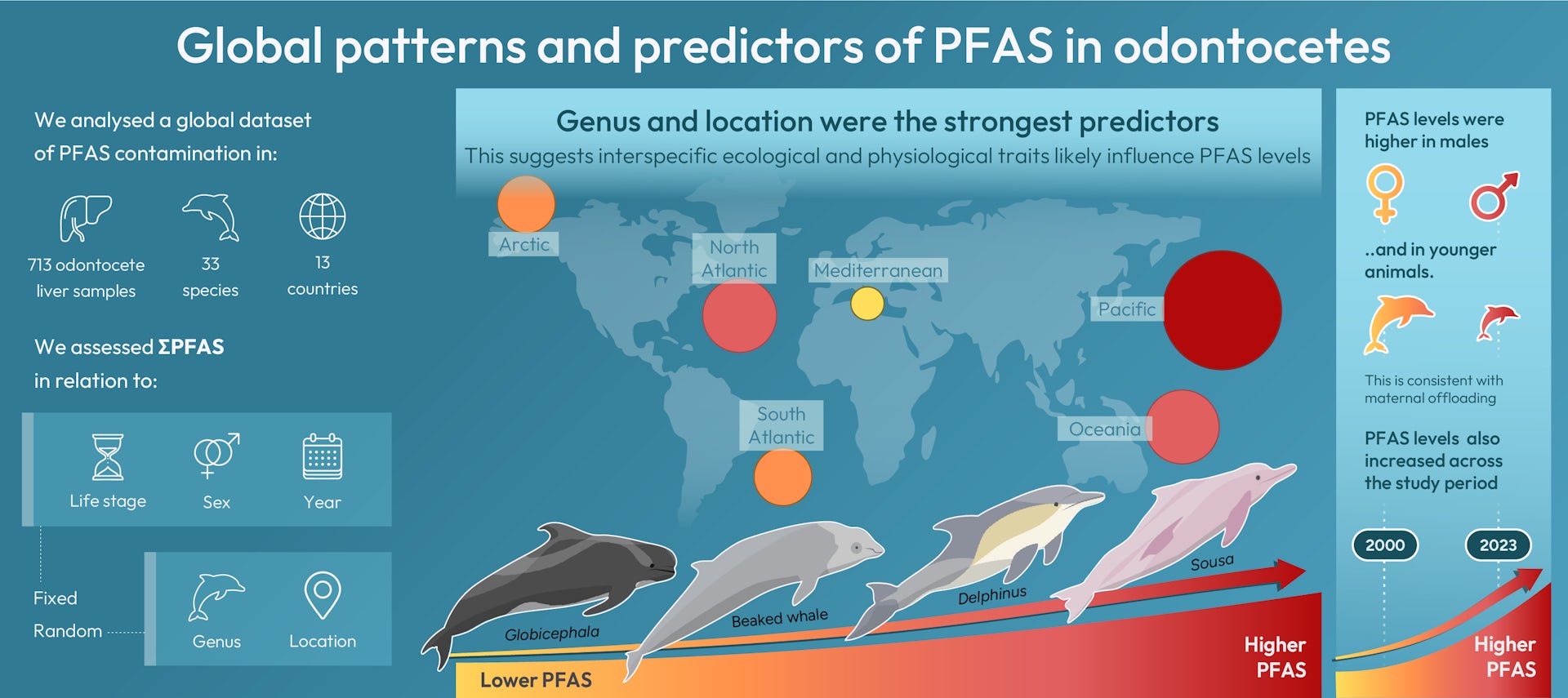
The highest concentrations tended to be found in coastal dolphins and porpoises, suggesting animals living near urban and industrial areas face greater exposure.
最高浓度倾向于在沿海海豚和鼠海豚中发现,这表明生活在城市和工业区附近的动物暴露程度更高。
Cetaceans in the Pacific had higher levels than other oceans. This is likely due to high industrial activity and the extent of historical PFAS production in coastal regions.
太平洋的鲸类比其他大洋水平更高。这可能是由于沿海地区较高的工业活动和历史PFAS生产量造成的。
Female whales and dolphins can transfer forever chemicals during pregnancy and nursing. This means their calves can be exposed to concerning levels of PFAS at a very early age.
母鲸和海豚可以在怀孕和哺乳期间传递永久性化学物质。这意味着它们的幼崽在非常小的年龄就可能暴露于令人担忧水平的PFAS。
Males often end up with higher levels than females overall, as they cannot transfer these chemicals to their young.
总的来说,雄性通常比雌性水平更高,因为它们无法将这些化学物质传递给幼崽。
There are some large gaps in the global dataset we collated, which means we don’t fully know the extent of PFAS contamination in cetaceans off India, Indonesia and parts of Africa.
我们汇编的全球数据集存在一些很大的空白,这意味着我们不能完全了解印度、印度尼西亚和非洲部分地区海豚类动物PFAS污染的程度。
What should we do?
我们应该怎么做?
While important questions remain about the effects of forever chemicals on whales and dolphins, the widespread contamination we observed is a real concern. We need to continue monitoring while strengthening regulations and working to reduce PFAS flows into the environment.
尽管关于永久性化学物质对鲸鱼和海豚影响的问题仍有待解决,但我们观察到的广泛污染是一个真正的担忧。我们需要继续监测,同时加强监管并努力减少PFAS流入环境的量。
History shows global action on harmful chemicals works. After it became clear Earth’s protective ozone layer was being eaten away, nations agreed to phase out the chemicals responsible. The ozone layer is now recovering.
历史表明,全球行动可以应对有害化学品。当人们清楚地知道地球保护臭氧层正在被消耗时,各国就同意淘汰了负责这些污染的化学物质。目前,臭氧层正在恢复。
The European Union moved to ban some PFAS compounds 20 years ago. Our study found lower levels of some legacy PFAS compounds in the Mediterranean Sea, a pattern that may reflect the effects of regulation. This is positive, but not sufficient given overall PFAS levels in whales and dolphins have increased globally over time. The EU is now moving to better regulate this class of forever chemicals.
欧盟在20年前开始禁止某些PFAS化合物。我们的研究发现地中海一些传统PFAS化合物的水平较低,这可能反映了监管的影响。这是一个积极的信号,但考虑到鲸鱼和海豚体内整体PFAS水平随着时间在全球范围内增加,这一点还不够充分。目前,欧盟正着手更好地规范这类永久性化学物质。
Forever chemicals are one of the defining pollution challenges of our time. The more we understand how these chemicals accumulate in whales and dolphins, the better equipped we will be to reduce future contamination and protect marine ecosystems.
永久性化学物质是我们这个时代最具代表性的污染挑战之一。我们越了解这些化学物质如何在鲸鱼和海豚体内积累,就越能做好减少未来污染和保护海洋生态系统的准备。
What ends up in the ocean does not simply disappear. And neither do PFAS.
进入海洋的东西不会简单地消失。PFAS也不会。
This article is based on collaborative research that also included Lavinia Stokes (University of Wollongong) , Jesuina de Araujo (National Measurement Institute) and Gavin Stevenson (National Measurement Institute) .
本文基于一项合作研究,该研究还包括了来自卧龙岗大学的Lavinia Stokes、国家测量学研究所的Jesuina de Araujo以及Gavin Stevenson。
Frédérik Saltré receives funding from the Australian Research Council.
Frédérik Saltré接受澳大利亚研究理事会的资助。
Karen Stockin and Katharina J. Peters do not work for, consult, own shares in or receive funding from any company or organisation that would benefit from this article, and have disclosed no relevant affiliations beyond their academic appointment.
Karen Stockin和Katharina J. Peters不为任何受益于本文的公司或组织工作,也不从其咨询、拥有股份或获得资金,并且除了他们的学术任命外,没有披露任何相关的隶属关系。