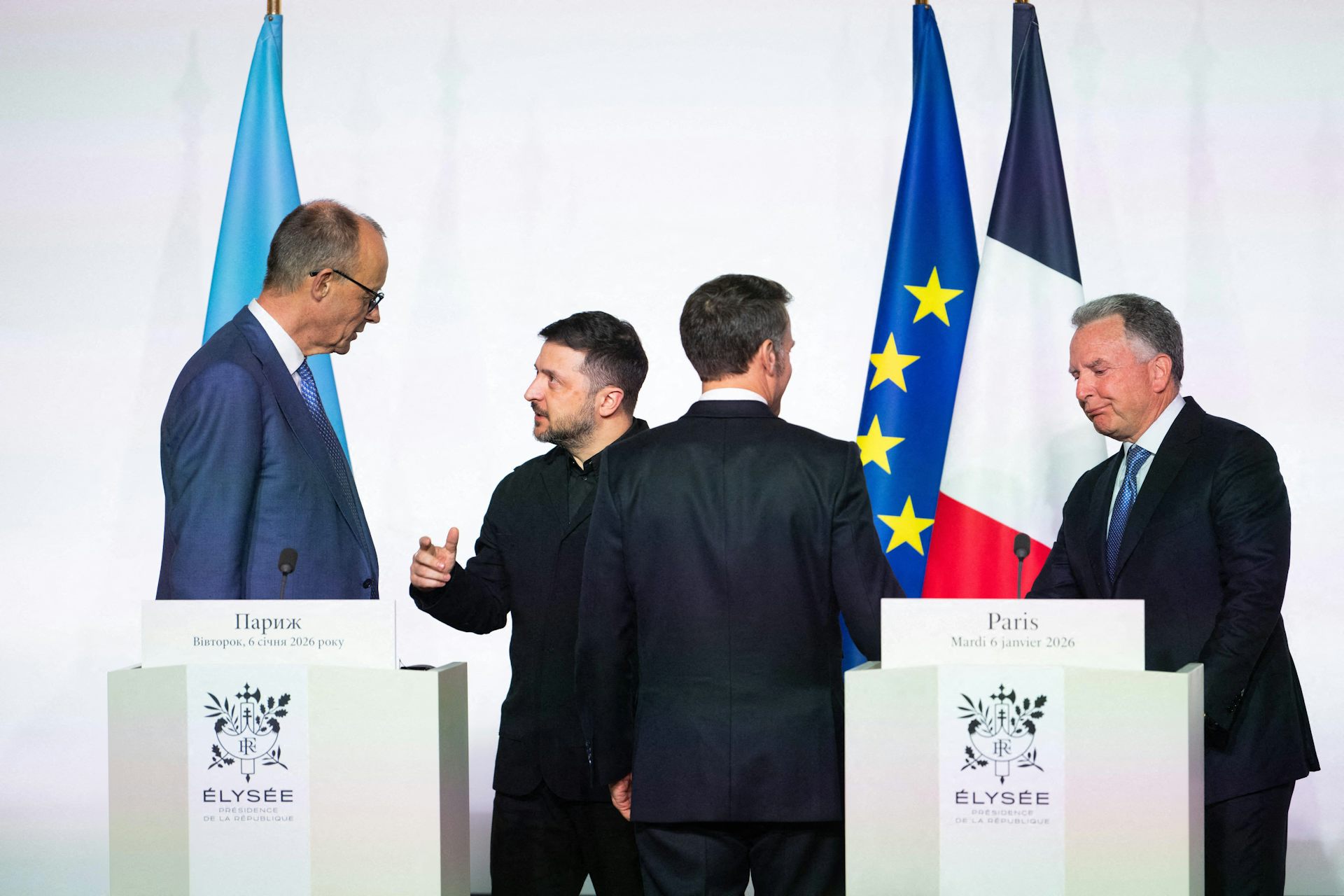
如果欧洲想在安全问题上“各自为政”,各国就得学会唱同一份乐谱。
If Europe wants to ‘go it alone’ on security, countries…
Splits are appearing in Europe’s approach to Russia’s aggression just when it needs to present a united front.
就在它需要展现统一战线的时候,欧洲对待俄罗斯侵略的态度出现了分裂。
The G7 summit at Evian from June 15 to 17 is most revealing not for what was agreed, but for what was exposed about the state of play among Europeans, and their relationship with the US. For all the choreography and displays of unity, the summit was, in large part, theatre. It was an attempt to paper over what is becoming increasingly obvious: many of the most critical international issues are now decided without the EU. Brussels is now, at best, an informed bystander.
在埃维安举行的G7峰会从6月15日到17日,最引人注目之处并非是达成了什么协议,而是暴露了欧洲内部的现状,以及他们与美国的关系。尽管有许多精心策划的统一展示和姿态,但这次峰会在很大程度上不过是一场“戏”。它试图掩盖一个日益明显的事实:目前许多最重要的国际问题正在欧盟之外做出决定。布鲁塞尔现在充其量只是一个知情的旁观者。
This was obvious when the US president, Donald Trump, signed a physical copy of his deal with Iran at a post-G7 dinner at the Palace of Versailles hosted by Emmanuel Macron. It was a diplomatic coup for France, rather than a plan hatched by the EU.
当美国总统唐纳德·特朗普在法国总统马克龙主办的凡尔赛宫举行的G7晚宴上,签署了与伊朗协议的实体副本时,这一点就显而易见了。这对于法国来说是一次外交胜利,而不是欧盟策划的计划。
The G7 produced nine joint declarations and seemingly reaffirmed more than just the bare minimum of western unity that has been possible of late. The leaders’ statement on geopolitical issues included strong language on Ukraine. The G7 promised “to increase the delivery of air defence capacities, additional systems and interceptors, and long-range capabilities” and “to increase the pressure on the Russian war economy”.
G7出台了九份联合声明,似乎重申了西方近期能够维持的最低限度的团结。领导人关于地缘政治问题的声明中包含了对乌克兰强烈的措辞。G7承诺“增加提供防空能力、额外系统和拦截器以及远程能力”,并“加大对俄罗斯战争经济的压力”。
Yet, it fell short on concrete provisions and timelines. And it notably lacked the commitment to the “robust and legally binding security guarantees” and “the deployment of the Multinational Force – Ukraine” that France, Germany and the UK (the “E3”) had emphasised in their joint declaration with Ukraine’s president, Volodymyr Zelensky on June 7.
然而,它在具体条款和时间表上却有所欠缺。而且,它明显缺乏对“稳健且具有法律约束力的安全保障”和“多国部队——乌克兰部署”的承诺,而这些正是法国、德国和英国(“E3”)在6月7日与乌克兰总统弗拉基米尔·泽连斯基联合声明中强调的内容。
The E3 and Ukraine mini-summit showed European diplomatic coordination at its most effective. Évian, by contrast, showed how little of that coordination carries into the decisions that ultimately matter.
E3和乌克兰的小型峰会展示了欧洲外交协调的最有效状态。相比之下,埃维安则显示出这种协调在最终真正重要的决策中是多么的微不足道。
Europe’s struggle for relevance is also obvious in relation to Ukraine. The last meaningful – if hardly constructive – negotiations occurred in the so-called “Geneva track” in February. Mediated by Trump’s Witkoff-Kushner team (which was also involved in talks with Iran) , this brought Russia and Ukraine together for talks.
欧洲寻求相关性的挣扎在与乌克兰的关系中也显而易见。上次有意义——尽管可以说不具建设性——的谈判发生在二月份所谓的“日内瓦轨道”。这次谈判由特朗普的维特科夫-库什纳团队(该团队也参与了与伊朗的会谈)斡旋,促成了俄乌双方进行对话。
But while Washington reported “meaningful progress”, Zelensky commented that “sensitive political matters … have not yet been sufficiently addressed” and called for European to be involved in the next round of talks. This has not happened.
但当华盛顿报告称取得了“有意义的进展”时,泽连斯基评论说,“敏感的政治问题……尚未得到充分解决”,并呼吁欧洲参与下一轮谈判。然而,这并没有发生。
Meanwhile, Europe’s own efforts also failed. Putin immediately rejected the call from E3 and Ukraine for direct talks. This was reinforced in a June 19 essay penned by Russia’s foreign minister, Sergey Lavrov, accusing Europe of complicity in the 2014 political crisis in Ukraine which ousted the pro-Russian president, Viktor Yanukovych, and precipitated the conflict. He added they had sabotaged any attempts at peace.
与此同时,欧洲自身的努力也失败了。普京立即拒绝了E3和乌克兰要求进行直接对话的呼吁。俄罗斯外交部长谢尔盖·拉夫罗夫在6月19日撰写的一篇文章强化了这一点,指责欧洲参与了2014年乌克兰政治危机,这场危机推翻了亲俄总统维克多·亚努科维奇,并引发了冲突。他还补充说,他们破坏了任何和平的尝试。
But the EU was already at loggerheads with itself. Earlier that day, EU leaders gathering for a summit in Brussels discovered that António Costa, the European Council president, had instructed his office to reach out to the Kremlin — without consulting member states — to lay the groundwork for potential peace negotiations with Russia over Ukraine. Their reaction ranged from surprise to outrage. Germany’s chancellor, Friedrich Merz, and Macron both publicly pushed back against Costa. Macron stated that “he [Costa] cannot represent [EU states] when security guarantees are at stake”.
但欧盟本身就已经内部矛盾重重。当天早些时候,在布鲁塞尔举行峰会的欧盟领导人发现,欧洲理事会主席安东尼奥·科斯塔已指示其办公室——未经成员国协商——与克里姆林宫接洽,为乌克兰潜在的和平谈判奠定基础。他们的反应从惊讶到愤怒不等。德国总理弗里德里希·梅尔茨和马克龙都公开反对了科斯塔的做法。马克龙表示,“当安全保障处于风险之中时,他[科斯塔]无法代表[欧盟国家]。”
The episode was damaging for reasons that go well beyond procedural embarrassment. The spectacle of European leaders publicly repudiating their own council president will have given Moscow the satisfaction of knowing that Europe still cannot speak with a single voice.
这一事件的损害原因远超出了程序上的尴尬。欧洲领导人公开否认自己理事会主席的场面,让莫斯科获得了这样的满足感:即欧洲仍然无法发出统一的声音。
The European Commission president, Ursula von der Leyen, tried to bring the message under control. At her press conference after the EU leaders’ summit, she noted that “sooner or later Russia will need to come to the negotiating table, and when that comes we need a united European message to President Putin”. That ambition, however, contrasts sharply with the reality of the earlier Costa episode.
欧盟委员会主席欧尔舒拉·冯德莱恩试图控制住信息传达。在欧盟领导人峰会后的新闻发布会上,她指出“迟早俄罗斯需要坐到谈判桌前,届时我们需要一个统一的欧洲信息传递给普京总统”。然而,这种雄心壮志与此前科斯塔事件的现实形成了鲜明对比。
A unified approach
文本翻译成简体中文(中国大陆):
Diplomatic embarrassment is not the only issue when it comes to how quickly Europe will be able to close the persistent gap between ambition and reality.
欧洲在如何快速弥合雄心与现实之间持续存在的差距方面,并非只有外交上的尴尬问题。
On June 8, the German government formalised its withdrawal from the Future Combat Air System (FCAS) , the €100 billion (£86 billion) joint fighter jet project launched in 2017 as the flagship expression of Franco-German defence ambition. FCAS also included engines, sensors and a digital intelligence network known as “combat cloud”.
德国政府于6月8日正式宣布退出“未来作战空战系统”(FCAS)项目。该项目是一个价值1000亿欧元(860亿英镑)的联合战斗机项目,最初于2017年启动,是法德两国国防雄心的旗舰体现。FCAS还包括被称为“战场云”的发动机、传感器和数字情报网络。
One point of contention was reportedly the leadership role played by French aerospace giant Dassault. Germany wanted more of a leadership role and the partners are reported to have had divergent visions of the end product.
争议点之一据报道是法国航空巨头达索公司所扮演的领导角色。德国希望获得更大的主导地位,而各合作伙伴报告显示其对最终产品的设想存在分歧。
Germany’s aspiration to “lead or substantially shape” future European air combat systems may seem rational given the country’s financial muscle and engineering prowess. With more than €750 billion committed to rebuilding its armed forces by 2030, Germany’s instinct that this investment should produce proportionate industrial and strategic leadership is understandable. But when applied to European defence cooperation, it is counterproductive.
德国渴望在未来欧洲空战系统中“发挥主导或实质性塑造作用”的愿望,考虑到该国强大的财力和工程实力,看似是合理的。鉴于到2030年承诺投入超过7500亿欧元重建武装部队,德国认为这项投资应带来相应的工业和战略领导地位的本能反应是可以理解的。但在应用于欧洲防务合作时,这种做法却是适得其反的。
While European states, including Germany, have repeatedly stressed the need for collective action on defence, there is a repeated fallback on national initiatives. It’s hard to escape the conclusion that Europe continues to struggle to effectively coordinate efforts.
尽管包括德国在内的欧洲国家一再强调集体行动的重要性,但仍反复依赖于国家层面的倡议。很难不得出结论:欧洲仍在努力有效协调各方行动。
In a development that neatly illustrates this point, on June 20 the UK unveiled three prototype long-range strike missiles built without any US-manufactured components. The product of an 18-month programme known as Project Brakestop, the explicit purpose of developing this capability is to remove Washington’s ability to veto their deployment in Ukraine.
在一个完美说明这一点的进展中,英国于6月20日展示了三枚原型远程打击导弹,这些导弹没有使用任何美国制造的组件。该产品是“制动项目”(Project Brakestop)18个月计划的成果,明确开发此能力的目的在于消除华盛顿否决其在乌克兰部署的能力。
On the positive side, the UK’s ability to pull this off is commendable. It encapsulates the transformation in European thinking about the transatlantic relationship under Trump – and the capability to follow through on this.
从积极方面来看,英国能够完成这一任务值得称赞。它体现了欧洲对跨大西洋关系思维模式的转变——以及实现这种能力的决心。
But as an act of strengthening European strategic sovereignty, it falls short. It is British rather than European.
但作为加强欧洲战略主权的行为,它仍有所欠缺。这更像是英国式的行动,而非欧洲式的行动。
Europe’s ambition to rise to the simultaneous challenges of Trump’s transactionalism and Putin’s adventurism has been stated loudly and clearly on more than one occasion over the past 18 months or so. This ambition is most commonly expressed in the quest for strategic autonomy or “going it alone”. But it is not matched with an ability to act coherently.
欧洲渴望应对特朗普的交易主义和普京的冒险主义带来的双重挑战,这一点在过去大约18个月内已经多次被高声、清晰地宣扬。这种雄心最常表现为追求战略自主或“单打独斗”。但它并未伴随着协调一致的行动能力。
Richard Whitman has received funding from the Economic and Research Council of the UK as a Senior Fellow of the UK in a Changing Europe initiative. He is a past recipient of grant funding from the British Academy of the UK, EU Erasmus+ and Jean Monnet Programme. He is a Senior Associate Fellow at the Royal United Services Institute (RUSI) , and an Academic Fellow of the European Policy Centre in Brussels. He is a past Associate Fellow and Head of the Europe Programme of the Royal Institute of International Affairs (Chatham House) .
理查德·惠特曼(Richard Whitman)曾获得英国经济与研究委员会资助,担任“英国改变欧洲”倡议下的高级研究员。他曾获得英国学士会、欧盟伊拉斯谟+和让·莫内项目等机构的资助。他是伦敦皇家联合服务学院(RUSI)的高级副研究员,也是布鲁塞尔欧洲政策中心学术研究员。他曾是国际事务皇家学会(查塔姆茅斯)的副研究员兼欧洲项目负责人。
Stefan Wolff is a past recipient of grant funding from the Natural Environment Research Council of the UK, the United States Institute of Peace, the Economic and Social Research Council of the UK, the British Academy, the NATO Science for Peace Programme, the EU Framework Programmes 6 and 7 and Horizon 2020, as well as the EU’s Jean Monnet Programme. He is a Trustee and Honorary Treasurer of the Political Studies Association of the UK and a Senior Research Fellow at the Foreign Policy Centre in London.
斯特凡·沃尔夫(Stefan Wolff)曾获得英国自然环境研究委员会、美国和平研究所、英国经济与社会研究委员会、英国学士会、北约和平科学计划、欧盟框架计划6和7以及“地平线2020”等机构的资助,也获得了欧盟让·莫内项目资助。他是英国政治学协会的受托人兼荣誉财务总监,也是伦敦外交政策中心的高级研究员。
Read more
-

合成生物学曾承诺重写生命——随着其先驱J.克雷格·文特尔的逝世,科学家们离目标还有多远?
Synthetic biology promised to rewrite life – with the d…
-
特朗普的美国-伊朗停火协议是代价高昂地回归战前状态——而解决核问题将面临“不可分割性问题”
Trump’s US-Iran ceasefire deal is a costly return to pr…