“抓耳”的音乐如何由节奏模式驱动
How ‘catchy’ music is driven by rhythmic patterns
Catchy rhythms like the tresillo are examples of how our musical perception and preference negotiate between simplicity and complexity.
像特雷西略这样的抓耳节奏,就是我们的音乐感知和偏好如何在简单性与复杂性之间进行权衡的例证。
Puerto Rican icon Bad Bunny, a superstar rapper, has recently risen to global prominence as demonstrated by the 2026 Super Bowl halftime show.
波多黎各偶像坏兔子(Bad Bunny)是一位超级巨星说唱歌手,最近在全球范围内声名鹊起,这体现在了2026年超级碗中场秀上。
Bad Bunny’s success is not only down to his charismatic performances or engagement in social activism for Puerto Rico, but also his catchy use of rhythm.
坏兔子的成功不仅归功于他富有魅力的表演或参与为波多黎各的社会活动,更在于他对节奏抓耳的运用。
He infuses the characteristic rhythms of reggaeton into Latin trap, creating his signature sound.
他将雷鬼顿(reggaeton)的标志性节奏融入到拉丁陷阱音乐(Latin trap)中,创造出其独特的风格。
Rhythm can be defined as the musical duration or timing properties of music. Many rhythms derive from human speech patterns and are also linked to movement, including dance (as suggested by numerous studies on embodiment) .
节奏可定义为音乐的时长或时序属性。许多节奏源自人类语音模式,也与运动相关联,包括舞蹈(正如关于具身性的诸多研究所示)。
The “catchiness” of a rhythm has the potential to make or break a song. And it’s not just in recent pop songs, but across classical, jazz and throughout global musical styles.
一个节奏的“抓耳度”具有决定一首歌成败的潜力。这不仅体现在近期的流行歌曲中,更贯穿了古典乐、爵士乐以及全球所有的音乐风格。
Rhythm in music
音乐中的节奏
Rhythm is one of the key parameters of music alongside pitch and timbre, which is the quality of auditory sensations produced by the tone of a sound wave.
节奏是音乐的关键参数之一,与音高和音色并列;而音色是指声波的音调所产生的听觉感觉的质量。
As 20th-century composer Igor Stravinsky scribbled on his sketches of his rhythmic masterpiece, The Rite of Spring: “there is music wherever there is rhythm, as there is life wherever there beats a pulse.”
二十世纪作曲家伊戈尔·斯特拉文斯基在他的节奏杰作《春之祭》的草稿上写道:“只要有节奏,就有音乐;只要有脉搏跳动,就是生命。”
What makes a rhythm distinctive or catchy? The answer lies in the pattern that underlies the structure. Much of human creativity beyond rhythm and music is also shaped by the math underneath the patterns.
什么让一个节奏具有独特的或抓耳的特点?答案在于构成结构的基础模式。除了节奏和音乐之外,人类创造力的许多方面也受到图案背后数学的影响。
The tresillo
三连音(Tresillo)
Bad Bunny’s characteristic reggaeton rhythms are derived from what is called the tresillo, a distinctive pattern created by two groups of three beats followed by a group of two beats. It’s especially associated with African and Caribbean music.
Bad Bunny标志性的雷鬼顿节奏源自所谓的“三连音”(tresillo),这是一种独特的节奏型,由两组三拍和一组二拍组成。它尤其与非洲和加勒比音乐相关联。
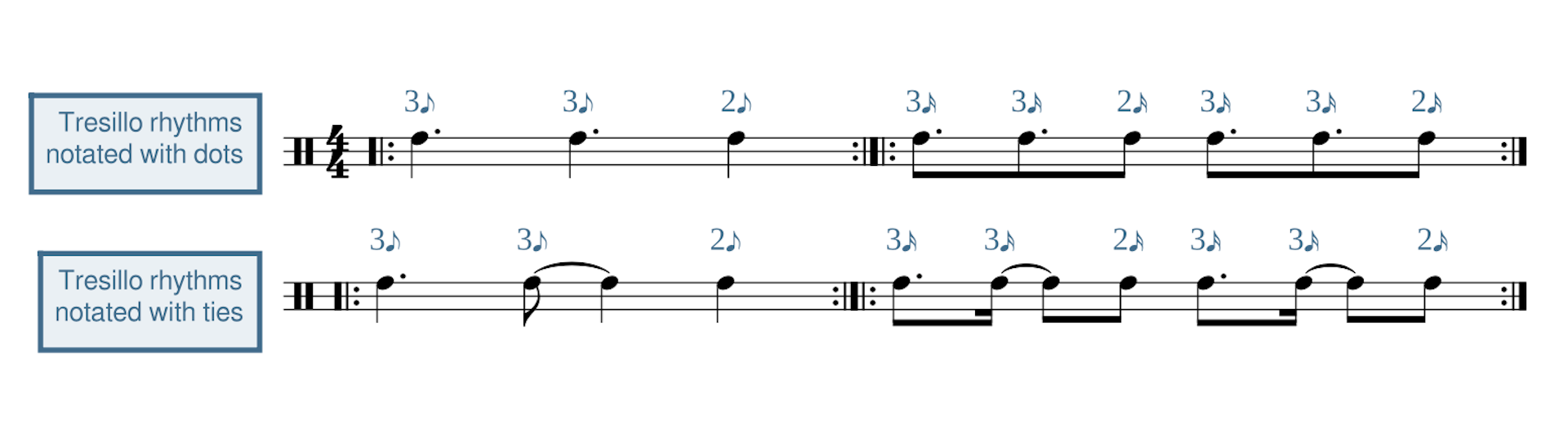
The tresillo is found across an array of music from all over the globe including tango, jazz, reggaeton and bossa nova.
三连音出现在全球各种音乐中,包括探戈、爵士乐、雷鬼顿和波萨诺瓦等。
The tresillo was first made famous through the West in a song from an 1875 opera, Georges Bizet’s Carmen, “L’amour est un oiseau rebelle” (“Love is a rebellious bird”) , usually called “The Habanera.” And it has since been widely circulated in varied ways through popular culture.
三连音最初通过西方世界广为人知,出自1875年的一部歌剧——乔治·比才的《卡门》,其中有一首曲目叫“L’amour est un oiseau rebelle”(意为“爱是一只叛逆的小鸟”),通常被称为“哈巴涅拉”。此后,它通过流行文化以各种方式广泛流传。
Carmen was set in what dominant French society at the time viewed as an “exotic” and culturally distant south of Spain. To emphasize this cultural difference, Bizet was keen to introduce what scholars have termed “local colour” through the use of an apparent folk tune, which became “The Habanera.”
《卡门》的故事背景设定在当时被主导的法国社会视为“异域”且文化遥远的西班牙南部。为了强调这种文化差异,比才热衷于引入学者们所谓的“地方色彩”,使用了看似民谣的曲调,这就是后来被称为“哈巴涅拉”。
However, little did the composer know that “The Habanera” was not a folk tune and was actually a recent popular song by Spanish composer Sebastián Yradier. Certainly, this use of the tresillo was part of what made Bizet’s aria, and Yradier’s song, so catchy.
然而,作曲家并不知道“哈巴涅拉”并非民谣,而是西班牙作曲家塞巴斯蒂安·伊拉迪尔创作的近期流行歌曲。当然,三连音的使用是让比才的咏叹调和伊拉迪尔的歌曲如此抓耳的关键部分之一。
“The Habanera” is not only the name of this composition but also of a genre of a musical dance. It first appeared in 1700s-era Cuba, where it grew out of an English country dance that was then infused with elements from French, Spanish and African traditions, which eventually led to the dance being characterized by the tresillo rhythm.
“哈巴涅拉”不仅是一个作品名称,也是一种音乐舞蹈流派的名称。它最早出现在1700年代的古巴,起源于英式乡村舞曲,随后融入了法国、西班牙和非洲的元素,最终使这种舞蹈以三连音节奏为特征。
This shows how the tresillo is a product of cross-cultural transfer.
这表明了三连音是如何成为跨文化传播的产物。
‘Maximal evenness’
“最大均匀度”
The tresillo consists of a “three-three-two” pattern across eight beats. The three attacks are distributed evenly across those eight beats, but not perfectly so.
Tresillo 的模式是在八拍上呈现出一种“三-三-二”的节奏。这三个重音分布在这八拍上,但并非完全均匀。
The tresillo is a classic example of a larger class of “maximally even” rhythms. An arrangement is “maximally even” if the elements are spread out as much as possible in a given unit. With the tresillo, the “imperfect” arrangement often makes these “maximally even” rhythms sounds both simple yet catchy.
Tresillo 是一类更大范围的“最大均匀”节奏的经典例子。如果一个编排的元素在一个给定的单位内尽可能地分散开来,那么它就被认为是“最大均匀”的。对于 tresillo 而言,“不完美”的排列方式往往使这些“最大均匀”的节奏听起来既简单又抓耳。
Many other maximally even rhythms are constructed in similar manner with alternating rhythmic durations that are spread out as much possible in the space that they have.
许多其他最大均匀的节奏也是以类似的方式构建的,它们交替使用不同长度的节拍持续时间,并在其可用的空间内尽可能地分散开来。
This is usually achieved by having two and three beats grouped together that alternate and create a somewhat irregular feel, but is widely popular and found across the globe in many musical genres and cultures including jazz, African drumming patterns, Indian classical music and more recent western classical music.
这通常是通过将两个和三个节拍分组并交替使用来实现的,从而营造出一种略微不规则的感觉,但这种感觉非常流行,在全球许多音乐流派和文化中都能找到,包括爵士乐、非洲鼓点模式、印度古典音乐以及更近期的西方古典音乐等。
In addition to Bad Bunny’s tresillos, another well-known example of maximally even rhythms appears in Radiohead’s “Pyramid Song” from their album Amnesiac (2001) . The title alludes to the ambiguous, much debated yet mesmerizing rhythms created through irregular beats that reference the geometric structure of a pyramid.
除了 Bad Bunny 的 tresillos 之外,另一个著名的最大均匀节奏的例子出现在 Radiohead 的专辑《失忆症》(Amnesiac, 2001)中的歌曲《金字塔之歌》(Pyramid Song)。该曲名暗示了通过不规则节拍所创造出的模糊、备受争议但又令人着迷的节奏,这些节奏让人联想到金字塔的几何结构。
Radiohead had already used this rhythm in their earlier 2000 hit “Everything in its right place,” making maximally even rhythms a key part of their signature sound.
Radiohead 早在 2000 年代早期的热门歌曲《一切都在其位》(Everything in its right place)中就使用过这种节奏,使最大均匀的节奏成为他们标志性声音的关键组成部分。
Maximally even arrangements also appear in nature — for example in the arrangement of magnetic particles in physics.
最大均匀的编排在自然界中也存在——例如物理学中磁性颗粒的排列。
Perceiving rhythm
感知节奏
The concept of maximal evenness also affects how our brains perceive rhythms. When hearing a rhythm, the human mind is sensitive to the relations of time intervals between notes (for example, the hits of a drum) within the rhythm.
“最大均匀性”的概念也影响着我们的大脑如何感知节奏。当听到一个节奏时,人脑对节奏内部音符之间的时间间隔关系(例如鼓点)非常敏感。
Specifically, our brains try to find a repeating pattern of regularities to organize the rhythm at different time scales. Regular, simple rhythmic patterns are more likely to be remembered.
具体来说,我们的大脑会尝试寻找重复的、具有规律性的模式来组织不同时间尺度上的节奏。规则、简单的节奏模式更容易被记住。
Early research on rhythm perception has found that study participants memorized and reproduced rhythms more accurately when the time intervals between notes have simple relations such as two to one, or one to one.
早期的节奏感知研究发现,当音符之间的时间间隔具有简单的比例关系(例如二比一或一比一)时,受试者记忆和重现节奏的准确性更高。
For more complex patterns where the intervals are related by other ratios larger or smaller than two to one, participants often reproduced these patterns as though they were closer to two to one (or one to one) .
对于间隔由大于或小于二比一的其他比例关系关联的更复杂的模式,参与者往往会重现这些模式时,使其看起来更接近二比一(或一比一)。
More recent research also found similar advantage for rhythms with simpler ratios of time intervals between notes to be more easily remembered and reproduced by people. Researchers found this “rhythmic bias” for simple ratios exists across different cultures, though the exact ratio people prefer varies across cultural groups.
最近的研究也发现,具有更简单时间间隔比例的节奏更容易被人们记住和重现。研究人员发现这种对简单比例的“节奏偏好”存在于不同的文化中,尽管人们偏好的确切比例在不同文化群体之间有所不同。
As we have seen, catchy rhythms like the tresillo could be explained by principles such as “maximal evenness” and human perception.
正如我们所见,像三连音(tresillo)这样抓耳的节奏可以用“最大均匀性”和人类感知等原理来解释。
From Bad Bunny to Bizet, Radiohead and far beyond, artists appeal to these shared principles and patterns, and these catchy rhythms connect people across cultures, languages and generations.
从Bad Bunny到俾泽(Bizet)、Radiohead,乃至更远的地方,艺术家们都诉诸于这些共同的原则和模式,而这些抓耳的节奏连接着跨越文化、语言和世代的人们。
Catchy rhythms like the tresillo are examples of how our musical perception and preference negotiate between simplicity and complexity, between predictability and unpredictability.
像三连音这样的抓耳节奏,是我们的音乐感知和偏好如何在简单与复杂、可预测与不可预测之间进行权衡的例证。
Aidan McGartland receives funding from The Ramsay Centre for Western Civilisation, McGill University and the Fonds de Recherche du Québec.
Aidan McGartland 的资金来自拉姆齐西方文明中心、麦吉尔大学和魁北克研究基金(Fonds de Recherche du Québec)。
Linglan Zhu receives funding from McGill University and Fonds de recherche du Québec (FRQ) .
Linglan Zhu 的资金来自麦吉尔大学和魁北克研究基金(Fonds de recherche du Québec, FRQ)。
Matthew Anthony Ludwig receives funding from Boston University.
Matthew Anthony Ludwig 的资金来自波士顿大学。