Três razões pelas quais Donald Trump não retirará os EUA da Nato
Three reasons Donald Trump won’t pull the US out of Nato
The US president has been bitterly criticising the alliance in recent weeks over its reluctance to join the war in Iran.
O presidente dos EUA tem criticado duramente a aliança nas últimas semanas por sua relutância em participar da guerra no Irã.
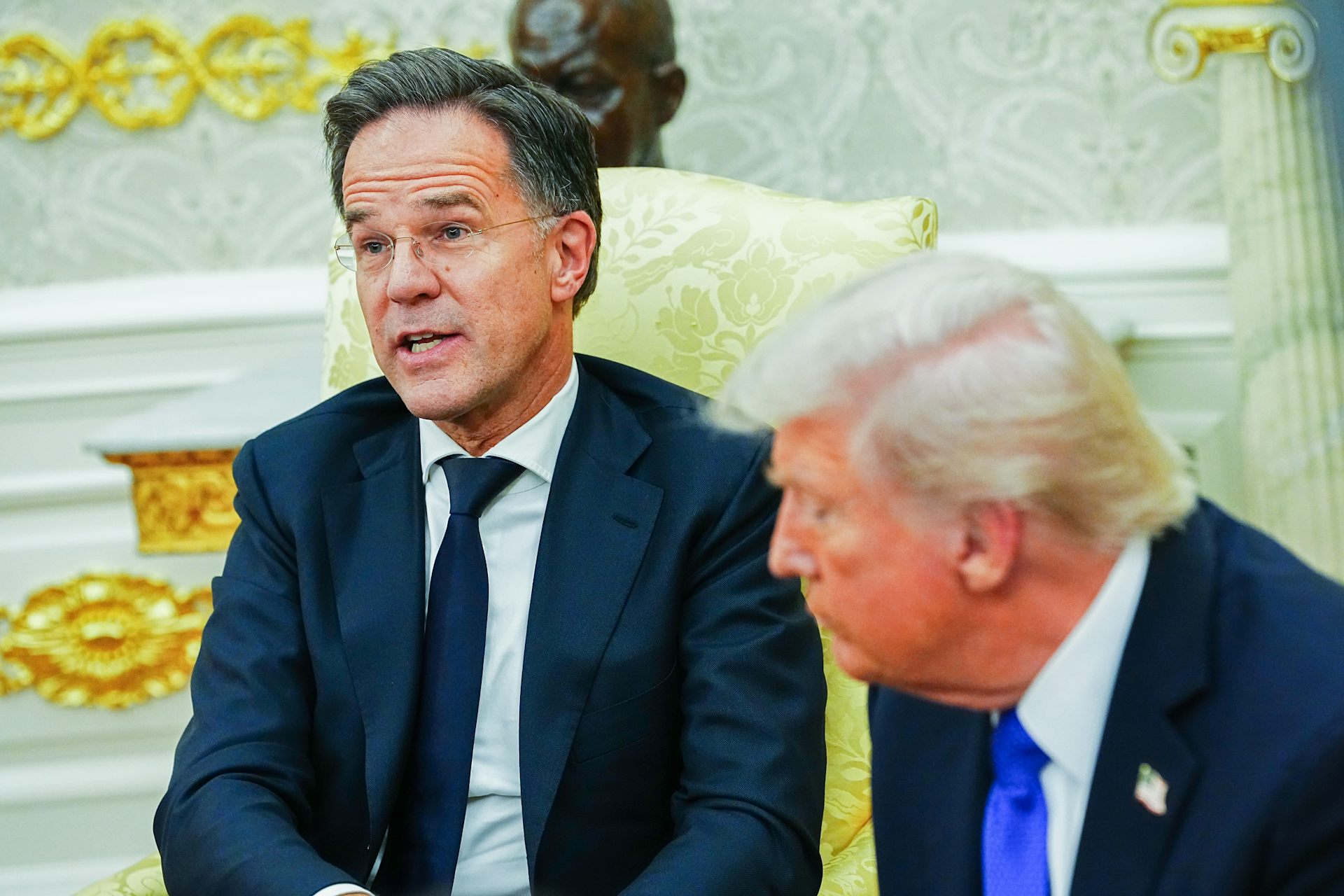
President Donald Trump met Nato secretary general Mark Rutte on April 8 for what Rutte described as a “very frank, very open” discussion. The pair are reported to have discussed the US-Israeli war against Iran at which, according to White House spokesperson Karoline Leavitt, Trump believes that Nato was “tested and they failed”.
O presidente Donald Trump encontrou-se com o secretário-geral da Nato, Mark Rutte, em 8 de abril para o que Rutte descreveu como uma discussão “muito franca, muito aberta”. Os dois foram relatados como tendo discutido a guerra dos EUA-Israel contra o Irã, na qual, segundo a porta-voz da Casa Branca, Karoline Leavitt, Trump acredita que a Nato foi “testada e falhou”.
The president later posted to his Truth Social platform that “NATO WASN’T THERE WHEN WE NEEDED THEM, AND THEY WON’T BE THERE IF WE NEED THEM AGAIN.”
O presidente mais tarde publicou em sua plataforma Truth Social que “A NATO NÃO ESTAVA LÁ QUANDO PRECISAMOS DELA, E NÃO ESTARÁ LÁ SE PRECISAMOS DELA NOVAMENTE.”
The US president’s meeting with Rutte came a week after he told Reuters press agency that he was “absolutely” considering withdrawing the US from Nato, after America’s allies refused to join the US-Israeli campaign against Iran. But this is very unlikely to occur for three reasons.
O encontro do presidente dos EUA com Rutte ocorreu uma semana depois de ele dizer à agência de notícias Reuters que estava “absolutamente” considerando retirar os EUA da Nato, após os aliados americanos se recusarem a participar da campanha dos EUA-Israel contra o Irã. Mas é muito improvável que isso aconteça por três motivos.
First, in 2023, Congress enacted a law that prohibits the president from “suspending, terminating, denouncing, or withdrawing the United States from the North Atlantic Treaty” — which established the North Atlantic Treaty Organization (Nato) — without the advice and consent of the Senate or an act of Congress. It is extremely unlikely that this will be changed before the midterm elections in November and impossible subsequently if the Democrats end up controlling the House of Representatives.
Primeiro, em 2023, o Congresso promulgou uma lei que proíbe o presidente de “suspender, rescindir, denunciar ou retirar os Estados Unidos do Tratado do Atlântico Norte” — que estabeleceu a Organização do Tratado do Atlântico Norte (Nato) — sem o aconselhamento e consentimento do Senado ou um ato do Congresso. É extremamente improvável que isso seja alterado antes das eleições de meio de mandato em novembro e impossível posteriormente se os democratas acabarem controlando a Câmara dos Representantes.
The second reason is that Nato membership is popular among Americans. A Pew survey conducted in 2025 showed that 66% of US respondents thought that America benefited from Nato membership while 32% thought the opposite. While, as in many things, the US is divided – with more Democrat voters (77%) supporting Nato membership than Republicans (45%) – it’s clear that, on the whole, Americans approve of Nato membership.
O segundo motivo é que a adesão à Nato é popular entre os americanos. Uma pesquisa Pew realizada em 2025 mostrou que 66% dos entrevistados nos EUA pensavam que a América se beneficiava da adesão à Nato, enquanto 32% pensavam o contrário. Embora, como em muitas coisas, os EUA estejam divididos – com mais eleitores democratas (77%) apoiando a adesão à Nato do que republicanos (45%) – está claro que, no geral, os americanos aprovam a adesão à Nato.
The third reason is that leaving Nato would significantly weaken the US militarily. More than half a century of research by historians and international relations specialists has concluded that leaving Nato would also significantly weaken the US.
O terceiro motivo é que deixar a Nato enfraqueceria significativamente os EUA militarmente. Mais de meio século de pesquisa de historiadores e especialistas em relações internacionais concluíram que deixar a Nato também enfraqueceria significativamente os EUA.
In 1989, historian Paul Kennedy’s detailed study of wars over a period of 500 years, The Rise and Fall of the Great Powers, found that a decisive feature of success in war is the resources that parties to the conflict can mobilise. Kennedy cites the examples of the two world wars and demonstrates that a key reason why Germany was defeated was that the allies could mobilise many more resources in manpower, arms production and economic assets than Germany and its allies. Eventually, this proved decisive in both conflicts.
Em 1989, o estudo detalhado do historiador Paul Kennedy sobre guerras ao longo de um período de 500 anos, The Rise and Fall of the Great Powers, descobriu que uma característica decisiva do sucesso na guerra são os recursos que as partes do conflito podem mobilizar. Kennedy cita os exemplos das duas guerras mundiais e demonstra que um motivo chave pelo qual a Alemanha foi derrotada foi que os aliados puderam mobilizar muitos mais recursos em mão de obra, produção de armas e ativos econômicos do que a Alemanha e seus aliados. Eventualmente, isso provou ser decisivo em ambos os conflitos.
Research into quantifying the military capacity of nations has been conducted for more than half a century as part of the Correlates of War project founded in 1963 by American political scientist J. David Singer. The project aims to systematically collect data about the causes and consequences of wars.
Pesquisas sobre a quantificação da capacidade militar das nações foram realizadas por mais de meio século como parte do projeto Correlates of War, fundado em 1963 pelo cientista político americano J. David Singer. O projeto visa coletar sistematicamente dados sobre as causas e consequências das guerras.
One of the datasets collected in the project is called the Composite Index of National Capability. This combines data on the demographic, industrial, economic and military capabilities of nations, including the US and China. The higher the index score the more resources a county has to fight wars.
Um dos conjuntos de dados coletados no projeto é chamado Índice Composto de Capacidade Nacional. Ele combina dados sobre as capacidades demográficas, industriais, econômicas e militares das nações, incluindo os EUA e a China. Quanto maior o índice, mais recursos um país tem para lutar guerras.
Scores in the Composite Index of National Capability of the Top Nations
Pontuações no Índice Composto de Capacidade Nacional das Nações Principais
The chart shows the size of the index for the top countries in the database. China is the most powerful nation in the chart with a score of 23 on the index. The US comes a rather distant second with a score of 13.
O gráfico mostra o tamanho do índice para os principais países no banco de dados. A China é a nação mais poderosa no gráfico com uma pontuação de 23 no índice. Os EUA vêm em segundo lugar, com uma pontuação de 13.
There are five Nato nations in the chart in addition to the US. They are Germany, Turkey, the UK, France and Italy. The total score of all six Nato members is 20 – much closer to the Chinese total.
Há cinco nações da Nato no gráfico, além dos EUA. São Alemanha, Turquia, Reino Unido, França e Itália. A pontuação total dos seis membros da Nato é de 20 – muito mais perto do total chinês.
The chart does not include the scores for the remaining Nato member states, but when they are added to the total the Nato score is well above that of China. So the assumption that the US can go it alone in a war with China is doubtful.
O gráfico não inclui as pontuações dos estados membros restantes da Nato, mas quando são adicionadas ao total, a pontuação da Nato está bem acima da China. Assim, a suposição de que os EUA podem ir sozinhos em uma guerra com a China é duvidosa.
How Article 5 works
Como funciona o Artigo 5
Article 5 of the Nato charter stipulates that an armed attack against one member state is considered an attack against all, triggering collective defence by all the member states. A recent report by the US Naval War College concluded that: “A large and growing body of evidence suggests that the PLA (People’s Liberation Army) is preparing credible capabilities to invade Taiwan”. The report argued that extensive deception will be used by China to confuse its opponents when the war is launched with rapid action by its armed forces to create a fait accompli. It notes that this type of blitzkrieg attack is very often successful.
O Artigo 5 da carta da Nato estipula que um ataque armado contra um estado membro é considerado um ataque contra todos, acionando a defesa coletiva de todos os estados membros. Um relatório recente do US Naval War College concluiu que: “Um corpo grande e crescente de evidências sugere que o PLA (Exército de Libertação do Povo) está preparando capacidades credíveis para invadir Taiwan”. O relatório argumentou que a China usará um extenso engano para confundir seus oponentes quando a guerra for lançada com ação rápida de suas forças armadas para criar um fait accompli. Ele observa que este tipo de ataque relâmpago (blitzkrieg) é muito frequentemente bem-sucedido.
If this occurred, then since the US has military advisers in Taiwan and military assets in the region that would need to be neutralised in the first phase of the war if the invasion were to be successful this would trigger Article 5 of the Nato charter. In that case China would find itself at war with 32 Nato countries – not to mention countries in the Far East, such as Japan, Indonesia and Vietnam, who have serious concerns about Chinese aggression, but are not members of the alliance.
Se isso ocorresse, então, visto que os EUA têm assessores militares em Taiwan e ativos militares na região que precisariam ser neutralizados na primeira fase da guerra se a invasão fosse bem-sucedida, isso acionaria o Artigo 5 da carta da Nato. Nesse caso, a China se encontraria em guerra com 32 países da Nato – sem mencionar países no Extremo Oriente, como Japão, Indonésia e Vietnã, que têm sérias preocupações com a agressão chinesa, mas não são membros da aliança.
So, whatever the US president’s ambivalence towards Nato, the fact is that without its support, the US could face a humiliating defeat by China in a future confrontation over Taiwan. America is much stronger as part of Nato – and Trump’s advisers should be strenuously reinforcing that message.
Assim, qual for a ambivalência do presidente dos EUA em relação à Nato, o fato é que, sem o seu apoio, os EUA poderiam enfrentar uma derrota humilhante por parte da China em um futuro confronto sobre Taiwan. A América é muito mais forte como parte da Nato – e os assessores de Trump devem estar reforçando vigorosamente essa mensagem.
Paul Whiteley has received funding from the British Academy and the ESRC.
Paul Whiteley recebeu financiamento da British Academy e do ESRC.
Read more
-

Keir Starmer renuncia: alguém consegue sobreviver como primeiro-ministro na Grã-Bretanha de hoje?
Keir Starmer resigns: can anyone survive as prime minister in today’s Britain?
-
A rede que monitora os oceanos do mundo está sob pressão – justamente quando é mais necessária.
The network watching the world’s oceans is under pressure – just when it’s needed most