
O banimento da camisa do Haiti pela FIFA ecoa a longa campanha para desacreditar e minimizar a Revolução Haitiana
FIFA’s Haiti jersey ban echoes the long campaign to discredit and downplay the Haitian Revolution
The move is part of a longer history of obscuring and demonizing the Haitian Revolution and its leader, Jean-Jacques Dessalines.
A medida faz parte de uma história mais longa de obscurecimento e demonização da Revolução Haitiana e de seu líder, Jean-Jacques Dessalines.
Ahead of its first match in the 2026 World Cup, the Haitian national soccer team was forced to make a last-minute change. But it didn’t have anything to do with its roster or travel plans. It was the team’s jersey.
Antes de seu primeiro jogo na Copa do Mundo de 2026, a seleção haitiana foi forçada a fazer uma mudança de última hora. Mas não tinha nada a ver com o elenco ou planos de viagem. Era a camisa da equipe.
FIFA, the sport’s global governing body, said the jersey design violated its rules, which ban political slogans or imagery.
A FIFA, o órgão regulador global do esporte, disse que o design da camisa violou suas regras, as quais proíbem slogans ou imagens de cunho político.
FIFA didn’t elaborate on which components of the jersey were problematic. But the issue almost certainly stemmed from the small image of a group of people holding the Haitian flag that appeared on the right hip of the jersey. After the decision was made, a spokesperson for the team confirmed that the original jersey included “an image depicting the Battle of Vertières and some independence heroes raising the Haitian flag.”
A FIFA não detalhou quais componentes da camisa eram problemáticos. Mas o problema quase certamente decorreu da pequena imagem de um grupo de pessoas segurando a bandeira haitiana que apareceu no quadril direito da camisa. Após a decisão ser tomada, um porta-voz da equipe confirmou que a camisa original incluía “uma imagem retratando a Batalha de Vertières e alguns heróis da independência levantando a bandeira haitiana.”
The commemoration was doubly symbolic since Haiti officially qualified for the World Cup for just the second time in the men’s tournament’s history on Nov. 18, 2025, which also marked the 222nd anniversary of the famous 1803 battle that secured Haiti’s victory over France in its war for independence.
A comemoração foi duplamente simbólica, já que o Haiti se classificou oficialmente para a Copa do Mundo pela segunda vez na história do torneio masculino em 18 de novembro de 2025, data que também marcou o 222º aniversário da famosa batalha de 1803 que garantiu a vitória haitiana sobre a França em sua guerra pela independência.
While the spokesperson for the team described the image as including “some independence heroes,” I think it’s safe to assume that Jean-Jacques Dessalines, who led the Haitian revolutionaries during the Battle of Vertières, is the central figure of the vignette.
Embora o porta-voz da equipe tenha descrito a imagem como incluindo “alguns heróis da independência”, creio que é seguro assumir que Jean-Jacques Dessalines, que liderou os revolucionários haitianos durante a Batalha de Vertières, é a figura central da vinheta.
The subject of my 2025 book, “I Have Avenged America,” Dessalines was the man who declared Haiti’s independence from France, and he was Haiti’s first head of state.
O tema do meu livro de 2025, “I Have Avenged America”, é Dessalines, o homem que declarou a independência do Haiti da França e foi seu primeiro chefe de estado.
But because of his radical and violent fight for freedom, Dessalines’ enemies often described him as ferocious and barbaric, both during his lifetime and in the centuries after his death. They sought to undermine his leadership and undermine Haiti as a country, depicting him as a figure whose sole purpose was violence for violence’s sake, rather than a revolutionary driven by any ideological or political commitments.
Mas por causa de sua luta radical e violenta pela liberdade, os inimigos de Dessalines frequentemente o descreveram como feroz e bárbaro, tanto durante sua vida quanto nos séculos após sua morte. Eles buscaram minar sua liderança e enfraquecer o Haiti como país, retratando-o como uma figura cujo único propósito era a violência pela própria violência, em vez de um revolucionário impulsionado por quaisquer compromissos ideológicos ou políticos.
A successful slave revolution
Uma revolução de escravos bem-sucedida
In the late 17th century, France had colonized the western third of Hispaniola, the island that Haiti now shares with the Dominican Republic.
No final do século XVII, a França havia colonizado o terço ocidental de Hispaniola, a ilha que hoje Haiti compartilha com a República Dominicana.
By forcing enslaved men, women and children to work on sugar and coffee plantations, the French turned the colony, which they called Saint-Domingue, into one of the wealthiest in the world.
Ao forçar homens, mulheres e crianças escravizados a trabalhar em plantações de açúcar e café, os franceses transformaram a colônia, que chamavam de Saint-Domingue, em uma das mais ricas do mundo.
In August 1791, enslaved men and women rose up in revolution. It was the world’s first and only successful slave revolution: Within two years, they forced the French to abolish slavery.
Em agosto de 1791, homens e mulheres escravizados se levantaram em revolta. Foi a primeira e única revolução de escravos bem-sucedida do mundo: Em dois anos, eles forçaram os franceses a abolir a escravidão.
The Haitian Revolution – as the event is known today – became a war for independence only when the French tried to reinstitute slavery in 1802. Dessalines declared Haitian independence on Jan. 1, 1804, and Haiti became the first nation to permanently ban slavery.
A Revolução Haitiana – como o evento é conhecido hoje – só se tornou uma guerra pela independência quando os franceses tentaram reinstituir a escravidão em 1802. Dessalines declarou a independência haitiana em 1º de janeiro de 1804, e Haiti se tornou a primeira nação a banir permanentemente a escravidão.
The ‘silencing’ of the revolution
O ‘silenciamento’ da revolução
The effort to discredit the Haitian Revolution by targeting Dessalines began during the war for independence against the French. Criticism only intensified after the Declaration of Independence.
O esforço para desacreditar a Revolução Haitiana, visando Dessalines, começou durante a guerra pela independência contra os franceses. A crítica só se intensificou após a Declaração de Independência.
That year, French propagandist Louis Dubroca, a mouthpiece of the Napoleonic government, published a slanted, factually incorrect biography of Dessalines. Even though the book got some basic facts wrong, such as claiming that Dessalines was born in Africa, its impact has been indelible.
Naquele ano, o propagandista francês Louis Dubroca, porta-voz do governo napoleônico, publicou uma biografia tendenciosa e factualmente incorreta de Dessalines. Embora o livro tenha errado alguns fatos básicos, como alegar que Dessalines nasceu na África, seu impacto foi indelével.
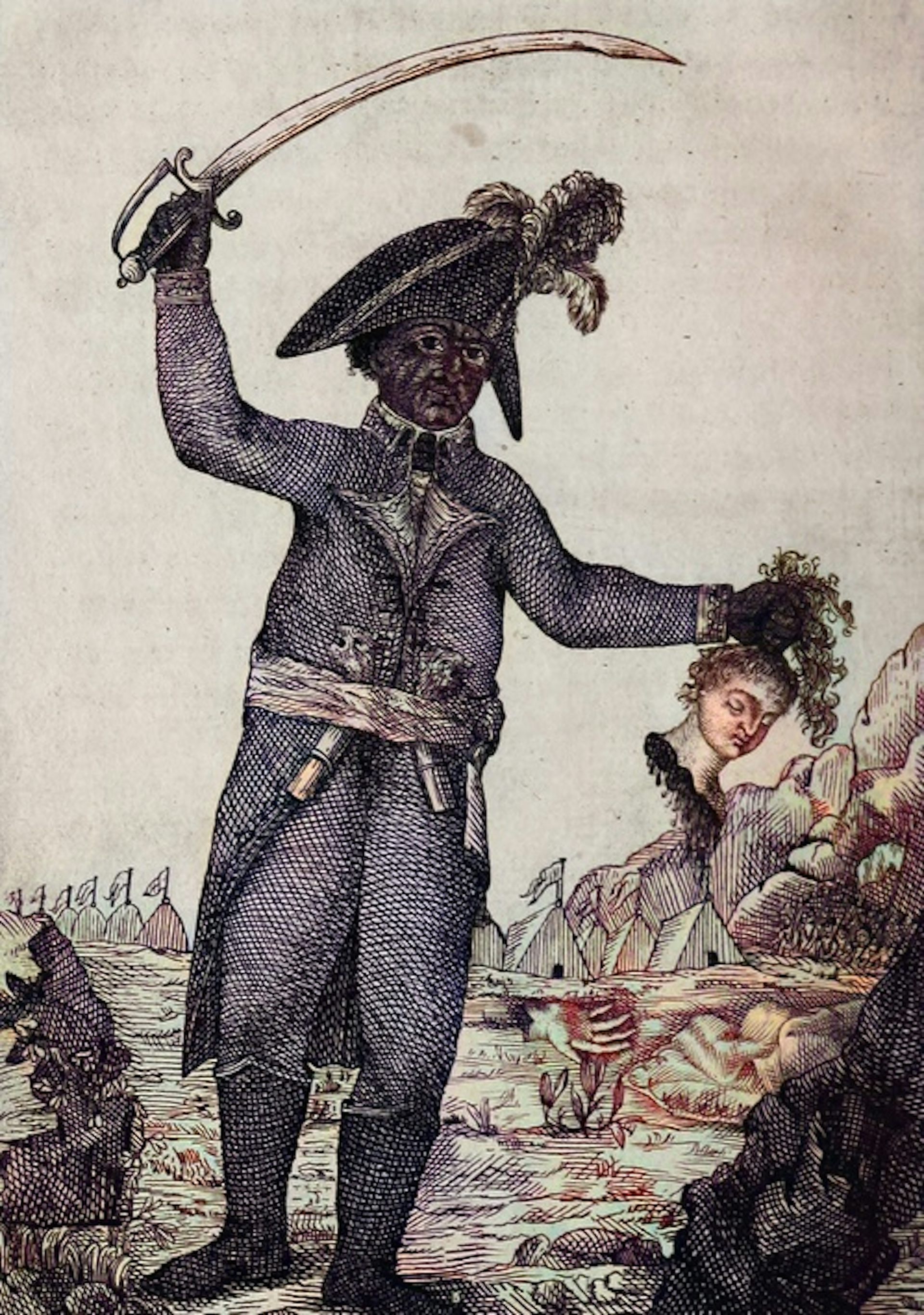
“Cunning and hypocritical,” Dubroca wrote, Dessalines “is also brutal, impetuous, and violently excessive. He inspires a kind of terror in all around him.”
“Astuto e hipócrita,” escreveu Dubroca, “Dessalines também é brutal, impetuoso e violentamente excessivo. Ele inspira um tipo de terror em todos ao seu redor.”
An image that accompanied an 1806 Spanish translation of the book still haunts the memory of the Haitian Revolution: It depicts Dessalines hoisting a sword in one hand and holding the severed head of a white woman in the other
Uma imagem que acompanhou uma tradução espanhola do livro em 1806 ainda assombra a memória da Revolução Haitiana: ela retrata Dessalines erguendo uma espada em uma mão e segurando a cabeça decepada de uma mulher branca na outra.
In the decades after the revolution, opponents of the young nation routinely claimed that Dessalines had massacred the entire white population on the island after declaring independence.
Nas décadas após a revolução, os oponentes da jovem nação alegaram rotineiramente que Dessalines havia massacrado toda a população branca na ilha após declarar a independência.
Yes, in the context of ongoing war with France, Dessalines executed some French citizens, including those who had participated in Napoleon Bonaparte’s bloody campaign from 1802 to 1803 to regain control over the colony and reintroduce slavery. After 1804, however, hundreds of white French people remained in Haiti and were naturalized as Haitian citizens, securing equal rights under Dessalines’ 1805 Haitian constitution.
Sim, no contexto de guerra em curso com a França, Dessalines executou alguns cidadãos franceses, incluindo aqueles que haviam participado da sangrenta campanha de Napoleão Bonaparte de 1802 a 1803 para recuperar o controle sobre a colônia e reintroduzir a escravidão. Após 1804, no entanto, centenas de brancos franceses permaneceram no Haiti e foram naturalizados como cidadãos haitianos, garantindo direitos iguais sob a constituição haitiana de Dessalines de 1805.
But the facts didn’t matter. The hyperbolic narrative of unmitigated violence served to discredit and undermine the revolution’s successes.
Mas os fatos não importavam. A narrativa hiperbólica da violência sem limites serviu para desacreditar e minar os sucessos da revolução.
Thomas Jefferson became so worried that enslaved people in the United States would be inspired by the Haitians that in his correspondence he frequently depicted the Haitian Revolution as a violent upheaval rather than a struggle for freedom. Jefferson went on to ban trade with Haiti in 1806, and the U.S. did not formally recognize Haiti’s independence until 1862.
Thomas Jefferson ficou tão preocupado que os escravizados nos Estados Unidos seriam inspirados pelos haitianos, que em sua correspondência frequentemente retratou a Revolução Haitiana como um levante violento em vez de uma luta pela liberdade. Jefferson foi além e proibiu o comércio com o Haiti em 1806, e os EUA só reconheceram formalmente a independência do Haiti até 1862.
The strategy of denying Haiti’s success became so effective that the Haitian anthropologist Michel-Rolph Trouillot called it the “silencing” of the Haitian Revolution.
A estratégia de negar o sucesso do Haiti tornou-se tão eficaz que o antropólogo haitiano Michel-Rolph Trouillot chamou isso de “silenciamento” da Revolução Haitiana.
A pattern emerges
Um padrão emerge
The World Cup jersey ban marks Haiti’s second sartorial controversy of 2026.
A proibição da camisa da Copa do Mundo marca a segunda controvérsia sartorial de Haiti em 2026.
In early 2026, the International Olympic Committee required Haiti’s Winter Olympics team to modify its opening ceremony outfit for similar reasons.
No início de 2026, o Comitê Olímpico Internacional exigiu que a equipe olímpica de Inverno de Haiti modificasse seu traje de cerimônia de abertura por razões semelhantes.
The garments, designed by Stella Jean, a Haitian Italian fashion designer, featured a painting of the Haitian revolutionary Toussaint Louverture, Dessalines’ fellow revolutionary.
As vestimentas, projetadas por Stella Jean, uma estilista haitiana-italiana, apresentavam uma pintura do revolucionário haitiano Toussaint Louverture, companheiro revolucionário de Dessalines.
Once again, the design was deemed political.
Mais uma vez, o design foi considerado político.
Dessalines and Louverture fought together throughout the revolution, but they are often portrayed as opposites. Louverture, in this framing, is strategic, diplomatic, rational and reasonable. In contrast, Dessalines is typically described as violent, unthinking, emotional and heartless.
Dessalines e Louverture lutaram juntos durante toda a revolução, mas são frequentemente retratados como opostos. Louverture, neste enquadramento, é estratégico, diplomático, racional e sensato. Em contraste, Dessalines é tipicamente descrito como violento, sem pensar, emocional e desalmado.
But there’s a noteworthy distinction between the Olympic ban and the current one imposed by FIFA. For the Olympics opening ceremony, the banned outfits depicted a single, specific person: Louverture. In the case of the World Cup jerseys, the mere implication of Dessalines, standing alongside his fellow revolutionaries, was enough to elicit a backlash.
Mas há uma distinção notável entre a proibição olímpica e a atual imposta pela FIFA. Para a cerimônia de abertura dos Jogos Olímpicos, os trajes proibidos retratavam uma única pessoa específica: Louverture. No caso das camisas da Copa do Mundo, a mera implicação de Dessalines, ao lado de seus companheiros revolucionários, foi suficiente para provocar uma reação negativa.
Ever since the Haitian revolutionaries first rebelled against the French in 1791, the proslavery and imperialist powers of Europe and the Americas had a special interest in ensuring that Haiti failed.
Desde que os revolucionários haitianos se revoltaram contra os franceses em 1791, as potências pró-escravistas e imperialistas da Europa e das Américas tiveram um interesse especial em garantir o fracasso de Haiti.
Both then and now, targeting revolutionaries like Dessalines has supported that goal. The irony is that more people may be learning about Haiti’s revolutionary history in the process. Saeta, the company that designed the controversial jersey, has announced on Instagram that it will restock it. The jersey has become a fan favorite.
Tanto então quanto agora, mirar em revolucionários como Dessalines apoiou esse objetivo. A ironia é que mais pessoas podem estar aprendendo sobre a história revolucionária de Haiti nesse processo. Saeta, a empresa que projetou a polêmica camisa, anunciou no Instagram que irá reabastecê-la. A camisa se tornou um favorito dos fãs.
Julia Gaffield does not work for, consult, own shares in or receive funding from any company or organization that would benefit from this article, and has disclosed no relevant affiliations beyond their academic appointment.
Julia Gaffield não trabalha para, consulta, possui ações em ou recebe financiamento de qualquer empresa ou organização que se beneficiaria deste artigo, e não divulgou nenhuma afiliação relevante além de seu cargo acadêmico.
Read more
-
Pequim é a ‘sala de estar’ do mundo? A China está desfrutando do palco global, mas há limites para sua influência
Is Beijing the world’s ‘living room’? China is enjoying the global stage, but there are limits to its influence
-
Por que as pessoas estão obcecadas com (e roubando) cartas Pokémon de novo?
Why are people obsessed with (and stealing) Pokemon cards again?