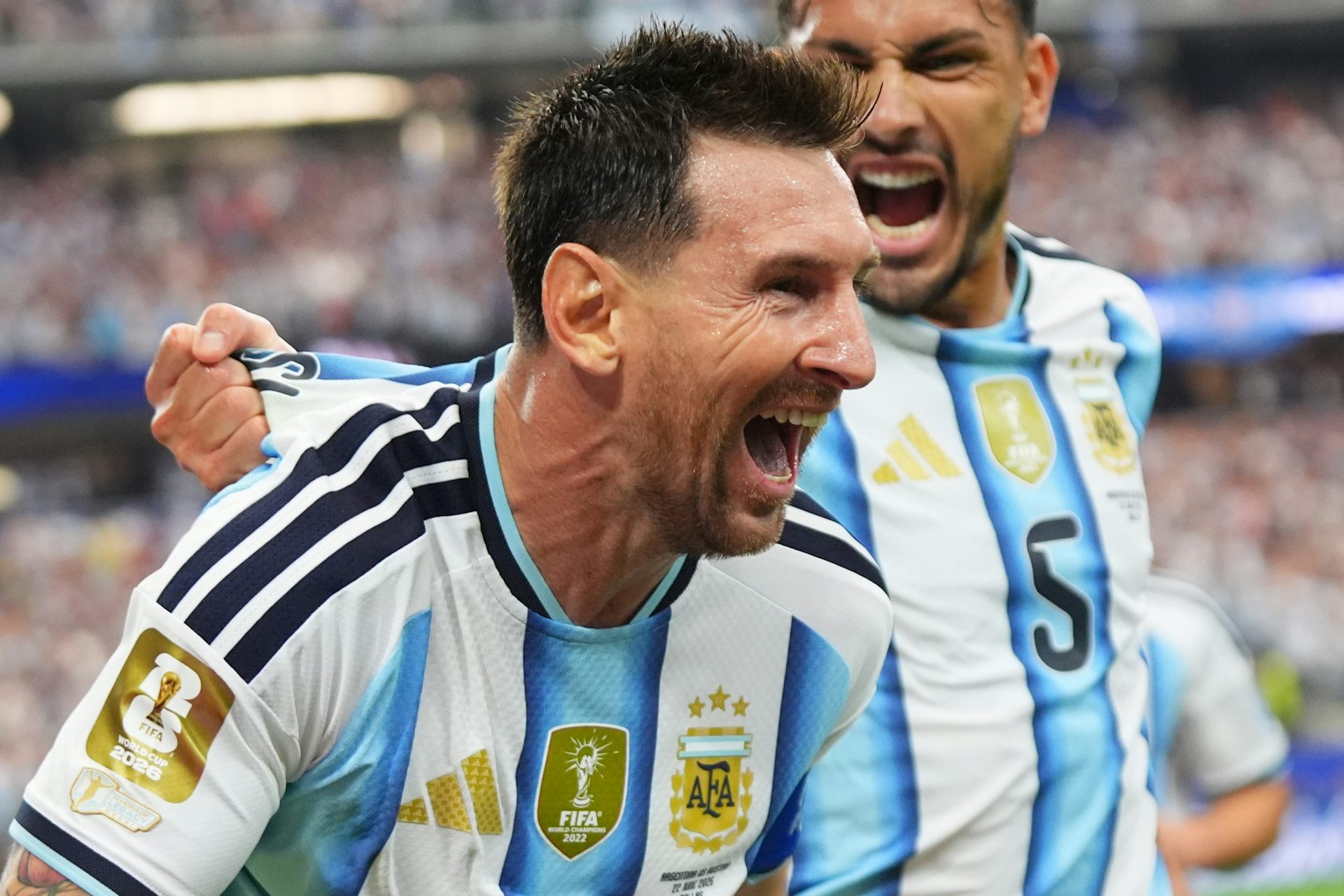
Messi é velho, baixo e lento. Como ele ainda está dominando na Copa do Mundo?
Messi is old, short and slow. How is he still dominating at the World Cup?
Lionel Messi’s shorter, slower, ageing body is a handicap he overcomes through a mental process called scanning.
O corpo mais baixo, mais lento e envelhecido de Lionel Messi é uma deficiência que ele supera por meio de um processo mental chamado scanning.
Lionel Messi is 39 years old. He is 1.70 metres tall – shorter than almost every defender he plays against. He was never astoundingly quick, and he is slower now.
Lionel Messi tem 39 anos. Ele tem 1,70 metros de altura – mais baixo do que quase todo zagueiro contra quem joga. Ele nunca foi incrivelmente rápido, e agora está mais lento.
And yet, watching this World Cup, you would be hard pressed to name a player doing more damage: he has scored the equal most goals so far (six) , alongside France’s Kylian Mbappé.
E ainda assim, assistindo a esta Copa do Mundo, seria difícil nomear um jogador que causa mais impacto: ele marcou o mesmo número de gols até agora (seis) , ao lado do francês Kylian Mbappé.
How can someone with so little of what we might call athleticism (relative to his peers, at least) still be the best player on the pitch?
Como alguém com tão pouco do que poderíamos chamar de atletismo (em relação aos seus pares, pelo menos) ainda pode ser o melhor jogador em campo?
Does athleticism really matter?
O atletismo realmente importa?
Maybe the puzzle is the wrong way round. Many are surprised by Messi only because we have been told a story about what makes an athlete great, and the story is mostly about the body: speed, height, strength, fitness.
Talvez o quebra-cabeça esteja invertido. Muitos ficam surpresos com Messi apenas porque nos contaram uma história sobre o que faz um atleta ser ótimo, e essa história é principalmente sobre o corpo: velocidade, altura, força, aptidão física.
Measured against that story, Messi looks like an exception.
Medido contra essa história, Messi parece uma exceção.
But what if the story itself is the problem? What if soccer was never a contest of physical attributes?
Mas e se a própria história for o problema? E se o futebol nunca foi um concurso de atributos físicos?
Johan Cruyff, the great Dutch player, manager, commentator and soccer philosopher, saw this clearly half a century ago. He said:
Johan Cruyff, o grande jogador holandês, técnico, comentarista e filósofo do futebol, viu isso claramente há meio século. Ele disse:
What is speed? The sports press often confuses speed with insight. If I start running slightly earlier than someone else, I seem faster.
O que é velocidade? A imprensa esportiva frequentemente confunde velocidade com visão. Se eu começar a correr um pouco antes de outra pessoa, pareço mais rápido.
It is a remark that sounds like a riddle, but a fast player is often not the one with quicker legs. They are often the ones who set off sooner and arrive first. What looks like speed is very often a head start bought by perception.
É uma observação que soa como um enigma, mas o jogador rápido nem sempre é aquele com pernas mais ágeis. Muitas vezes são aqueles que saem antes e chegam primeiro. O que parece velocidade é muito frequentemente uma vantagem inicial comprada pela percepção.
Cruyff understood this. What we have been able to do more recently is measure it.
Cruyff entendeu isso. O que conseguimos fazer mais recentemente é medir isso.
The importance of scanning
A importância do escaneamento
Consider what happens in the seconds before Messi receives a pass. Watch him for 30 seconds when the ball is nowhere near him: his head rarely stays still. One glance over the left shoulder, another to the right, then back to the player on the ball.
Considere o que acontece nos segundos antes de Messi receber um passe. Observe-o por 30 segundos quando a bola não está nem perto dele: sua cabeça raramente fica parada. Um olhar sobre o ombro esquerdo, outro para a direita, e depois volta para o jogador com a bola.
None of it looks remarkable until you realise he has already gathered information others are yet to find, or at least are less adept at finding.
Nada disso parece notável até você perceber que ele já coletou informações que os outros ainda não encontraram, ou pelo menos têm mais dificuldade em encontrar.
By the time the ball reaches him, he already knows where the defenders and teammates are, and where the gaps will open. The control, the turn, the pass that splits the defence: all of that is the easy part. The hard part happens before he had even touched the ball.
Quando a bola chega até ele, ele já sabe onde estão os zagueiros e companheiros de equipe, e onde as lacunas vão se abrir. O controle, o giro, o passe que divide a defesa: tudo isso é a parte fácil. A parte difícil acontece antes mesmo dele tocar na bola.
This is something we can measure.
Isto é algo que podemos medir.
For more than a decade, we have been studying how soccer players gather information before receiving the ball. Working with athletes from youth academies up to senior professionals, we fitted small motion sensors to the backs of their heads, and recorded how often and how widely they turned to look around during a match.
Por mais de uma década, temos estudado como os jogadores de futebol coletam informações antes de receberem a bola. Trabalhando com atletas desde academias juvenis até profissionais seniores, colocamos pequenos sensores de movimento nas costas da cabeça deles e registramos com que frequência e quão amplamente eles viravam para olhar ao redor durante uma partida.
We were measuring what we call visual exploration – or, more plainly, scanning.
Estávamos medindo o que chamamos de exploração visual – ou, mais simplesmente, escaneamento.
We were asking a simple question: how much do players look around before the ball reaches them, and does it matter?
Fazíamos uma pergunta simples: quanto os jogadores olham ao redor antes que a bola chegue até eles, e isso importa?
The finding was consistent and clear. Players who scanned more frequently in the seconds before receiving the ball were faster to release their next pass, more likely to turn with the ball rather than play it safely backwards, and more likely to play a forward pass that actually threatened the opposition.
A descoberta foi consistente e clara. Jogadores que escaneavam com mais frequência nos segundos anteriores ao recebimento da bola eram mais rápidos para soltar o próximo passe, mais propensos a girar com a bola em vez de jogá-la de volta de forma segura, e mais propensos a fazer um passe avançado que realmente ameaçava o adversário.
The information they gathered before the ball arrived shaped what they were able to do once it did. Scanning is how a player gets that information in the first place.
A informação que eles coletavam antes da chegada da bola moldou o que eles foram capazes de fazer depois que ela chegou. O escaneamento é como um jogador obtém essa informação em primeiro lugar.
Our work separates two purposes of scanning. The first is orientation: looking around to discover what the whole field is offering, which options exist, where the danger is and what might become available.
Nosso trabalho separa dois propósitos do escaneamento. O primeiro é a orientação: olhar ao redor para descobrir o que todo o campo está oferecendo, quais opções existem, onde está o perigo e o que pode se tornar disponível.
The second is specification: the finer, later looking that guides the execution of a pass.
O segundo é a especificação: o olhar mais fino e tardio que guia a execução de um passe.
Orientation comes first and it is the one we tend to neglect, in research and in coaching alike, because it happens away from the ball, when nothing dramatic appears to be going on. Yet it is the foundation. You cannot aim a pass you never saw was there. Cruyff put it like this:
A orientação vem primeiro e é aquela que tendemos a negligenciar, tanto na pesquisa quanto no treinamento, porque acontece longe da bola, quando nada dramático parece estar acontecendo. No entanto, é o fundamento. Você não pode mirar um passe onde nunca viu que ele estava lá. Cruyff disse assim:
There is only one moment in which you can arrive in time. If you are not there, you are either too early or too late.
Há apenas um momento em que você pode chegar a tempo. Se você não está lá, ou está muito cedo ou muito tarde.
This is where Messi stops being an anomaly and becomes the clearest example imaginable of what the sport rewards. He has never beaten opponents primarily with his body. He beats them with time, and he wins it by seeing sooner.
É aqui que Messi deixa de ser uma anomalia e se torna o exemplo mais claro possível do que o esporte recompensa. Ele nunca superou os adversários principalmente com o corpo. Ele os supera com o tempo, e ele o ganha por ver antes.
If he is slower, it does not matter, because he is not racing anyone – he has arranged, through earlier and better perception, never to need to. The shorter, slower, ageing body is not a handicap he overcomes through genius. It is a sign that the body was never the main event.
Se ele for mais lento, não importa, porque ele não está correndo contra ninguém – ele conseguiu, através de uma percepção anterior e melhor, nunca precisar correr. O corpo menor, mais lento e envelhecido não é um handicap que ele supera com genialidade. É um sinal de que o corpo nunca foi o evento principal.
The skill you can build
O texto a ser traduzido para Português (Brasil- pt_BR):
Of course, scanning is not the whole story. Technique, experience and team tactics all matter. But without timely information, those qualities rarely have the chance to express themselves.
A percepção é algo que podemos desenvolver, deliberadamente, em jogadores que nunca serão os mais rápidos ou os mais altos.
There is a lesson in this: perception is something we can develop, deliberately, in players who will never be the quickest or the tallest.
Há uma lição nisso: a percepção é algo que podemos desenvolver, deliberadamente, em jogadores que nunca serão os mais rápidos ou os mais altos.
Coaches already sense this when they shout “check your shoulder” at a player about to turn into trouble or lose track of an opposing player.
Os treinadores já sentem isso quando gritam “olhe por cima do ombro” para um jogador prestes a se meter em apuros ou perder o rastro de um adversário.
Our data suggest the habit of scanning the field before the ball arrives can be trained from a young age.
Nossos dados sugerem que o hábito de escanear o campo antes da chegada da bola pode ser treinado desde uma idade jovem.
Where greatness really lives
Onde a grandeza realmente vive
We have spent a century building athletes in the gym, but far less time building the thing Messi does in abundance.
Passamos um século construindo atletas na academia, mas muito menos tempo construindo aquilo que o Messi faz em abundância.
So the next time someone wonders how a 39-year-old, standing just 1.70m tall, is still dominating a World Cup, watch their head, not their feet.
Então, da próxima vez que alguém se pergunte como um homem de 39 anos, com apenas 1,70m de altura, ainda está dominando uma Copa do Mundo, observe a cabeça dele, não os pés.
Greatness was never hiding in the body. It was always in the looking.
A grandeza nunca esteve escondida no corpo. Estava sempre no olhar.
Gert-Jan Pepping receives funding from the Queensland Academy of Sport and the NHMRC.
Gert-Jan Pepping recebe financiamento da Queensland Academy of Sport e do NHMRC.
Thomas McGuckian does not work for, consult, own shares in or receive funding from any company or organisation that would benefit from this article, and has disclosed no relevant affiliations beyond their academic appointment.
Thomas McGuckian não trabalha para, não consulta, não possui ações nem recebe financiamento de nenhuma empresa ou organização que se beneficiaria deste artigo, e não divulgou afiliações relevantes além do seu cargo acadêmico.
Read more
-

O acordo de cessar-fogo do Irã confirma o que temos dito há anos: força militar não funciona
Iran ceasefire deal confirms what we’ve been saying for years: military might doesn’t work
-
Veneza está afundando – analisamos todos os planos para salvá-la, e nenhum preservaria a cidade como a conhecemos
Venice is sinking – we analysed every plan to save it, and none would preserve the city as we know it