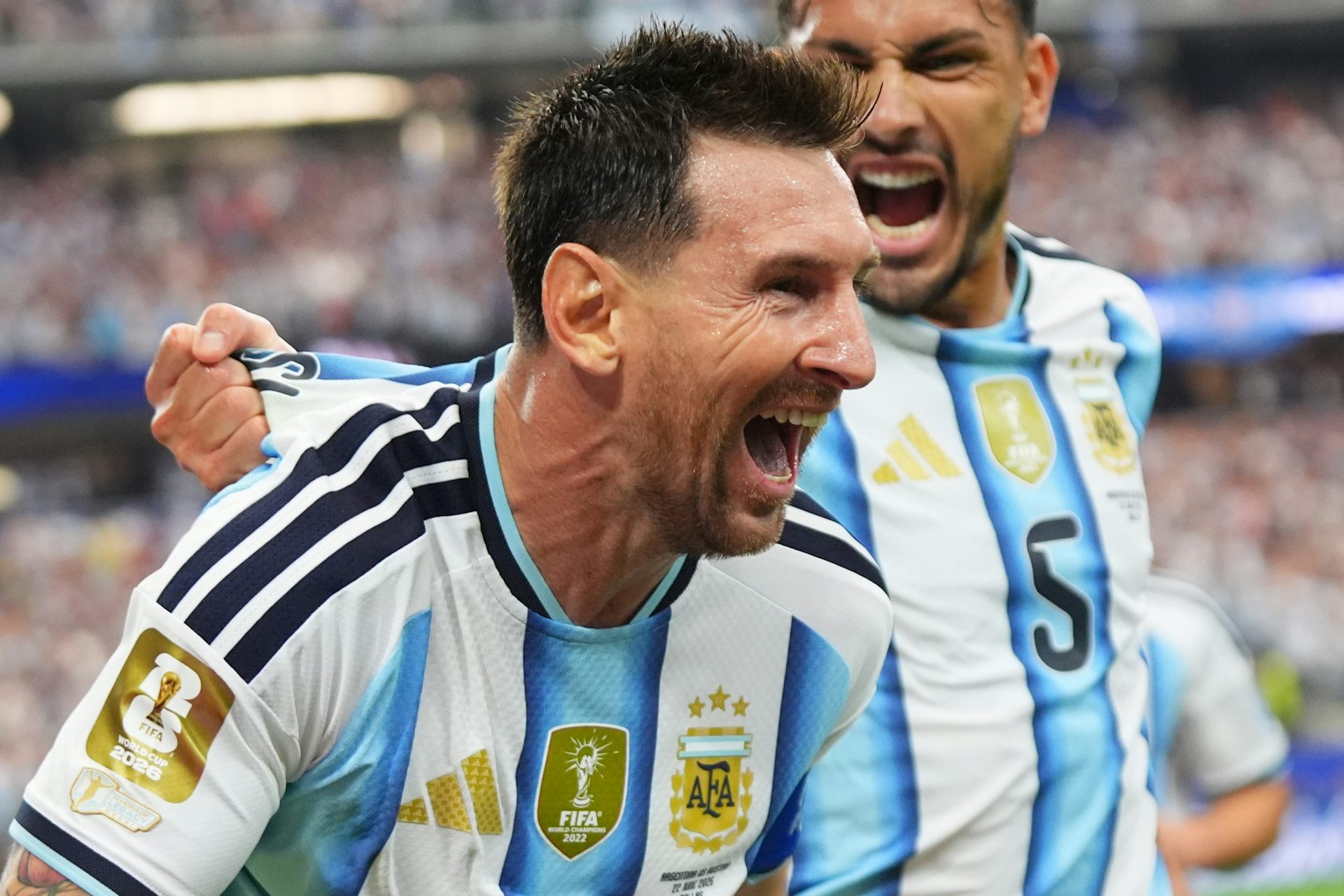
Messi está viejo, bajo y lento. ¿Cómo sigue dominando en el Mundial?
Messi is old, short and slow. How is he still dominating at the World Cup?
Lionel Messi’s shorter, slower, ageing body is a handicap he overcomes through a mental process called scanning.
El cuerpo más bajo, lento y envejecido de Lionel Messi es una desventaja que supera mediante un proceso mental llamado escaneo (scanning).
Lionel Messi is 39 years old. He is 1.70 metres tall – shorter than almost every defender he plays against. He was never astoundingly quick, and he is slower now.
Lionel Messi tiene 39 años. Mide 1,70 metros, lo que lo hace más bajo que casi todos los defensores contra los que juega. Nunca fue asombrosamente rápido, y ahora es más lento.
And yet, watching this World Cup, you would be hard pressed to name a player doing more damage: he has scored the equal most goals so far (six) , alongside France’s Kylian Mbappé.
Y sin embargo, viendo esta Copa del Mundo, sería difícil nombrar a un jugador que esté causando más daño: ha marcado la misma cantidad de goles hasta ahora (seis) , junto a Kylian Mbappé de Francia.
How can someone with so little of what we might call athleticism (relative to his peers, at least) still be the best player on the pitch?
¿Cómo puede alguien con tan poco de lo que podríamos llamar atletismo (en relación con sus pares, al menos) seguir siendo el mejor jugador en el campo?
Does athleticism really matter?
¿Realmente importa el atletismo?
Maybe the puzzle is the wrong way round. Many are surprised by Messi only because we have been told a story about what makes an athlete great, and the story is mostly about the body: speed, height, strength, fitness.
Quizás el problema es que estamos mirando la cosa al revés. Muchos se sorprenden con Messi solo porque nos han contado una historia sobre lo que hace a un atleta grande, y esa historia trata en su mayoría del cuerpo: velocidad, altura, fuerza, condición física.
Measured against that story, Messi looks like an exception.
Medido contra esa historia, Messi parece una excepción.
But what if the story itself is the problem? What if soccer was never a contest of physical attributes?
Pero ¿y si el problema es la historia misma? ¿Y si el fútbol nunca fue un concurso de atributos físicos?
Johan Cruyff, the great Dutch player, manager, commentator and soccer philosopher, saw this clearly half a century ago. He said:
Johan Cruyff, el gran jugador holandés, entrenador, comentarista y filósofo del fútbol, vio esto claramente hace medio siglo. Dijo:
What is speed? The sports press often confuses speed with insight. If I start running slightly earlier than someone else, I seem faster.
¿Qué es la velocidad? La prensa deportiva a menudo confunde la velocidad con la perspicacia. Si empiezo a correr un poco antes que otra persona, parezco más rápido.
It is a remark that sounds like a riddle, but a fast player is often not the one with quicker legs. They are often the ones who set off sooner and arrive first. What looks like speed is very often a head start bought by perception.
Es una observación que suena como un acertijo, pero el jugador rápido no suele ser el de las piernas más veloces. Suelen ser aquellos que salen antes y llegan primero. Lo que parece velocidad es muy a menudo una ventaja inicial comprada por la percepción.
Cruyff understood this. What we have been able to do more recently is measure it.
Cruyff entendió esto. Lo que hemos podido hacer más recientemente es medirlo.
The importance of scanning
La importancia de escanear
Consider what happens in the seconds before Messi receives a pass. Watch him for 30 seconds when the ball is nowhere near him: his head rarely stays still. One glance over the left shoulder, another to the right, then back to the player on the ball.
Considera lo que sucede en los segundos antes de que Messi reciba un pase. Obsérvalo durante 30 segundos cuando el balón no está cerca de él: su cabeza rara vez permanece quieta. Una mirada por encima del hombro izquierdo, otra hacia la derecha, y luego de vuelta al jugador con el balón.
None of it looks remarkable until you realise he has already gathered information others are yet to find, or at least are less adept at finding.
Nada de esto parece notable hasta que te das cuenta de que ya ha recopilado información que otros aún no han encontrado, o al menos tienen menos facilidad para encontrar.
By the time the ball reaches him, he already knows where the defenders and teammates are, and where the gaps will open. The control, the turn, the pass that splits the defence: all of that is the easy part. The hard part happens before he had even touched the ball.
Para cuando el balón llega a él, ya sabe dónde están los defensores y los compañeros de equipo, y dónde se abrirán los huecos. El control, el giro, el pase que parte la defensa: todo eso es lo fácil. La parte difícil ocurre antes incluso de que tocara el balón.
This is something we can measure.
Esto es algo que podemos medir.
For more than a decade, we have been studying how soccer players gather information before receiving the ball. Working with athletes from youth academies up to senior professionals, we fitted small motion sensors to the backs of their heads, and recorded how often and how widely they turned to look around during a match.
Durante más de una década, hemos estado estudiando cómo los jugadores de fútbol recopilan información antes de recibir el balón. Trabajando con atletas desde academias juveniles hasta profesionales senior, colocamos pequeños sensores de movimiento en la nuca y registramos con qué frecuencia y cuán ampliamente giraban para mirar durante un partido.
We were measuring what we call visual exploration – or, more plainly, scanning.
Estábamos midiendo lo que llamamos exploración visual, o, más sencillamente, escaneo.
We were asking a simple question: how much do players look around before the ball reaches them, and does it matter?
Nos hacíamos una pregunta simple: ¿cuánto miran los jugadores alrededor antes de que les llegue el balón, y importa?
The finding was consistent and clear. Players who scanned more frequently in the seconds before receiving the ball were faster to release their next pass, more likely to turn with the ball rather than play it safely backwards, and more likely to play a forward pass that actually threatened the opposition.
El hallazgo fue consistente y claro. Los jugadores que escanearon con más frecuencia en los segundos previos a recibir el balón fueron más rápidos para soltar su siguiente pase, más propensos a girar con el balón en lugar de jugarlo de forma segura hacia atrás, y más propensos a realizar un pase adelantado que realmente amenazara al equipo contrario.
The information they gathered before the ball arrived shaped what they were able to do once it did. Scanning is how a player gets that information in the first place.
La información que recopilaron antes de que llegara el balón moldeó lo que pudieron hacer una vez que llegó. Escanear es cómo un jugador obtiene esa información en primer lugar.
Our work separates two purposes of scanning. The first is orientation: looking around to discover what the whole field is offering, which options exist, where the danger is and what might become available.
Nuestro trabajo separa dos propósitos del escaneo. El primero es la orientación: mirar alrededor para descubrir lo que ofrece todo el campo, qué opciones existen, dónde está el peligro y qué podría estar disponible.
The second is specification: the finer, later looking that guides the execution of a pass.
El segundo es la especificación: la mirada más fina y tardía que guía la ejecución de un pase.
Orientation comes first and it is the one we tend to neglect, in research and in coaching alike, because it happens away from the ball, when nothing dramatic appears to be going on. Yet it is the foundation. You cannot aim a pass you never saw was there. Cruyff put it like this:
La orientación viene primero y es la que tendemos a descuidar, tanto en la investigación como en el entrenamiento, porque sucede lejos del balón, cuando no parece que esté pasando nada dramático. Sin embargo, es el fundamento. No puedes apuntar un pase si nunca viste que estaba allí. Cruyff lo expresó así:
There is only one moment in which you can arrive in time. If you are not there, you are either too early or too late.
Solo hay un momento en el que se puede llegar a tiempo. Si no estás ahí, o eres demasiado pronto o demasiado tarde.
This is where Messi stops being an anomaly and becomes the clearest example imaginable of what the sport rewards. He has never beaten opponents primarily with his body. He beats them with time, and he wins it by seeing sooner.
Aquí es donde Messi deja de ser una anomalía y se convierte en el ejemplo más claro imaginable de lo que recompensa este deporte. Nunca ha superado a sus oponentes principalmente con su cuerpo. Los supera con el tiempo, y lo gana al ver antes.
If he is slower, it does not matter, because he is not racing anyone – he has arranged, through earlier and better perception, never to need to. The shorter, slower, ageing body is not a handicap he overcomes through genius. It is a sign that the body was never the main event.
Si es más lento, no importa, porque no está compitiendo contra nadie: ha logrado, mediante una percepción anterior y mejor, nunca tener que hacerlo. El cuerpo más corto, más lento y envejecido no es una desventaja que supere con genialidad. Es un signo de que el cuerpo nunca fue el evento principal.
The skill you can build
Los siguientes segmentos de texto se traducen al español (Español neutro / Español latinoamericano):
Of course, scanning is not the whole story. Technique, experience and team tactics all matter. But without timely information, those qualities rarely have the chance to express themselves.
Los siguientes segmentos de texto se traducen al español (Español neutro / Español latinoamericano):
There is a lesson in this: perception is something we can develop, deliberately, in players who will never be the quickest or the tallest.
Hay una lección en esto: la percepción es algo que podemos desarrollar, deliberadamente, en jugadores que nunca serán los más rápidos o los más altos.
Coaches already sense this when they shout “check your shoulder” at a player about to turn into trouble or lose track of an opposing player.
Los entrenadores ya lo sienten cuando gritan «revisa tu hombro» a un jugador que está a punto de meterse en problemas o perder el rastro de un rival.
Our data suggest the habit of scanning the field before the ball arrives can be trained from a young age.
Nuestros datos sugieren que el hábito de escanear el campo antes de que llegue el balón puede entrenarse desde una edad temprana.
Where greatness really lives
Donde realmente reside la grandeza
We have spent a century building athletes in the gym, but far less time building the thing Messi does in abundance.
Hemos pasado un siglo formando atletas en el gimnasio, pero mucho menos tiempo construyendo lo que Messi hace con abundancia.
So the next time someone wonders how a 39-year-old, standing just 1.70m tall, is still dominating a World Cup, watch their head, not their feet.
Así que la próxima vez que alguien se pregunte cómo un hombre de 39 años, con solo 1,70 m de altura, sigue dominando una Copa Mundial, mira su cabeza, no sus pies.
Greatness was never hiding in the body. It was always in the looking.
La grandeza nunca estuvo escondida en el cuerpo. Siempre estuvo en la mirada.
Gert-Jan Pepping receives funding from the Queensland Academy of Sport and the NHMRC.
Gert-Jan Pepping recibe financiación de la Academia de Deportes de Queensland y del NHMRC.
Thomas McGuckian does not work for, consult, own shares in or receive funding from any company or organisation that would benefit from this article, and has disclosed no relevant affiliations beyond their academic appointment.
Thomas McGuckian no trabaja para, asesora, posee acciones de, ni recibe financiación de ninguna empresa u organización que se beneficiaría de este artículo, y no ha revelado afiliaciones relevantes más allá de su nombramiento académico.
Read more
-

Los australianos indígenas fueron los primeros astrónomos del mundo. Pero su conocimiento corre peligro
Indigenous Australians were the world’s first astronomers. But their knowledge is now at risk
-
Los precios disparados de las entradas podrían ayudar a la FIFA a recaudar 15.000 millones de dólares en este ciclo de Copa Mundial — ¿de dónde viene el dinero y adónde va?
Soaring ticket prices could help FIFA pull in $15B this World Cup cycle — where does the money come from, where does it go?