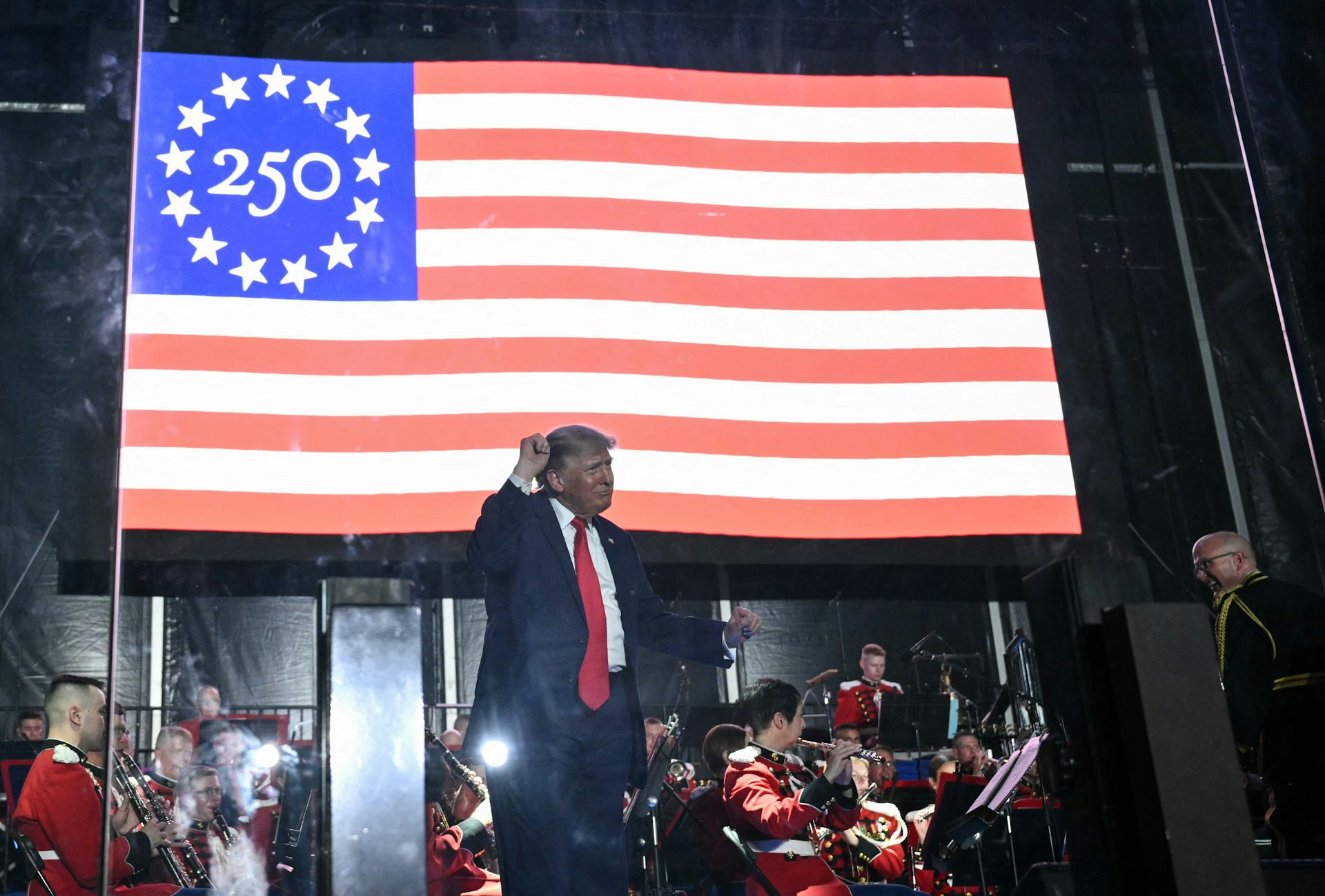
Los EE. UU. cumplen 250 años – y Trump lo está haciendo todo sobre él
The US is turning 250 – and Trump is making it all about him
Trump is not the first president to lean into an exaggerated patriotism at a time of crisis. But the vanity of his actions signals something perhaps unique.
Trump no es el primer presidente en aprovechar un patriotismo exagerado en tiempos de crisis. Pero la vanidad de sus acciones señala algo quizás único.
It’s almost the Fourth of July and Donald Trump is making the most of the 250th anniversary of American independence. He has all but declared himself Patriot-in-Chief.
Ya casi es el Cuatro de Julio y Donald Trump está aprovechando al máximo el 250 aniversario de la independencia estadounidense. Prácticamente se ha declarado Patriota en Jefe.
He’s putting his face on commemorative $250 bills and passports. A giant structure on the White House’s South Lawn, built for a pay-per-view UFC bout on Trump’s 80th birthday, was nicknamed the Arc de Trump. Perhaps Trump would have put his name on that, too, but as it was being built a court ordered his name be removed from another federal building.
Está poniendo su rostro en billetes y pasaportes conmemorativos de $250. Una estructura gigante en el Jardín del Sur de la Casa Blanca, construida para un combate UFC de pago por visión en el octogésimo cumpleaños de Trump, fue apodada el Arco de Trump. Quizás Trump también habría puesto su nombre en eso, pero mientras se estaba construyendo, un tribunal ordenó que su nombre fuera retirado de otro edificio federal.
Trump is not the first president to lean into an exaggerated patriotism at a time of crisis, attempting to direct or reorient Americans’ sense of national purpose.
Trump no es el primer presidente en apoyarse en un patriotismo exagerado en tiempos de crisis, intentando dirigir o reorientar el sentido de propósito nacional de los estadounidenses.
But the vanity of Trump’s actions signals something perhaps unique or at least singularly intense, as he attempts to fuse patriotism with personal loyalty so that love of country is the same as loving him.
Pero la vanidad de las acciones de Trump señala algo quizás único o al menos singularmente intenso, ya que intenta fusionar el patriotismo con la lealtad personal para que amar al país sea lo mismo que amarlo a él.
Other presidents have used patriotism to narrate the character of the nation, or to emphasise some change they felt necessary.
Otros presidentes han utilizado el patriotismo para narrar el carácter de la nación, o para enfatizar algún cambio que sintieron necesario.
Patriotism as service and the presidency as stewardship
El patriotismo como servicio y la presidencia como administración
For George Washington, patriotism took the form of stepping down from the role as the nation’s first president.
Para George Washington, el patriotismo tomó la forma de renunciar al cargo de primer presidente de la nación.
In doing so, he showed the new republic was serious about its claim that it would be governed by popular sovereignty rather than by an inherited monarchy.
Al hacerlo, demostró que la nueva república se tomaba en serio su afirmación de que sería gobernada por la soberanía popular y no por una monarquía hereditaria.
Washington’s actions showed that keeping the balance of the three branches of government – executive, legislative and judicial – required good-faith actors and restraint.
Las acciones de Washington demostraron que mantener el equilibrio de las tres ramas del gobierno —ejecutiva, legislativa y judicial— requería actores de buena fe y moderación.
Roughly 200 years later, President Gerald Ford faced a dilemma. Richard Nixon had recently resigned in disgrace, and the oil shocks of the early 1970s meant wages were stagnant and inflation rampant for the first time since the Great Depression.
Aproximadamente 200 años después, el presidente Gerald Ford se enfrentó a un dilema. Richard Nixon había renunciado recientemente en desgracia, y los choques petroleros de principios de la década de 1970 significaron que los salarios estaban estancados y la inflación era rampante por primera vez desde la Gran Depresión.
In those circumstances, Ford opted to mark the nation’s 200th birthday with a low-key expression of US patriotism. On July 4, Ford did not appear at an edifice built to honour him. Rather, he presided over a ceremony at Thomas Jefferson’s hallowed home and plantation, Monticello, to naturalise immigrant citizens.
En esas circunstancias, Ford optó por conmemorar el 200 cumpleaños de la nación con una expresión discreta del patriotismo estadounidense. El 4 de julio, Ford no apareció en un edificio construido para honrarlo. Más bien, presidió una ceremonia en la sagrada casa y plantación de Thomas Jefferson, Monticello, para naturalizar a ciudadanos inmigrantes.
Patriotism as a global mission and a loyalty test
Patriotismo como misión global y prueba de lealtad
Many American presidents have framed national pride and devotion in terms of the United States’ place in the world. They adopt a tradition captured in revolutionary pamphleteer Thomas Paine’s 1776 work, Common Sense, that
Muchos presidentes estadounidenses han enmarcado el orgullo y la devoción nacional en términos del lugar de Estados Unidos en el mundo. Adoptan una tradición capturada en la obra de 1776 del panfletario revolucionario Thomas Paine, Common Sense, que
the cause of America is in a great measure the cause of mankind.
la causa de América es en gran medida la causa de la humanidad.
With the rise of fascism and Nazism in the 1930s, this sense of the US as having a global mission became acute.
Con el auge del fascismo y el nazismo en la década de 1930, este sentido de EE. UU. como poseedor de una misión global se agudizó.
As Franklin Roosevelt exhorted those he called “my fellow Americans” to step up to join the Allies, he argued their good fortune was also an obligation. His January 1941 Four Freedoms speech said the US must defend the freedom of expression and religion Americans already enjoyed but also “freedom from want” and “freedom from fear” for everyone, worldwide.
Cuando Franklin Roosevelt exhortó a quienes llamó «mis conciudadanos americanos» a levantarse para unirse a los Aliados, argumentó que su buena fortuna era también una obligación. Su discurso de las Cuatro Libertades en enero de 1941 afirmó que EE. UU. debía defender la libertad de expresión y religión que los estadounidenses ya disfrutaban, pero también la «libertad de carencia» y la «libertad de miedo» para todos, en todo el mundo.
This strain of internationally-focused patriotism remained the hallmark of presidential rhetoric all the way through the Cold War and its immediate aftermath.
Esta veta de patriotismo con enfoque internacional siguió siendo la seña de identidad de la retórica presidencial durante toda la Guerra Fría y su posguerra inmediata.
Then, in 2000, George W. Bush entered office with a promise to curb the US’s international entanglements. The 9/11 attacks ended that ambition, and from there Bush trumpeted a patriotism that foreshadowed what is happening today in its emphasis on loyalty. “Either you are with us, or you are with the terrorists,” Bush told other nations.
Luego, en 2000, George W. Bush asumió la presidencia con la promesa de frenar los entanglements internacionales de EE. UU. Los ataques del 11-S terminaron esa ambición, y a partir de ahí Bush pregonó un patriotismo que presagiaba lo que está sucediendo hoy en su énfasis en la lealtad. «O están con nosotros, o están con los terroristas», dijo Bush a otras naciones.
American citizens were also subject to new laws (one literally known as The Patriot Act) , institutions and norms to intensify domestic surveillance and stifle dissent.
Los ciudadanos estadounidenses también estuvieron sujetos a nuevas leyes (una conocida literalmente como The Patriot Act) , instituciones y normas para intensificar la vigilancia interna y sofocar la disidencia.
Freedom for some Americans, unfreedom for others
Libertad para algunos estadounidenses, falta de libertad para otros
Even presidents with the grandest ideas of patriotism have not escaped the contradiction at the core of America’s self-image as a nation uniquely devoted to freedom. Because while in theory all people may be born equal, the US has never treated all of them that way.
Incluso los presidentes con las ideas más grandiosas de patriotismo no han escapado de la contradicción en el núcleo de la autoimagen de Estados Unidos como nación dedicada exclusivamente a la libertad. Porque si bien en teoría todas las personas pueden nacer iguales, EE. UU. nunca las ha tratado así.
American freedom has always come by excluding some from its bounty. George Washington himself enslaved hundreds of people and ferociously pursued those who escaped to freedom. President Woodrow Wilson, who wanted the US to make the world safe for democracy, segregated a previously integrated federal public service and promoted racist myths about America’s history. Franklin Roosevelt’s much-lauded New Deal and GI Bill, which did so much to redistribute wealth and build America’s middle class, excluded African Americans, Native Americans and many other people of colour.
La libertad estadounidense siempre ha llegado excluyendo a algunos de su beneficio. George Washington mismo esclavizó a cientos de personas y persiguió ferozmente a aquellos que escapaban hacia la libertad. El presidente Woodrow Wilson, quien quería que EE. UU. hiciera del mundo un lugar seguro para la democracia, segregó un servicio público federal previamente integrado e impulsó mitos racistas sobre la historia de Estados Unidos. El muy elogiado New Deal y GI Bill de Franklin Roosevelt, que hicieron tanto por redistribuir la riqueza y construir la clase media estadounidense, excluyeron a los afroamericanos, nativos americanos y a muchas otras personas de color.
In this regard, Trump’s inward-looking patriotism is familiar, although it is much more explicit about who it excludes than most presidents have been for some time.
En este sentido, el patriotismo introspectivo de Trump es familiar, aunque es mucho más explícito sobre a quién excluye que la mayoría de los presidentes lo han sido en algún tiempo.
What is new, however, is Trump’s fusion of patriotism, personal loyalty and an idea that he – as president but also because of his self-proclaimed sense of superiority in all aspects of life – somehow embodies the nation itself.
Lo nuevo, sin embargo, es la fusión del patriotismo, la lealtad personal y una idea de Trump de que él —como presidente pero también debido a su autoproclamada sensación de superioridad en todos los aspectos de la vida— encarna de alguna manera a la nación misma.
This is the patriotism of the corporate raider: acquire the institution, put your name on the façade, reward loyalists and above all, extract all the value you can.
Este es el patriotismo del depredador corporativo: adquirir la institución, poner tu nombre en la fachada, recompensar a los leales y, sobre todo, extraer todo el valor que puedas.
The 250th anniversary of independence doesn’t require us to ask if Trump is politicising patriotism. Patriotism is always political. The question is whether and how patriotism can be made to serve the greater good, or whether it is just yet another asset for Trump to own.
El 250 aniversario de la independencia no nos exige preguntar si Trump está politizando el patriotismo. El patriotismo siempre es político. La pregunta es si y cómo se puede hacer que el patriotismo sirva al bien común, o si es solo otro activo más para que Trump posea.
Clare Corbould has received funding from the Australian Research Council. She is a member of the Australian Historical Association.
Clare Corbould ha recibido financiación del Australian Research Council. Es miembro de la Australian Historical Association.
Read more
-
Los niveles de ‘químicos eternos’ en delfines y ballenas están aumentando a nivel mundial
Levels of ‘forever chemicals’ in dolphins and whales are rising globally
-
La propuesta de Alemania para aliviar las tensiones comerciales con China no ha sido bien recibida en Beijing
Germany’s proposal to ease trade tensions with China has not gone down well in Beijing