Ensayo del viernes: cómo la lealtad de los medios de Murdoch a Israel genera hipocresía, ataques y «periodismo fallido»
Friday essay: how the Murdoch media’s loyalty to Israel births hypocrisy, attacks and ‘failed journalism’
News Corporation’s decades-long support for Israel is reflected in its coverage of Israel–Palestine, reducing its complexities to a black and white issue.
El apoyo de News Corporation a Israel durante décadas se refleja en su cobertura de Israel-Palestina, reduciendo sus complejidades a un asunto blanco o negro.
When it comes to covering the Middle East, News Corporation has two guiding principles. The first is that it supports Israel, which means it opposes any nation, organisation or individual that doesn’t. This support is decades old and it’s unwavering, even in the face of global condemnation of Israel for the atrocities committed in Gaza.
Cuando se trata de cubrir el Medio Oriente, News Corporation tiene dos principios rectores. El primero es que apoya a Israel, lo que significa que se opone a cualquier nación, organización o individuo que no lo haga. Este apoyo tiene décadas de antigüedad y es inquebrantable, incluso ante la condena global de Israel por las atrocidades cometidas en Gaza.
News’ loyalty doesn’t just determine news content in the foreign pages of its newspapers. It also shapes the way it covers local events, down to who gets targeted for criticism.
La lealtad de News no solo determina el contenido informativo en las páginas extranjeras de sus periódicos. También moldea la forma en que cubre los eventos locales, hasta quién se convierte en blanco de críticas.
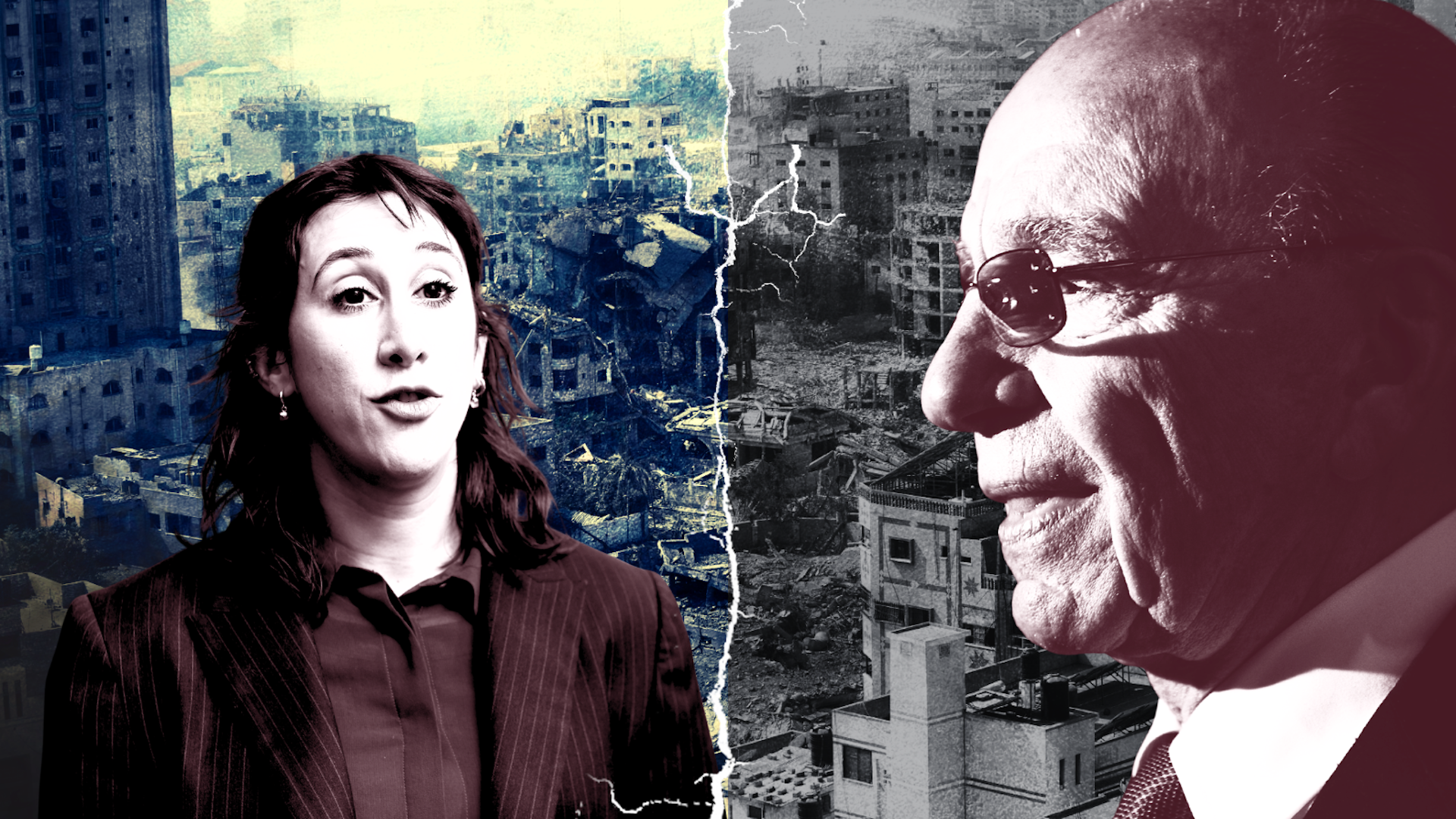
Young Jewish lawyer Sarah Schwartz has campaigned against Israel’s human rights abuses. For this, she has been subjected to sustained criticism that has demonstrated the other principle guiding News’ coverage. You could call this the “we’re‑always‑right‑no‑matter‑what” approach, which allows News to sustain its editorial assaults even in the face of inconvenient inconsistencies.
Sarah Schwartz, una joven abogada judía, ha militado contra los abusos de derechos humanos de Israel. Por esto, ha sido objeto de críticas constantes que han demostrado el otro principio que guía la cobertura de News. Se podría llamar un enfoque de «siempre tenemos razón sin importar qué», lo que permite a News sostener sus ataques editoriales incluso ante inconsistencias inconvenientes.
On the one hand, News has attacked Schwartz for being supposedly antisemitic. On the other, it has criticised her for calling out the antisemitism she’s been subjected to by her Zionist opponents. But when you’re always right no matter what, this is not an inconsistency at all.
Por un lado, News atacó a Schwartz por ser supuestamente antisemita. Por otro, criticó que señalara el antisemitismo al que ella ha sido sometida por sus oponentes sionistas. Pero cuando siempre tienes razón sin importar qué, esto no es una inconsistencia en absoluto.
Her story demonstrates how News goes about contriving controversy to discredit both individuals and what they’re saying, with little regard for the effect it has on the person being targeted. We interviewed her about her experience of News’ coverage last August.
Su historia demuestra cómo News se dedica a crear controversia para desacreditar tanto a individuos como lo que dicen, con poco interés por el efecto que tiene en la persona señalada. La entrevistamos sobre su experiencia de la cobertura de News el pasado mes de agosto.
Like so many other liberal Jews, Schwartz was appalled by Israel’s conduct in Gaza. She joined with several others to form an organisation called the Jewish Council of Australia, a diverse coalition of Jewish academics, lawyers, writers and teachers. They represent people who believe Israel’s response was not only disproportionate, but counterproductive to regional security and peace.
Como muchos otros judíos liberales, Schwartz se horrorizó por la conducta de Israel en Gaza. Se unió a varias personas para formar una organización llamada Jewish Council of Australia (Consejo Judío de Australia) , una diversa coalición de académicos, abogados, escritores y profesores judíos. Representan a personas que creen que la respuesta de Israel no solo fue desproporcionada, sino contraproducente para la seguridad regional y la paz.
This posed something of a threat to News, which for several decades has championed Israel and the Zionist cause. The notion of a Jew speaking out against Israel and in defence of Gaza challenged the News line that Israel can do no wrong and that criticism of Israel is inherently antisemitic.
Esto representó cierta amenaza para News, que durante varias décadas ha defendido a Israel y la causa sionista. La idea de un judío hablando en contra de Israel y en defensa de Gaza desafió la línea de News de que Israel no puede hacer nada mal y que cualquier crítica a Israel es inherentemente antisemita.
Initially, News outlets wrote a few disparaging pieces, dismissing the council as unrepresentative and irrelevant, even though its membership was steadily growing and its board comprised many high‑profile and influential people. But then Schwartz did something that gave News an opportunity to sharpen its attack.
Inicialmente, los medios de comunicación de News publicaron algunos artículos despectivos, desestimando al consejo como irrelevante y sin representación, aunque su membresía estaba creciendo constantemente y su junta estaba compuesta por muchas personas influyentes y de alto perfil. Pero luego Schwartz hizo algo que le dio a News la oportunidad de agudizar su ataque.
‘Painted as a Judenrat’
Pintado como un Consejo Judío
In January 2025, she was invited to speak at the “pre-event” for an academic antiracism conference. “The Greatest Race Debate” was held at a university, but billed as a comedy event. Essentially, it used the format of a debate to call out the absurdity of what constitutes race conversations in this country; everyone was to give their best “worst” takes on race debates in Australia.
En enero de 2025, fue invitada a hablar en el «preevento» de una conferencia académica antirracista. “The Greatest Race Debate” se celebró en una universidad, pero fue anunciado como un evento de comedia. Esencialmente, utilizó el formato de un debate para exponer la absurdidad de lo que constituyen las conversaciones sobre raza en este país; todos debían dar sus mejores «peores» perspectivas sobre los debates raciales en Australia.
So, Schwartz entered into the spirit of things by creating a cartoon image of a caped superhero whose chest carries the letters “DJ”. She titled the slide “Dutton’s Jew”, to depict the then opposition leader’s stereotyping of Jews as anti‑immigrant and hateful of Muslims, using them as “a human shield”. She said: “For Dutton and his ilk, Jews are just the perfect avatars to use to peddle racism, Islamophobia and anti-immigrant sentiment.”
Así que Schwartz contribuyó al espíritu del momento creando una imagen en caricatura de un superhéroe encapuchado cuyo pecho lleva las letras “DJ”. Tituló la diapositiva «El judío de Dutton», para representar el estereotipo del entonces líder de la oposición sobre los judíos como antiinmigrantes y odiosos hacia los musulmanes, usándolos como «escudo humano.» Dijo: «Para Dutton y su clase, los judíos son simplemente los avatares perfectos para usar y vender racismo, islamofobia y sentimiento antiinmigrante.»
Admittedly, the term “Dutton’s Jew” was open to misinterpretation and what unfolded could have been predicted. But at that stage, Schwartz wasn’t as media savvy as she’s since become.
Hay que admitir que el término “Dutton’s Jew” era susceptible a la mala interpretación y lo que ocurrió podría haber sido predicho. Pero en ese momento, Schwartz no tenía tanto conocimiento de los medios como lo ha hecho desde entonces.
The Australian and Murdoch’s Brisbane daily, The Courier Mail, pounced on the story, although they did take the time to add an important clarification, requested by Schwartz. She wanted to make it clear she wasn’t saying Jews were anti‑immigration and hateful of Muslims; this was about Dutton’s conception of Jews. In other words, it was political commentary.
El diario de Brisbane, The Courier Mail, propiedad de The Australian y Murdoch, abordó la historia, aunque se tomaron el tiempo de añadir una aclaración importante, solicitada por Schwartz. Ella quería dejar claro que no estaba diciendo que los judíos fueran antiinmigración ni odiaran a los musulmanes; esto era sobre la concepción de los judíos por parte de Dutton. En otras palabras, fue un comentario político.
Unfortunately, some of the subsequent stories left out that important distinction. They referenced the “Dutton’s Jew” cartoon as if to make the point that Schwartz was controversial, maybe even antisemitic.
Desafortunadamente, algunas de las historias posteriores omitieron esa importante distinción. Hicieron referencia al cómic «Dutton’s Jew» como si quisieran señalar que Schwartz era controvertido, quizás incluso antisemita.
Both papers stayed on the story, with follow‑ups about federal ministers criticising the Queensland University of Technology for hosting the event, and vice chancellor Margaret Sheil rushing to apologise for any “hurt and offence” the conference caused.
Ambos artículos mantuvieron el enfoque en la historia, con seguimientos sobre ministros federales criticando a la Universidad de Tecnología de Queensland por albergar el evento, y la vicerrectora Margaret Sheil apresurándose a disculparse por cualquier «dolor e ofensa» que causó la conferencia.
They also covered Sheil’s decision to commission former Federal Court judge John Middleton to determine whether the Jewish community had been vilified. A few months later, Middleton found that nothing Schwartz said was racist.
También cubrieron la decisión de Sheil de encargar al ex juez del Tribunal Federal, John Middleton, para determinar si la comunidad judía había sido vilipendiada. Unos meses después, Middleton encontró que nada de lo que dijo Schwartz era racista.
He concluded, “Ms Schwartz’s slide was photographed and delivered to The Australian and The Courier Mail devoid of context” and “Ms Schwartz’s depiction of ‘Dutton’s Jew’ was not critical of Jewish people themselves, but of the way in which political figures may typecast Jewish identity to serve particular narratives”.
Concluyó: “La diapositiva de la Sra. Schwartz fue fotografiada y entregada a The Australian y The Courier Mail desprovista de contexto” y “la representación de ‘el judío de Dutton’ por parte de la Sra. Schwartz no era crítica del pueblo judío en sí mismo, sino de la manera en que las figuras políticas pueden estereotipar la identidad judía para servir a narrativas particulares”.
But Middleton’s report came too late to stop the abuse Schwartz was copping from online activists such as pro‑Israel advocate Zara Cooper, who according to Schwartz posted “over 600 times” on Instagram about Schwartz and the Jewish Council of Australia. One image was of a rat, another was of Schwartz’s face superimposed over a train. Was the latter suggesting she would be deported to a concentration camp for siding with Palestinians?
Pero el informe de Middleton llegó demasiado tarde para detener los abusos que Schwartz estaba sufriendo por parte de activistas en línea, como la defensora proisraelí Zara Cooper, quien, según Schwartz, publicó «más de 600 veces» en Instagram sobre Schwartz y el Consejo Judío de Australia. Una imagen era la de una rata, otra era la cara de Schwartz superpuesta sobre un tren. ¿Estaba esta última sugiriendo que sería deportada a un campo de concentración por apoyar a los palestinos?
Schwartz told us she was “painted as a Judenrat, as someone who is collaborating with Nazis because Nazis and Palestinians had become conflated in some Zionists’ minds”. She says her opponents became “utterly fixated” by the idea of her being harmed by Palestinians, the very people she was defending. It became so extreme that Schwartz went to the police.
Schwartz nos dijo que la pintaban como un «Judenrat», como alguien que colabora con los nazis porque los nazis y palestinos se habían confundido en la mente de algunos sionistas.» Ella dice que sus oponentes quedaron «completamente obsesionados» con la idea de que los palestinos la lastimarían, precisamente las personas que ella estaba defendiendo. Se volvió tan extremo que Schwartz acudió a la policía.
This is when things got a little crazy, because, as Schwartz says, up until then the paper’s “whole narrative had been that Jewish people have been the victim of antisemitism”. But when Schwartz, as a Jewish person, complained about being the victim of antisemitism, The Australian switched. Its line suddenly became, she says: “That’s outrageous that she’s going to the police, she’s trying to suppress her enemies.”
Esto es cuando las cosas se pusieron un poco locas, porque, como dice Schwartz, hasta entonces la «narrativa completa del periódico había sido que el pueblo judío ha sido víctima de antisemitismo.» Pero cuando Schwartz, como persona judía, se quejó de ser víctima de antisemitismo, The Australian cambió. Su línea de repente fue, dice ella: «Es escandaloso que vaya a la policía, está tratando de suprimir a sus enemigos.»
When the police proposed an intervention order against Cooper to stop the online abuse, Schwartz says the newspaper suggested she was a hypocrite because she was “a lawyer who cares about free speech”.
Cuando la policía propuso una orden de intervención contra Cooper para detener el abuso en línea, Schwartz dice que el periódico sugirió que ella era una hipócrita porque era «una abogada que se preocupa por la libertad de expresión.»
When the matter first went to court, Schwartz insisted the paper correct its claim that she, rather than the police, had initiated the intervention order. She says the paper bullied her by republishing the “incredibly distressing” memes that surfaced online.
Cuando el asunto llegó a los tribunales por primera vez, Schwartz insistió en que el periódico corrigiera su afirmación de que ella, y no la policía, había iniciado la orden de intervención. Ella dice que el periódico la acosó volviendo a publicar los memes «increíblemente angustiantes» que surgieron en línea.
“I think those images are antisemitic; whatever you want to say, they are certainly racialised, they are attacking me because I’m Jewish and because I hold a particular political view. The Australian is then republishing those images in articles that are smearing me.”
“Creo que esas imágenes son antisemitas; lo que quieran decir, ciertamente están racializadas, me están atacando porque soy judía y porque tengo una opinión política particular. Y The Australian está republicando esas imágenes en artículos que me están difamando”.
Schwartz says the pressure made it “untenable for the intervention order to proceed” so she asked the police to withdraw it. She says, “It’s like the bullies won.”
Schwartz dice que la presión hizo que fuera “insostenible que la orden de intervención pudiera continuar”, por lo que pidió a la policía que la retirara. Ella afirma: “Es como si los acosadores hubieran ganado”.
For her part, Zara Cooper told The Australian, “I have never met Sarah Schwartz. I have never spoken with her, threatened her, posted private information about her or encouraged others to do so.”
Por su parte, Zara Cooper dijo a The Australian: “Nunca he conocido a Sarah Schwartz. Nunca he hablado con ella, ni la he amenazado, ni he publicado información privada sobre ella o animado a otros a hacerlo”.
‘A malicious pile-on’
‘Un ataque malicioso’
Schwartz says a particularly hurtful aspect of the paper’s coverage was an opinion piece by Indigenous scholar Professor Marcia Langton, who wrote that Schwartz “deeply offended Jewish Australians and other Australians, including me”.
Schwartz afirma que un aspecto particularmente hiriente de la cobertura del periódico fue un artículo de opinión de la académica indígena Profesora Marcia Langton, quien escribió que Schwartz “ofendió profundamente a los australianos judíos y a otros australianos, incluyéndome”.
Referring to the “Dutton’s Jew” cartoon, Langton said,
En referencia al caricatura «El judío de Dutton», Langton dijo:
There was nothing satirical about this message. It was objectively anti-Semitic in its depiction of her nemesis, the ‘bad Jew’, who [Schwartz] imagines has lost all agency and is an unwitting puppet of various warmongering masters.
No había nada satírico en este mensaje. Era objetivamente antisemita en su representación de su némesis, el ‘mal judío’, quien [Schwartz] imagina que ha perdido toda agencia y es un títere involuntario de varios señores de la guerra.
Langton concluded, “As a Jewish friend said to me about this, the ‘good Jew/bad Jew’ narrative is the ‘absolute epitome of anti‑Semitic conspiracy theory’.” Schwartz’s requests for corrections to Langton’s column prior to publication were ignored by the paper, she told us.
Langton concluyó: “Como me dijo un amigo judío sobre esto, la narrativa del ‘buen judío/mal judío’ es el ‘epítome absoluto de la teoría conspirativa antisemita’”. Schwartz nos dijo que las solicitudes de corrección para la columna de Langton antes de su publicación fueron ignoradas por el periódico.
Following publication, her lawyer argued the piece took the cartoon out of context and portrayed Schwartz as an antisemite who had publicly represented all Jews as “bloodthirsty monsters”. The lawyer asserted the opinion piece “contributed to a malicious pile‑on, attacking Ms Schwartz and attempting to inflict maximum personal and reputational harm on her, based on an entirely false premise that does not withstand the slightest scrutiny.”
Después de la publicación, su abogado argumentó que el artículo sacó el dibujo de contexto y retrató a Schwartz como una antisemita que había representado públicamente a todos los judíos como “monstruos sedientos de sangre”. El abogado afirmó que el artículo de opinión “contribuyó a un ataque malicioso, atacando a la Sra. Schwartz e intentando infligirle el máximo daño personal y reputacional, basándose en una premisa completamente falsa que no resiste el menor escrutinio.”
The Australian denied the allegations and warned it would invest heavily in defending what it said was clearly an opinion piece on a matter of public interest.
La australiana negó las acusaciones y advirtió que invertiría mucho en defender lo que dijo que era claramente un artículo de opinión sobre un asunto de interés público.
A ‘serious threat to News’ narrative’
Una narrativa de «grave amenaza para News»
Schwartz has had time to ponder why she became a News target: “I think I represent a really serious threat to News’ narrative that criticism of Israel is antisemitic.” She told us, “News wants to use Jews to bolster their right‑wing claims, but I and the Jewish Council of Australia represent a real threat to that.”
Schwartz ha tenido tiempo para reflexionar sobre por qué se convirtió en un objetivo de News: «Creo que represento una amenaza realmente grave para la narrativa de News, según la cual la crítica a Israel es antisemita». Nos dijo: «News quiere usar a los judíos para reforzar sus afirmaciones de derecha, pero yo y el Consejo Judío de Australia representamos una amenaza real para eso».
She accuses the Murdoch press of “working hand in hand with Zionist lobby groups with the intention to silence me or shame me or stop my advocacy”.
Acusa a la prensa Murdoch de «trabajar mano a mano con grupos de presión sionistas con la intención de silenciarme o avergonzarme o detener mi defensa».
Creating a negative image of a person under attack is a fundamental component of a Murdoch campaign. Schwartz says the papers “cultivated this image of me as controversial, obscene, dangerous, frivolous or attention seeking”. This “false narrative” was based on “concocted events”, but its effect was powerful: “Now when they refer to me they can refer to me as just a controversial individual,” says Schwartz.
Crear una imagen negativa de una persona atacada es un componente fundamental de una campaña de Murdoch. Schwartz dice que los periódicos «cultivaron esta imagen de mí como controvertida, obscena, peligrosa, frívola o que busca atención». Esta «falsa narrativa» se basó en «eventos concoctados», pero su efecto fue poderoso: «Ahora cuando hablan de mí pueden referirse a mí simplemente como una persona controversial», dice Schwartz.
When an article appeared with a headline describing her as a “Radical fringe Jewish voice”, she knew “they were complete in their objectification of me”.
Cuando apareció un artículo con un titular describiéndola como una «voz judía radical y marginal», supo que «estaban completamente en su objetivación de mí».
This sort of treatment is damaging because it reaches so many different audiences. “Maybe I can explain individual incidents to people in my life who still read The Australian, but I’ll never be able to get over this confected persona they’ve created for me,” she told us. “I think that’s the most hurtful thing.”
Este tipo de trato es perjudicial porque llega a tantas audiencias diferentes. «Quizás pueda explicar incidentes individuales a las personas de mi vida que todavía leen The Australian, pero nunca podré superar esta personalidad inventada que han creado para mí», nos dijo. «Creo que eso es lo más hiriente».
Even within her own community, the coverage is caustic. “There is just a whole segment of the Jewish community who now look at me as someone who is antisemitic and who is offensive and who is radical, and that affects me going about my day‑to-day life, going to synagogue, going to Jewish communal events.”
Incluso dentro de su propia comunidad, la cobertura es cáustica. «Hay todo un segmento de la comunidad judía que ahora me ve como alguien antisemita y ofensivo y radical, y eso me afecta en mi vida diaria, al ir a la sinagoga, a eventos comunitarios judíos».
While on one level this coverage is just about one person in a far corner of the world, far removed from the atrocities of the Middle East, it is also indicative of News’ broader coverage of the conflict and of its framing of both Jewish and Muslim people.
Si bien en un nivel esta cobertura trata solo de una persona en un rincón lejano del mundo, muy alejado de las atrocidades de Oriente Medio, también es indicativa de la cobertura más amplia que News hace sobre el conflicto y de su encuadre tanto de los pueblos judíos como musulmanes.
News is unquestioningly loyal to Israel and Zionism, and deeply sceptical of, if not aggressive towards, Israel’s enemies, both perceived and real. And that means News is especially hostile towards Muslims and the Islamic faith.
News es incondicionalmente leal a Israel y al sionismo, y profundamente escéptico, si no agresivo, con los enemigos de Israel, tanto percibidos como reales. Y eso significa que News es especialmente hostil hacia los musulmanes y la fe islámica.
Something nasty and scary and manipulative
Algo desagradable, aterrador y manipulador
In a recent interview for The Atlantic, Rupert’s youngest son, James, described the way tabloid culture “is contrarian for the sake of it” and “delights in poking people in the eye”. He said, “At its worst, it metastasizes into something nasty and scary and manipulative.”
En una entrevista reciente para The Atlantic, James, el hijo menor de Rupert, describió la forma en que la cultura sensacionalista «es contraria por sí misma» y «disfruta pinchando a la gente en los ojos.» Dijo: «En su peor momento, se metastatiza en algo desagradable, aterrador y manipulador.»
By that definition, Fox News should be classified as tabloid, but so too The Times and The Australian, even though the latter still retains its broadsheet format. Along with many News mastheads, they’ve been poking at Muslims and Islam for decades. They’ve aggravated fear and done little to encourage understanding or tolerance. And, like a cancer, that kind of coverage has spread and metastasised in grotesque forms.
Por esa definición, Fox News debería clasificarse como tabloide, pero también lo son The Times y The Australian, aunque estos últimos aún conservan su formato de periódico grande. Junto con muchas cabeceras de noticias, han estado molestando a los musulmanes y al islam durante décadas. Han exacerbado el miedo y poco han hecho para fomentar la comprensión o la tolerancia. Y, como un cáncer, ese tipo de cobertura se ha extendido y metastatizado en formas grotescas.
No longer is there a need for the proprietor to hammer out his fury in the middle of the night in the New York Post newsroom, as Murdoch had in 1977, when a group of radical Hanafi Islamists seized control of three buildings in Washington DC and held 149 people hostage.
Ya no es necesario que el propietario desahogue su furia en la sala de redacción del New York Post en medio de la noche, como lo hizo Murdoch en 1977, cuando un grupo de islamistas hanafíes radicales tomó el control de tres edificios en Washington DC y retuvo a 149 personas como rehenes.
By now, everyone knows where he, and consequently his publications, stand. Islam is posed as an ever-present threat to Western society and Judeo-Christian values. Muslims are too often characterised as hateful and untrustworthy. The Palestinian side of the current conflict does not warrant equal treatment because News stands with and for the other side.
A estas alturas, todo el mundo sabe dónde está él, y por consiguiente sus publicaciones. El Islam se presenta como una amenaza siempre presente para la sociedad occidental y los valores judeocristianos. Los musulmanes son demasiado a menudo caracterizados como odiosos e indignos de confianza. La parte palestina del conflicto actual no merece un trato igualitario porque News se mantiene con y para el otro lado.
Therefore, it almost didn’t matter how Israel responded to Hamas’ atrocities of October 7 2023. It was always going to be considered proportionate, regardless of how many thousands of innocent Palestinians were killed.
Por lo tanto, casi no importó cómo respondiera Israel a las atrocidades de Hamás del 7 de octubre de 2023. Siempre iba a considerarse proporcionado, sin importar cuántos miles de palestinos inocentes murieran.
On the first anniversary of the war, many media outlets paused to reflect, most with at least some balance. There was recognition that both sides had suffered trauma and loss, which in some cases prompted analysis about the blurred boundaries between defence and retribution.
En el primer aniversario de la guerra, muchos medios de comunicación hicieron una pausa para reflexionar, la mayoría con cierto equilibrio. Hubo un reconocimiento de que ambos bandos habían sufrido trauma y pérdidas, lo que en algunos casos llevó a análisis sobre los límites difusos entre la defensa y la represalia.
The Weekend Australian, however, had no interest in balance. Despite devoting 13 broadsheet pages to the topic, it could not find room to even note that 100,000 Palestinians had been injured and that two million had become refugees.
Sin embargo, The Weekend Australian no tenía interés en el equilibrio. A pesar de dedicar 13 páginas de periódico grande al tema, no pudo encontrar espacio ni siquiera para señalar que 100.000 palestinos habían sido heridos y que dos millones se habían convertido en refugiados.
The Weekend Australian instead blamed the Australian government for abandoning Israel, while focusing on Israeli suffering and instances of antisemitism within Australia. The paper described the conflict as “Israel’s war in defence of world order”.
The Weekend Australian culpó en cambio al gobierno australiano por abandonar a Israel, mientras se centraba en el sufrimiento israelí e instancias de antisemitismo dentro de Australia. El periódico describió el conflicto como «la guerra de Israel en defensa del orden mundial.»
As Paul Barry, the then presenter of the ABC’s Media Watch, noted, “42,000 dead Palestinians rarely get a mention” and there was “not one picture or human story of a Palestinian child, woman or family”. Barry concluded, “To call the coverage one-eyed is the understatement of the year. It is quite frankly astonishing and a journalistic disgrace.”
Como señaló Paul Barry, entonces presentador de Media Watch de la ABC, «rara vez se menciona la muerte de 42.000 palestinos» y no había «ni una sola foto o historia humana de un niño, mujer o familia palestina.» Barry concluyó: «Llamar a la cobertura miope es quedarse corto. Es francamente asombroso y una deshonra periodística.»
It was happening in every corner of the News empire. In February 2025, Trump had a thought bubble. Along with annexing Greenland, turning Canada into the 51st state, retaking the Panama Canal and giving Putin Ukraine, he had an idea that the United States could “take over” and “own” Gaza.
Estaba sucediendo en cada rincón del imperio News. En febrero de 2025, Trump tuvo una burbuja de pensamiento. Junto con anexar Groenlandia, convertir Canadá en el estado 51, recuperar el Canal de Panamá y darle Ucrania a Putin, tuvo la idea de que Estados Unidos podría «tomar el control» y «poseer» Gaza.
After the Palestinian people were resettled somewhere else, the US could turn Gaza into a new Middle East Riviera, where there would be “unlimited numbers of jobs and housing”. As you’d hope, reputable media outlets pulled apart the plan, and within minutes revealed its thoughtless cruelty. World leaders said it was inconceivable. Arab leaders said it was a violation of international law.
Después de que el pueblo palestino fuera reasentado en otro lugar, EE. UU. podría convertir Gaza en una nueva Riviera de Oriente Medio, donde habría «un número ilimitado de empleos y viviendas». Como se esperaría, los medios de comunicación reputados desmenuzaron el plan y en minutos revelaron su crueldad descuidada. Los líderes mundiales dijeron que era inconcebible. Los líderes árabes dijeron que era una violación del derecho internacional.
But the idea found supporters on Fox News. Ainsley Earhardt, the co-host of Fox & Friends, asked her audience, “If you have the opportunity for economic development, and supplied unlimited number of jobs and housing, and a good, fresh, ‘beautiful piece of land’ like he calls it, why wouldn’t you consider it?” She seemed genuine, like she actually believed it, when she asked, “Why wouldn’t they say thanks for doing this?”
Pero la idea encontró partidarios en Fox News. Ainsley Earhardt, coanfitriona de Fox & Friends, preguntó a su audiencia: «¿Si tienes la oportunidad de desarrollo económico, y suministrado un número ilimitado de empleos y viviendas, y un buen, fresco ‘hermoso pedazo de tierra’ como él lo llama, por qué no lo considerarías?». Parecía genuina, como si realmente creyera en ello, cuando preguntó: «¿Por qué no dirían gracias por hacer esto?».
But perhaps the most egregious example was provided by Sharri Markson, a host on Murdoch’s Sky News Australia. In 2025, Markson scored a 16-minute interview with Israeli Prime Minister Benjamin Netanyahu but then wasted it by asking not a single probing question.
Pero quizás el ejemplo más flagrante fue proporcionado por Sharri Markson, presentadora de Sky News Australia de Murdoch. En 2025, Markson consiguió una entrevista de 16 minutos con el primer ministro israelí Benjamin Netanyahu, pero luego la desperdició sin hacer ni una sola pregunta profunda.
Instead, she provided a platform for Netanyahu to further his personal attack on Australian Prime Minister Anthony Albanese, who had just announced Australia would recognise the state of Palestine.
En cambio, le dio una plataforma a Netanyahu para que intensificara su ataque personal contra el primer ministro australiano Anthony Albanese, quien acababa de anunciar que Australia reconocería el estado de Palestina.
She declared, as fact, that the Albanese government was “aiding and abetting” a “propaganda campaign” against Israel. Many of her questions were mini editorials, like this one: “Is it true you still plan to take over Gaza and eliminate the terrorists if they do agree to a deal?” She nodded in agreement throughout the interview. “Absolutely, absolutely,” she added enthusiastically as he explained Israel’s good conduct. The result was that she let a man charged with war crimes off the hook.
Declaró, como un hecho, que el gobierno de Albanese estaba “ayudando y encubriendo” una “campaña de propaganda” contra Israel. Muchas de sus preguntas fueron mini editoriales, como esta: «¿Es cierto que todavía planea tomar Gaza y eliminar a los terroristas si llegan a aceptar un acuerdo?». Asintió en señal de acuerdo durante toda la entrevista. «Absolutamente, absolutamente», añadió con entusiasmo mientras él explicaba la buena conducta de Israel. El resultado fue que dejó libre a un hombre acusado de crímenes de guerra.
The interview was widely condemned. Veteran television interviewer Ray Martin told Media Watch it was a “sycophantic endorsement” that “failed journalism 101”. In a responding statement, Markson said she “had been inundated with high praise from leading editors and journalists, describing the interview as outstanding, first class and agenda setting”.
La entrevista fue ampliamente condenada. El veterano entrevistador de televisión Ray Martin dijo a Media Watch que fue un “apoyo adulador” que “fracasó en los fundamentos del periodismo”. En una declaración de respuesta, Markson dijo que había sido «inundada de elogios por parte de editores y periodistas destacados, describiendo la entrevista como sobresaliente, de primera clase y capaz de marcar la agenda».
‘Determined avoidance’ of other perspectives
‘Evasión determinada’ de otras perspectivas
The company’s editorial line was on display in its coverage of the Bondi Beach massacre in December 2025, when two terrorists killed 15 people, and injured a further 40 who were celebrating the Jewish festival of Hanukkah.
La línea editorial de la compañía se mostró en su cobertura de la masacre de Bondi Beach en diciembre de 2025, cuando dos terroristas mataron a 15 personas y hirieron a otros 40 que celebraban el festival judío de Hanukkah.
News Corp mastheads rightly deplored the appalling violence and questioned whether the Australian government had heeded warnings about such an attack. The papers rightly commemorated and mourned the loss of innocent life, and investigated and exposed the ugly ideologies and personal pathologies behind the killings.
Los titulares de News Corp lamentaron con razón la terrible violencia y cuestionaron si el gobierno australiano había atendido las advertencias sobre un ataque de este tipo. Los periódicos recordaron y lloraron con acierto la pérdida de vidas inocentes, e investigaron y expusieron las feas ideologías y patologías personales detrás de los asesinatos.
But inevitably – and sadly for the health of public discourse – the coverage displayed a determined avoidance to present any perspectives other than its own on the rise of antisemitism in Australia.
Pero inevitablemente —y lamentablemente para la salud del discurso público— la cobertura mostró una evasión determinada al presentar cualquier perspectiva que no fuera la suya sobre el aumento del antisemitismo en Australia.
This is an edited extract of Getting Murdoched: How Murdoch’s Media Wields Power and Punishment by Andrew Dodd and Matthew Ricketson (Hardie Grant) .
Este es un extracto editado de Getting Murdoched: How Murdoch’s Media Wields Power and Punishment (Obteniendo a Murdoch: Cómo los medios de Murdoch ejercen poder y castigo) de Andrew Dodd y Matthew Ricketson (Hardie Grant) .
Matthew Ricketson worked on staff at News Corp Australia publications, The Australian between 1986 and 1989, and The Sunday Herald in 1989.
Matthew Ricketson trabajó como empleado en las publicaciones de News Corp Australia, The Australian, entre 1986 y 1989, y en The Sunday Herald en 1989.
Andrew worked as a journalist at The Australian newspaper between 1999 and 2004.
Andrew trabajó como periodista en el periódico The Australian entre 1999 y 2004.
Read more
-

La capacidad de China para superar la guerra comercial de Trump fue el resultado de dos décadas
China’s ability to weather Trump’s trade war was two decades in the making
-
La crisis de los derechos de las mujeres en Afganistán es una calamidad humanitaria en curso.
The women’s rights crisis in Afghanistan is an ongoing humanitarian calamity