Ensaio de sexta-feira: como a lealdade da mídia Murdoch a Israel gera hipocrisia, ataques e ‘jornalismo fracassado’
Friday essay: how the Murdoch media’s loyalty to Israel births hypocrisy, attacks and ‘failed journalism’
News Corporation’s decades-long support for Israel is reflected in its coverage of Israel–Palestine, reducing its complexities to a black and white issue.
O apoio de décadas da News Corporation a Israel é refletido em sua cobertura de Israel-Palestina, reduzindo suas complexidades a uma questão preto no branco.
When it comes to covering the Middle East, News Corporation has two guiding principles. The first is that it supports Israel, which means it opposes any nation, organisation or individual that doesn’t. This support is decades old and it’s unwavering, even in the face of global condemnation of Israel for the atrocities committed in Gaza.
Quando se trata de cobrir o Oriente Médio, a News Corporation tem dois princípios orientadores. O primeiro é que ela apoia Israel, o que significa que se opõe a qualquer nação, organização ou indivíduo que não o faça. Esse apoio é antigo e inabalável, mesmo diante da condenação global de Israel pelas atrocidades cometidas em Gaza.
News’ loyalty doesn’t just determine news content in the foreign pages of its newspapers. It also shapes the way it covers local events, down to who gets targeted for criticism.
A lealdade da News não determina apenas o conteúdo das notícias nas páginas internacionais de seus jornais. Ela também molda a maneira como cobre eventos locais, até mesmo quem será alvo de críticas.
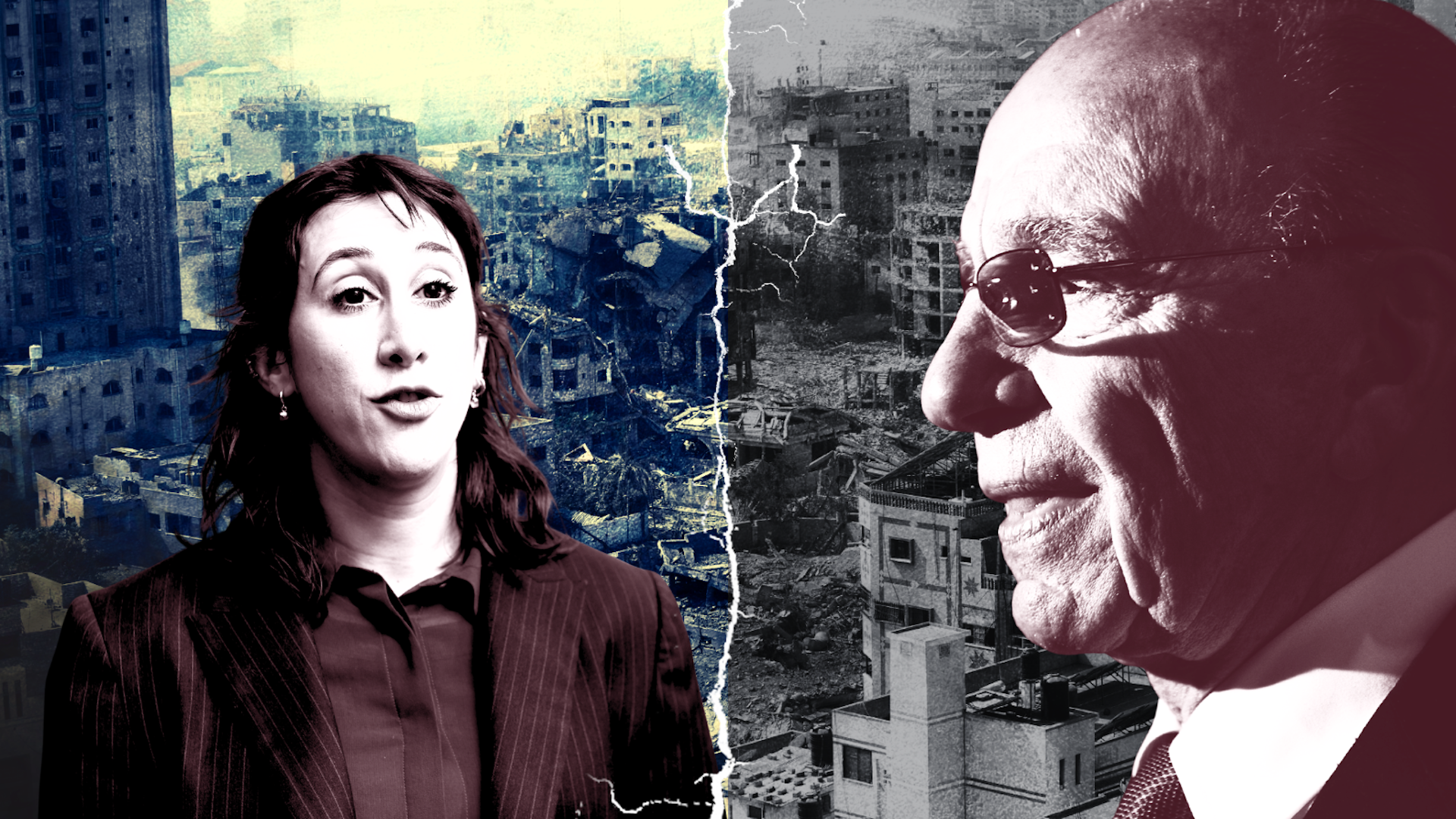
Young Jewish lawyer Sarah Schwartz has campaigned against Israel’s human rights abuses. For this, she has been subjected to sustained criticism that has demonstrated the other principle guiding News’ coverage. You could call this the “we’re‑always‑right‑no‑matter‑what” approach, which allows News to sustain its editorial assaults even in the face of inconvenient inconsistencies.
A jovem advogada judaica Sarah Schwartz fez campanha contra os abusos de direitos humanos de Israel. Por isso, ela foi submetida a críticas contínuas que demonstraram o outro princípio que guia a cobertura da News. Poder-se-ia chamar isso de abordagem de “sempre estamos certos, não importa o quê”, o que permite à News sustentar seus ataques editoriais mesmo diante de inconsistências inconvenientes.
On the one hand, News has attacked Schwartz for being supposedly antisemitic. On the other, it has criticised her for calling out the antisemitism she’s been subjected to by her Zionist opponents. But when you’re always right no matter what, this is not an inconsistency at all.
Por um lado, a News atacou Schwartz por ser supostamente antissemita. Por outro, criticou-a por denunciar o antissemitismo ao qual ela foi submetida por seus oponentes sionistas. Mas quando você está sempre certo, não importa o quê, isso não é uma inconsistência de forma alguma.
Her story demonstrates how News goes about contriving controversy to discredit both individuals and what they’re saying, with little regard for the effect it has on the person being targeted. We interviewed her about her experience of News’ coverage last August.
A história dela demonstra como a News procede para criar controvérsia e desacreditar tanto indivíduos quanto o que eles dizem, com pouco cuidado pelo efeito que isso tem sobre a pessoa visada. Nós a entrevistamos sobre sua experiência com a cobertura da News em agosto passado.
Like so many other liberal Jews, Schwartz was appalled by Israel’s conduct in Gaza. She joined with several others to form an organisation called the Jewish Council of Australia, a diverse coalition of Jewish academics, lawyers, writers and teachers. They represent people who believe Israel’s response was not only disproportionate, but counterproductive to regional security and peace.
Como muitos outros judeus liberais, Schwartz ficou horrorizada com a conduta de Israel em Gaza. Ela se juntou a várias outras pessoas para formar uma organização chamada Jewish Council of Australia (Conselho Judaico da Austrália) , uma coalizão diversa de acadêmicos, advogados, escritores e professores judeus. Eles representam pessoas que acreditam que a resposta de Israel não foi apenas desproporcional, mas contraproducente para a segurança e paz regional.
This posed something of a threat to News, which for several decades has championed Israel and the Zionist cause. The notion of a Jew speaking out against Israel and in defence of Gaza challenged the News line that Israel can do no wrong and that criticism of Israel is inherently antisemitic.
Isso representou uma espécie de ameaça à News, que por várias décadas defendeu Israel e a causa sionista. A ideia de um judeu falar contra Israel e em defesa de Gaza desafiou a linha da News de que Israel não pode fazer nada de errado e que qualquer crítica a Israel é inerentemente antissemita.
Initially, News outlets wrote a few disparaging pieces, dismissing the council as unrepresentative and irrelevant, even though its membership was steadily growing and its board comprised many high‑profile and influential people. But then Schwartz did something that gave News an opportunity to sharpen its attack.
Inicialmente, veículos da News escreveram alguns artigos depreciativos, desconsiderando o conselho como não representativo e irrelevante, embora sua membresia estivesse crescendo constantemente e seu conselho fosse composto por muitas pessoas influentes e de alto perfil. Mas então Schwartz fez algo que deu à News a oportunidade de intensificar seu ataque.
‘Painted as a Judenrat’
‘Pintada como um Judenrat’
In January 2025, she was invited to speak at the “pre-event” for an academic antiracism conference. “The Greatest Race Debate” was held at a university, but billed as a comedy event. Essentially, it used the format of a debate to call out the absurdity of what constitutes race conversations in this country; everyone was to give their best “worst” takes on race debates in Australia.
Em janeiro de 2025, ela foi convidada para falar no “pré-evento” de uma conferência acadêmica antirracista. O evento chamado “The Greatest Race Debate” ocorreu em uma universidade, mas foi divulgado como um evento de comédia. Essencialmente, ele usou o formato de um debate para expor o absurdo do que constitui conversas sobre raça neste país; todos deveriam dar suas piores e melhores opiniões sobre debates raciais na Austrália.
So, Schwartz entered into the spirit of things by creating a cartoon image of a caped superhero whose chest carries the letters “DJ”. She titled the slide “Dutton’s Jew”, to depict the then opposition leader’s stereotyping of Jews as anti‑immigrant and hateful of Muslims, using them as “a human shield”. She said: “For Dutton and his ilk, Jews are just the perfect avatars to use to peddle racism, Islamophobia and anti-immigrant sentiment.”
Assim, Schwartz entrou no espírito das coisas criando uma imagem em quadrinhos de um super-herói com capa cujo peito exibia as letras “DJ”. Ela intitulou o slide de “Dutton’s Jew”, para retratar o estereotipamento dos judeus pelo então líder da oposição como anti-imigrante e odioso aos muçulmanos, usando-os como “escudo humano”. Ela disse: “Para Dutton e seus semelhantes, os judeus são apenas os avatares perfeitos para usar na venda de racismo, islamofobia e sentimento anti-imigrante.”
Admittedly, the term “Dutton’s Jew” was open to misinterpretation and what unfolded could have been predicted. But at that stage, Schwartz wasn’t as media savvy as she’s since become.
Admitidamente, o termo “Dutton’s Jew” estava aberto a má interpretação e o que se desenrolou poderia ter sido previsto. Mas naquele estágio, Schwartz não era tão experiente com a mídia quanto se tornou desde então.
The Australian and Murdoch’s Brisbane daily, The Courier Mail, pounced on the story, although they did take the time to add an important clarification, requested by Schwartz. She wanted to make it clear she wasn’t saying Jews were anti‑immigration and hateful of Muslims; this was about Dutton’s conception of Jews. In other words, it was political commentary.
O jornal australiano The Australian e o diário de Brisbane da Murdoch, The Courier Mail, atacaram a história, embora tenham tirado um tempo para adicionar um esclarecimento importante, solicitado por Schwartz. Ela queria deixar claro que não estava dizendo que os judeus eram anti-imigração e odiosos aos muçulmanos; isso era sobre a concepção de judeus de Dutton. Em outras palavras, era comentário político.
Unfortunately, some of the subsequent stories left out that important distinction. They referenced the “Dutton’s Jew” cartoon as if to make the point that Schwartz was controversial, maybe even antisemitic.
Infelizmente, algumas das reportagens subsequentes deixaram de fora essa distinção importante. Elas fizeram referência ao cartoon “Dutton’s Jew” como se quisessem dar a entender que Schwartz era controversa, talvez até antissemita.
Both papers stayed on the story, with follow‑ups about federal ministers criticising the Queensland University of Technology for hosting the event, and vice chancellor Margaret Sheil rushing to apologise for any “hurt and offence” the conference caused.
Ambos os jornais mantiveram o foco na história, com acompanhamentos sobre ministros federais criticando a Queensland University of Technology por sediar o evento, e a vice-canceleira Margaret Sheil apressando-se em pedir desculpas por qualquer “dor e ofensa” que a conferência tenha causado.
They also covered Sheil’s decision to commission former Federal Court judge John Middleton to determine whether the Jewish community had been vilified. A few months later, Middleton found that nothing Schwartz said was racist.
Eles também cobriram a decisão de Sheil de comissionar o ex juiz do Tribunal Federal John Middleton para determinar se a comunidade judaica havia sido vilipendiada. Alguns meses depois, Middleton descobriu que nada que Schwartz disse era racista.
He concluded, “Ms Schwartz’s slide was photographed and delivered to The Australian and The Courier Mail devoid of context” and “Ms Schwartz’s depiction of ‘Dutton’s Jew’ was not critical of Jewish people themselves, but of the way in which political figures may typecast Jewish identity to serve particular narratives”.
Ele concluiu que “o slide da Sra. Schwartz foi fotografado e entregue ao The Australian e ao The Courier Mail desprovido de contexto” e que “a representação da ‘Dutton’s Jew’ pela Sra. Schwartz não era crítica às pessoas judaicas em si, mas à maneira como figuras políticas podem tipificar a identidade judaica para servir a narrativas específicas”.
But Middleton’s report came too late to stop the abuse Schwartz was copping from online activists such as pro‑Israel advocate Zara Cooper, who according to Schwartz posted “over 600 times” on Instagram about Schwartz and the Jewish Council of Australia. One image was of a rat, another was of Schwartz’s face superimposed over a train. Was the latter suggesting she would be deported to a concentration camp for siding with Palestinians?
Mas o relatório de Middleton veio tarde demais para impedir os abusos que Schwartz estava sofrendo de ativistas online, como a defensora pró-Israel Zara Cooper, que segundo Schwartz postou “mais de 600 vezes” no Instagram sobre Schwartz e o Conselho Judaico da Austrália. Uma imagem era de um rato, outra era do rosto de Schwartz sobreposto a um trem. Estava a última sugerindo que ela seria deportada para um campo de concentração por apoiar os palestinos?
Schwartz told us she was “painted as a Judenrat, as someone who is collaborating with Nazis because Nazis and Palestinians had become conflated in some Zionists’ minds”. She says her opponents became “utterly fixated” by the idea of her being harmed by Palestinians, the very people she was defending. It became so extreme that Schwartz went to the police.
Schwartz nos disse que foi “pintada como um Judenrat, como alguém que está colaborando com nazistas porque nazistas e palestinos se tornaram confundidos na mente de alguns sionistas”. Ela diz que seus oponentes ficaram “completamente fixados” na ideia de ela ser prejudicada pelos palestinos, as mesmas pessoas que ela estava defendendo. Tornou-se tão extremo que Schwartz foi à polícia.
This is when things got a little crazy, because, as Schwartz says, up until then the paper’s “whole narrative had been that Jewish people have been the victim of antisemitism”. But when Schwartz, as a Jewish person, complained about being the victim of antisemitism, The Australian switched. Its line suddenly became, she says: “That’s outrageous that she’s going to the police, she’s trying to suppress her enemies.”
Foi quando as coisas ficaram um pouco malucas, porque, como Schwartz diz, até então a “narrativa inteira do jornal era que o povo judeu havia sido vítima de antissemitismo”. Mas quando Schwartz, como pessoa judia, reclamou de ser vítima de antissemitismo, The Australian mudou. Sua linha de raciocínio passou subitamente a ser: “É escandaloso ela ir à polícia, ela está tentando reprimir seus inimigos.”
When the police proposed an intervention order against Cooper to stop the online abuse, Schwartz says the newspaper suggested she was a hypocrite because she was “a lawyer who cares about free speech”.
Quando a polícia propôs uma ordem de intervenção contra Cooper para parar os abusos online, Schwartz diz que o jornal sugeriu que ela era hipócrita por ser “uma advogada que se preocupa com a liberdade de expressão”.
When the matter first went to court, Schwartz insisted the paper correct its claim that she, rather than the police, had initiated the intervention order. She says the paper bullied her by republishing the “incredibly distressing” memes that surfaced online.
Quando o caso foi levado ao tribunal pela primeira vez, Schwartz insistiu que o jornal corrigisse sua alegação de que ela, e não a polícia, havia iniciado a ordem de intervenção. Ela diz que o jornal a intimidou ao republicar os memes “incrivelmente angustiantes” que surgiram online.
“I think those images are antisemitic; whatever you want to say, they are certainly racialised, they are attacking me because I’m Jewish and because I hold a particular political view. The Australian is then republishing those images in articles that are smearing me.”
“Acho que essas imagens são antissemitas; o que quer que vocês digam, elas certamente são racializadas, estão atacando-me por eu ser judia e por ter uma visão política específica. O australiano está então republicando essas imagens em artigos que estão me difamando.”
Schwartz says the pressure made it “untenable for the intervention order to proceed” so she asked the police to withdraw it. She says, “It’s like the bullies won.”
Schwartz diz que a pressão tornou “insustentável o prosseguimento da ordem de intervenção”, então ela pediu à polícia que a retirasse. Ela afirma: “É como se os valentões tivessem vencido.”
For her part, Zara Cooper told The Australian, “I have never met Sarah Schwartz. I have never spoken with her, threatened her, posted private information about her or encouraged others to do so.”
Por sua vez, Zara Cooper disse ao The Australian: “Eu nunca conheci Sarah Schwartz. Nunca falei com ela, ameacei ela, publiquei informações privadas sobre ela ou encorajei outros a fazerem isso.”
‘A malicious pile-on’
‘Um ataque malicioso’
Schwartz says a particularly hurtful aspect of the paper’s coverage was an opinion piece by Indigenous scholar Professor Marcia Langton, who wrote that Schwartz “deeply offended Jewish Australians and other Australians, including me”.
Schwartz diz que um aspecto particularmente doloroso da cobertura do jornal foi uma coluna de opinião da acadêmica indígena Professora Marcia Langton, que escreveu que Schwartz “ofendeu profundamente australianos judeus e outros australianos, incluindo eu”.
Referring to the “Dutton’s Jew” cartoon, Langton said,
Referindo-se ao cartum “O Judeu de Dutton”, Langton disse,
There was nothing satirical about this message. It was objectively anti-Semitic in its depiction of her nemesis, the ‘bad Jew’, who [Schwartz] imagines has lost all agency and is an unwitting puppet of various warmongering masters.
Não havia nada satírico nesta mensagem. Era objetivamente antissemita em sua representação de sua inimiga, o ‘mau judeu’, que [Schwartz] imagina ter perdido toda agência e ser um fantoche inconsciente de vários mestres belicistas.
Langton concluded, “As a Jewish friend said to me about this, the ‘good Jew/bad Jew’ narrative is the ‘absolute epitome of anti‑Semitic conspiracy theory’.” Schwartz’s requests for corrections to Langton’s column prior to publication were ignored by the paper, she told us.
Langton concluiu: “Como um amigo judeu me disse sobre isso, a narrativa do ‘bom judeu/mau judeu’ é o ‘absoluto epítome da teoria conspiratória antissemita’”. Os pedidos de correção de Schwartz para a coluna de Langton antes da publicação foram ignorados pelo jornal, ela nos disse.
Following publication, her lawyer argued the piece took the cartoon out of context and portrayed Schwartz as an antisemite who had publicly represented all Jews as “bloodthirsty monsters”. The lawyer asserted the opinion piece “contributed to a malicious pile‑on, attacking Ms Schwartz and attempting to inflict maximum personal and reputational harm on her, based on an entirely false premise that does not withstand the slightest scrutiny.”
Após a publicação, seu advogado argumentou que a matéria tirou o cartum do contexto e retratou Schwartz como uma antissemita que havia representado publicamente todos os judeus como “monstros sedentos de sangue”. O advogado afirmou que a coluna de opinião “contribuiu para um ataque malicioso, atacando Ms Schwartz e tentando infligir o máximo dano pessoal e reputacional a ela, com base em uma premissa totalmente falsa que não resiste ao menor escrutínio.”
The Australian denied the allegations and warned it would invest heavily in defending what it said was clearly an opinion piece on a matter of public interest.
A australiana negou as acusações e alertou que investiria pesadamente na defesa do que disse ser claramente uma coluna de opinião sobre um assunto de interesse público.
A ‘serious threat to News’ narrative’
Uma narrativa de ‘séria ameaça ao News’
Schwartz has had time to ponder why she became a News target: “I think I represent a really serious threat to News’ narrative that criticism of Israel is antisemitic.” She told us, “News wants to use Jews to bolster their right‑wing claims, but I and the Jewish Council of Australia represent a real threat to that.”
Schwartz teve tempo para ponderar por que se tornou um alvo do News: “Acho que represento uma ameaça muito séria à narrativa do News de que a crítica a Israel é antissemita.” Ela nos disse: “O News quer usar os judeus para reforçar suas alegações de direita, mas eu e o Conselho Judaico da Austrália representamos uma ameaça real a isso.”
She accuses the Murdoch press of “working hand in hand with Zionist lobby groups with the intention to silence me or shame me or stop my advocacy”.
Ela acusa a imprensa de Murdoch de “trabalhar em conjunto com grupos de lobby sionistas com a intenção de silenciá-la ou envergonhá-la ou impedir meu ativismo”.
Creating a negative image of a person under attack is a fundamental component of a Murdoch campaign. Schwartz says the papers “cultivated this image of me as controversial, obscene, dangerous, frivolous or attention seeking”. This “false narrative” was based on “concocted events”, but its effect was powerful: “Now when they refer to me they can refer to me as just a controversial individual,” says Schwartz.
Criar uma imagem negativa de uma pessoa sob ataque é um componente fundamental de uma campanha de Murdoch. Schwartz diz que os jornais “cultivaram essa imagem de mim como controversa, obscena, perigosa, frívola ou em busca de atenção”. Essa “falsa narrativa” foi baseada em “eventos concoctados”, mas seu efeito foi poderoso: “Agora, quando se referem a mim, podem me chamar apenas de uma pessoa controversa,” diz Schwartz.
When an article appeared with a headline describing her as a “Radical fringe Jewish voice”, she knew “they were complete in their objectification of me”.
Quando um artigo apareceu com uma manchete descrevendo-a como uma “voz judaica radical e marginal”, ela soube que “eles estavam completíssimos em sua objetificação de mim”.
This sort of treatment is damaging because it reaches so many different audiences. “Maybe I can explain individual incidents to people in my life who still read The Australian, but I’ll never be able to get over this confected persona they’ve created for me,” she told us. “I think that’s the most hurtful thing.”
Esse tipo de tratamento é prejudicial porque atinge tantos públicos diferentes. “Talvez eu consiga explicar incidentes individuais às pessoas da minha vida que ainda leem The Australian, mas nunca vou conseguir superar essa persona concoctada que criaram para mim,” ela nos disse. “Acho que isso é a coisa mais dolorosa.”
Even within her own community, the coverage is caustic. “There is just a whole segment of the Jewish community who now look at me as someone who is antisemitic and who is offensive and who is radical, and that affects me going about my day‑to-day life, going to synagogue, going to Jewish communal events.”
Mesmo dentro de sua própria comunidade, a cobertura é cáustica. “Há um segmento inteiro da comunidade judaica que agora me vê como alguém antissemita e ofensivo e radical, e isso me afeta no meu dia a dia, indo à sinagoga, indo a eventos comunitários judeus.”
While on one level this coverage is just about one person in a far corner of the world, far removed from the atrocities of the Middle East, it is also indicative of News’ broader coverage of the conflict and of its framing of both Jewish and Muslim people.
Embora em um nível esta cobertura seja apenas sobre uma pessoa em um canto distante do mundo, longe das atrocidades do Oriente Médio, ela também é indicativa da cobertura mais ampla do News sobre o conflito e de como enquadra tanto os judeus quanto os muçulmanos.
News is unquestioningly loyal to Israel and Zionism, and deeply sceptical of, if not aggressive towards, Israel’s enemies, both perceived and real. And that means News is especially hostile towards Muslims and the Islamic faith.
O News é inquestionavelmente leal a Israel e ao sionismo, e profundamente cético, senão agressivo em relação aos inimigos de Israel, percebidos ou reais. E isso significa que o News é especialmente hostil em relação aos muçulmanos e à fé islâmica.
Something nasty and scary and manipulative
Algo nojento, assustador e manipulador
In a recent interview for The Atlantic, Rupert’s youngest son, James, described the way tabloid culture “is contrarian for the sake of it” and “delights in poking people in the eye”. He said, “At its worst, it metastasizes into something nasty and scary and manipulative.”
Em uma entrevista recente para The Atlantic, James, o filho mais novo de Rupert, descreveu como a cultura sensacionalista “é contrária por si só” e “se deleita em cutucar as pessoas no olho”. Ele disse: “No pior dos casos, ela se metastatiza em algo nojento, assustador e manipulador.”
By that definition, Fox News should be classified as tabloid, but so too The Times and The Australian, even though the latter still retains its broadsheet format. Along with many News mastheads, they’ve been poking at Muslims and Islam for decades. They’ve aggravated fear and done little to encourage understanding or tolerance. And, like a cancer, that kind of coverage has spread and metastasised in grotesque forms.
Por essa definição, Fox News deveria ser classificada como tabloide, mas também The Times e The Australian, mesmo que este último ainda mantenha seu formato de jornal grande. Junto com muitos veículos de notícias, eles têm atacado muçulmanos e o Islã por décadas. Eles agravaram o medo e pouco fizeram para incentivar a compreensão ou a tolerância. E, como um câncer, esse tipo de cobertura se espalhou e metastatizou em formas grotescas.
No longer is there a need for the proprietor to hammer out his fury in the middle of the night in the New York Post newsroom, as Murdoch had in 1977, when a group of radical Hanafi Islamists seized control of three buildings in Washington DC and held 149 people hostage.
Não há mais necessidade de o proprietário desabafar sua fúria no meio da noite na redação do New York Post, como Murdoch fez em 1977, quando um grupo de islamistas Hanafi radicais tomou o controle de três edifícios em Washington DC e manteve 149 pessoas reféns.
By now, everyone knows where he, and consequently his publications, stand. Islam is posed as an ever-present threat to Western society and Judeo-Christian values. Muslims are too often characterised as hateful and untrustworthy. The Palestinian side of the current conflict does not warrant equal treatment because News stands with and for the other side.
Agora, todos sabem onde ele, e consequentemente suas publicações, se posicionam. O Islã é apresentado como uma ameaça constante à sociedade ocidental e aos valores judaico-cristãos. Os muçulmanos são frequentemente caracterizados como odiosos e não confiáveis. A parte palestina do conflito atual não merece tratamento igual porque a News está com e para o outro lado.
Therefore, it almost didn’t matter how Israel responded to Hamas’ atrocities of October 7 2023. It was always going to be considered proportionate, regardless of how many thousands of innocent Palestinians were killed.
Portanto, quase não importou como Israel respondeu às atrocidades do Hamas em 7 de outubro de 2023. Sempre seria considerado proporcional, independentemente de quantos milhares de palestinos inocentes foram mortos.
On the first anniversary of the war, many media outlets paused to reflect, most with at least some balance. There was recognition that both sides had suffered trauma and loss, which in some cases prompted analysis about the blurred boundaries between defence and retribution.
No primeiro aniversário da guerra, muitos veículos de mídia fizeram uma pausa para refletir, a maioria com pelo menos algum equilíbrio. Houve o reconhecimento de que ambos os lados sofreram trauma e perdas, o que em alguns casos levou à análise sobre as fronteiras tênues entre defesa e retribuição.
The Weekend Australian, however, had no interest in balance. Despite devoting 13 broadsheet pages to the topic, it could not find room to even note that 100,000 Palestinians had been injured and that two million had become refugees.
O The Weekend Australian, no entanto, não tinha interesse em equilíbrio. Apesar de dedicar 13 páginas de jornal grande ao tema, não conseguiu encontrar espaço nem para notar que 100.000 palestinos haviam sido feridos e que dois milhões se tornaram refugiados.
The Weekend Australian instead blamed the Australian government for abandoning Israel, while focusing on Israeli suffering and instances of antisemitism within Australia. The paper described the conflict as “Israel’s war in defence of world order”.
O The Weekend Australian, em vez disso, culpou o governo australiano por abandonar Israel, enquanto se concentrava no sofrimento israelense e em casos de antissemitismo na Austrália. O jornal descreveu o conflito como “a guerra de Israel na defesa da ordem mundial”.
As Paul Barry, the then presenter of the ABC’s Media Watch, noted, “42,000 dead Palestinians rarely get a mention” and there was “not one picture or human story of a Palestinian child, woman or family”. Barry concluded, “To call the coverage one-eyed is the understatement of the year. It is quite frankly astonishing and a journalistic disgrace.”
Como Paul Barry, então apresentador do Media Watch da ABC, observou: “42.000 palestinos mortos raramente recebem menção” e não havia “nenhuma foto ou história humana de uma criança, mulher ou família palestina”. Barry concluiu: “Dizer que a cobertura é unilateral é o eufemismo do ano. É francamente assustador e uma desgraça jornalística.”
It was happening in every corner of the News empire. In February 2025, Trump had a thought bubble. Along with annexing Greenland, turning Canada into the 51st state, retaking the Panama Canal and giving Putin Ukraine, he had an idea that the United States could “take over” and “own” Gaza.
Isso estava acontecendo em todos os cantos do império da News. Em fevereiro de 2025, Trump teve uma ideia maluca. Além de anexar a Groenlândia, transformar o Canadá no 51º estado, retomar o Canal do Panamá e dar a Ucrânia a Putin, ele teve a ideia de que os Estados Unidos poderiam “tomar conta” e “possuir” Gaza.
After the Palestinian people were resettled somewhere else, the US could turn Gaza into a new Middle East Riviera, where there would be “unlimited numbers of jobs and housing”. As you’d hope, reputable media outlets pulled apart the plan, and within minutes revealed its thoughtless cruelty. World leaders said it was inconceivable. Arab leaders said it was a violation of international law.
Depois que o povo palestino fosse reassentado em outro lugar, os EUA poderiam transformar Gaza em uma nova Riviera do Oriente Médio, onde haveria “números ilimitados de empregos e moradias”. Como esperado, veículos de mídia respeitáveis desmantelaram o plano e, em minutos, revelaram sua crueldade desconsiderada. Líderes mundiais disseram que era inconcebível. Líderes árabes disseram que era uma violação do direito internacional.
But the idea found supporters on Fox News. Ainsley Earhardt, the co-host of Fox & Friends, asked her audience, “If you have the opportunity for economic development, and supplied unlimited number of jobs and housing, and a good, fresh, ‘beautiful piece of land’ like he calls it, why wouldn’t you consider it?” She seemed genuine, like she actually believed it, when she asked, “Why wouldn’t they say thanks for doing this?”
Mas a ideia encontrou apoiadores na Fox News. Ainsley Earhardt, co-apresentadora do Fox & Friends, perguntou ao seu público: “Se você tem a oportunidade de desenvolvimento econômico, e fornecido um número ilimitado de empregos e moradias, e um bom, fresco ‘belo pedaço de terra’, como ele chama, por que você não consideraria?” Ela parecia genuína, como se realmente acreditasse, quando perguntou: “Por que eles não diriam obrigado por fazer isso?”
But perhaps the most egregious example was provided by Sharri Markson, a host on Murdoch’s Sky News Australia. In 2025, Markson scored a 16-minute interview with Israeli Prime Minister Benjamin Netanyahu but then wasted it by asking not a single probing question.
Mas talvez o exemplo mais flagrante foi dado por Sharri Markson, uma apresentadora do Sky News Australia de Murdoch. Em 2025, Markson conduziu uma entrevista de 16 minutos com o Primeiro-Ministro israelense Benjamin Netanyahu, mas depois desperdiçou-a ao não fazer nem uma única pergunta aprofundada.
Instead, she provided a platform for Netanyahu to further his personal attack on Australian Prime Minister Anthony Albanese, who had just announced Australia would recognise the state of Palestine.
Em vez disso, ela forneceu uma plataforma para Netanyahu intensificar seu ataque pessoal contra o Primeiro-Ministro australiano Anthony Albanese, que acabara de anunciar que a Austrália reconheceria o estado da Palestina.
She declared, as fact, that the Albanese government was “aiding and abetting” a “propaganda campaign” against Israel. Many of her questions were mini editorials, like this one: “Is it true you still plan to take over Gaza and eliminate the terrorists if they do agree to a deal?” She nodded in agreement throughout the interview. “Absolutely, absolutely,” she added enthusiastically as he explained Israel’s good conduct. The result was that she let a man charged with war crimes off the hook.
Ela declarou, como fato, que o governo Albanese estava “auxiliando e encobrindo” uma “campanha de propaganda” contra Israel. Muitas de suas perguntas eram mini editoriais, como esta: “É verdade que você ainda planeja tomar Gaza e eliminar os terroristas se eles concordarem com um acordo?” Ela acenou em concordância durante toda a entrevista. “Absolutamente, absolutamente”, ela acrescentou entusiasticamente enquanto ele explicava a boa conduta de Israel. O resultado foi que ela deixou impune um homem acusado de crimes de guerra.
The interview was widely condemned. Veteran television interviewer Ray Martin told Media Watch it was a “sycophantic endorsement” that “failed journalism 101”. In a responding statement, Markson said she “had been inundated with high praise from leading editors and journalists, describing the interview as outstanding, first class and agenda setting”.
A entrevista foi amplamente condenada. O veterano entrevistador de televisão Ray Martin disse à Media Watch que foi um “endosso adulatório” que “falhou no básico do jornalismo”. Em um comunicado de resposta, Markson disse que ela “havia sido inundada com elogios efusivos de editores e jornalistas proeminentes, descrevendo a entrevista como excelente, de primeira classe e definidora de pauta”.
‘Determined avoidance’ of other perspectives
‘Evitação determinada’ de outras perspectivas
The company’s editorial line was on display in its coverage of the Bondi Beach massacre in December 2025, when two terrorists killed 15 people, and injured a further 40 who were celebrating the Jewish festival of Hanukkah.
A linha editorial da empresa estava em exibição na sua cobertura do massacre de Bondi Beach em dezembro de 2025, quando dois terroristas mataram 15 pessoas e feriram mais 40 que estavam celebrando o festival judaico de Hanukkah.
News Corp mastheads rightly deplored the appalling violence and questioned whether the Australian government had heeded warnings about such an attack. The papers rightly commemorated and mourned the loss of innocent life, and investigated and exposed the ugly ideologies and personal pathologies behind the killings.
Os títulos da News Corp lamentaram corretamente a violência apavorante e questionaram se o governo australiano havia atendido aos avisos sobre tal ataque. Os jornais comemoraram e lamentaram corretamente a perda de vidas inocentes, e investigaram e expuseram as feias ideologias e patologias pessoais por trás dos assassinatos.
But inevitably – and sadly for the health of public discourse – the coverage displayed a determined avoidance to present any perspectives other than its own on the rise of antisemitism in Australia.
Mas inevitavelmente – e tristemente para a saúde do discurso público – a cobertura exibiu uma evitação determinada de apresentar quaisquer perspectivas diferentes da sua própria sobre o aumento do antissemitismo na Austrália.
This is an edited extract of Getting Murdoched: How Murdoch’s Media Wields Power and Punishment by Andrew Dodd and Matthew Ricketson (Hardie Grant) .
Este é um trecho editado de Getting Murdoched: How Murdoch’s Media Wields Power and Punishment, de Andrew Dodd e Matthew Ricketson (Hardie Grant) .
Matthew Ricketson worked on staff at News Corp Australia publications, The Australian between 1986 and 1989, and The Sunday Herald in 1989.
Matthew Ricketson trabalhou em tempo integral nas publicações da News Corp Australia, The Australian entre 1986 e 1989, e o The Sunday Herald em 1989.
Andrew worked as a journalist at The Australian newspaper between 1999 and 2004.
Andrew trabalhou como jornalista no jornal The Australian entre 1999 e 2004.
Read more
-

A região do Sahel está menos segura do que nunca: forças estrangeiras apenas adicionam ao ciclo de violência
The Sahel region is less secure than ever: foreign forces just add to the cycle of violence
-
‘Sem medo de leões rugindo’: O Irã tem uma longa história de resistência contra agressores externos
‘No fear of roaring lions’: Iran has a long history of standing firm against outside aggressors