¿Qué alternativas tienen los estados del Golfo al Estrecho de Ormuz?
What alternatives do Gulf states have to the Strait of Hormuz?
While the UAE and Saudi Arabia can at least partly circumvent the Strait of Hormuz, other Gulf states are less fortunate.
Aunque los EAU y Arabia Saudita pueden sortear al menos parcialmente el Estrecho de Ormuz, otros estados del Golfo son menos afortunados.
Two months into the Iran war and the Strait of Hormuz is still mostly shut. Vessel traffic is running at a fraction of pre-war levels, with the patchwork of ceasefires, blockades and re-closures since February 28 not restoring confidence on the bridge of any tanker.
Dos meses después de la guerra de Irán y el Estrecho de Ormuz sigue mayormente cerrado. El tráfico de buques opera a una fracción de los niveles previos a la guerra, y el mosaico de altos el fuego, bloqueos y re-cierres desde el 28 de febrero no está restaurando la confianza en el puente de ningún petrolero.
Hormuz has long been understood as one of the world’s central trade chokepoints. It normally carries around 20 million barrels of crude and oil products each day, as well as roughly a fifth of global liquefied natural gas (LNG) exports. A third of the world’s helium and a similar amount of the urea that ends up as fertiliser also pass through the strait.
Ormuz ha sido entendido durante mucho tiempo como uno de los puntos comerciales centrales del mundo. Normalmente transporta alrededor de 20 millones de barriles de crudo y productos petrolíferos cada día, así como aproximadamente una quinta parte de las exportaciones globales de gas natural licuado (GNL) . Un tercio del helio mundial y una cantidad similar de urea que termina como fertilizante también pasan por el estrecho.
Plans and projects to diversify away from Hormuz have been on drawing boards for decades, and those workarounds are now being stress-tested as never before. The bypass infrastructure is doing roughly what architects had hoped, providing around 3.5 million barrels to 5.5 million barrels a day of crude capacity.
Los planes y proyectos para diversificarse de Ormuz han estado en los planos durante décadas, y estas soluciones alternativas ahora están siendo puestas a prueba como nunca antes. La infraestructura de desvío está haciendo aproximadamente lo que esperaban los arquitectos, proporcionando entre 3.5 y 5.5 millones de barriles de capacidad de crudo al día.
But this is still nowhere near enough.
Pero esto todavía está muy lejos de ser suficiente.
Hormuz workarounds
Desvíos de Hormuz
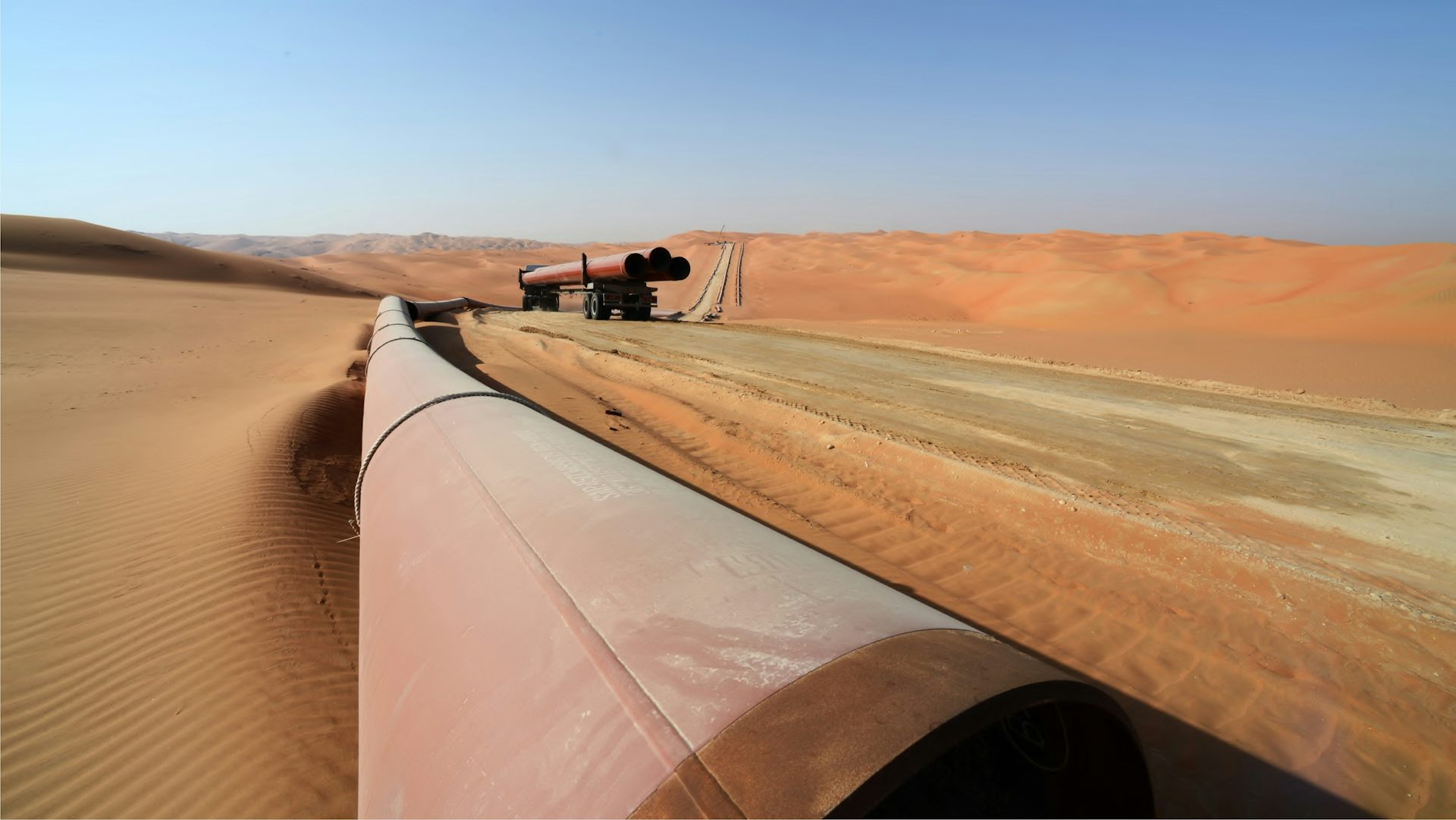
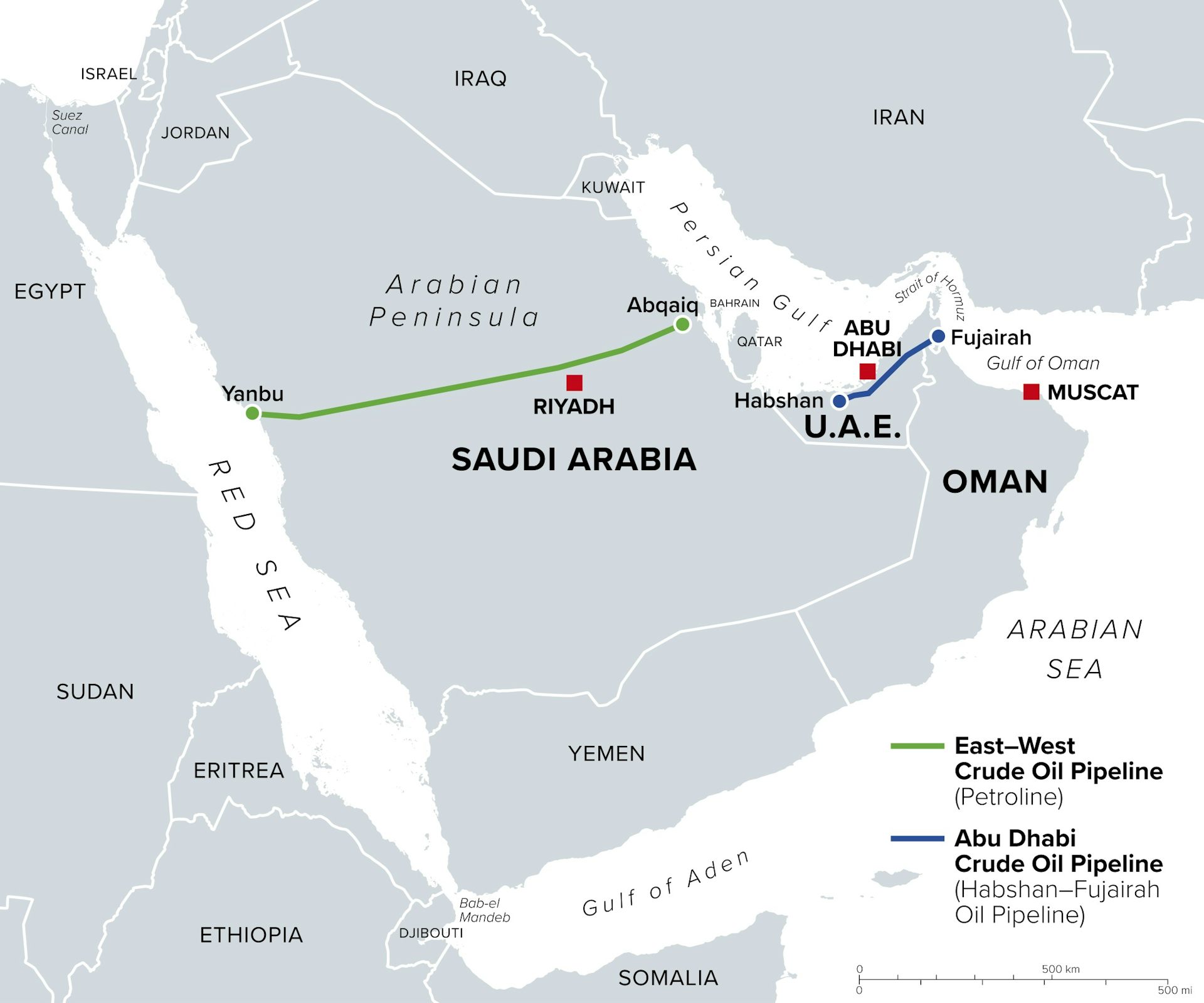
The most important pipeline on the planet right now runs across Saudi Arabia. The East-West Pipeline – also known as Petroline – was built in the 1980s during the original Tanker war, when Iran and Iraq attacked merchant vessels in the Gulf as part of their wider conflict.
El oleoducto más importante del planeta en este momento atraviesa Arabia Saudita. El Oleoducto Este-Oeste, también conocido como Petroline, fue construido en la década de 1980 durante la guerra original de los petroleros, cuando Irán e Irak atacaron a buques mercantes en el Golfo como parte de su conflicto más amplio.
The pipeline’s capacity was expanded to a 7 million barrel emergency ceiling in 2019. However, the loading terminals in the city of Yanbu on Saudi Arabia’s Red Sea coast were never designed to carry this much oil this fast, and analysts tracking tanker traffic estimate that less oil is currently flowing through the pipeline than its theoretical ceiling.
La capacidad del oleoducto se expandió a un techo de emergencia de 7 millones de barriles en 2019. Sin embargo, las terminales de carga en la ciudad de Yanbu, en la costa del Mar Rojo de Arabia Saudita, nunca fueron diseñadas para transportar tanto petróleo tan rápido, y los analistas que rastrean el tráfico de petroleros estiman que actualmente fluye menos petróleo por el oleoducto de lo que su techo teórico.
From Yanbu, oil bound for Europe still has to cross Egypt via the Sumed pipeline, which has a capacity of just 2.5 million barrels per day. Although oil flows through this pipeline have surged by 150% since the start of the war, its comparatively small capacity remains a binding constraint on European supply.
Desde Yanbu, el petróleo destinado a Europa todavía tiene que cruzar Egipto a través del oleoducto Sumed, que tiene una capacidad de solo 2.5 millones de barriles por día. Aunque el flujo de petróleo por este oleoducto ha aumentado en un 150% desde el inicio de la guerra, su capacidad comparativamente pequeña sigue siendo una limitación restrictiva para el suministro europeo.
Iran noticed the geoeconomic importance of Petroline and has targeted it accordingly. An Iranian drone strike on a pumping station in April knocked 700,000 barrels a day offline. Saudi Aramco, the operator, had the line back at full capacity within three days. While the repair time is reassuring, the fact of the strike is not.
Irán notó la importancia geoeconómica de Petroline y lo ha tenido en cuenta. Un ataque con dron iraní a una estación de bombeo en abril dejó fuera de servicio 700.000 barriles por día. Saudi Aramco, el operador, recuperó la línea a su capacidad total en tres días. Si bien el tiempo de reparación es tranquilizador, el hecho del ataque no lo es.
The other half of the Gulf bypass story runs through the United Arab Emirates (UAE) . The Abu Dhabi Crude Oil Pipeline (Adcop) goes from Habshan to Fujairah on the Gulf of Oman side of the country. With a capacity of just under 2 million barrels per day, Adcop is the only major bypass that exits the Gulf directly into the Indian Ocean.
La otra mitad de la historia del desvío del Golfo pasa por los Emiratos Árabes Unidos (EAU) . El Oleoducto de Petróleo Crudo de Abu Dabi (Adcop) va de Habshan a Fujairah en el lado del Golfo de Omán del país. Con una capacidad de poco menos de 2 millones de barriles por día, Adcop es el único desvío importante que sale del Golfo directamente hacia el Océano Índico.
But as with Petroline, it has been targeted during the war. Iranian drone strikes on Fujairah on March 3, 14 and 16 set storage tanks on fire and suspended loadings. While Adcop offers some diversification for the UAE, it does not solve the targeting problem.
Pero al igual que con Petroline, ha sido objetivo durante la guerra. Los ataques con drones iraníes en Fujairah los días 3, 14 y 16 de marzo incendiaron tanques de almacenamiento y suspendieron las cargas. Si bien Adcop ofrece cierta diversificación para los EAU, no resuelve el problema de los objetivos.
The situation is worse for the Gulf region’s other big oil producers. Iraq’s 3.4 million barrels per day of pre-war crude exports went almost entirely through the southern port city of Basra and the Strait of Hormuz.
La situación es peor para otros grandes productores de petróleo de la región del Golfo. Las exportaciones de crudo de Irak, de 3.4 millones de barriles por día antes de la guerra, pasaron casi en su totalidad por la ciudad portuaria meridional de Basra y el Estrecho de Hormuz.
There is one northern pipeline, connecting oil fields in Kirkuk to Ceyhan in Turkey. This pipeline was reopened in September 2025 after a two-and-a-half-year halt, with flows ramped up to 250,000 barrels a day in March. But this volume pales in comparison to what Iraq has lost.
Hay un oleoducto septentrional, que conecta campos petroleros en Kirkuk con Ceyhan en Turquía. Este oleoducto se reabrió en septiembre de 2025 después de una interrupción de dos años y medio, con flujos aumentados a 250.000 barriles por día en marzo. Pero este volumen palidece en comparación con lo que Irak ha perdido.
Kuwait has it worse still. Pre-war crude exports ran at around 2 million barrels per day, with every barrel exiting through Hormuz. Kuwait has no pipeline alternative. Kuwait Petroleum Corporation declared force majeure in March, temporarily allowing it to suspend its obligations to meet delivery contracts.
Kuwait está en peores condiciones aún. Las exportaciones de crudo antes de la guerra rondaban los 2 millones de barriles por día, y cada barril salía por Hormuz. Kuwait no tiene alternativa de oleoducto. Kuwait Petroleum Corporation declaró fuerza mayor en marzo, lo que le permitió suspender temporalmente sus obligaciones de cumplir con los contratos de entrega.
This was extended on April 20, with the oil company saying it could not meet contractual obligations even if Hormuz reopened. Overcoming the damage that has been inflicted on Kuwait’s production base – and then ramping up production – will take months.
Esto se extendió hasta el 20 de abril, cuando la compañía petrolera dijo que no podía cumplir con las obligaciones contractuales incluso si Hormuz reabría. Superar el daño infligido a la base de producción de Kuwait —y luego aumentar la producción— llevará meses.
Qatar’s vulnerability is a different shape. Its pre-war crude exports were smaller than its Gulf neigbours, at around 0.6 million barrels per day. These exports all left Qatar via the strait. For Qatar, the story is gas. Its 77 million tonne LNG capacity at Ras Laffan is the largest in the world, supplying about 19% of global LNG trade. There is no alternative to shipping this gas through Hormuz.
La vulnerabilidad de Qatar tiene una forma diferente. Sus exportaciones de crudo antes de la guerra eran menores que las de sus vecinos del Golfo, alrededor de 0.6 millones de barriles por día. Todas estas exportaciones salían de Qatar a través del estrecho. Para Qatar, la historia es el gas. Su capacidad de GNL de 77 millones de toneladas en Ras Laffan es la más grande del mundo, suministrando alrededor del 19% del comercio mundial de GNL. No hay alternativa a enviar este gas a través de Hormuz.
Iran itself has built a Hormuz bypass: a 1,000-kilometre pipeline from Goreh at the head of the Gulf to a terminal at Jask on the Gulf of Oman. It is designed for 1 million barrels per day. But in practice, sanctions and unfinished terminal infrastructure have kept actual throughput at a fraction of design.
Irán mismo ha construido un desvío de Hormuz: un oleoducto de 1.000 kilómetros desde Goreh en la cabecera del Golfo hasta una terminal en Jask en el Golfo de Omán. Está diseñado para 1 millón de barriles por día. Pero en la práctica, las sanciones y la infraestructura de terminales inacabada han mantenido el rendimiento real en una fracción del diseño.
The US Energy Information Administration estimated that, in summer 2024, under 70,000 barrels per day were flowing through the pipeline. Loadings stopped altogether that September. According to Kpler, which provides real-time data on global shipping movements, only a single tanker – around two million barrels – has loaded at Jask in the war so far.
La Administración de Información Energética de EE. UU. estimó que, en el verano de 2024, menos de 70,000 barriles por día fluían por el oleoducto. Las cargas cesaron por completo ese septiembre. Según Kpler, que proporciona datos en tiempo real sobre movimientos de envío globales, solo un único petrolero —alrededor de dos millones de barriles— ha cargado en Jask en la guerra hasta ahora.
A call for more pipes in the Gulf, as there have been since the war began, is understandable. But it is no answer. Replicating Hormuz in pipelines would cost hundreds of billions of US dollars and a decade of construction. And at the end of it, new pipelines and terminals at Yanbu, Fujairah and wherever else would be no harder to reach with a drone than the old ones.
La petición de más oleoductos en el Golfo, como ha habido desde que comenzó la guerra, es comprensible. Pero no es una respuesta. Replicar Hormuz en oleoductos costaría cientos de miles de millones de dólares estadounidenses y una década de construcción. Y al final, los nuevos oleoductos y terminales en Yanbu, Fujairah y dondequiera que sea no serían más difíciles de alcanzar con un dron que los antiguos.
David B Roberts does not work for, consult, own shares in or receive funding from any company or organisation that would benefit from this article, and has disclosed no relevant affiliations beyond their academic appointment.
David B Roberts no trabaja para, asesora, posee acciones en o recibe financiación de ninguna empresa u organización que se beneficiaría de este artículo, y no ha revelado afiliaciones relevantes más allá de su nombramiento académico.
Read more
-

Cómo decide la Corte Suprema de EE. UU. sus casos: una guía paso a paso
How the US Supreme Court decides its cases – a step-by-step guide