为什么波兰总统在与弗拉基米尔·泽连斯基的争端中援引了战时历史
Why Poland’s president is invoking wartime history in a…
This row is more about domestic Polish politics than any diplomatic incident.
这场争议更多的是关于波兰的国内政治,而非任何外交事件。
There have long been tensions, political, economic and cultural, between Poland and Ukraine. But that hasn’t prevented Poland from being the biggest supporter of its neighbour, taking in millions of Ukrainians fleeing the war, about 1 million of whom have remained.
长期以来,波兰和乌克兰之间一直存在政治、经济和文化上的紧张关系。但这并没有阻止波兰成为其邻国的最大支持者,接纳了数百万逃离战争的乌克兰人,其中约有100万人留了下来。
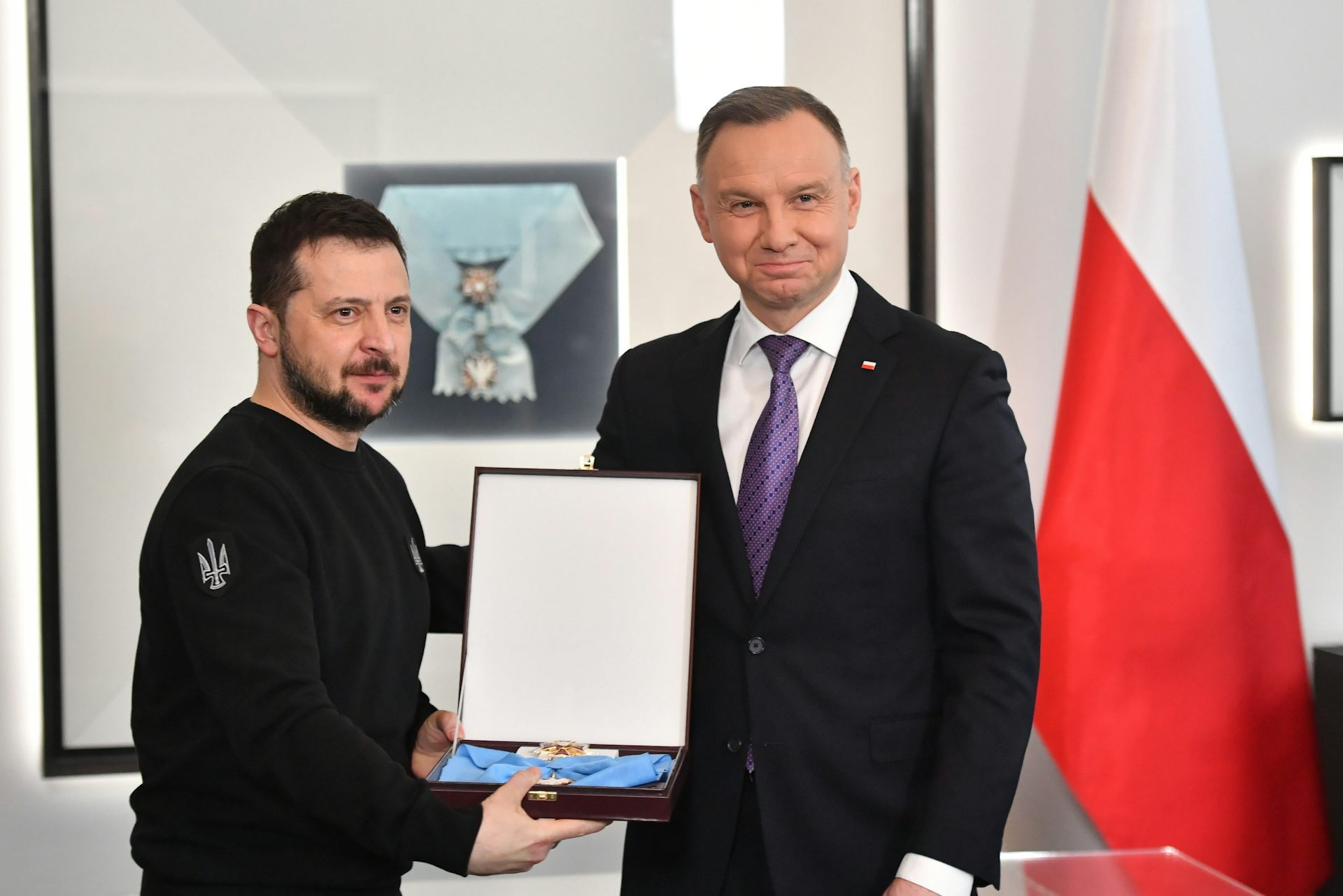
And in 2023, Poland conferred its highest honour, the Order of the White Eagle, on Ukraine’s president Volodymyr Zelensky. At the time, then-president Andrzej Duda told the Ukrainian president: “It is difficult to hide the tears of emotion watching your service to your homeland.”
2023年,波兰向乌克兰总统弗拉基米尔·泽连斯基授予了其最高荣誉——白鹰勋章。当时,前总统安杰伊·杜达对这位乌克兰总统说:“看到您为祖国服务,很难不流泪。”
But on June 19, the current president, Karol Nawrocki, announced he was rescinding the order and stripping Zelensky of the honour. He did so after Zelensky awarded the honorary title “Heroes of the UPA” to an elite unit of Ukraine’s special forces. Zelensky said he had awarded the honour at the unit’s request. He said it was his duty as commander-in-chief, who “must provide them with everything they need to protect our people and our land”. He added: “And if they are motivated by our heroes … and if this is very important to them, I must do whatever they tell me.”
但6月19日,现任总统卡罗尔·纳夫罗茨基宣布他撤销该奖项,并取消了泽连斯基的荣誉。此前,泽连斯基曾授予乌克兰特种部队的一个精英单位“乌克兰民族解放军(UPA)英雄”的荣誉称号。泽连斯基说,这是应该单位的要求而颁发的荣誉。他说,作为总司令,他有责任“提供他们保护人民和土地所需的一切”。他还补充道:“如果我们的英雄激励了他们……如果这对他们非常重要,我必须听从他们的指示。”
Political spats between the two countries over historical memory are nothing new. But this is the first since Russia’s full-scale invasion of Ukraine to escalate to this degree. And the fact is that it has more to do with domestic Polish politics than any long-term rift between Poland and Ukraine.
两国之间关于历史记忆的政治争端并非新鲜事。但自俄罗斯全面入侵乌克兰以来,这是首次升级到如此程度。事实上,这更多地与波兰国内政治有关,而与波兰和乌克兰之间的任何长期裂痕都没有关系。
First, some background. The Ukrainian Insurgent Army (UPA) was a Ukrainian nationalist formation that fought against the Soviets during the second world war. After harsh Soviet rule in Ukraine many in the UPA saw the German military invasion as liberating them from Soviet repression.
首先,一些背景信息。乌克兰民族解放军(UPA)是一个在第二次世界大战期间反对苏联的乌克兰民族主义组织。在经历了苏联严酷统治后,许多UPA成员将德国军事入侵视为摆脱苏联压迫的解放。
But it turned out that the Nazis were even worse than the Soviets. For the Poles, though, memories of the massacre of ethnic Poles in Volhynia, now Volyn, in Ukraine, by members of the UPA, remain raw.
但事实证明,纳粹比苏联更糟糕。然而,对于波兰人来说,关于UPA成员在乌克兰沃伦尼亚(现称沃尔尹)屠杀波兰族人的记忆仍然是鲜活的创伤。
As American historian Timothy Snyder has written: “Ukrainians think about the UPA mainly through … the struggle against the Red Army after 1945. Poles remember … 1943, when the UPA killed tens of thousands of Poles in Volhynia.”
正如美国历史学家蒂莫西·斯奈德所写:“乌克兰人主要通过……1945年之后与红军的斗争来思考UPA。而波兰人记得的是……1943年,UPA在沃伦尼亚杀害了数万名波兰人。”
These memories lead to different interpretations which are used to serve often divergent domestic political purposes in the two countries. Despite the UPA’s history, Ukraine continues to award UPA-related honours because the nationalist movement has become a symbol of resistance to Soviet and Russian rule, which fits with the broader post-2014 campaign to rid Ukraine of vestiges of its communist past.
这些记忆导致了不同的解读,这些解读被用于服务于两国经常相悖的国内政治目的。尽管有UPA的历史,乌克兰仍然继续授予与UPA相关的荣誉,因为民族主义运动已成为抵抗苏联和俄罗斯统治的象征,这符合2014年之后摆脱共产主义残余痕迹的更广泛运动。
Russia’s invasion of Ukraine has reinforced this trend, making such honours less about revisiting the past than about mobilising contemporary symbols of national resistance in Ukraine – even if they remain deeply controversial in Poland.
俄罗斯入侵乌克兰加剧了这一趋势,使得此类荣誉不再是回顾过去,而是动员乌克兰当代国家抵抗符号——即使这些符号在波兰仍然极具争议。
Nawrocki claims he revoked Zelensky’s award because “his countrymen’s pain threshold has been crossed”. It’s a strong reaction, which drastically contrasts with Nawrocki’s own previous position as head of the Institute of National Remembrance in 2023, when he stated that Ukraine was free to honour its own historical figures, including the UPA’s leaders.
纳夫罗茨基声称他撤销泽连斯基的奖项是因为“他的同胞的痛阈已经被突破”。这是一个强烈的反应,与纳夫罗茨基本人2023年作为国家记忆研究所所长时的立场形成了鲜明对比,当时他曾表示乌克兰有权表彰自己的历史人物,包括UPA的领导人。
The Polish prime minister, Donald Tusk, was more restrained, urging both countries to stop quarrelling about the past for the sake of the future. His deputy Radosław Sikorski, who is also Poland’s minister of foreign affairs, pointed out that while Zelensky’s decree was inappropriate, that Nawrocki’s reaction was disproportionate and had been welcomed in Moscow.
波兰总理唐纳德·图斯克则更为克制,敦促两国为了未来停止争论过去的问题。他的副手拉多斯瓦夫·西科尔斯基,同时也是波兰外交部长,指出,虽然泽连斯基的法令不恰当,但纳夫罗茨基的反应是过度且在莫斯科受到了欢迎的。
Jockeying for political advantage
争夺政治优势
This contrast between the responses of Nawrocki, a rightwing populist, and the centre-left government suggests that the dispute cannot be explained by history alone. It illustrates the friction between the right-leaning president and the left-leaning government. Nawrocki has unofficially started a campaign for next year’s parliamentary election and is rallying for his Law and Justice party (PiS) by playing up anti-Ukrainian sentiment.
诺沃茨基(Nawrocki)这位右翼民粹主义者与中左翼政府的反应之间的这种对比表明,这场争端不能仅用历史来解释。它体现了右倾总统和左倾政府之间的摩擦。诺沃茨基已非正式地开始了明年的议会选举竞选活动,并通过夸大反乌克兰情绪来为他的法律与正义党(PiS)造势。
Before being elected, Nawrocki promised to block Ukraine’s accession to Nato. He has also been against Ukraine’s membership of the EU. Zelensky has given him an opportunity to capitalise on anti-Ukrainian narratives that play well to Poles disaffected by the war.
在当选之前,纳夫罗茨基曾承诺阻止乌克兰加入北约。他也一直反对乌克兰成为欧盟成员国。泽连斯基给了他一个机会,让他可以利用那些迎合了对战争心怀不满的波兰人的反乌克兰叙事。
Additionally, by revoking Zelensky’s honour, Nawrocki has laid down a challenge to Tusk. The prime minister’s countersignature is required to validate the decision – and this would put him in a difficult political situation domestically.
此外,通过取消泽连斯基的荣誉,纳夫罗茨基向图什提出了挑战。总理的联署是确认这一决定的必要条件——这在国内使他处于一个困难的政治境地。
Following the dispute, Nawrocki’s approval ranking is at a historic high of 54.8% – up by 8.4 percentage points from a month before.
争议过后,Nawrocki 的支持率达到了历史新高的 54.8%,比一个月前提高了 8.4 个百分点。
While anti-Ukrainian rhetoric falls on fertile soil in Poland due to popular fatigue at supporting so many refugees, there is still strong support for Ukraine.
由于民众在支持大量难民方面感到疲惫,反乌克兰的言论在波兰很容易滋生,但对乌克兰的支持仍然非常强烈。
Jerzy Wójcik, a prominent Polish journalist and media executive, who has led major humanitarian campaigns like Warmth from Poland for Kyiv, initiated a petition to present Zelenskyy with Citizen’s Order of the Future award. He said that “the Polish right wing has launched a campaign ahead of the parliamentary elections and is ruthlessly exploiting the Volhynia tragedy for political gain”.
杰日·沃伊茨克(Jerzy Wójcik)是一位著名的波兰记者和媒体高管,他曾领导过“波兰为基辅发起的温暖”等大型人道主义运动。他发起了一份请愿书,旨在向泽连科总统呈递“未来公民勋章”。他说:“波兰右翼政党在议会选举前夕发动了运动,正在为了政治利益残忍地利用沃伦尼亚悲剧。”
UPA’s past links to genocide are felt by most Poles. But there is still a strong tension when it comes to Nawrocki’s revocation of Zelensky’s order. This, along with Polish public support for Ukraine, suggests that the dispute is more complex than the political rhetoric implies.
UPA过去与种族灭绝的联系让大多数波兰人深感不安。但在诺沃茨基撤销泽连斯基命令的问题上,仍然存在巨大的张力。这,加上波兰民众对乌克兰的支持,表明这场争端比政治言辞所暗示的更为复杂。
The dispute is not primarily about the UPA – nor is it evidence of a fundamental shift in Polish foreign policy. While it has the potential to become a bigger diplomatic challenge for the two countries, it illustrates a broader phenomenon: political leaders mobilising contested history to solve present-day domestic political problems.
这场争端主要不是关于乌克兰人民共和国(UPA)——它也不是波兰外交政策发生根本性转变的证据。虽然它有可能成为两国更大的外交挑战,但它说明了一个更广泛的现象:政治领导人动员有争议的历史来解决当代的国内政治问题。
Similar dynamics can be seen in relations between Serbia and Kosovo. Their political leaders regularly invoke competing historical narratives surrounding the 14th-century Battle of Kosovo to strengthen their domestic political standing, often at the expense of dialogue between the two sides.
类似的动态在塞尔维亚和科索沃之间的关系中也能看到。他们的政治领导人经常援引围绕14世纪科索沃战役的相互冲突的历史叙事,以巩固其国内政治地位,但这往往是以牺牲双方对话为代价的。
These strategies may generate short-term domestic political gains. But they risk undermining strategically important relationships.
这些策略可能会带来短期的国内政治收益。但它们也可能损害具有战略重要性的关系。
Artur Nadiiev does not work for, consult, own shares in or receive funding from any company or organisation that would benefit from this article, and has disclosed no relevant affiliations beyond their academic appointment.
Artur Nadiiev 不受任何受益于本文的公司或组织雇佣、提供咨询服务、拥有股份或获得资金支持,并且除了其学术职位之外未披露任何相关的任职关系。