¿Por qué el presidente de Polonia está invocando la historia de tiempos de guerra en una disputa con Volodímir Zelenski?
Why Poland’s president is invoking wartime history in a dispute with Volodymyr Zelensky
This row is more about domestic Polish politics than any diplomatic incident.
Esta disputa tiene más que ver con la política interna polaca que con cualquier incidente diplomático.
There have long been tensions, political, economic and cultural, between Poland and Ukraine. But that hasn’t prevented Poland from being the biggest supporter of its neighbour, taking in millions of Ukrainians fleeing the war, about 1 million of whom have remained.
Desde hace mucho tiempo ha habido tensiones políticas, económicas y culturales entre Polonia y Ucrania. Pero eso no ha impedido que Polonia sea el mayor apoyo de su vecino, acogiendo a millones de ucranianos huyendo de la guerra, de los cuales unos 1 millón han permanecido.
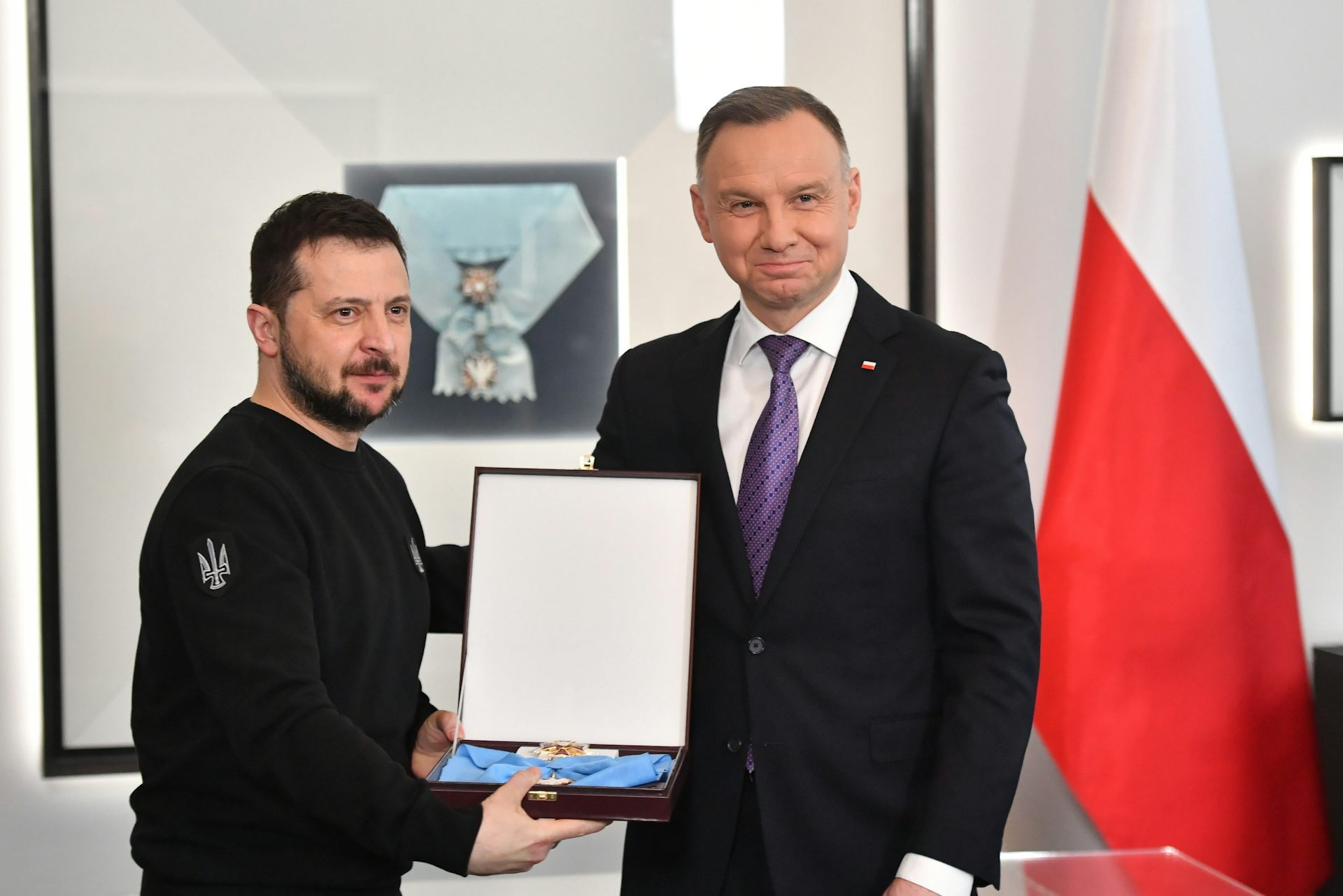
And in 2023, Poland conferred its highest honour, the Order of the White Eagle, on Ukraine’s president Volodymyr Zelensky. At the time, then-president Andrzej Duda told the Ukrainian president: “It is difficult to hide the tears of emotion watching your service to your homeland.”
Y en 2023, Polonia concedió su más alto honor, la Orden del Águila Blanca, al presidente de Ucrania, Volodímir Zelenski. En ese momento, el entonces presidente Andrzej Duda dijo al presidente ucraniano: “Es difícil ocultar las lágrimas de emoción viendo vuestro servicio a vuestra patria”.
But on June 19, the current president, Karol Nawrocki, announced he was rescinding the order and stripping Zelensky of the honour. He did so after Zelensky awarded the honorary title “Heroes of the UPA” to an elite unit of Ukraine’s special forces. Zelensky said he had awarded the honour at the unit’s request. He said it was his duty as commander-in-chief, who “must provide them with everything they need to protect our people and our land”. He added: “And if they are motivated by our heroes … and if this is very important to them, I must do whatever they tell me.”
Pero el 19 de junio, el actual presidente, Karol Nawrocki, anunció que revocaba la orden y despojaba a Zelenski del honor. Lo hizo después de que Zelenski otorgara el título honorífico “Héroes de la UPA” a una unidad de élite de las fuerzas especiales de Ucrania. Zelenski dijo que había concedido el honor a petición de la unidad. Dijo que era su deber como comandante en jefe, quien “debe proporcionarles todo lo que necesitan para proteger a nuestra gente y nuestra tierra”. Añadió: “Y si nuestros héroes están motivados… y si esto es muy importante para ellos, debo hacer lo que me digan”.
Political spats between the two countries over historical memory are nothing new. But this is the first since Russia’s full-scale invasion of Ukraine to escalate to this degree. And the fact is that it has more to do with domestic Polish politics than any long-term rift between Poland and Ukraine.
Las disputas políticas entre los dos países sobre la memoria histórica no son nada nuevo. Pero esta es la primera vez desde la invasión a gran escala de Rusia en Ucrania que se eleva a este grado. Y el hecho es que tiene más que ver con la política interna polaca que con cualquier brecha a largo plazo entre Polonia y Ucrania.
First, some background. The Ukrainian Insurgent Army (UPA) was a Ukrainian nationalist formation that fought against the Soviets during the second world war. After harsh Soviet rule in Ukraine many in the UPA saw the German military invasion as liberating them from Soviet repression.
Primero, un poco de contexto. El Ejército Insurgente Ucraniano (UPA) fue una formación nacionalista ucraniana que luchó contra los soviéticos durante la segunda guerra mundial. Después del duro régimen soviético en Ucrania, muchos miembros de la UPA vieron la invasión militar alemana como algo que les liberaría de la represión soviética.
But it turned out that the Nazis were even worse than the Soviets. For the Poles, though, memories of the massacre of ethnic Poles in Volhynia, now Volyn, in Ukraine, by members of the UPA, remain raw.
Pero resultó que los nazis fueron incluso peores que los soviéticos. Sin embargo, para los polacos, los recuerdos de la masacre de polacos étnicos en Volhínia, ahora Volyn, en Ucrania, por miembros de la UPA, siguen frescos.
As American historian Timothy Snyder has written: “Ukrainians think about the UPA mainly through … the struggle against the Red Army after 1945. Poles remember … 1943, when the UPA killed tens of thousands of Poles in Volhynia.”
Como ha escrito el historiador estadounidense Timothy Snyder: “Los ucranianos piensan en la UPA principalmente a través… la lucha contra el Ejército Rojo después de 1945. Los polacos recuerdan… 1943, cuando la UPA mató a decenas de miles de polacos en Volhínia”.
These memories lead to different interpretations which are used to serve often divergent domestic political purposes in the two countries. Despite the UPA’s history, Ukraine continues to award UPA-related honours because the nationalist movement has become a symbol of resistance to Soviet and Russian rule, which fits with the broader post-2014 campaign to rid Ukraine of vestiges of its communist past.
Estos recuerdos conducen a diferentes interpretaciones que se utilizan para servir a menudo a propósitos políticos internos divergentes en los dos países. A pesar de la historia de la UPA, Ucrania continúa otorgando honores relacionados con la UPA porque el movimiento nacionalista se ha convertido en un símbolo de resistencia al dominio soviético y ruso, lo que encaja con la campaña más amplia posterior a 2014 para despojar a Ucrania de los vestigios de su pasado comunista.
Russia’s invasion of Ukraine has reinforced this trend, making such honours less about revisiting the past than about mobilising contemporary symbols of national resistance in Ukraine – even if they remain deeply controversial in Poland.
La invasión de Rusia a Ucrania ha reforzado esta tendencia, haciendo que tales honores se trate menos de revisar el pasado que de movilizar símbolos contemporáneos de resistencia nacional en Ucrania, incluso si siguen siendo profundamente controvertidos en Polonia.
Nawrocki claims he revoked Zelensky’s award because “his countrymen’s pain threshold has been crossed”. It’s a strong reaction, which drastically contrasts with Nawrocki’s own previous position as head of the Institute of National Remembrance in 2023, when he stated that Ukraine was free to honour its own historical figures, including the UPA’s leaders.
Nawrocki afirma que revocó el premio de Zelenski porque “el umbral del dolor de sus compatriotas ha sido cruzado”. Es una reacción fuerte, que contrasta drásticamente con la propia posición anterior de Nawrocki como jefe del Instituto de Memoria Nacional en 2023, cuando declaró que Ucrania era libre de honrar a sus propias figuras históricas, incluidos los líderes de la UPA.
The Polish prime minister, Donald Tusk, was more restrained, urging both countries to stop quarrelling about the past for the sake of the future. His deputy Radosław Sikorski, who is also Poland’s minister of foreign affairs, pointed out that while Zelensky’s decree was inappropriate, that Nawrocki’s reaction was disproportionate and had been welcomed in Moscow.
El primer ministro polaco, Donald Tusk, fue más moderado, instando a ambos países a dejar de pelear por el pasado por el bien del futuro. Su diputado Radosław Sikorski, que también es ministro de asuntos exteriores de Polonia, señaló que si bien el decreto de Zelenski fue inapropiado, la reacción de Nawrocki fue desproporcionada y había sido recibida con satisfacción en Moscú.
Jockeying for political advantage
Luchando por ventaja política
This contrast between the responses of Nawrocki, a rightwing populist, and the centre-left government suggests that the dispute cannot be explained by history alone. It illustrates the friction between the right-leaning president and the left-leaning government. Nawrocki has unofficially started a campaign for next year’s parliamentary election and is rallying for his Law and Justice party (PiS) by playing up anti-Ukrainian sentiment.
Este contraste entre las respuestas de Nawrocki, un populista de derecha, y el gobierno centroizquierda sugiere que la disputa no puede explicarse solo por la historia. Ilustra la fricción entre el presidente de tendencia derecha y el gobierno de tendencia izquierda. Nawrocki ha iniciado de manera no oficial una campaña para las elecciones parlamentarias del próximo año y está movilizando a favor de su partido Ley y Justicia (PiS) al exagerar el sentimiento antiucraniano.
Before being elected, Nawrocki promised to block Ukraine’s accession to Nato. He has also been against Ukraine’s membership of the EU. Zelensky has given him an opportunity to capitalise on anti-Ukrainian narratives that play well to Poles disaffected by the war.
Antes de ser elegido, Nawrocki prometió bloquear la adhesión de Ucrania a la OTAN. También se ha opuesto a la membresía de Ucrania en la UE. Zelensky le ha dado una oportunidad para capitalizar narrativas antiucranianas que resuenan bien entre los polacos descontentos con la guerra.
Additionally, by revoking Zelensky’s honour, Nawrocki has laid down a challenge to Tusk. The prime minister’s countersignature is required to validate the decision – and this would put him in a difficult political situation domestically.
Además, al revocar el honor de Zelensky, Nawrocki ha planteado un desafío a Tusk. Se requiere la contrafirma del primer ministro para validar la decisión, y esto lo pondría en una difícil situación política a nivel nacional.
Following the dispute, Nawrocki’s approval ranking is at a historic high of 54.8% – up by 8.4 percentage points from a month before.
Tras la disputa, el índice de aprobación de Nawrocki está en un máximo histórico del 54.8% – un aumento de 8.4 puntos porcentuales respecto al mes anterior.
While anti-Ukrainian rhetoric falls on fertile soil in Poland due to popular fatigue at supporting so many refugees, there is still strong support for Ukraine.
Aunque la retórica antiucraniana encuentra un terreno fértil en Polonia debido al cansancio popular de apoyar a tantos refugiados, todavía existe un fuerte apoyo para Ucrania.
Jerzy Wójcik, a prominent Polish journalist and media executive, who has led major humanitarian campaigns like Warmth from Poland for Kyiv, initiated a petition to present Zelenskyy with Citizen’s Order of the Future award. He said that “the Polish right wing has launched a campaign ahead of the parliamentary elections and is ruthlessly exploiting the Volhynia tragedy for political gain”.
Jerzy Wójcik, un destacado periodista polaco y ejecutivo de medios, que ha dirigido grandes campañas humanitarias como «Warmth from Poland for Kyiv», inició una petición para presentarle a Zelenskyy el premio Orden de Ciudadano del Futuro. Dijo que «la derecha polaca ha lanzado una campaña antes de las elecciones parlamentarias y está explotando sin piedad la tragedia de Volinia con fines políticos.»
UPA’s past links to genocide are felt by most Poles. But there is still a strong tension when it comes to Nawrocki’s revocation of Zelensky’s order. This, along with Polish public support for Ukraine, suggests that the dispute is more complex than the political rhetoric implies.
Los vínculos pasados de la UPA con el genocidio son sentidos por la mayoría de los polacos. Pero todavía hay una fuerte tensión en lo que respecta a la revocación por parte de Nawrocki de la orden de Zelenski. Esto, junto con el apoyo público polaco a Ucrania, sugiere que la disputa es más compleja de lo que implica la retórica política.
The dispute is not primarily about the UPA – nor is it evidence of a fundamental shift in Polish foreign policy. While it has the potential to become a bigger diplomatic challenge for the two countries, it illustrates a broader phenomenon: political leaders mobilising contested history to solve present-day domestic political problems.
La disputa no se trata principalmente de la UPA, ni es evidencia de un cambio fundamental en la política exterior polaca. Aunque tiene el potencial de convertirse en un desafío diplomático mayor para los dos países, ilustra un fenómeno más amplio: líderes políticos movilizando historia controvertida para resolver problemas políticos internos de la actualidad.
Similar dynamics can be seen in relations between Serbia and Kosovo. Their political leaders regularly invoke competing historical narratives surrounding the 14th-century Battle of Kosovo to strengthen their domestic political standing, often at the expense of dialogue between the two sides.
Dinámicas similares se pueden observar en las relaciones entre Serbia y Kosovo. Sus líderes políticos invocan regularmente narrativas históricas contrapuestas sobre la Batalla de Kosovo del siglo XIV para fortalecer su posición política interna, a menudo a expensas del diálogo entre ambas partes.
These strategies may generate short-term domestic political gains. But they risk undermining strategically important relationships.
Estas estrategias pueden generar ganancias políticas a corto plazo. Pero corren el riesgo de socavar relaciones estratégicamente importantes.
Artur Nadiiev does not work for, consult, own shares in or receive funding from any company or organisation that would benefit from this article, and has disclosed no relevant affiliations beyond their academic appointment.
Artur Nadiiev no trabaja para, asesora, posee acciones en o recibe financiación de ninguna empresa u organización que se beneficiaría de este artículo, y no ha revelado afiliaciones relevantes más allá de su nombramiento académico.
Read more
-
La guerra de Ucrania ahora es más larga que la Primera Guerra Mundial – pero las similitudes son inquietantes
Ukraine war now longer than the first world war – but the similarities are unsettling
-
¿Qué es la ‘memoria muscular’ y puedo mejorar la mía?
What is ‘muscle memory’ and can I improve mine?