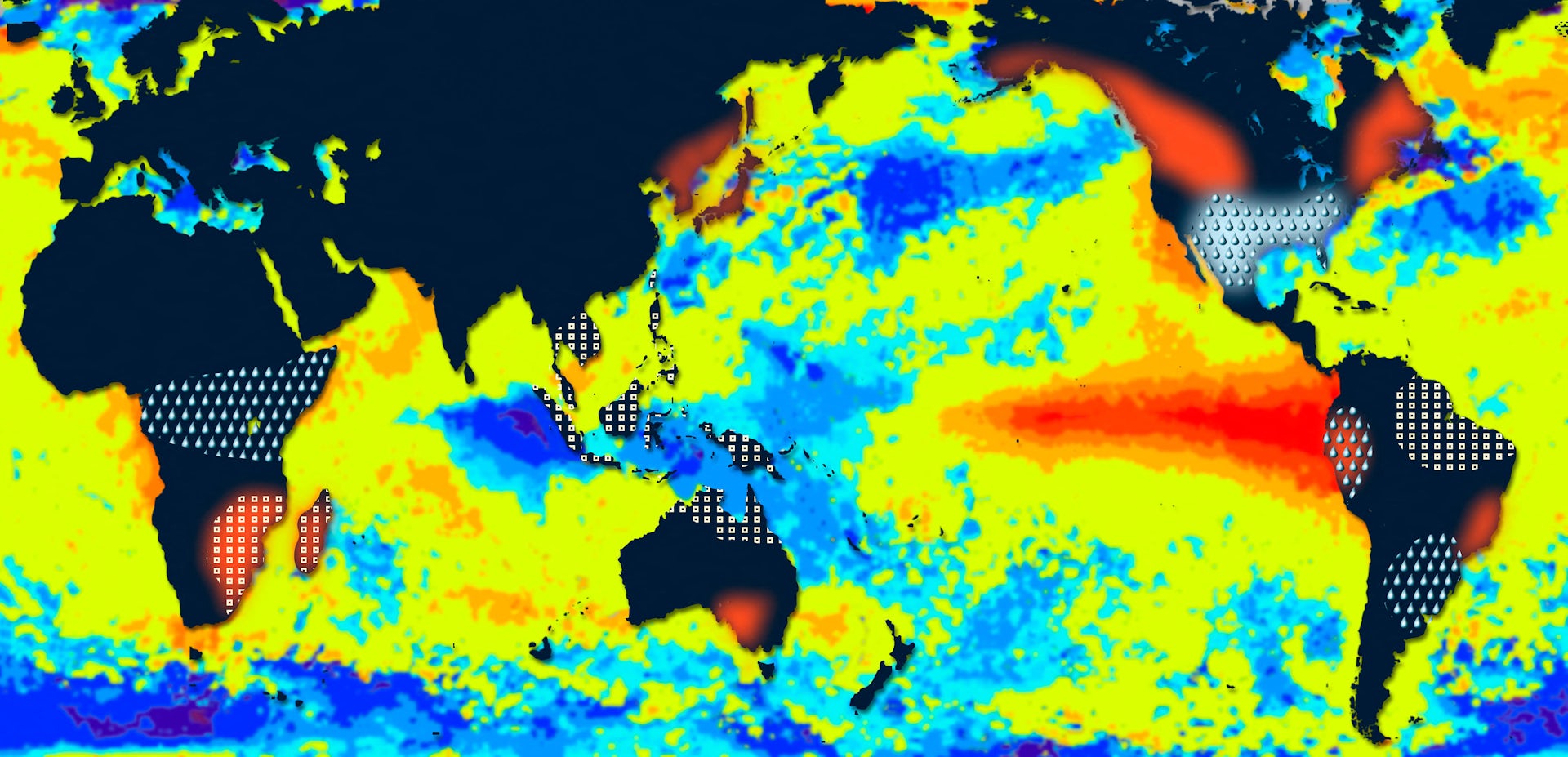
Cómo un El Niño se convierte en un súper El Niño
How an El Niño becomes a super El Niño
Climate expert Ioana Colfescu talks to The Conversation Weekly podcast about predicting the impact of El Niño.
La experta climática Ioana Colfescu habla en el pódcast The Conversation Weekly sobre la predicción del impacto de El Niño.
El Niño has begun and forecasters predict a more than 60% chance that the naturally occurring phenomenon could become a very strong, or super El Niño later in 2026.
Ha comenzado El Niño y los pronosticadores predicen una probabilidad superior al 60% de que el fenómeno natural pueda convertirse en un super El Niño muy fuerte a finales de 2026.
El Niño begins with warmer water in the Pacific Ocean near the equator and can have a cascade of dramatic effects on the world’s weather.
El Niño comienza con aguas más cálidas en el Océano Pacífico cerca del ecuador y puede tener una cascada de efectos dramáticos en el clima mundial.
But what chain of events has to happen for high temperatures in the Pacific to translate into severe floods, droughts and storms around the world? And what role does climate change play in El Niño?
Pero, ¿qué cadena de eventos tiene que ocurrir para que las altas temperaturas en el Pacífico se traduzcan en inundaciones graves, sequías y tormentas alrededor del mundo? ¿Y qué papel juega el cambio climático en El Niño?
In this episode of The Conversation Weekly podcast, Ioana Colfescu, an expert in climate and machine learning at the University of St Andrews and the University of Edinburgh, explains how El Niño works and what it could mean for the world.
En este episodio del pódcast The Conversation Weekly, Ioana Colfescu, experta en clima y aprendizaje automático de la Universidad de St Andrews y la Universidad de Edimburgo, explica cómo funciona El Niño y lo que podría significar para el mundo.
In the early 1600s, fishermen in Peru and Ecuador noticed something unusual. Their nets were usually flush with anchovies which thrive in the cold waters of the Pacific Ocean. But every few years, the waters began to turn warmer, driving the anchovies away. They called this phenomenon El Niño, meaning little boy, or Christ child, because it tends to peak around Christmas time.
A principios del siglo XVII, pescadores en Perú y Ecuador notaron algo inusual. Sus redes solían estar llenas de anchoas que prosperan en las aguas frías del Océano Pacífico. Pero cada pocos años, el agua comenzó a calentarse, alejando a las anchoas. Llamaron a este fenómeno El Niño, que significa niño pequeño o hijo de Cristo, porque tiende a alcanzar su punto máximo alrededor de la Navidad.
Centuries later, scientists would understand that this warmer water in the equatorial Pacific is part of a naturally occurring cycle and they would start trying to predict when the next one was coming and how bad it would be.
Siglos después, los científicos comprenderían que esta agua más cálida en el Pacífico ecuatorial es parte de un ciclo natural y comenzarían a intentar predecir cuándo llegaría el siguiente y cuán grave sería.
“We have indicators that place this El Niño in a similar pattern or signs that other very large El Niños had,” says Colfescu. “But while we know it’s gonna be a big event in terms of temperature, this temperature index is not yet defined as a big event in terms of impact.”
«Tenemos indicadores que sitúan este El Niño en un patrón similar o signos de lo que tuvieron otros El Niños muy grandes», dice Colfescu. «Pero si bien sabemos que va a ser un gran evento en términos de temperatura, este índice de temperatura aún no está definido como un gran evento en términos de impacto.»
The 2023-24 El Niño was one of the top five strongest ever recorded. While it dramatically affected some parts of the world, including severe flooding in Brazil, and also contributed to 2024 being the hottest year ever recorded, some of the expected effects did not materialise. Colfescu says that’s because El Niño’s “impacts are nuanced … and the response across the tropics, can be different to the one [outside the] tropics”.
El Niño de 2023-24 fue uno de los cinco más fuertes jamás registrados. Si bien afectó drásticamente a algunas partes del mundo, incluyendo inundaciones graves en Brasil y también contribuyó a que 2024 fuera el año más cálido registrado, algunos de los efectos esperados no se materializaron. Colfescu dice que esto se debe a que los «impactos de El Niño son matizados… y la respuesta en los trópicos puede ser diferente a la [fuera de los] trópicos».
Whatever severe weather conditions do happen, Colfescu says they’re likely to be “made much worse because the El Niño right now is overlapped on an already warm ocean because of climate change.”
Cualquiera que sean las condiciones climáticas severas, Colfescu dice que es probable que se «empeoren mucho porque el El Niño actual se superpone a un océano ya cálido debido al cambio climático.»
Listen to Colfescu explain the mechanisms behind El Niño on The Conversation Weekly podcast.
Escuche a Colfescu explicar los mecanismos detrás de El Niño en el pódcast The Conversation Weekly.
This episode of The Conversation Weekly was written and produced by Gemma Ware and Mend Mariwany. Mixing by Eleanor Brezzi and theme music by Neeta Sarl.
Este episodio de The Conversation Weekly fue escrito y producido por Gemma Ware y Mend Mariwany. Mezcla por Eleanor Brezzi y música temática por Neeta Sarl.
Newsclips in this episode from Al Jazeera English, KCRA 3, Bloomberg-News, CBC News and DW News.
Fragmentos de noticias en este episodio de Al Jazeera English, KCRA 3, Bloomberg-News, CBC News y DW News.
Listen to The Conversation Weekly via any of the apps listed above, download it directly via our RSS feed or find out how else to listen here. A transcript of this episode is available via the Apple Podcasts or Spotify apps.
Escuche The Conversation Weekly a través de cualquiera de las aplicaciones mencionadas anteriormente, descárguelo directamente a través de nuestro feed RSS o descubra otras formas de escucharlo aquí. Una transcripción de este episodio está disponible a través de las aplicaciones Apple Podcasts o Spotify.
Ioana Colfescu is the Digital Atmosphere Programme Leader at the National Centre for Atmospheric Science, which has also provided her with research funding.
Ioana Colfescu es la líder del Programa de Atmósfera Digital en el Centro Nacional de Ciencias Atmosféricas, que también le ha proporcionado financiación para investigación.
Read more
-
¿Se puede poseer una voz? El último movimiento legal de Taylor Swift plantea grandes preguntas para la IA y los derechos de autor
Can you own a voice? Taylor Swift’s latest legal move raises big questions for AI and copyright
-
6 maneras en que tu reloj inteligente te está mintiendo, según la ciencia
6 ways your smartwatch is lying to you, according to science