Alternatif apa yang dimiliki negara-negara Teluk selain Selat Hormuz?
What alternatives do Gulf states have to the Strait of Hormuz?
While the UAE and Saudi Arabia can at least partly circumvent the Strait of Hormuz, other Gulf states are less fortunate.
Meskipun UEA dan Arab Saudi setidaknya dapat memitigasi Selat Hormuz sebagian, negara-negara Teluk lainnya kurang beruntung.
Two months into the Iran war and the Strait of Hormuz is still mostly shut. Vessel traffic is running at a fraction of pre-war levels, with the patchwork of ceasefires, blockades and re-closures since February 28 not restoring confidence on the bridge of any tanker.
Dua bulan setelah perang Iran, Selat Hormuz masih sebagian besar tertutup. Lalu lintas kapal berjalan pada fraksi dari tingkat pra-perang, dengan campuran gencatan senjata, blokade, dan penutupan kembali sejak 28 Februari yang belum memulihkan kepercayaan di anjungan kapal tanker mana pun.
Hormuz has long been understood as one of the world’s central trade chokepoints. It normally carries around 20 million barrels of crude and oil products each day, as well as roughly a fifth of global liquefied natural gas (LNG) exports. A third of the world’s helium and a similar amount of the urea that ends up as fertiliser also pass through the strait.
Hormuz telah lama dipahami sebagai salah satu titik sempit perdagangan pusat dunia. Selat ini biasanya mengangkut sekitar 20 juta barel minyak mentah dan produk minyak setiap hari, serta sekitar seperlima dari ekspor gas alam cair (LNG) global. Sepertiga helium dunia dan jumlah urea yang serupa yang akhirnya menjadi pupuk juga melewati selat tersebut.
Plans and projects to diversify away from Hormuz have been on drawing boards for decades, and those workarounds are now being stress-tested as never before. The bypass infrastructure is doing roughly what architects had hoped, providing around 3.5 million barrels to 5.5 million barrels a day of crude capacity.
Rencana dan proyek untuk melakukan diversifikasi dari Hormuz telah ada di atas kertas selama beberapa dekade, dan solusi alternatif tersebut kini sedang diuji ketahanannya seperti belum pernah sebelumnya. Infrastruktur bypass melakukan perkiraan apa yang diharapkan oleh para arsitek, menyediakan kapasitas minyak mentah sekitar 3,5 juta hingga 5,5 juta barel per hari.
But this is still nowhere near enough.
Namun ini masih jauh dari cukup.
Hormuz workarounds
Jalur Penghubung Hormuz
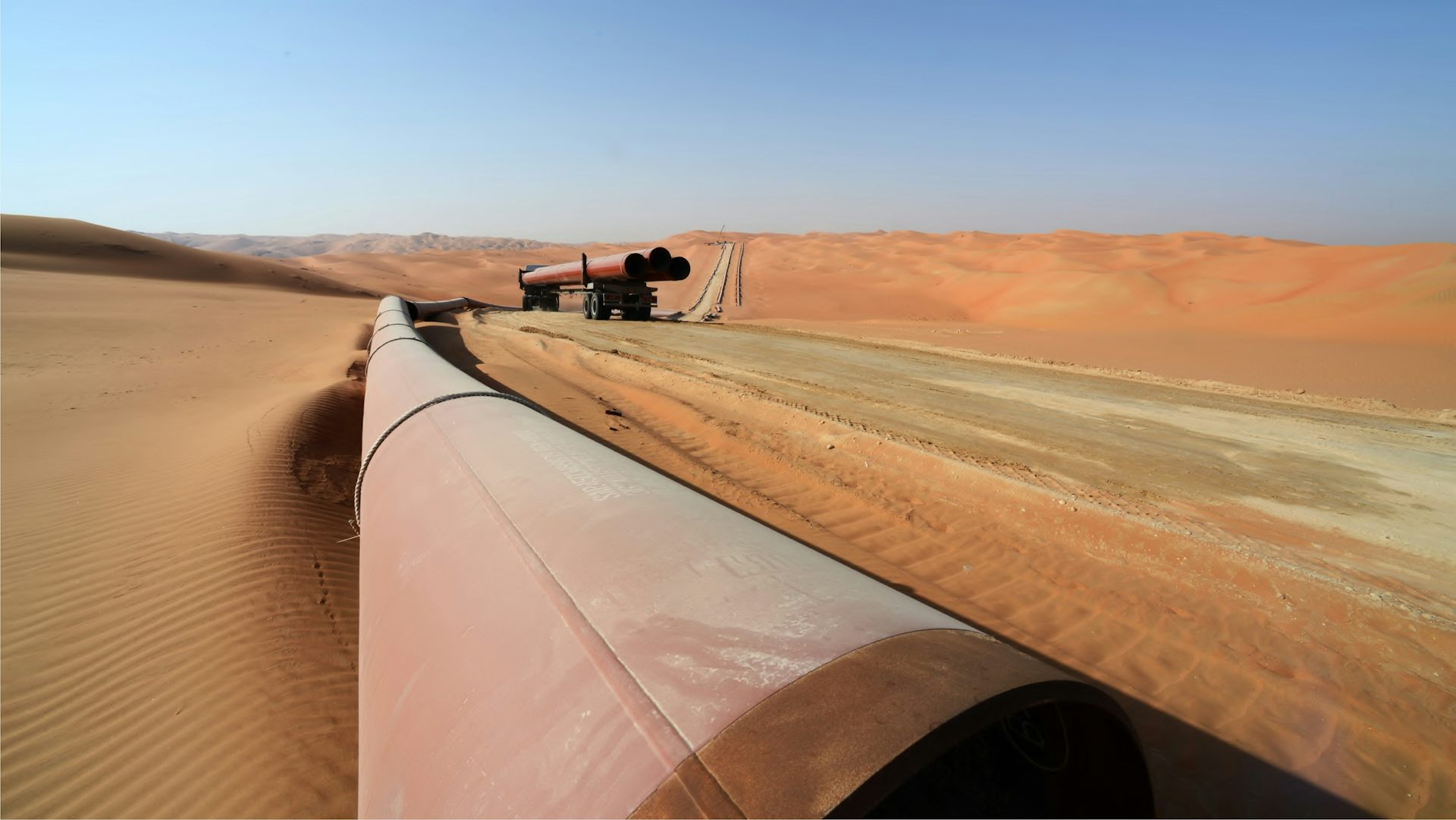
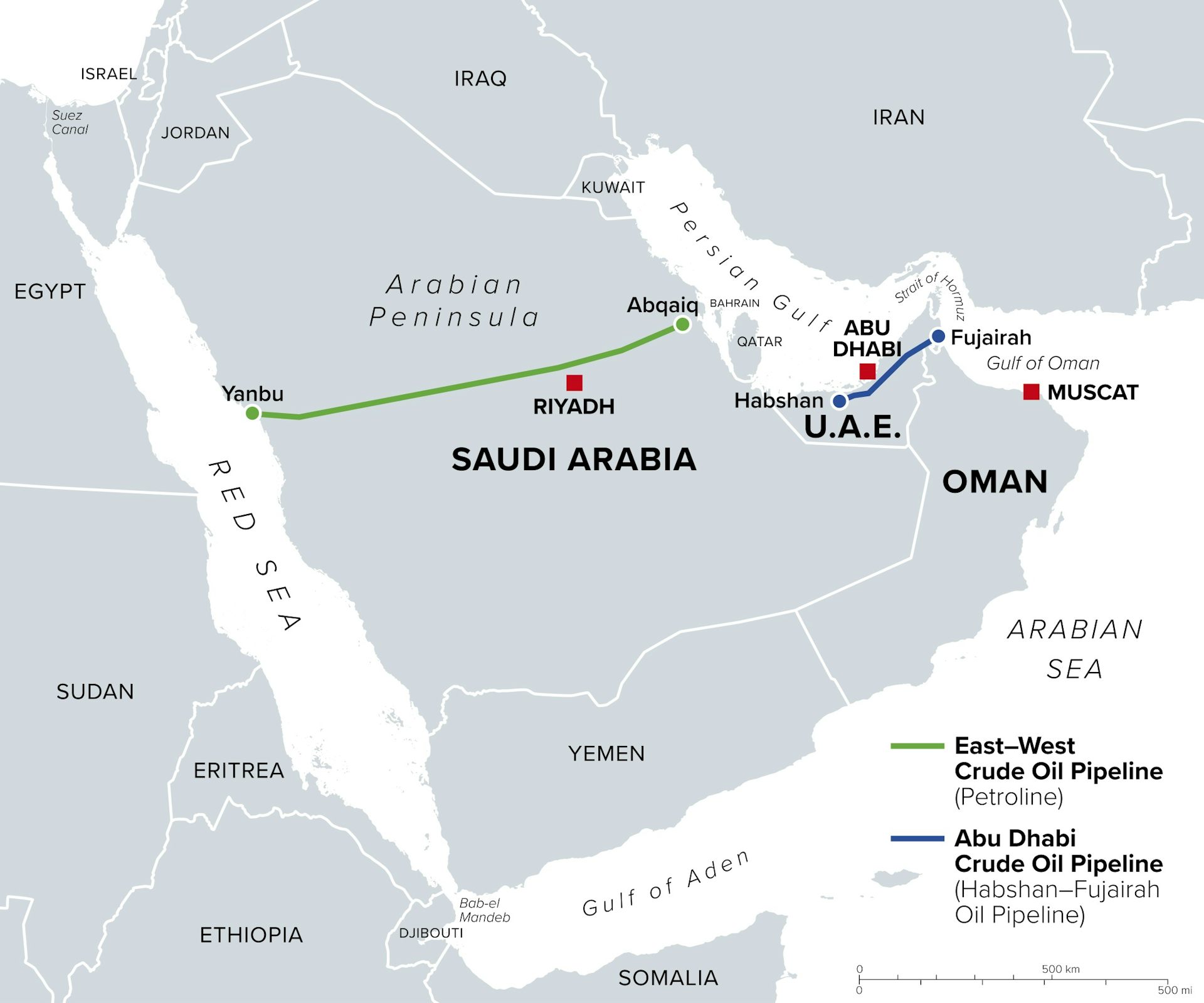
The most important pipeline on the planet right now runs across Saudi Arabia. The East-West Pipeline – also known as Petroline – was built in the 1980s during the original Tanker war, when Iran and Iraq attacked merchant vessels in the Gulf as part of their wider conflict.
Pipa minyak terpenting di planet ini saat ini melintasi Arab Saudi. East-West Pipeline – juga dikenal sebagai Petroline – dibangun pada tahun 1980-an selama perang Tanker awal, ketika Iran dan Irak menyerang kapal dagang di Teluk sebagai bagian dari konflik mereka yang lebih luas.
The pipeline’s capacity was expanded to a 7 million barrel emergency ceiling in 2019. However, the loading terminals in the city of Yanbu on Saudi Arabia’s Red Sea coast were never designed to carry this much oil this fast, and analysts tracking tanker traffic estimate that less oil is currently flowing through the pipeline than its theoretical ceiling.
Kapasitas pipa ini diperluas hingga batas darurat 7 juta barel pada tahun 2019. Namun, terminal pemuatan di kota Yanbu di pantai Laut Merah Arab Saudi tidak pernah dirancang untuk membawa minyak sebanyak ini secepat ini, dan analis yang melacak lalu lintas tanker memperkirakan bahwa minyak yang mengalir melalui pipa saat ini lebih sedikit daripada batas teoretisnya.
From Yanbu, oil bound for Europe still has to cross Egypt via the Sumed pipeline, which has a capacity of just 2.5 million barrels per day. Although oil flows through this pipeline have surged by 150% since the start of the war, its comparatively small capacity remains a binding constraint on European supply.
Dari Yanbu, minyak yang ditujukan ke Eropa masih harus melewati Mesir melalui pipa Sumed, yang memiliki kapasitas hanya 2,5 juta barel per hari. Meskipun aliran minyak melalui pipa ini telah melonjak sebesar 150% sejak awal perang, kapasitasnya yang relatif kecil tetap menjadi kendala yang mengikat bagi pasokan Eropa.
Iran noticed the geoeconomic importance of Petroline and has targeted it accordingly. An Iranian drone strike on a pumping station in April knocked 700,000 barrels a day offline. Saudi Aramco, the operator, had the line back at full capacity within three days. While the repair time is reassuring, the fact of the strike is not.
Iran menyadari pentingnya geoeonomi Petroline dan menargetkannya sesuai dengan itu. Serangan drone Iran pada stasiun pompa pada bulan April menonaktifkan 700.000 barel per hari. Saudi Aramco, operatornya, telah mengembalikan jalur tersebut ke kapasitas penuh dalam waktu tiga hari. Meskipun waktu perbaikan melegakan, fakta serangan itu tidak.
The other half of the Gulf bypass story runs through the United Arab Emirates (UAE) . The Abu Dhabi Crude Oil Pipeline (Adcop) goes from Habshan to Fujairah on the Gulf of Oman side of the country. With a capacity of just under 2 million barrels per day, Adcop is the only major bypass that exits the Gulf directly into the Indian Ocean.
Setengah cerita bypass Teluk lainnya melalui Uni Emirat Arab (UEA) . Abu Dhabi Crude Oil Pipeline (Adcop) membentang dari Habshan ke Fujairah di sisi Teluk Oman negara tersebut. Dengan kapasitas kurang dari 2 juta barel per hari, Adcop adalah bypass utama satu-satunya yang keluar dari Teluk langsung ke Samudra Hindia.
But as with Petroline, it has been targeted during the war. Iranian drone strikes on Fujairah on March 3, 14 and 16 set storage tanks on fire and suspended loadings. While Adcop offers some diversification for the UAE, it does not solve the targeting problem.
Namun, seperti Petroline, pipa ini telah menjadi sasaran selama perang. Serangan drone Iran di Fujairah pada 3, 14, dan 16 Maret membakar tangki penyimpanan dan menangguhkan pemuatan. Meskipun Adcop menawarkan beberapa diversifikasi bagi UEA, itu tidak menyelesaikan masalah penargetan.
The situation is worse for the Gulf region’s other big oil producers. Iraq’s 3.4 million barrels per day of pre-war crude exports went almost entirely through the southern port city of Basra and the Strait of Hormuz.
Situasi lebih buruk bagi produsen minyak besar lainnya di kawasan Teluk. Ekspor minyak mentah pra-perang Irak sebesar 3,4 juta barel per hari hampir seluruhnya melalui kota pelabuhan selatan Basra dan Selat Hormuz.
There is one northern pipeline, connecting oil fields in Kirkuk to Ceyhan in Turkey. This pipeline was reopened in September 2025 after a two-and-a-half-year halt, with flows ramped up to 250,000 barrels a day in March. But this volume pales in comparison to what Iraq has lost.
Ada satu pipa utara, yang menghubungkan ladang minyak di Kirkuk ke Ceyhan di Turki. Pipa ini dibuka kembali pada September 2025 setelah penangguhan selama dua setengah tahun, dengan aliran ditingkatkan hingga 250.000 barel per hari pada bulan Maret. Tetapi volume ini sangat kecil dibandingkan dengan apa yang telah hilang oleh Irak.
Kuwait has it worse still. Pre-war crude exports ran at around 2 million barrels per day, with every barrel exiting through Hormuz. Kuwait has no pipeline alternative. Kuwait Petroleum Corporation declared force majeure in March, temporarily allowing it to suspend its obligations to meet delivery contracts.
Kuwait kondisinya lebih buruk. Ekspor minyak mentah pra-perang berjalan sekitar 2 juta barel per hari, dengan setiap barel keluar melalui Hormuz. Kuwait tidak memiliki alternatif pipa. Kuwait Petroleum Corporation menyatakan force majeure pada bulan Maret, sementara waktu memungkinkannya menangguhkan kewajibannya untuk memenuhi kontrak pengiriman.
This was extended on April 20, with the oil company saying it could not meet contractual obligations even if Hormuz reopened. Overcoming the damage that has been inflicted on Kuwait’s production base – and then ramping up production – will take months.
Ini diperpanjang pada 20 April, dengan perusahaan minyak tersebut mengatakan bahwa mereka tidak dapat memenuhi kewajiban kontraktual bahkan jika Hormuz dibuka kembali. Mengatasi kerusakan yang telah ditimbulkan pada basis produksi Kuwait – dan kemudian meningkatkan produksi – akan memakan waktu berbulan-bulan.
Qatar’s vulnerability is a different shape. Its pre-war crude exports were smaller than its Gulf neigbours, at around 0.6 million barrels per day. These exports all left Qatar via the strait. For Qatar, the story is gas. Its 77 million tonne LNG capacity at Ras Laffan is the largest in the world, supplying about 19% of global LNG trade. There is no alternative to shipping this gas through Hormuz.
Kerentanan Qatar memiliki bentuk yang berbeda. Ekspor minyak mentah pra-perang-nya lebih kecil daripada tetangga Teluknya, sekitar 0,6 juta barel per hari. Semua ekspor ini meninggalkan Qatar melalui selat. Bagi Qatar, ceritanya adalah gas. Kapasitas LNG 77 juta ton-nya di Ras Laffan adalah yang terbesar di dunia, memasok sekitar 19% perdagangan LNG global. Tidak ada alternatif untuk mengirim gas ini melalui Hormuz.
Iran itself has built a Hormuz bypass: a 1,000-kilometre pipeline from Goreh at the head of the Gulf to a terminal at Jask on the Gulf of Oman. It is designed for 1 million barrels per day. But in practice, sanctions and unfinished terminal infrastructure have kept actual throughput at a fraction of design.
Iran sendiri telah membangun bypass Hormuz: pipa sepanjang 1.000 kilometer dari Goreh di ujung Teluk ke terminal di Jask di Teluk Oman. Pipa ini dirancang untuk 1 juta barel per hari. Namun dalam praktiknya, sanksi dan infrastruktur terminal yang belum selesai telah menjaga throughput aktual pada pecahan dari desain.
The US Energy Information Administration estimated that, in summer 2024, under 70,000 barrels per day were flowing through the pipeline. Loadings stopped altogether that September. According to Kpler, which provides real-time data on global shipping movements, only a single tanker – around two million barrels – has loaded at Jask in the war so far.
Administrasi Informasi Energi AS memperkirakan bahwa, pada musim panas 2024, kurang dari 70.000 barel per hari mengalir melalui pipa. Pemuatan berhenti sama sekali pada September itu. Menurut Kpler, yang menyediakan data waktu nyata tentang pergerakan pelayaran global, hanya satu kapal tanker – sekitar dua juta barel – yang telah memuat di Jask sejak perang ini.
A call for more pipes in the Gulf, as there have been since the war began, is understandable. But it is no answer. Replicating Hormuz in pipelines would cost hundreds of billions of US dollars and a decade of construction. And at the end of it, new pipelines and terminals at Yanbu, Fujairah and wherever else would be no harder to reach with a drone than the old ones.
Seruan untuk lebih banyak pipa di Teluk, seperti yang telah ada sejak perang dimulai, dapat dimengerti. Tetapi itu bukanlah jawaban. Mereplikasi Hormuz dalam pipa akan menelan biaya ratusan miliar dolar AS dan membutuhkan waktu konstruksi selama satu dekade. Dan pada akhirnya, pipa dan terminal baru di Yanbu, Fujairah, dan di mana pun tempat lainnya tidak akan lebih sulit dijangkau dengan drone daripada yang lama.
David B Roberts does not work for, consult, own shares in or receive funding from any company or organisation that would benefit from this article, and has disclosed no relevant affiliations beyond their academic appointment.
David B Roberts tidak bekerja untuk, berkonsultasi dengan, memiliki saham di, atau menerima pendanaan dari perusahaan atau organisasi mana pun yang akan mendapat manfaat dari artikel ini, dan tidak mengungkapkan afiliasi relevan selain jabatan akademiknya.
Read more
-
Ukraina melawan dampak perang di Iran dengan menyerang fasilitas energi Rusia
Ukraine is countering the impact of the war in Iran by attacking Russian energy facilities
-

Biologi sintetis menjanjikan untuk menulis ulang kehidupan – dengan meninggalnya pelopornya, J. Craig Venter, seberapa dekat ilmuwan?
Synthetic biology promised to rewrite life – with the death of its pioneer, J. Craig Venter, how close are scientists?