Tres razones por las que Donald Trump no sacará a EE. UU. de la OTAN
Three reasons Donald Trump won’t pull the US out of Nato
The US president has been bitterly criticising the alliance in recent weeks over its reluctance to join the war in Iran.
El presidente de EE. UU. ha estado criticando duramente la alianza en las últimas semanas por su renuencia a unirse a la guerra en Irán.
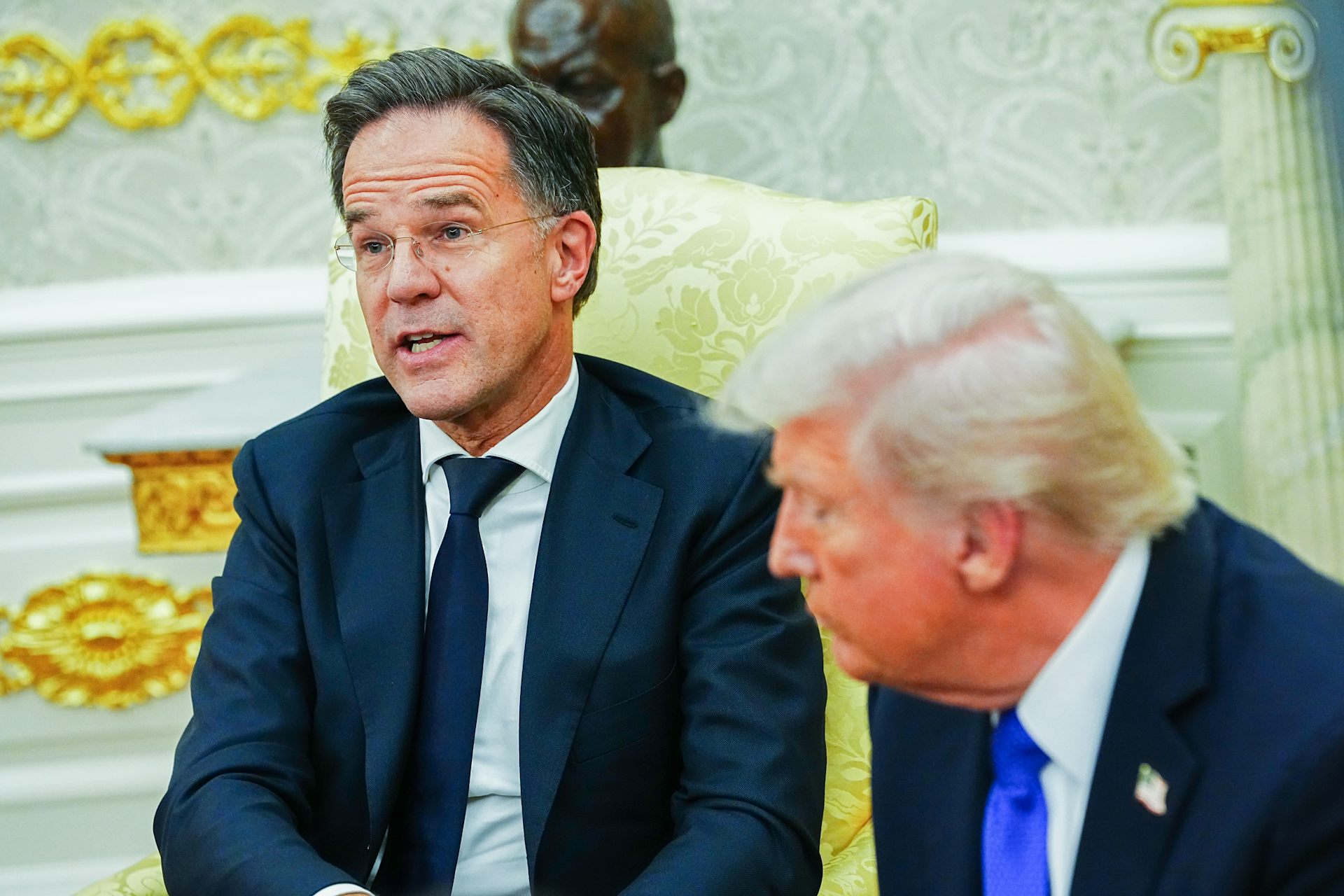
President Donald Trump met Nato secretary general Mark Rutte on April 8 for what Rutte described as a “very frank, very open” discussion. The pair are reported to have discussed the US-Israeli war against Iran at which, according to White House spokesperson Karoline Leavitt, Trump believes that Nato was “tested and they failed”.
El presidente Donald Trump se reunió con el secretario general de la OTAN, Mark Rutte, el 8 de abril para lo que Rutte describió como una discusión «muy franca, muy abierta.» Se informa que la pareja discutió la guerra estadounidense-israelí contra Irán, en la que, según la portavoz de la Casa Blanca, Karoline Leavitt, Trump cree que la OTAN fue «puesta a prueba y fracasó.»
The president later posted to his Truth Social platform that “NATO WASN’T THERE WHEN WE NEEDED THEM, AND THEY WON’T BE THERE IF WE NEED THEM AGAIN.”
El presidente publicó más tarde en su plataforma Truth Social que «LA OTAN NO ESTUVO CUANDO LO NECESITÁMOS, Y NO ESTARÁ AHÍ SI LO NECESITAMOS DE NUEVO.»
The US president’s meeting with Rutte came a week after he told Reuters press agency that he was “absolutely” considering withdrawing the US from Nato, after America’s allies refused to join the US-Israeli campaign against Iran. But this is very unlikely to occur for three reasons.
La reunión del presidente estadounidense con Rutte tuvo lugar una semana después de que dijera a la agencia de prensa Reuters que estaba «absolutamente» considerando retirar a EE. UU. de la OTAN, después de que los aliados de Estados Unidos se negaran a participar en la campaña estadounidense-israelí contra Irán. Pero es muy poco probable que esto ocurra por tres razones.
First, in 2023, Congress enacted a law that prohibits the president from “suspending, terminating, denouncing, or withdrawing the United States from the North Atlantic Treaty” — which established the North Atlantic Treaty Organization (Nato) — without the advice and consent of the Senate or an act of Congress. It is extremely unlikely that this will be changed before the midterm elections in November and impossible subsequently if the Democrats end up controlling the House of Representatives.
Primero, en 2023, el Congreso promulgó una ley que prohíbe al presidente «suspender, terminar, denunciar o retirar a los Estados Unidos del Tratado del Atlántico Norte» —que estableció la Organización del Tratado del Atlántico Norte (OTAN) — sin el consejo y consentimiento del Senado o un acto del Congreso. Es extremadamente improbable que esto cambie antes de las elecciones de mitad de mandato en noviembre e imposible posteriormente si los demócratas llegan a controlar la Cámara de Representantes.
The second reason is that Nato membership is popular among Americans. A Pew survey conducted in 2025 showed that 66% of US respondents thought that America benefited from Nato membership while 32% thought the opposite. While, as in many things, the US is divided – with more Democrat voters (77%) supporting Nato membership than Republicans (45%) – it’s clear that, on the whole, Americans approve of Nato membership.
La segunda razón es que la membresía en la OTAN es popular entre los estadounidenses. Una encuesta de Pew realizada en 2025 mostró que el 66% de los encuestados estadounidenses pensaron que Estados Unidos se beneficiaba de la membresía en la OTAN, mientras que el 32% pensó lo contrario. Si bien, como en muchas cosas, EE. UU. está dividido —con más votantes demócratas (77%) que apoyan la membresía en la OTAN que republicanos (45%) —, está claro que, en general, los estadounidenses aprueban la membresía en la OTAN.
The third reason is that leaving Nato would significantly weaken the US militarily. More than half a century of research by historians and international relations specialists has concluded that leaving Nato would also significantly weaken the US.
La tercera razón es que abandonar la OTAN debilitaría significativamente a EE. UU. militarmente. Más de medio siglo de investigación de historiadores y especialistas en relaciones internacionales ha concluido que abandonar la OTAN también debilitaría significativamente a EE. UU.
In 1989, historian Paul Kennedy’s detailed study of wars over a period of 500 years, The Rise and Fall of the Great Powers, found that a decisive feature of success in war is the resources that parties to the conflict can mobilise. Kennedy cites the examples of the two world wars and demonstrates that a key reason why Germany was defeated was that the allies could mobilise many more resources in manpower, arms production and economic assets than Germany and its allies. Eventually, this proved decisive in both conflicts.
En 1989, el estudio detallado del historiador Paul Kennedy sobre las guerras durante un período de 500 años, The Rise and Fall of the Great Powers, encontró que una característica decisiva del éxito en la guerra son los recursos que las partes en el conflicto pueden movilizar. Kennedy cita los ejemplos de las dos guerras mundiales y demuestra que una razón clave por la que Alemania fue derrotada fue que los aliados pudieron movilizar muchos más recursos en mano de obra, producción de armas y activos económicos que Alemania y sus aliados. Eventualmente, esto resultó decisivo en ambos conflictos.
Research into quantifying the military capacity of nations has been conducted for more than half a century as part of the Correlates of War project founded in 1963 by American political scientist J. David Singer. The project aims to systematically collect data about the causes and consequences of wars.
La investigación para cuantificar la capacidad militar de las naciones se ha llevado a cabo durante más de medio siglo como parte del proyecto Correlates of War, fundado en 1963 por el politólogo estadounidense J. David Singer. El proyecto tiene como objetivo recopilar sistemáticamente datos sobre las causas y consecuencias de las guerras.
One of the datasets collected in the project is called the Composite Index of National Capability. This combines data on the demographic, industrial, economic and military capabilities of nations, including the US and China. The higher the index score the more resources a county has to fight wars.
Uno de los conjuntos de datos recopilados en el proyecto se llama Índice Compuesto de Capacidad Nacional. Combina datos sobre las capacidades demográficas, industriales, económicas y militares de las naciones, incluidos EE. UU. y China. Cuanto mayor es la puntuación del índice, más recursos tiene un país para librar guerras.
Scores in the Composite Index of National Capability of the Top Nations
Puntuaciones en el Índice Compuesto de Capacidad Nacional de las Naciones Principales
The chart shows the size of the index for the top countries in the database. China is the most powerful nation in the chart with a score of 23 on the index. The US comes a rather distant second with a score of 13.
El gráfico muestra el tamaño del índice para los principales países de la base de datos. China es la nación más poderosa del gráfico con una puntuación de 23 en el índice. EE. UU. viene en un segundo lugar bastante distante con una puntuación de 13.
There are five Nato nations in the chart in addition to the US. They are Germany, Turkey, the UK, France and Italy. The total score of all six Nato members is 20 – much closer to the Chinese total.
Hay cinco naciones de la OTAN en el gráfico además de EE. UU. Son Alemania, Turquía, el Reino Unido, Francia e Italia. La puntuación total de los seis miembros de la OTAN es de 20, mucho más cerca del total chino.
The chart does not include the scores for the remaining Nato member states, but when they are added to the total the Nato score is well above that of China. So the assumption that the US can go it alone in a war with China is doubtful.
El gráfico no incluye las puntuaciones de los estados miembros restantes de la OTAN, pero cuando se añaden al total, la puntuación de la OTAN está muy por encima de la de China. Por lo tanto, la suposición de que EE. UU. puede ir solo en una guerra con China es dudosa.
How Article 5 works
Cómo funciona el Artículo 5
Article 5 of the Nato charter stipulates that an armed attack against one member state is considered an attack against all, triggering collective defence by all the member states. A recent report by the US Naval War College concluded that: “A large and growing body of evidence suggests that the PLA (People’s Liberation Army) is preparing credible capabilities to invade Taiwan”. The report argued that extensive deception will be used by China to confuse its opponents when the war is launched with rapid action by its armed forces to create a fait accompli. It notes that this type of blitzkrieg attack is very often successful.
El Artículo 5 de la carta de la OTAN estipula que un ataque armado contra un estado miembro se considera un ataque contra todos, lo que activa la defensa colectiva de todos los estados miembros. Un informe reciente del US Naval War College concluyó que: «Una gran y creciente cantidad de evidencia sugiere que el PLA (Ejército de Liberación del Pueblo) se está preparando capacidades creíbles para invadir Taiwán.» El informe argumentó que China utilizará un engaño extenso para confundir a sus oponentes cuando se lance la guerra con acciones rápidas de sus fuerzas armadas para crear un hecho consumado. Señala que este tipo de ataque relámpago es muy a menudo exitoso.
If this occurred, then since the US has military advisers in Taiwan and military assets in the region that would need to be neutralised in the first phase of the war if the invasion were to be successful this would trigger Article 5 of the Nato charter. In that case China would find itself at war with 32 Nato countries – not to mention countries in the Far East, such as Japan, Indonesia and Vietnam, who have serious concerns about Chinese aggression, but are not members of the alliance.
Si esto ocurriera, dado que EE. UU. tiene asesores militares en Taiwán y activos militares en la región que tendrían que ser neutralizados en la primera fase de la guerra si la invasión fuera exitosa, esto activaría el Artículo 5 de la carta de la OTAN. En ese caso, China se encontraría en guerra con 32 países de la OTAN, sin mencionar países del Lejano Oriente, como Japón, Indonesia y Vietnam, que tienen serias preocupaciones sobre la agresión china, pero que no son miembros de la alianza.
So, whatever the US president’s ambivalence towards Nato, the fact is that without its support, the US could face a humiliating defeat by China in a future confrontation over Taiwan. America is much stronger as part of Nato – and Trump’s advisers should be strenuously reinforcing that message.
Por lo tanto, independientemente de la ambivalencia del presidente de EE. UU. hacia la OTAN, el hecho es que sin su apoyo, EE. UU. podría enfrentar una derrota humillante por parte de China en una futura confrontación por Taiwán. América es mucho más fuerte como parte de la OTAN, y los asesores de Trump deberían reforzar enérgicamente ese mensaje.
Paul Whiteley has received funding from the British Academy and the ESRC.
Paul Whiteley ha recibido financiación de la British Academy y el ESRC.
Read more
-
Appolonia: la historia de un reino africano que resistió la trata transatlántica de esclavos
Appolonia: the story of an African kingdom that resisted the Atlantic slave trade
-

Jeff Bezos dice que la poesía sin rima es fácil, pero no es tan simple
Jeff Bezos says poetry without rhyming is easy – but it’s not that simple