30年《合理怀疑》之后,Jay-Z的职业生涯体现了嘻哈最巨大的矛盾。
30 years after ‘Reasonable Doubt,’ Jay-Z’s career embod…
What happens when a rapper whose early work explored capitalism’s brutality becomes one of the system’s most successful beneficiaries?
当一位早期作品探讨了资本主义残暴性的说唱歌手,反而成为了这个体系最成功的受益者之一时,会发生什么?
“Reasonable Doubt” was not the first rap album I ever owned. But Jay-Z’s debut was the first hip-hop album I bought with my own money. More importantly, it was the first one I studied as a young writer who aspired to become a rapper, a dream that eventually came true.
《Reasonable Doubt》并非我最早拥有的说唱专辑。但Jay-Z的这张出道作,是我用自己的钱买的第一张嘻哈专辑。更重要的是,它是我作为一名渴望成为说唱歌手的年轻写作者所研究的第一张作品,一个最终实现的梦想。
Jay-Z sounded cool in a way that resembled a jazz musician more than a conventional rap star. He rapped with a quiet calm that also conveyed supreme confidence. His lyrics were layered, skillful and unorthodox.
Jay-Z的声音很酷,带有一种更接近爵士音乐家的气质,而非传统的说唱明星。他以一种平静的沉稳来说唱,但其中又流淌着至高无上的自信。他的歌词层次丰富、技巧娴熟且不落俗套。
Yes, the tracks often revolved around drug dealing. But the hustlers who populated “Reasonable Doubt” weren’t degenerates. They were refined and astute thinkers. And unlike other gangsta rappers, there was a moral quandary at the heart of his storytelling. In tracks like “D’Evils,” Jay-Z’s narrator turns crime, aspiration and paranoia into meditations on capitalism and the psychic cost of wealth:
是的,这些曲目经常围绕毒品交易展开。但《Reasonable Doubt》中描绘的那些“街头混混”并非堕落不堪的人。他们是精致而精明的思考者。与许多其他“匪帮说唱歌手”不同的是,他的故事叙述核心存在着一个道德困境。在像《D’Evils》这样的曲目中,Jay-Z的叙事者将犯罪、抱负和偏执,转化为对资本主义和财富精神代价的沉思:
We used to fight for building blocks Now we fight for blocks with buildings that make a killing The closest of friends when we first started But grew apart as the money grew, and soon grew black-hearted
我们曾为积木而战 现在却为能大生财的建筑块而战 最亲近的朋友,在我们刚开始时 却随着金钱的增长而渐行渐远,很快变得心怀鬼胎
And later:
以及后来:
My soul is possessed by D’Evils in the form of diamonds and Lexuses
我的灵魂被钻石和雷克萨斯这些“恶魔”附身
The cinematic complexity displayed in its tracks helps explain why “Reasonable Doubt” was inducted into the Grammy Hall of Fame, and why it still matters 30 years later.
其曲目所展现的电影般的复杂性有助于解释为什么《Reasonable Doubt》被列入了格莱美名人堂,以及为什么即使在三十年后它依然重要。
But the album also launched the career of a rapper whose own trajectory has come to mirror hip-hop’s own transformation.
但这张专辑也开启了一个说唱歌手的事业,而这个说唱歌手自身的轨迹,最终映照了嘻哈音乐本身的蜕变。
In 1996, hip-hop was still fighting for legitimacy. Three decades later, it had been folded into the mainstream. Kendrick Lamar can win a Pulitzer Prize, Nas can have an endowed fellowship at Harvard University, and Jay-Z, who once couldn’t get signed to a label, can create a label of his own and become a billionaire business mogul.
1996年,嘻哈音乐仍在为合法性抗争。三十年后,它已经融入主流文化。肯德里克·拉马尔可以获得普利策奖,纳斯可以在哈佛大学获得捐赠研究员资格,而曾经无法签约唱片公司的Jay-Z,却能创立自己的厂牌,成为一位亿万富翁的商业巨头。
Is it even possible for hip-hop to be seen as countercultural in 2026? And what happens when hip-hop’s most successful outsider becomes central to the very institutions he once seemed to challenge?
在2026年,嘻哈音乐是否还能被视为反文化?当嘻哈音乐最成功的“局外人”,反而成为了其自身挑战过的制度的核心时,会发生什么?
From moral panic to corporate behemoth
从道德恐慌到企业巨头
When “Reasonable Doubt” was released, hip-hop was both ascendant and under siege.
当《Reasonable Doubt》发行时,嘻哈音乐既处于上升期也面临着围剿。
In February 1996, Tupac Shakur came out with “All Eyez on Me,” which became one of the bestselling rap albums of all time; seven months later, he was shot and killed. His friend-turned-rival, The Notorious B.I.G., was shot and killed in a drive-by shooting the following year. The media often cast these high-profile deaths as proof that rap music was inseparable from street violence, and the moral panic around hip-hop’s influence on young listeners only intensified.
1996年2月,Tupac Shakur推出了《All Eyez on Me》,这成为有史以来最畅销的说唱专辑之一;七个月后,他被枪杀身亡。他的朋友兼对手The Notorious B.I.G.在第二年的一次车祸中也被枪杀。媒体经常将这些高调的死亡事件描绘成证据,证明说唱音乐与街头暴力密不可分,围绕嘻哈对年轻听众影响的道德恐慌也随之加剧。
How times have changed. Today, hip-hop powers advertising campaigns, luxury branding and streaming platforms. According to Nielsen, rap surpassed rock music as the most popular music genre in the U.S. in 2018. Today, it accounts for roughly 1-in-4 on-demand audio streams.
时代变了。如今,嘻哈音乐主导着广告宣传、奢侈品牌和流媒体平台。根据尼尔森的数据,2018年说唱音乐已超越摇滚乐,成为美国最受欢迎的音乐类型。如今,它约占点播音频流的四分之一。
Jay-Z has played an outsized role in that transformation.
Jay-Z在这一转变中发挥了巨大的作用。
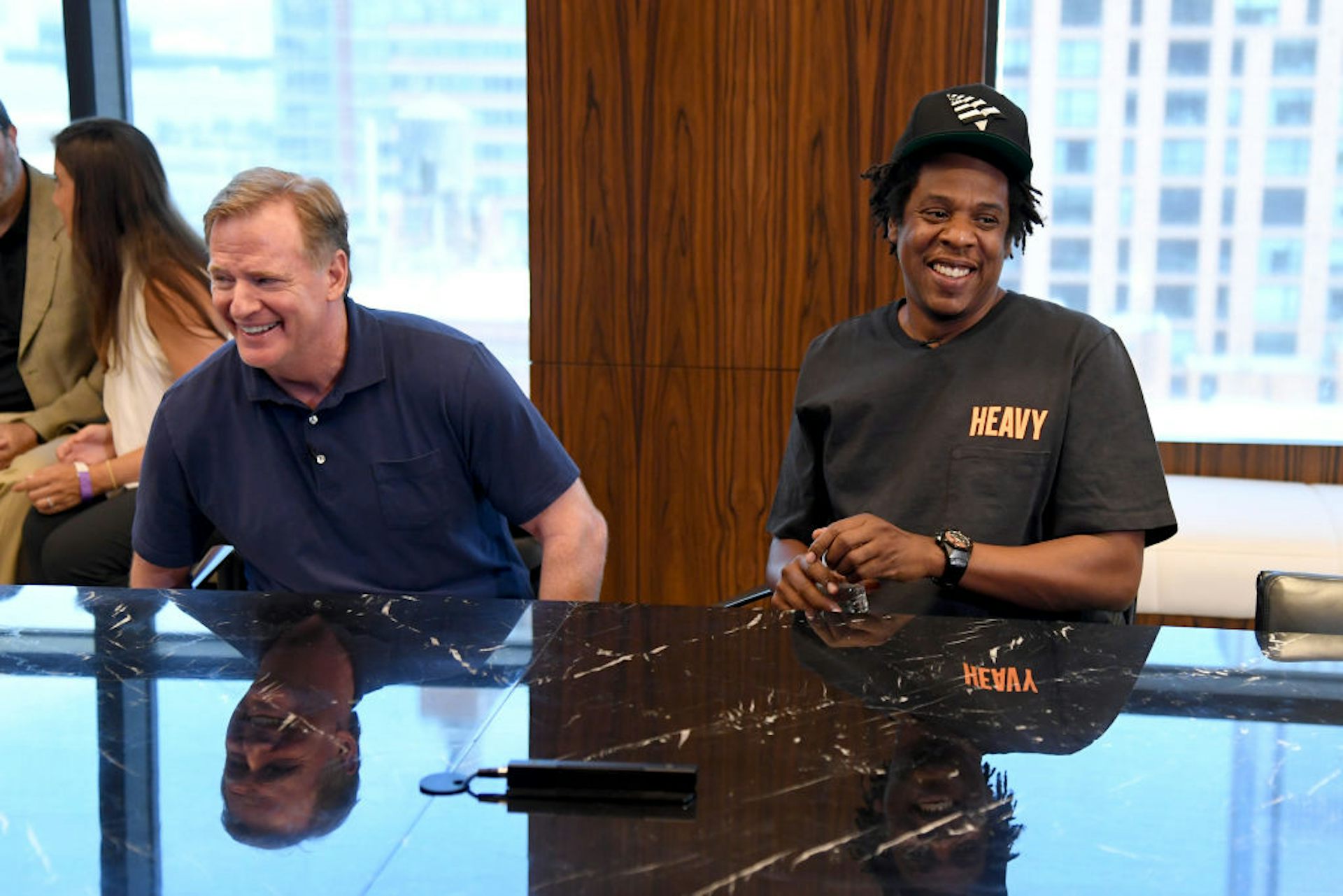
Since 1998, he’s won 25 Grammys for his own music. In that time, he’s also built a business empire. There’s his talent agency, Roc Nation; his streaming platform, TIDAL; his venture capital firm, Marcy Venture Partners; and his luxury alcohol brands, Armand de Brignac and D’Ussé. Through Roc Nation, he’s also a strategic partner with the NFL, advising the football league on its entertainment programming.
自1998年以来,他凭借自己的音乐获得了25座格莱美奖。在此期间,他还建立了一个商业帝国。他拥有人才机构Roc Nation;流媒体平台TIDAL;风险投资公司Marcy Venture Partners;以及奢侈酒品牌Armand de Brignac和D’Ussé。通过Roc Nation,他还与NFL建立了战略合作关系,为该橄榄球联盟的娱乐节目提供咨询服务。
Forbes currently pegs his net worth at US$2.8 billion.
福布斯目前将其净资产估值定为28亿美元。
Confronted on capitalism
面临资本主义的质疑
In April 2026, GQ published a long interview with Jay-Z.
2026年4月,GQ刊登了一篇与Jay-Z的长篇采访。
This was a big deal: Jay-Z hadn’t interacted with the media like this since 2017, when he was promoting his 13th solo album, “4:44.”
这意义重大:自2017年推广他的第13张个人专辑《4:44》以来,Jay-Z从未进行过如此媒体互动。
How would one of hip-hop’s elder statesmen reflect on his career and his many successes?
一位嘻哈界的资深人物,将如何回顾自己的职业生涯和诸多成就?
In the interview, Jay-Z didn’t present his riches as a complicated outcome of capitalism’s contradictions. Instead, he talked about his wealth as if it were something his critics had failed to understand. When asked about the belief that there’s something inherently suspect about accumulating so much money, he pushed back:
在这次采访中,Jay-Z没有将自己的财富描绘成资本主义矛盾的复杂结果。相反,他谈论自己的财富时,仿佛这是他的批评者们未能理解的东西。当被问及关于积累如此巨额金钱本身就存在某种内在可疑性的观点时,他进行了反驳:
“It’s almost like a cop-out. You get to demonize this group of folks without fixing the actual system that exists […] Your morality defines who you are. Your morality is not defined by a dollar amount.”
“这几乎像是一种逃避。你们可以在不解决实际存在的系统的情况下,去妖魔化这一群人 […] 你的道德定义了你是谁。你的道德不是由金额决定的。”
As for the notion that his career trajectory was somehow hypocritical:
至于关于他的职业轨迹在某种程度上是虚伪的说法:
“The only thing I heard coming up was the American dream. You could make it, if you pull yourself up by the bootstraps. I heard that my entire life – until we started being successful. Then it was like: You’re selling out because you’re making money.”
“我听到的唯一论点就是‘美国梦’。只要你靠自己努力就能成功。我感觉我的整个生命——直到我们开始成功。然后就变成了:因为你赚钱了,所以你在出卖自己。”
He then went on to insist that being handsomely paid is not some sort of betrayal to hip-hop, art or his community.
随后他坚持认为,获得丰厚的报酬绝不是对嘻哈、艺术或其社群的某种背叛。
“I make art first and then I make sure that I’m compensated for my art. … That [capitalist] structure exists; I just see the world for what it is, not for what I want it to be. I’m a realist.”
“我首先创作的是艺术,然后我确保为我的艺术得到补偿。……这种[资本主义]结构是存在的;我只是看到世界本来的样子,而不是我想让它成为的样子。我是一个现实主义者。”
To me, Jay-Z certainly sounded persuasive. He also sounded defensive. I think that’s because hip-hop has long been haunted by the idea that wealth compromises credibility, even as the tracks have always contained aspirational themes of luxury and entrepreneurship.
在我看来,Jay-Z确实听起来很有说服力。但他同时也显得很具有防御性。我认为这是因为嘻哈音乐长期以来一直被“财富会损害信誉”的观念所困扰,尽管其作品中始终包含着对奢华和创业精神的向往主题。
Don’t hate the player, hate the game
别骂玩家,骂游戏
For my generation, Jay-Z sold aspiration in addition to albums.
对我这一代人来说,Jay-Z贩卖的不仅是专辑,更是一种憧憬。
I wore Rocawear denim suits in high school with a kind of conviction that now feels almost funny to admit. In college, drinking Belvedere vodka, which appeared in many a Jay-Z track in the early 2000s, felt like a rite of passage.
高中时,我穿着Rocawear牛仔套装,带着一种现在回想起来几乎觉得可笑的信念感。大学里,喝着在21世纪初许多Jay-Z歌曲中出现的Belvedere伏特加,感觉像是一种成人礼。
That’s because Jay made luxury seem urbane, sophisticated and distinctly Black. Even later in life, when I’d smoke Cohiba cigars, drink D’USSÉ or read about art collecting, I felt like I was living inside a script he had helped write.
这是因为Jay让奢侈品看起来既都市化、又精致,而且带有明显的黑人特色。即使在我后来抽雪茄、喝D’USSÉ或阅读艺术收藏书籍时,我仍然觉得我仿佛生活在一个他帮助撰写的剧本里。
Looking back, I can see that much of my admiration for him was cloaked in materialism. Now, I think about the work of political scientist Cedric Robinson, who wrote extensively about what he called “racial capitalism.”
回想起来,我能看到我对他的许多钦佩都披着一层物质主义的外衣。现在,我想到了政治学家塞德里克·罗宾逊(Cedric Robinson)的工作,他曾大量撰写关于他所称的“种族资本主义”的内容。
He argued that capitalism has always been structured through race. It does not merely tolerate racial hierarchy; it depends on it. That means Black wealth – even spectacular Black wealth – does not automatically equal Black liberation. One Black billionaire can be held up as evidence of progress, while the broader system that continues to produce Black inequality remains intact.
他认为资本主义一直以来都是通过种族来构建的。它不只是容忍种族等级制度;它依赖于这种等级制度。这意味着黑人的财富——即使是惊人的黑人财富——并不能自动等同于黑人的解放。一个黑人亿万富翁可以被奉为进步的证据,而更广泛、持续制造黑人不平等的系统却依然完好无损。
In other words, if Jay-Z’s ascent becomes shorthand for Black progress, then the critique of the system that continues to oppress those at the margins starts to fade. The culture begins to confuse exceptional mobility with collective freedom.
换句话说,如果将Jay-Z的崛起视为黑人进步的代名词,那么对继续压迫边缘群体的体制批判就会开始褪色。文化开始混淆非凡的流动性与集体的自由。
At the same time, I don’t think Jay-Z can be simply understood as a sellout. Communication scholar A.J. Escoffery has written a lot about what he calls “reparative media.” Essentially, he calls for media institutions to do more than offer tokens of representation to marginalized communities. Media companies need to be built or owned by those communities.
与此同时,我也不认为Jay-Z可以简单地被理解为一个“出卖灵魂”的人。传播学学者A.J.埃斯科费里(A.J. Escoffery)撰写了大量关于他所称的“修复性媒体”(reparative media)的文章。本质上,他呼吁媒体机构提供的不仅仅是给边缘社区的象征性代表权。媒体公司需要由这些社区来建立或拥有。
Jay-Z’s defenders will sometimes describe him along these lines – as a Robin Hood-like figure who has taken capital from historically white-owned institutions and redirected some of it toward Black communities or Black entrepreneurs. Even if those gestures remain, at heart, capitalist – like his investments in cannabis brands – he’ll often use his positioning and clout to fund minority-owned businesses.
Jay-Z的支持者有时会这样描述他——说他是一个像罗宾汉一样的人物,从历史上属于白人拥有的机构那里获取了资本,并将一部分重新导向黑人社区或黑人企业家。即使这些姿态在本质上仍然是资本主义的——比如他对大麻品牌的投资——他也会经常利用自己的地位和影响力来资助少数族裔拥有的企业。
In the GQ interview, the rapper seemed to acknowledge the compromises he felt compelled to make, and he spoke of the limits Black artists face in industries they do not own:
在《GQ》采访中,这位说唱歌手似乎承认了自己不得不做出的妥协,并谈到了黑人在他们不拥有产业中所面临的局限性:
“[There’s] nowhere you’re going to go that Black people control distribution and control media. At some point you’re going to have to partner with somebody.”
“你不会去任何一个由黑人控制发行和媒体的地方。总有一天你必须与某人合作。”
In that, Jay-Z highlights what hip-hop continues to grapple with. The genre no longer has to prove it belongs in the mainstream. But it has to figure out what it means to survive without being fully absorbed by it.
在这句话中,Jay-Z强调了嘻哈音乐持续努力应对的问题。这个流派不再需要证明它属于主流。但它必须弄清楚的是,如何在不被完全吸收的情况下生存下去的意义。
Jabari M. Evans does not work for, consult, own shares in or receive funding from any company or organization that would benefit from this article, and has disclosed no relevant affiliations beyond their academic appointment.
Jabari M. Evans并未受雇于、咨询或持有任何从本文中受益的公司或组织股份,也未披露超出其学术任职的相关关联。