2026年世界杯:为何将比赛移至傍晚时间不足以应对极端高温问题
World Cup 2026: why moving games to evenings isn’t enou…
Extreme weather, both heat and rain, are expected to hit World Cup venues this summer.
预计今年夏天,世界杯场馆将面临高温和暴雨等极端天气。
The 2026 Fifa World Cup is the biggest ever edition of the world’s most watched sporting tournament. The 48 teams taking part in Canada, the US and Mexico may find their toughest opponent is the extreme heat.
2026年国际足联世界杯是全球关注度最高的体育赛事中规模最大的届次。参加加拿大、美国和墨西哥的48支球队,可能发现它们最艰难的对手是极端高温。
Very hot temperatures are expected across many of the states including Texas, California and Florida where World Cup games are being held this summer, with wildfire risks being highlighted in some states. The tournament kicks off on June 11.
今年夏天,世界杯比赛将在德克萨斯州、加利福尼亚州和佛罗里达州等许多州举行,预计这些州将出现非常高的气温,一些州甚至强调了野火风险。锦标赛将于6月11日开幕。
The problems heat causes during matches were visible during the 2025 Fifa Club World Cup, played in the same summer months and across many of the same North American venues. Players and managers repeatedly referenced the stifling weather conditions.
比赛中高温带来的问题在2025年国际足联俱乐部世界杯期间显现出来,该赛事在同一夏季和许多北美场馆举行。球员和教练反复提及了令人窒息的天气条件。
Borussia Dortmund manager Niko Kovač said after a match in Cincinnati he was “sweating like I’ve just come out of a sauna”. Chelsea midfielder Enzo Fernández described conditions as “very dangerous”, adding that “everything becomes very slow”. Juventus manager Igor Tudor revealed that ten players asked to be substituted during a match against Real Madrid in Miami, where temperatures reached 30°C, with 70% humidity.
多特蒙德主教练尼科·科瓦奇在辛辛那提的一场比赛后说,他“汗流浃背,就像刚从桑拿房出来一样”。切尔西中场恩佐·费尔南德斯将当时的条件描述为“非常危险”,并补充说“一切都变得非常缓慢”。尤文图斯主教练伊戈尔·图多透露,在迈阿密对阵皇家马德里的一场比赛中,当时气温达到30°C,湿度为70%,有十名球员要求换下。
North America’s last World Cup (USA 1994) also produced memorable scenes relating to heat. German striker Jürgen Klinsmann recalled: “I played in Dallas at 120 degrees [49°C ] I was dying” in a match against South Korea. Meanwhile, Republic of Ireland manager Jack Charlton was reprimanded by Fifa officials for throwing water bottles onto the pitch to help his dehydrated players during a game in Orlando.
北美最近一次世界杯(美国1994年)也产生了与高温相关的难忘场景。德国前锋于尔根·克林斯曼回忆说,在对阵韩国的一场比赛中,他在达拉斯“气温达到120度[49°C],我快不行了”。与此同时,爱尔兰共和国主教练杰克·查尔顿因在奥兰多的一场比赛中向场上扔水瓶帮助脱水的球员,受到了国际足联官员的训斥。
Extreme heat is not just uncomfortable – it threatens both health and performance. Football already has documented cases of heat-related fatigue, collapses and hospitalisations, including Guatemalan referee Humberto Panjoj collapsing during a 2024 Copa América match in Kansas City.
极端高温不仅仅是令人不适——它威胁着健康和表现。足球已经有记录的与高温相关的疲劳、晕倒和住院病例,包括危地马拉裁判洪贝托·潘霍霍在2024年堪萨斯城的一场美洲杯比赛中晕倒。
Heat also changes the game itself. Studies show players cover less distance, perform fewer high-intensity sprints and get tired more quickly in extreme conditions. Tired players are more prone to mistakes and injuries, while hotter matches have been linked to more penalty shootouts, as exhausted teams struggle to break each other down in extra time.
高温也会改变比赛本身。研究表明,在极端条件下,球员跑的距离更短,高强度冲刺次数更少,并且更容易感到疲劳。疲劳的球员更容易犯错和受伤,而高温比赛与更多的点球大战有关,因为筋疲力尽的球队在加时赛中难以击垮对方。
Scientists commonly use Wet Bulb Globe Temperature (WGBT) to assess heat stress. Unlike air temperature alone, WBGT combines temperature, humidity, solar radiation and wind, making it a better indicator of how dangerous conditions feel to the human body.
科学家通常使用湿球黑球温度(WBGT)来评估热应激。与单纯的空气温度不同,WBGT结合了温度、湿度、太阳辐射和风速,使其成为衡量环境对人体危险程度的更佳指标。
Several football governing bodies – including the global players’ union Fifpro – consider a WBGT above 28°C to be a threshold where matches should potentially be delayed or postponed.
多个足球管理机构——包括全球球员工会Fifpro——认为,WBGT超过28°C是一个潜在需要推迟或延期的比赛阈值。
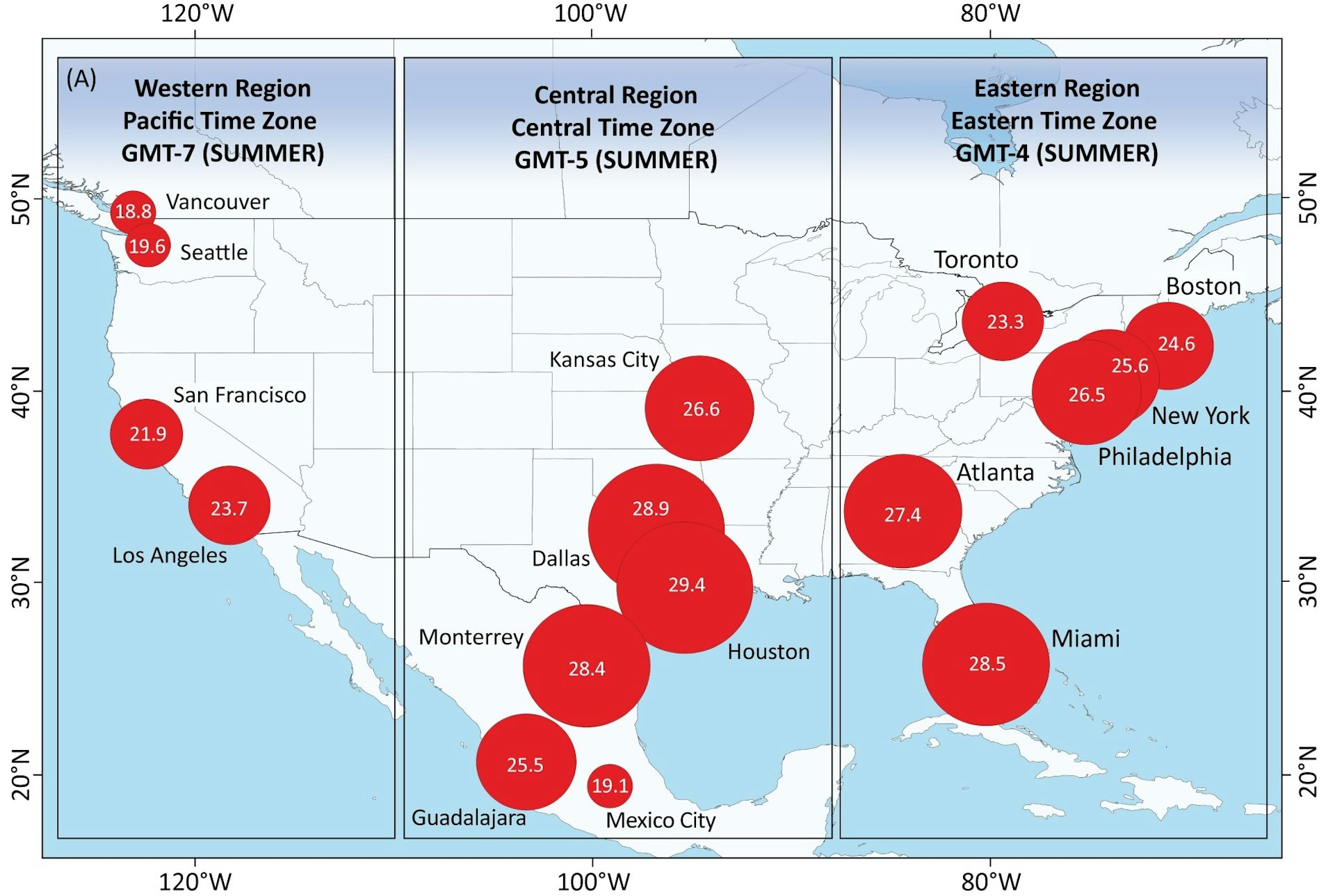
20-year average levels of extreme heat in 16 venue cities
16个比赛城市20年平均极端高温水平
Possible solutions?
可能的解决方案?
A study I led in 2025 found that 14 of the 16 upcoming World Cup host cities are likely to exceed the extreme 28°C WBGT threshold if conditions this summer are typical. Most of the danger falls during mid-afternoon, and Fifa has clearly tried to reduce some of the risk through scheduling. Compared with the Club World Cup, matches in the hottest cities and non-air-conditioned stadiums have largely been shifted away from the most dangerous hours of the day.
我于2025年领导的一项研究发现,如果今年夏季条件正常,未来16个世界杯举办城市中,有14个可能超过极端的28°C WBGT阈值。大部分危险发生在午后,国际足联(Fifa)显然已经通过赛程安排试图降低一些风险。与俱乐部世界杯相比,在最热城市和非空调体育场馆的比赛大多已避开一天中最危险的时段。
That will help – but it will not eliminate the problem.
这会有帮助——但它无法消除问题。
Some high-risk fixtures remain. Late afternoon (5pm) and early evening (6pm) matches in Miami and Kansas City carry a greater than 30% risk of WBGTs exceeding 28°C if summer temperatures are typical, rising above 50% if conditions are hotter than average. The final at MetLife Stadium in New Jersey kicks off at 3pm, when the probability of extreme heat is about 30% in a typical summer and 55% in a hot one.
仍有一些高风险的比赛。如果夏季气温正常,迈阿密和堪萨斯城下午晚些时候(5点)和傍晚(6点)的比赛,WBGT超过28°C的风险超过30%,如果条件比平均水平更热,则上升到50%以上。新泽西州梅特莱夫体育场举行的决赛于下午3点开幕,届时在正常夏季,极端高温的概率约为30%,在炎热的夏季约为55%。
Those estimates may even turn out to be conservative. Heatwaves are becoming more frequent and intense globally. The 2021 western North America heatwave shattered records by more than 4°C in some locations. A similarly extreme event during the World Cup could push lower-risk cities such as Seattle, Toronto and Vancouver into dangerous territory, while prolonging extreme evening heat in more vulnerable venues such as Miami, Kansas City and Philadelphia.
这些估计甚至可能是保守的。全球范围内热浪正变得更频繁、更强烈。2021年北美西部热浪在一些地区打破了超过4°C的记录。世界杯期间发生类似极端的事件,可能会将西雅图、多伦多和温哥华等低风险城市推入危险区域,同时延长迈阿密、堪萨斯城和费城等更脆弱场馆的极端夜间高温。
And even air-conditioned stadiums do not remove the wider public-health risk.
即使是空调体育场馆也无法消除更广泛的公共卫生风险。
In the hottest cities such as Dallas and Houston, indoor venues may protect players and match officials during the game itself. But tens of thousands of spectators will still spend hours travelling, queueing and celebrating in dangerous outdoor heat. Many fans are older, less physically fit than elite athletes, dehydrated from alcohol consumption, or arriving from cooler climates with little acclimatisation.
在达拉斯和休斯顿等最热的城市,室内场馆可以在比赛过程中保护球员和比赛官员。但成千上万的观众仍然要在危险的户外高温中花费数小时旅行、排队和庆祝。许多球迷年龄较大,体能不如精英运动员,因饮酒脱水,或来自气候较凉爽的地区,缺乏适应。
The risk therefore extends well beyond the pitch.
因此,风险远远超出了球场范围。
Yet Fifa’s current heat policy remains limited. All matches will have three-minute hydration breaks midway through each half, but the threshold for stronger action remains exceedingly high. Current Fifa guidance only mandates additional precautions at a WBGT of 32°C.
然而,国际足联目前的防暑政策仍然有限。所有比赛将在每个半场中途进行三分钟的补水休息,但采取更强行动的阈值仍然极高。目前的国际足联指导仅要求在WBGT达到32°C时采取额外的预防措施。
That figure has alarmed scientists and medical experts who have sent an open letter urging Fifa to strengthen its heat protections before the tournament begins. Their recommendations include doubling the time for cooling breaks to six minutes, lowering the WBGT threshold for intervention and introducing clearer rules for delaying or postponing matches in dangerous conditions.
这个数据引起了科学家和医学专家的警觉,他们发出了公开信,敦促国际足联在赛事开始前加强防暑保护。他们的建议包括将冷却休息时间加倍至六分钟,降低干预的WBGT阈值,并引入更明确的在危险条件下推迟或延期比赛的规则。
It is possible matches could be delayed or postponed if WBGTs exceed 32°C. This would be a decision for Fifa – and is something they have never done before. It is worth noting that the 32°C threshold is also considerably above levels many experts consider dangerous.
如果WBGT超过32°C,比赛可能会被推迟或延期。这将是国际足联的决定——这也是他们以前从未做过的事情。值得注意的是,32°C的阈值也明显高于许多专家认为危险的水平。
It’s likely that more World Cups will be played outside the traditional summer months in future. This was the case for the Qatar World Cup in 2022, moving from June/July to November/December and is almost certain to be the case for the 2034 tournament in Saudi Arabia.
未来,更多世界杯可能会在传统夏季月份之外举行。2022年卡塔尔世界杯就是如此,时间从六月/七月移至十一月/十二月,而2034年沙特阿拉伯的赛事几乎确定也会如此。
The 2026 World Cup may ultimately become a defining test for how global sport adapts in a warming world. Scheduling matches outside the hottest hours is a sensible start. But as temperatures continue to rise, timing alone may no longer be enough.
2026年世界杯最终可能会成为全球体育如何在变暖世界中适应的决定性考验。将比赛安排在非最热时段是一个合理的开始。但随着气温持续上升,仅靠时间安排可能将不再足够。
Donal Mullan does not work for, consult, own shares in or receive funding from any company or organisation that would benefit from this article, and has disclosed no relevant affiliations beyond their academic appointment.
Donal Mullan不为任何受益于本文的公司或组织工作、咨询、拥有股份或接受资金,并且除了其学术任命外,未披露任何相关隶属关系。