中国的侗族少数民族:我们为何正在数字化记录和保护其原住民建筑遗产
China’s Dong minority: why we’re digitally recording an…
A new project uses cutting-edge digital technology to precord the architecture and culture of China’s Indigenous Dong minority.
一个新项目利用尖端数字技术来记录中国原住民侗族的建筑和文化。
The Dong people in China are an Indigenous ethnic group who are known to have lived in the mountainous regions of southwestern China for about 600 years. They don’t have a written language – instead their cultural knowledge is shared by word of mouth. This means that the outside world doesn’t know much about them.
中国东族是一个原住民民族群体,据信他们生活在中国西南部的山区约六百年。他们没有文字语言——相反,他们的文化知识是通过口耳相传的。这意味着外界对他们了解甚少。
But an ambitious university-led research project to document the Dong people’s distinctive architecture is revealing a great deal about this marginalised Indigenous group’s way of life.
然而,一个雄心勃勃、由大学主导的研究项目,旨在记录东族的独特建筑,却揭示了许多关于这个边缘化原住民群体生活方式的信息。
There are an estimated 3 million Dong people living in the provinces of Guizhou, Hunan and Guangxi. They are renowned for their polyphonic choral singing, which has been inscribed by Unesco since 2009 as an example of world-class intangible cultural heritage. Their architecture, landscape and refined agricultural terracing are also distinctive, but less well known and never digitally recorded.
据估计,有约300万东族人居住在贵州、湖南和广西这些省份。他们以多声部合唱歌唱而闻名,该艺术形式自2009年起已被联合国教科文组织列为世界非物质文化遗产。他们的建筑、景观和精细的梯田农业也极具特色,但知名度较低,且从未被数字化记录。
Dong buildings and settlements are typically hidden in fir forests with direct access to waterways at the bottom of valleys or halfway up hills. A Dong settlement typically has around 200 households of four to five people – although some larger villages can have as many as 500 households.
东族的村落和定居点通常隐藏在云杉森林中,位于山谷底部或半山腰处,并与水路有直接连接。一个典型的东族聚居地通常有大约200户家庭,每家四到五口人——尽管一些较大的村庄可能有多达500户。
These villages tend to have a gatehouse marking their boundary, defining their territory in relation to neighbouring settlements. Many feature a distinctive “wind-and-rain bridge” – a mix of village gate and covered bridge – used for communal gatherings and blocking ceremonies. Ponds, wells, and granaries are scattered throughout the landscape.
这些村庄的趋势是设有门楼来标记边界,从而界定其与邻近定居点的领土范围。许多地方设有一个独特的“风雨桥”——它结合了村落大门和有顶的桥梁——用于社区聚会和封禁仪式。池塘、水井和粮仓散布在整个景观中。
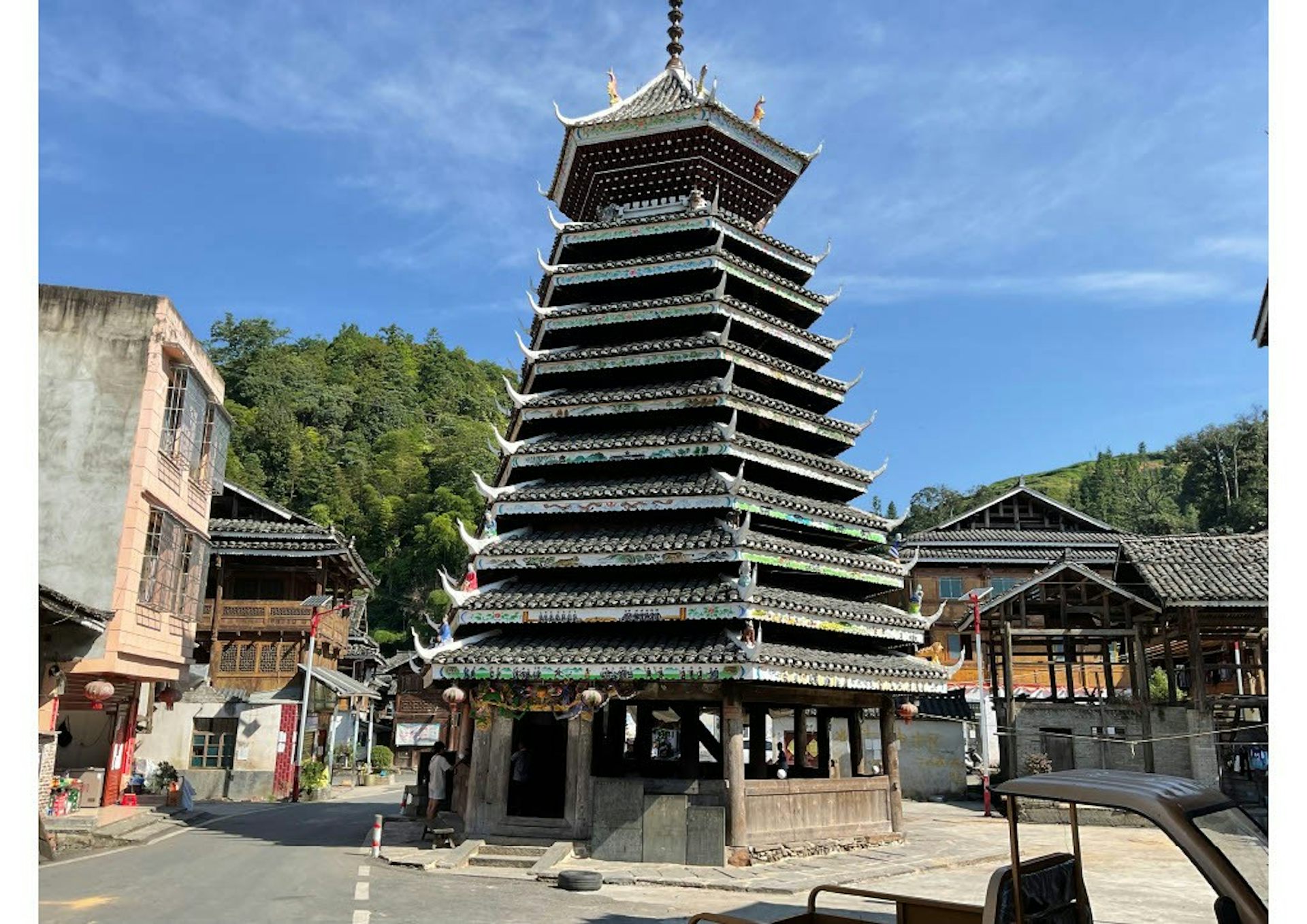
At the heart of most villages, surrounded by wooden houses of two or three storeys, there is a “drum tower” and a “Sa-Sui shrine”. The former represents the connection of the people’s sacred belief of clan kinship and fir trees, while the latter represents the centre of the Dong’s worship of the “Sa” or grandmother. They are the most important buildings in a village – for security, social and spiritual reasons.
在大多数村庄的核心地带,周围环绕着两到三层的木屋,矗立着一座“鼓楼”和一个“萨水祠”。前者代表了人们关于氏族血缘和云杉树的神圣信仰联系;而后者则代表了东族对“萨”(祖母)崇拜的中心。它们是村庄最重要的建筑——无论出于安全、社会还是精神层面的考虑。
Culture at risk
文化面临风险
Nowadays, the Dong’s built and cultural heritage are increasingly at risk. This is due to a combination of climate change, natural disasters, urban infrastructure development and the expansion of rural tourism.
如今,侗族的建筑和文化遗产正日益面临风险。这归因于气候变化、自然灾害、城市基础设施发展以及乡村旅游业的扩张等多重因素的叠加影响。
A warming climate is increasingly triggering wild fires and causing mountain flooding. We are also seeing the encroachment of urbanism into the Dong’s rural settings. While bringing improvements in the quality of life, this often presents domestic fire hazards due to poor-quality electrical infrastructure. And in recent years, the growth of tourism and the encroachment of roads, railways and bridges is in danger of turning these villages into decorated stage-sets. This may bring in money, but threatens the Dong people’s unique architecture and landscape.
变暖的气候正在引发越来越多的野火和山洪。我们还看到城市化进程侵入了侗族乡村环境。虽然带来了生活质量的改善,但这往往由于电气基础设施不完善而造成了国内火灾隐患。近年来,随着旅游业的发展以及道路、铁路和桥梁的侵入,这些村庄面临着被变成装饰性布景的危险。这或许能带来收入,但却威胁到了侗族人民独特的建筑和景观。
It’s a pressing challenge for this Indigenous people and for those of us dedicated to preserving their historic environment, their culture and their highly ritualised way of life.
这对这个原住民群体,以及所有致力于保护其历史环境、文化和高度仪式化生活方式的人来说,都是一个紧迫的挑战。
Tragically, the scarcity of resources means that schemes for repair, restoration and regeneration works, as well as insufficient conservation policies and frameworks, have been slow to help preserve these precious villages. The far remote mountainous environment does not help. Both the local communities and government authorities have extremely limited resources to manage almost any change to their historic environment.
悲剧的是,资源的匮乏意味着,无论是修复、恢复还是再生项目,抑或是不足的保护政策和框架,都迟缓地帮助着这些珍贵的村庄得以保存。偏远的山区环境也无能为力。当地社区和政府部门在管理任何对其历史环境的改变时,资源都极其有限。
Despite the remote location of many of these villages, they are now being encroached upon by modern development. We’re seeing the growth of contemporary housing developments using modern structures and materials. It’s part of the rapid urbanisation of China over the past few decades – but, like elsewhere, it’s irreversibly changing the image and identity of the Dong settlements and their architecture.
尽管许多村庄地理位置偏远,但它们现在正被现代开发所侵蚀。我们看到使用现代结构和材料建造的当代住宅发展正在增长。这是中国过去几十年快速城市化的一部分——但与世界其他地方一样,它正在不可逆转地改变着侗族聚居点及其建筑的形象和身份。
The problem of modern tourist development can be seen in the way traditional-style drum towers are being built as theme park attractions. At the Danzhai Wanda Village, a newly developed theme park near Kaili in Guizhou, the nearest city to the Dong’s Indigenous areas, there are five newly built drum towers, billed as “iconic”, which are presented as standalone monuments with no sense of their relationship with the surrounding houses and forests.
现代旅游开发的问题体现在传统风格的鼓楼被建造成主题公园景点的方式上。在位于贵州开力附近、距离侗族原住民地区最近的丹寨万达村,有五座新建的鼓楼,它们被称为“标志性”建筑,作为独立的纪念碑展示出来,完全没有体现出与周围房屋和森林之间的关联感。
Decoding Dong built heritage
解码洞族建筑遗产
The need to document and protect authentic Indigenous Dong culture is what has driven the Decoding Dong project.
对记录和保护真实的本土洞族文化的需求,推动了“解码洞族”项目。
This was launched in 2023 and completed in 2025 and set to digitally document Dong physical and cultural heritage.
该项目于2023年启动,计划于2025年完成,旨在为洞族的物质和文化遗产进行数字化记录。
This interdisciplinary project draws on humanities and social science disciplines ranging from architecture, anthropology, heritage sciences, sociology and digital humanities.
这个跨学科项目借鉴了人文学科和社会科学的多个领域,包括建筑学、人类学、遗产科学、社会学和数字人文等。
It put together a series of innovative and complementary research methods. This has involved 3D LiDAR scanning, aerial and terrestrial photogrammetry (the science of applying mathematics to photographs to extract accurate 3D measurements) , 3D reality capture modelling, measured drawing, documentary film making and mapping. This has been complemented with oral histories from provided by Dong people.
它整合了一系列创新且互补的研究方法。这些方法包括三维激光雷达扫描、航空和地面摄影测量学(利用数学原理从照片中提取精确的3D测量数据)、三维实景捕捉建模、测绘图稿绘制、纪录片制作和制图。此外,还结合了洞族人民提供的口述历史资料。
The project has completed a first-of-its-kind digital documentation of the Dong architectural heritage, building digital and audio-visual documentaries of around 100 historic buildings across a dozen remote Dong villages.
该项目完成了洞族建筑遗产首个数字化记录,为十几个偏远洞族村落的约100座历史建筑制作了数字和音视频纪录片。
A key part of the research process was to consult with key stakeholders, including clan leaders, elderly villagers and provincial policymakers wherever possible.
研究过程的关键部分是尽可能地咨询关键利益相关者,包括氏族领袖、年长的村民和省级政策制定者。
Indigenous Dong heritage is still under threat, due to the scarcity of resources faced by both the local authority and the communities themselves.
由于地方当局和社区自身都面临资源稀缺的问题,本土洞族遗产仍然处于威胁之下。
But this project represents a step change. By building a mutually beneficial store of information, supported by cutting-edge digital technologies, we hope to draw more attention to this distinctive people without threatening what it is that makes them unique.
但该项目代表了一次飞跃。通过建立一个由尖端数字技术支持、互惠互利的知识库,我们希望吸引更多关注到这个独特的民族,同时又不威胁其独特性所在。
Xiang Ren receives funding from Arcadia—a charitable fund to record cultural heritage, to conserve and restore nature, and to promote open access to knowledge, via its Endangered Wooden Architecture Programme coordinated by Oxford Brookes University (EWAP2039LG, 2023-25) , and the University of Sheffield Knowledge Exchange Funding (QR-PSF, 2026) .
向仁项目获得了来自Arcadia的资金支持——这是一个致力于记录文化遗产、保护和恢复自然环境,并促进知识开放获取的慈善基金,资金通过其由牛津布鲁克斯大学协调的濒危木结构建筑计划(EWAP2039LG, 2023-25)以及谢菲尔德大学知识交流基金(QR-PSF, 2026)。