A suposta imagem de ‘Jesus’ de Trump foi blasfêmia? Um especialista religioso explica
Was Trump’s so-called ‘Jesus’ image blasphemy? A religious expert explains
Donald Trump’s AI image of himself looking like Jesus has been widely derided as blasphemous. But what exactly is blasphemy?
A imagem de IA de Donald Trump, parecendo Jesus, foi amplamente ridicularizada como blasfema. Mas o que exatamente é blasfêmia?
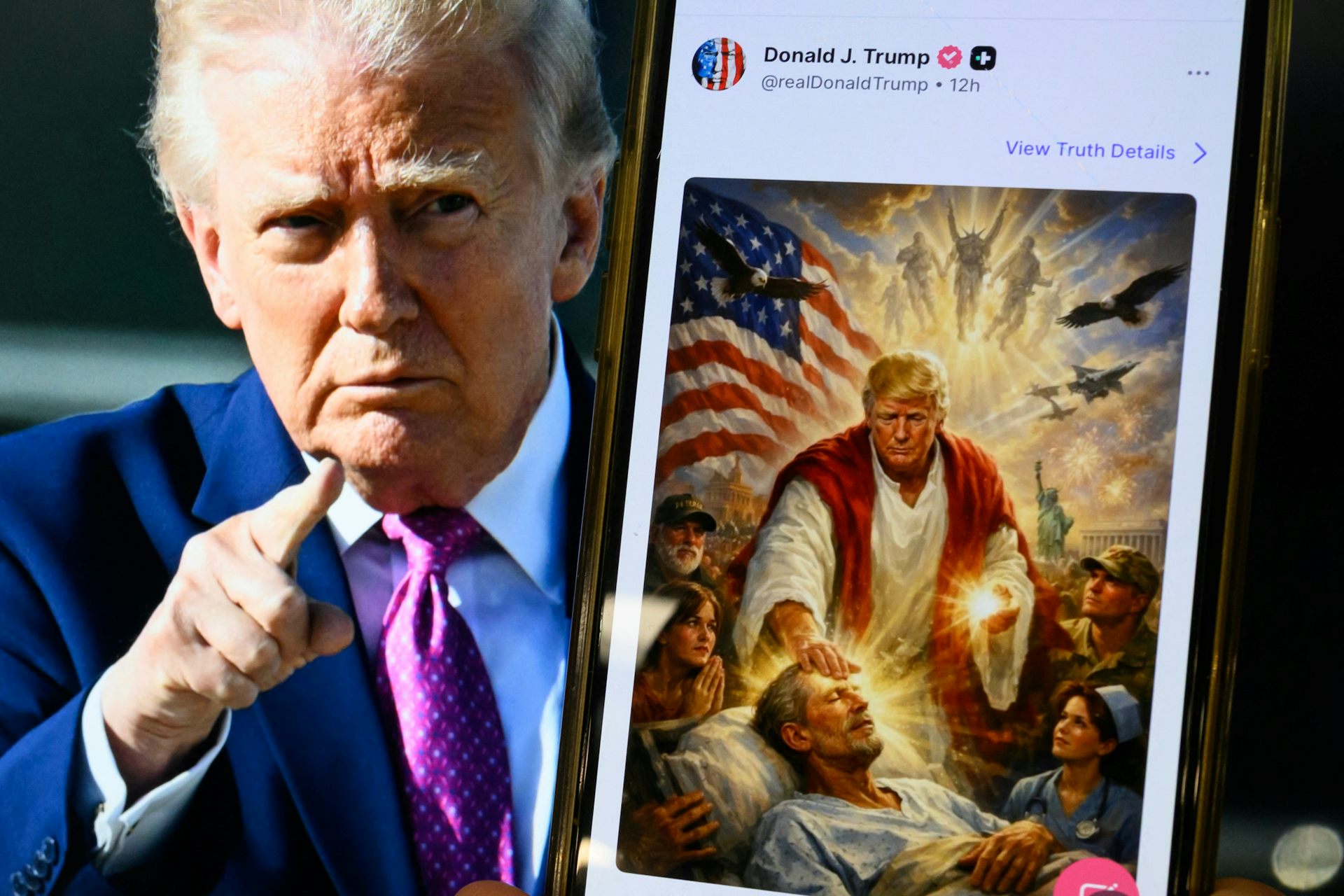
This week, Donald Trump posted an AI image of himself dressed in white robes, placing a glowing hand over an ill or deceased man in a hospital bed, as if to heal or resurrect him. The image, posted on Truth Social, was widely taken as him presenting himself as a Messianic Jesus figure.
Esta semana, Donald Trump postou uma imagem de IA de si mesmo vestido com vestes brancas, colocando uma mão brilhante sobre um homem doente ou falecido em uma cama de hospital, como se fosse curá-lo ou ressuscitá-lo. A imagem, postada no Truth Social, foi amplamente interpretada como ele se apresentando como uma figura messiânica de Jesus.
Sometime the next morning, he deleted the post. “I thought it was me as a doctor,” he explained to reporters, according to Time magazine. Jesus? “Only the fake news could come up with that one.”
Algum momento na manhã seguinte, ele deletou o post. “Eu pensei que fosse eu como médico,” ele explicou a repórteres, de acordo com a revista Time. Jesus? “Só as fake news poderiam inventar isso.”
But the post was widely interpreted as blasphemous – including by conservative Catholic group CatholicVote.org.
Mas o post foi amplamente interpretado como blasfemo – inclusive pelo grupo católico conservador CatholicVote.org.
“I don’t know if the President thought he was being funny or if he is under the influence of some substance or what possible explanation he could have for this OUTRAGEOUS blasphemy,” declared Megan Basham, a prominent conservative Protestant Christian writer, on X. “But he needs to take this down immediately and ask for forgiveness from the American people and then from God.”
“Não sei se o Presidente pensou que estava sendo engraçado ou se está sob a influência de alguma substância ou que possível explicação ele poderia ter para esta blasfêmia ESCANDALOSA,” declarou Megan Basham, uma proeminente escritora cristã protestante conservadora, no X. “Mas ele precisa remover isso imediatamente e pedir perdão ao povo americano e depois a Deus.”
“I was very grateful to see how many conservative Christians immediately denounced the blasphemous Jesus/Trump image,” said pastor Doug Wilson, who recently led a prayer service at the Pentagon and founded the network of churches War Secretary Pete Hegseth belongs to.
“Fiquei muito grato por ver quantos cristãos conservadores denunciaram imediatamente a blasfema imagem de Jesus/Trump,” disse o pastor Doug Wilson, que recentemente liderou um serviço de oração no Pentágono e fundou a rede de igrejas à qual o Secretário de Guerra Pete Hegseth pertence.
What is blasphemy?
O que é blasfêmia?
Within the Christian tradition, blasphemy has historically been an unstable, shifting idea. But, simply put, it means speech, thought or action that shows contempt for – or mockery of – God and sacred matters.
Dentro da tradição cristã, a blasfêmia tem sido historicamente uma ideia instável e mutável. Mas, simplesmente, significa discurso, pensamento ou ação que demonstra desprezo por – ou zombaria de – Deus e assuntos sagrados.
Judaism and Christianity’s concept of blasphemy came from the injunction in the Old Testament not to revile God. Within the Old Testament, it was treated as a crime, punishable by death: “One who blasphemes the name of the Lord shall be put to death; the whole congregation shall stone the blasphemer.”
O conceito de blasfêmia no Judaísmo e no Cristianismo veio da injunção no Antigo Testamento de não revirar Deus. No Antigo Testamento, foi tratado como um crime, punível com a morte: “Quem blasfemar o nome do Senhor será morto; toda a congregação atirará pedras no blasfemo.”
The New Testament expanded the concept to include the rejection of Jesus. Eventually, cursing, reproaching, challenging, mocking, rejecting or denying Jesus became blasphemous.
O Novo Testamento expandiu o conceito para incluir a rejeição de Jesus. Eventualmente, amaldiçoar, repreender, desafiar, zombar, rejeitar ou negar Jesus passou a ser blasfemo.
More particularly, posing as Jesus or asserting powers that belong only to him was considered blasphemous in medieval times. The “Christs” that emerged were treated harshly, as dangerous heretics. This is where Trump’s presentation of himself as Jesus would undoubtedly be considered blasphemous.
Mais particularmente, passar por Jesus ou afirmar poderes que pertencem apenas a ele era considerado blasfemo nos tempos medievais. Os “Cristos” que surgiram foram tratados duramente, como hereges perigosos. É aqui que a apresentação de Trump como Jesus seria, sem dúvida, considerada blasfema.
Broadly, anything said or done that offended believers could be construed as blasphemous. Catholics at the time of the Reformation in the 16th century tended to brand those who offended them as heretics.
De forma ampla, qualquer coisa dita ou feita que ofendesse os crentes poderia ser interpretada como blasfema. Os católicos no tempo da Reforma no século XVI tendiam a rotular aqueles que os ofendiam como hereges.
Protestants generally preferred the term blasphemy for anything they disliked or disagreed with. For example, 16th century theologian Martin Luther – a seminal figure in the Protestant Reformation – condemned as blasphemous not only Catholics, but also Jews and Muslims.
Os protestantes geralmente preferiam o termo blasfêmia para qualquer coisa que não gostassem ou com a qual discordassem. Por exemplo, o teólogo do século XVI Martinho Lutero – uma figura seminal na Reforma Protestante – condenou como blasfemo não apenas os católicos, mas também os judeus e os muçulmanos.
Blasphemy as sin or crime
Blasfêmia como pecado ou crime
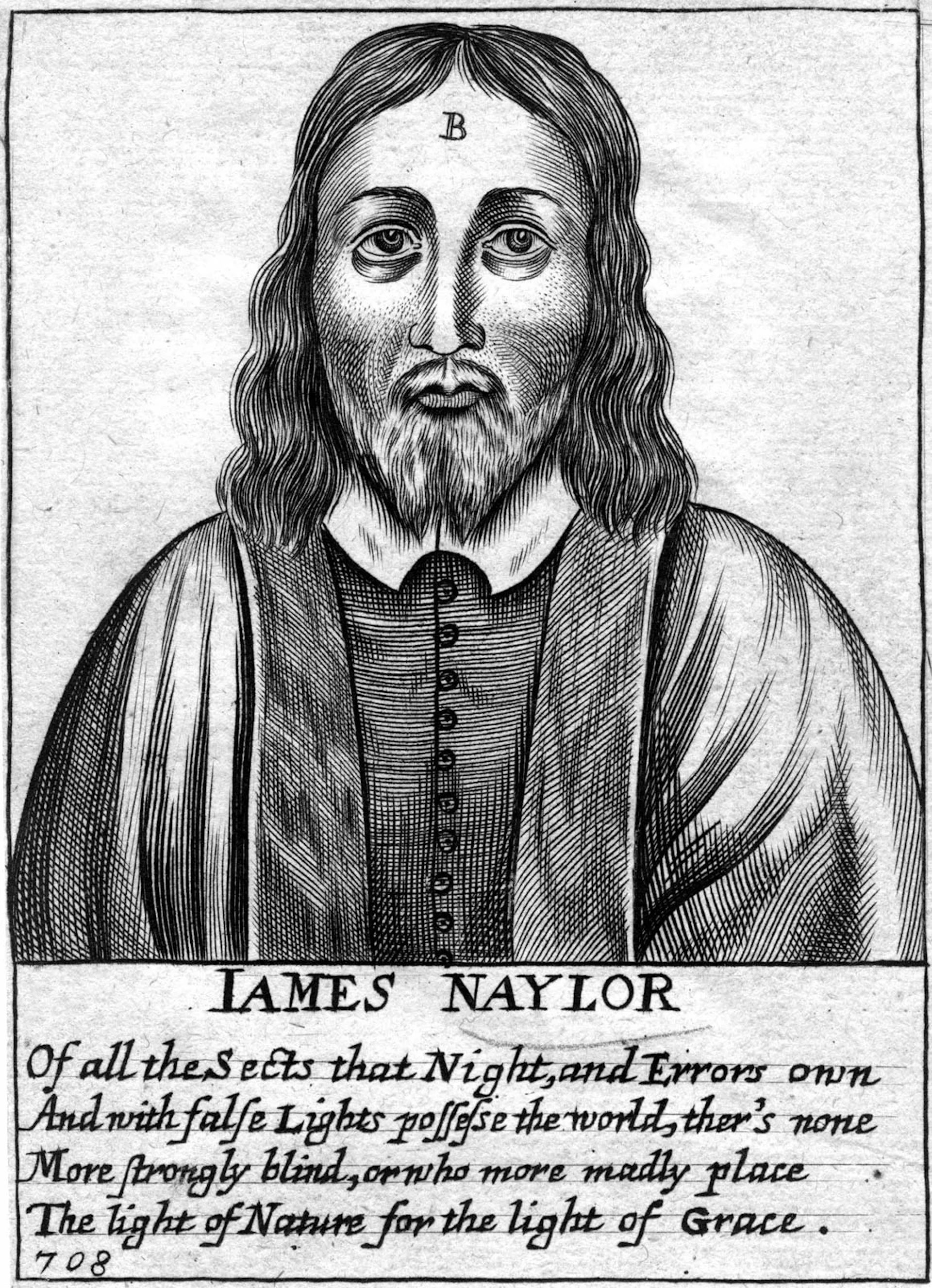
From the 17th century onwards, blasphemy became not so much an offence against God as one against society. Within the unstable societies of early modern Europe, blasphemy was viewed as socially and politically subversive and prosecuted as such. The Quaker James Naylor was imprisoned in 1656 for reenacting Jesus’s entry into Jerusalem on Palm Sunday.
A partir do século XVII, a blasfêmia passou a ser menos um crime contra Deus e mais um contra a sociedade. Nas sociedades instáveis da Europa moderna inicial, a blasfêmia era vista como subversiva social e politicamente e processada como tal. O quaker James Naylor foi preso em 1656 por encenar a entrada de Jesus em Jerusalém no Domingo de Ramos.
Early in the 17th century, blasphemy crossed to the United States. Virginia’s first law code specified death for blaspheming the divine Trinity.
No início do século XVII, a blasfêmia chegou aos Estados Unidos. O primeiro código de leis da Virgínia especificava a morte por blasfemar a Trindade divina.
Despite the first amendment to the US constitution, protecting free speech, blasphemy laws were regularly enacted. The US Supreme Court didn’t rule that laws against blasphemy infringed the right to free speech until after World War II. Several states still have blasphemy on their books.
Apesar da primeira emenda à Constituição dos EUA, que protege a liberdade de expressão, leis de blasfêmia foram regularmente promulgadas. A Suprema Corte dos EUA não decidiu que as leis contra a blasfêmia violavam o direito à livre expressão até depois da Segunda Guerra Mundial. Vários estados ainda têm blasfêmia em seus códigos.
England’s Blasphemy Act of 1697, which criminalised the denial of the Holy Trinity, the truth of Christianity, or the divine authority of the Bible, carried over into the colonies of Australia and New Zealand.
O Blasphemy Act de 1697 da Inglaterra, que criminalizava a negação da Santíssima Trindade, da verdade do Cristianismo ou da autoridade divina da Bíblia, foi levado para as colônias da Austrália e Nova Zelândia.
Blasphemy is no longer an offence under Australian federal law, though laws governing it vary across the states: it’s still in the criminal code of many of them. New Zealand’s criminal code deals with “blasphemous libel” as part of “crimes against religion, morality and public welfare”.
A blasfêmia não é mais um crime sob a lei federal australiana, embora as leis que a regem variem entre os estados: ainda está no código penal de muitos deles. O código penal da Nova Zelândia trata de “blasfêmia difamatória” como parte de “crimes contra a religião, a moralidade e o bem-estar público”.
Is there blasphemy in Islam?
Existe blasfêmia no Islã?
Within Islam, there is no exact equivalent to “blasphemy”. But the idea of the “word of infidelity” is analogous to it. In practice, it amounts to mockery of God, the prophet, or the Islamic tradition generally.
Dentro do Islã, não há um equivalente exato para “blasfêmia”. Mas a ideia da “palavra de infidelidade” é análoga a ela. Na prática, equivale a zombar de Deus, do profeta ou da tradição islâmica em geral.
So, when Trump mockingly declared “Praise be to Allah” in a recent post, he was guilty of blasphemy in Muslim eyes. Conservative commentator Dinesh D’Souza compared it to the Old Testament account of the prophet Elijah, who mocked the prophets of Baal in 1 Kings 18.
Assim, quando Trump declarou de forma zombeteira “Louvor a Allah” em uma postagem recente, ele foi culpado de blasfêmia aos olhos dos muçulmanos. O comentarista conservador Dinesh D’Souza comparou isso ao relato do Antigo Testamento sobre o profeta Elias, que zombou dos profetas de Baal em 1 Reis 18.
The Islamic advocacy group Council on American-Islamic Relations called it “disturbing” and “offensive to Muslims”.
O grupo de defesa islâmica Council on American-Islamic Relations chamou isso de “perturbador” e “ofensivo aos muçulmanos”.
Laws against blasphemy are actively enforced in many modern Islamic states.
Leis contra a blasfêmia são ativamente aplicadas em muitos estados islâmicos modernos.
Does blasphemy matter?
A blasfêmia importa?
It is not blasphemous to speak or publish opinions that are hostile to Christianity, Judaism or Islam – or for that matter, any religion. What matters is not so much the substance of criticism as the manner in which it is made.
Não é blasfêmia falar ou publicar opiniões hostis ao Cristianismo, Judaísmo ou Islamismo – ou, por assim dizer, a qualquer religião. O que importa não é tanto a substância da crítica, mas a maneira como ela é feita.
We should only worry when criticism becomes a form of “religious hate speech”. The question we should ask is about intent. In a secular society, where we do identify ill intent, we may wish to think about “blasphemy” as a matter of public morality, not theology.
Só devemos nos preocupar quando a crítica se torna uma forma de “discurso de ódio religioso”. A questão que devemos fazer é sobre a intenção. Numa sociedade secular, onde identificamos a má intenção, podemos querer pensar sobre “blasfêmia” como uma questão de moralidade pública, e não de teologia.
So, what about Donald Trump’s post? Does it matter?
Então, e o post de Donald Trump? Isso importa?
If we consider “blasphemy” to include the mocking of religion, there is little doubt that Trump’s mockery of Islam is blasphemous. If we believe his deleted Truth Social post was intended to suggest he is Jesus – or in some sense divine – then Christians are entitled to consider him blasphemous.
Se considerarmos que “blasfêmia” inclui o ridicularizar a religião, há pouca dúvida de que a zombaria de Trump sobre o Islamismo é blasfema. Se acreditarmos que o seu post excluído no Truth Social tinha a intenção de sugerir que ele é Jesus – ou em algum sentido divino – então os cristãos têm o direito de considerá-lo blasfemo.
That said, from a secular perspective, it is more self-indulgent foolishness than hate speech – but nonetheless, extremely inappropriate for a US president.
Dito isto, de uma perspectiva secular, é mais tolice autoindulgente do que discurso de ódio – mas, ainda assim, extremamente inapropriado para um presidente dos EUA.
Philip C. Almond does not work for, consult, own shares in or receive funding from any company or organisation that would benefit from this article, and has disclosed no relevant affiliations beyond their academic appointment.
Philip C. Almond não trabalha, não é consultor, não possui ações nem recebe financiamento de nenhuma empresa ou organização que se beneficiaria deste artigo, e não divulgou afiliações relevantes além do seu cargo académico.
Read more
-
A guerra no Irã – novamente – aponta para as falhas estratégicas do assassinato como política de relações exteriores.
The war in Iran – again – points to the strategic shortcomings of assassination as policy of foreign affairs
-
Os temas de paz e dignidade humana têm sido centrais para o Papa Leo ao marcar seu primeiro ano no cargo
Themes of peace and human dignity have been central to Pope Leo as he marks his first year in office