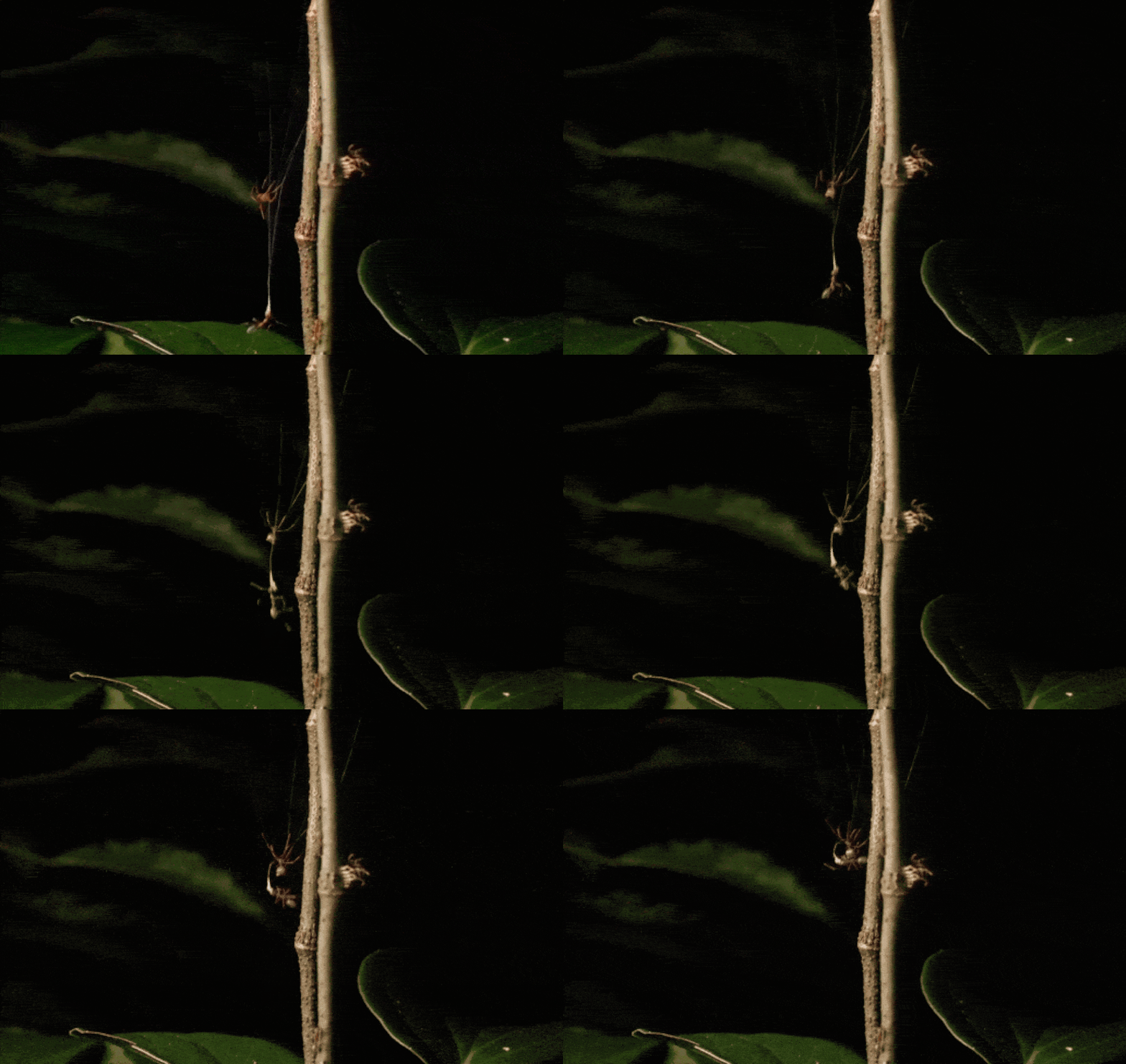
Esta diminuta araña australiana utiliza una catapulta de telaraña de alta potencia para atrapar y comer hormigas agresivas
This tiny Australian spider uses a high-powered web catapult to trap and eat aggressive ants
The ballista spider only feeds on extremely fierce green tree ants – so it has evolved sophisticated tools to safely catch its prey.
La araña ballista solo se alimenta de hormigas verdes extremadamente feroces, por lo que ha evolucionado herramientas sofisticadas para cazar a sus presas con seguridad.
There’s more than one way a spider can spin its web. Some construct large vertical orb webs, while others build horizontal sheet webs or tangled cobwebs that ensnare crawling insects.
Hay más de una manera en que una araña puede tejer su telaraña. Algunas construyen grandes telarañas esféricas verticales, mientras que otras construyen telarañas en lámina horizontales o marañas que atrapan insectos rastreros.
There’s also more than one way a spider can catch its dinner. Net-casting spiders throw small silk nets over unsuspecting prey, while slingshot spiders use their conical webs like catapults, launching both themselves and the web toward nearby prey.
También hay más de una manera en que una araña puede atrapar su cena. Las arañas lanzadoras de redes arrojan pequeñas redes de seda sobre presas desprevenidas, mientras que las arañas tipo honda usan sus telarañas cónicas como catapultas, lanzando tanto a sí mismas como la red hacia presas cercanas.
In the tropical rainforests of the Cape York Peninsula in Queensland, we discovered a spider with a new hunting strategy: a small nocturnal animal of the genus Propostira which we call the ballista spider.
En las selvas tropicales de la Península de Cape York en Queensland, descubrimos una araña con una nueva estrategia de caza: un pequeño animal nocturno del género Propostira, al que llamamos araña ballista.
As we describe in a paper published today in Current Biology, it constructs a unique spring-loaded snare triggered only by a single kind of prey: the highly territorial and aggressive green tree ant (Oecophylla smaragdina) .
Como describimos en un artículo publicado hoy en Current Biology, construye una trampa única accionado por resorte, activada solo por un tipo de presa: la hormiga arbórea verde (Oecophylla smaragdina) , altamente territorial y agresiva.
How the ballista spider catches ants
Cómo la araña ballista atrapa hormigas
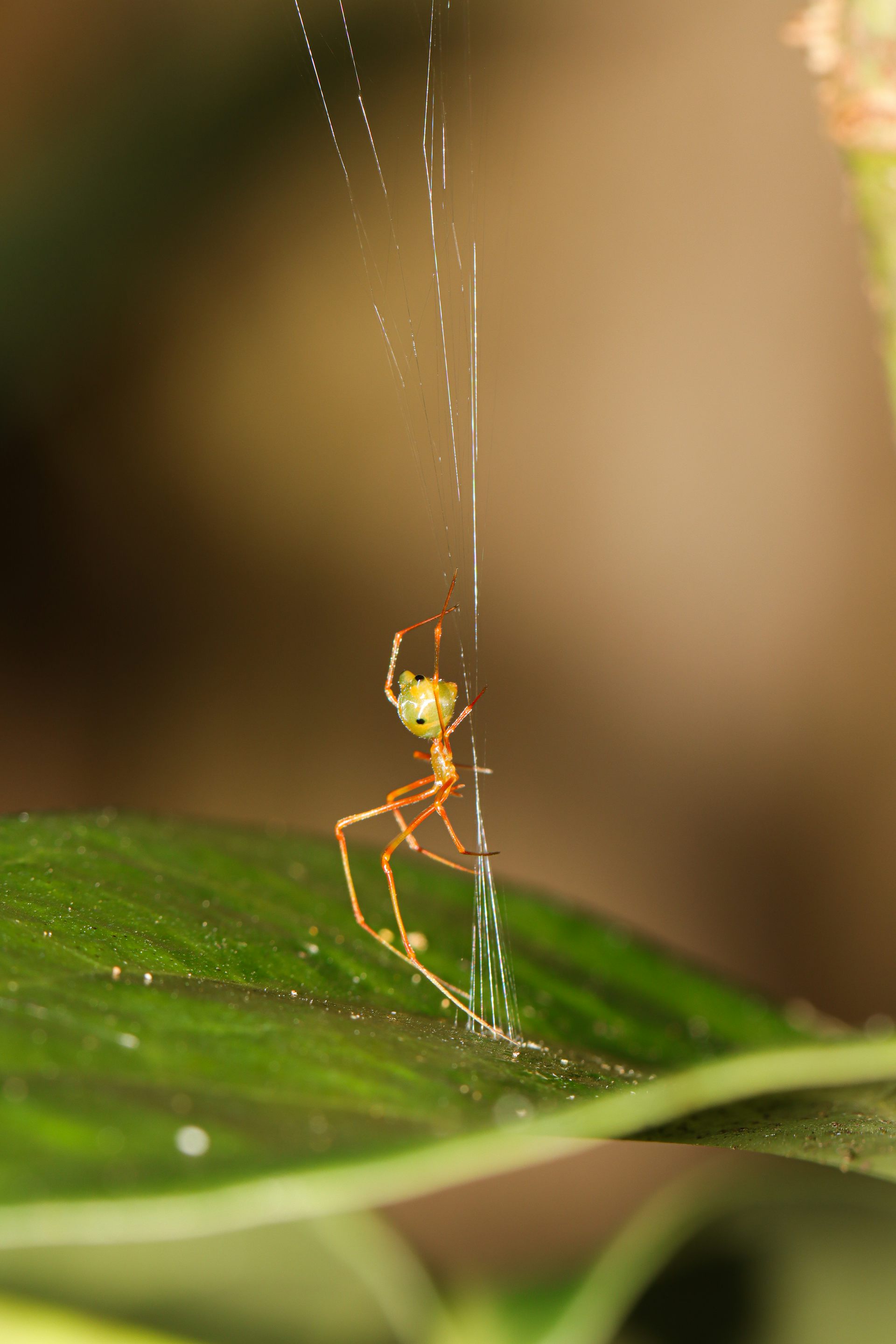
During the day, this spider rests within a silken retreat on the underside of leaves. As the night unfolds, the spider slowly descends on a silk line until it finds a suitable structure on which to lay an anchor point.
Durante el día, esta araña descansa en un refugio de seda en la parte inferior de las hojas. A medida que cae la noche, la araña desciende lentamente por una línea de seda hasta encontrar una estructura adecuada donde colocar un punto de anclaje.
Next it returns to the core web, leaving a “tension line” behind it, and repeats the process with incredible precision to build a fan-shaped web of silk tension lines. This gradually leads to the formation of a small conical scaffold which the spider then wraps in a thinner kind of silk before retreating to the core web.
Luego regresa a la telaraña principal, dejando una «línea de tensión» detrás de sí, y repite el proceso con increíble precisión para construir una red en forma de abanico de líneas tensas de seda. Esto conduce gradualmente a la formación de un pequeño andamio cónico que la araña luego envuelve con un tipo más fino de seda antes de retirarse a la telaraña principal.
The thinner silk seems to attract ants and provoke an attack response, possibly by means of pheromones. After the thinner silk is laid, worker green tree ants appear in moments. The ants react aggressively, biting the cone.
La seda más fina parece atraer hormigas y provocar una respuesta de ataque, posiblemente por medio de feromonas. Después de que se coloca la seda más fina, aparecen en momentos obreras hormigas verdes arbóreas. Las hormigas reaccionan agresivamente, mordiendo el cono.
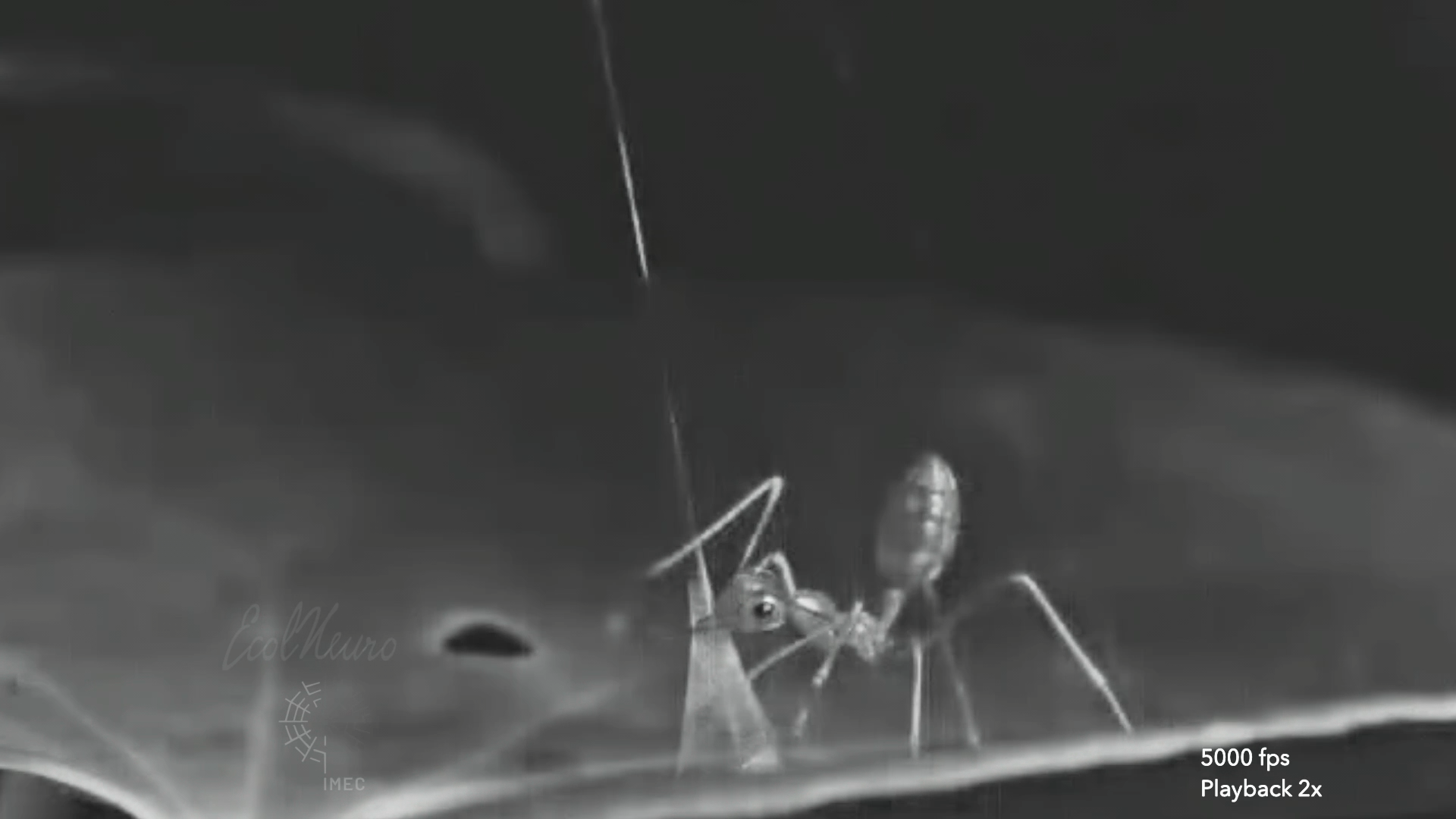
The bite detaches the cone from the surface, and the ant is pulled up and propelled into the core web in a fraction of a second. The ant is hauled off at accelerations of up to 1,367 metres per second squared – that’s roughly 140 times the acceleration due to gravity, or 15 times the most extreme g-forces experienced by jet pilots.
La mordida desaloja el cono de la superficie, y la hormiga es levantada y impulsada hacia la telaraña principal en una fracción de segundo. La hormiga es arrastrada a aceleraciones de hasta 1.367 metros por segundo al cuadrado: eso equivale aproximadamente a 140 veces la aceleración debida a la gravedad, o 15 veces las fuerzas g más extremas experimentadas por los pilotos de aviones a reacción.
The spider waits for the ant to be fully entangled in its web. When it’s safe to approach, the spider wraps the ant in silk until it is ready to eat.
La araña espera hasta que la hormiga esté completamente enredada en su telaraña. Cuando es seguro acercarse, la araña envuelve a la hormiga con seda hasta que está lista para comer.
A superior system
Un sistema superior
The ballista spider’s snare exhibits superior energy performance compared with other silk-based catapult systems.
La trampa de la araña ballista exhibe un rendimiento energético superior en comparación con otros sistemas de catapulta basados en seda.
Gram for gram, the webs store more energy and exert more power than any known biological catapult. A kilogram of the web would store 78.17 kilojoules of kinetic energy and very briefly exert 11.73 megawatts of power.
Gramo por gramo, las telarañas almacenan más energía y ejercen más potencia que cualquier catapulta biológica conocida. Un kilogramo de la tela almacenaría 78.17 kilojulios de energía cinética y ejercería muy brevemente 11.73 megavatios de potencia.
The exceptionally high power of the ballista spider’s snare has likely evolved to rapidly yank ants away from the vicinity of their nests and trail, where fellow ants might come to their defence.
Es probable que la potencia excepcionalmente alta de la trampa de la araña ballista haya evolucionado para arrancar rápidamente a las hormigas de la proximidad de sus nidos y senderos, donde otras hormigas podrían venir a defenderlas.
Extreme specialisation
Especialización extrema
There are two more unusual things about the ballista spider.
Hay dos cosas más inusuales sobre la araña ballista.
First is its extreme specialisation to a single prey species. This suggests the spiders may add specific pheromones to the thin wrapping silk on their snares to attract green tree ants.
Primero es su especialización extrema hacia una única especie de presa. Esto sugiere que las arañas pueden añadir feromonas específicas al hilo fino de seda en sus trampas para atraer hormigas de árbol verdes.
Second is that the snare is triggered by the prey itself, rather than the more common situation in which the predator senses the prey and triggers the snare.
Segundo es que la trampa es activada por la propia presa, en lugar de la situación más común en la que el depredador siente a la presa y activa la trampa.
The ballista spider demonstrates how extreme prey specialisation can drive the evolution of exceptional biomechanical performance.
La araña ballista demuestra cómo la especialización extrema de las presas puede impulsar la evolución de un rendimiento biomecánico excepcional.
Ajay Narendra receives funding from Australian Research Council and Herman Slade Foundation.
Ajay Narendra recibe financiación del Consejo Australiano de Investigación y la Fundación Herman Slade.
Read more
-

Nuevo documental recorre la carrera de Kylie Minogue, desde los duros críticos iniciales hasta el estrellato pop
New documentary traces Kylie Minogue’s career, from harsh early critics to pop stardom
-

¿Favorece la Copa del Mundo a las naciones democráticas o autocráticas? Hice algunos cálculos para averiguarlo
Does the World Cup favor democratic or autocratic nations? I did some number crunching to find out