Minoría Dong de China: por qué estamos grabando y preservando digitalmente su patrimonio arquitectónico indígena
China’s Dong minority: why we’re digitally recording and preserving their Indigenous architectural heritage
A new project uses cutting-edge digital technology to precord the architecture and culture of China’s Indigenous Dong minority.
Un nuevo proyecto utiliza tecnología digital de vanguardia para documentar la arquitectura y cultura de la minoría indígena Dong de China.
The Dong people in China are an Indigenous ethnic group who are known to have lived in the mountainous regions of southwestern China for about 600 years. They don’t have a written language – instead their cultural knowledge is shared by word of mouth. This means that the outside world doesn’t know much about them.
El pueblo Dong en China es un grupo étnico indígena conocido por haber vivido en las regiones montañosas del suroeste de China durante unos 600 años. No tienen lengua escrita; en cambio, su conocimiento cultural se transmite de boca en boca. Esto significa que el mundo exterior no sabe mucho sobre ellos.
But an ambitious university-led research project to document the Dong people’s distinctive architecture is revealing a great deal about this marginalised Indigenous group’s way of life.
Pero un ambicioso proyecto de investigación universitario para documentar la arquitectura distintiva del pueblo Dong está revelando muchísimo sobre el modo de vida de este grupo indígena marginado.
There are an estimated 3 million Dong people living in the provinces of Guizhou, Hunan and Guangxi. They are renowned for their polyphonic choral singing, which has been inscribed by Unesco since 2009 as an example of world-class intangible cultural heritage. Their architecture, landscape and refined agricultural terracing are also distinctive, but less well known and never digitally recorded.
Se estima que viven 3 millones de personas Dong en las provincias de Guizhou, Hunan y Guangxi. Son renombrados por su canto coral polifónico, inscrito por la Unesco desde 2009 como ejemplo de patrimonio cultural inmaterial de clase mundial. Su arquitectura, paisaje y refinado sistema de terrazas agrícolas también son distintivos, pero menos conocidos y nunca registrados digitalmente.
Dong buildings and settlements are typically hidden in fir forests with direct access to waterways at the bottom of valleys or halfway up hills. A Dong settlement typically has around 200 households of four to five people – although some larger villages can have as many as 500 households.
Los edificios y asentamientos Dong suelen estar escondidos en bosques de abetos con acceso directo a vías fluviales en la parte inferior de los valles o a mitad de las colinas. Un asentamiento Dong típicamente cuenta con alrededor de 200 hogares de cuatro a cinco personas, aunque algunas aldeas más grandes pueden tener hasta 500 hogares.
These villages tend to have a gatehouse marking their boundary, defining their territory in relation to neighbouring settlements. Many feature a distinctive “wind-and-rain bridge” – a mix of village gate and covered bridge – used for communal gatherings and blocking ceremonies. Ponds, wells, and granaries are scattered throughout the landscape.
Estas aldeas tienden a tener una puerta que marca su límite, definiendo su territorio en relación con los asentamientos vecinos. Muchas cuentan con un distintivo «puente del viento y la lluvia» —una mezcla de puerta de aldea y puente cubierto— utilizado para reuniones comunales y ceremonias de bloqueo. Estan dispersos estanques, pozos y graneros por todo el paisaje.
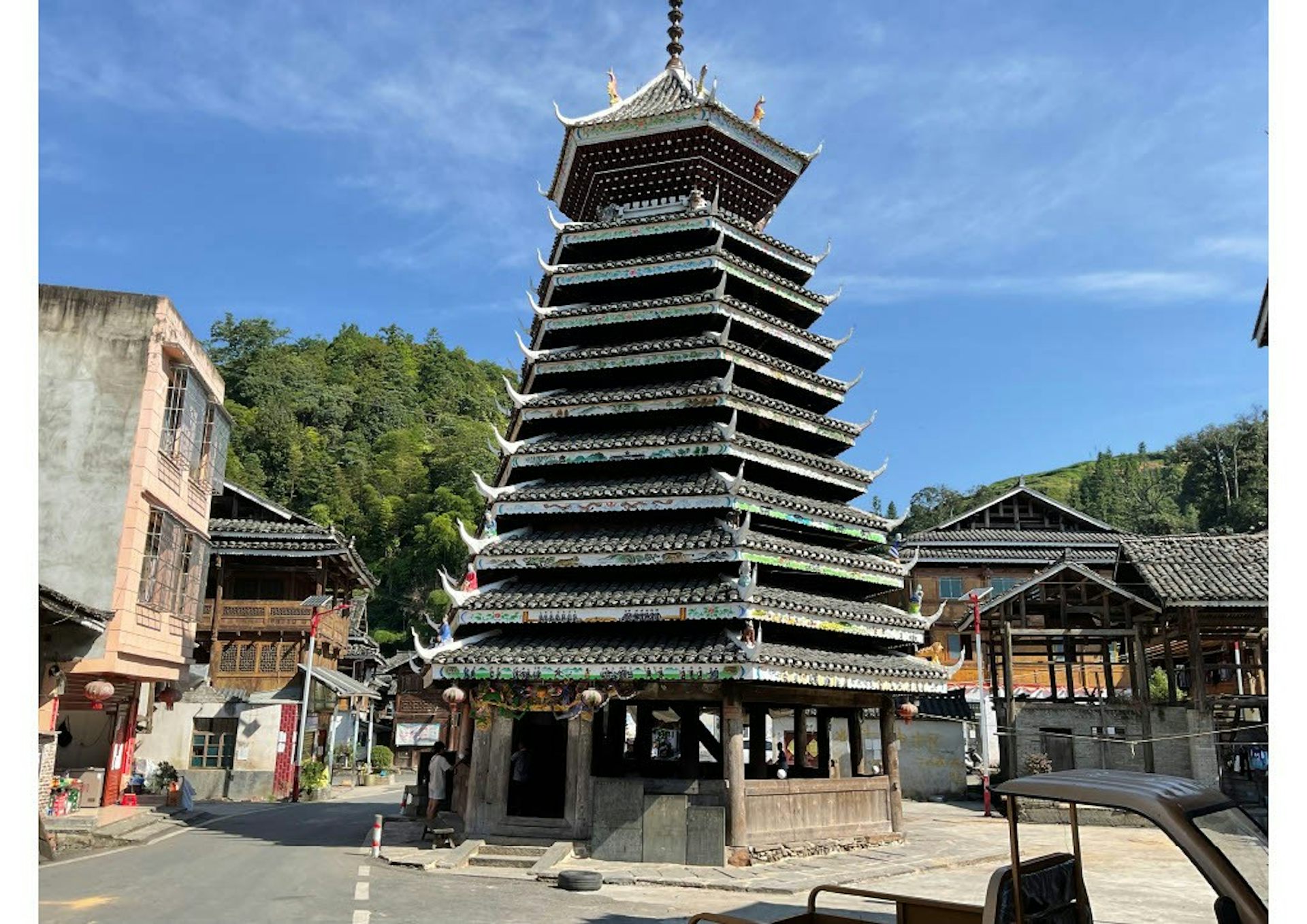
At the heart of most villages, surrounded by wooden houses of two or three storeys, there is a “drum tower” and a “Sa-Sui shrine”. The former represents the connection of the people’s sacred belief of clan kinship and fir trees, while the latter represents the centre of the Dong’s worship of the “Sa” or grandmother. They are the most important buildings in a village – for security, social and spiritual reasons.
En el corazón de la mayoría de las aldeas, rodeados de casas de madera de dos o tres pisos, hay una «torre del tambor» y un «santuario Sa-Sui.» La primera representa la conexión de la creencia sagrada del pueblo sobre el parentesco de clanes y los abetos, mientras que la segunda representa el centro de la adoración Dong a la «Sa», o abuela. Son los edificios más importantes de una aldea por razones de seguridad, sociales y espirituales.
Culture at risk
Patrimonio cultural en riesgo
Nowadays, the Dong’s built and cultural heritage are increasingly at risk. This is due to a combination of climate change, natural disasters, urban infrastructure development and the expansion of rural tourism.
Hoy en día, el patrimonio construido y cultural de los Dong está cada vez más en peligro. Esto se debe a una combinación de cambio climático, desastres naturales, desarrollo de infraestructura urbana y la expansión del turismo rural.
A warming climate is increasingly triggering wild fires and causing mountain flooding. We are also seeing the encroachment of urbanism into the Dong’s rural settings. While bringing improvements in the quality of life, this often presents domestic fire hazards due to poor-quality electrical infrastructure. And in recent years, the growth of tourism and the encroachment of roads, railways and bridges is in danger of turning these villages into decorated stage-sets. This may bring in money, but threatens the Dong people’s unique architecture and landscape.
Un clima que se calienta está desencadenando con mayor frecuencia incendios forestales y causando inundaciones en las montañas. También estamos viendo la invasión del urbanismo en los entornos rurales de los Dong. Si bien esto trae mejoras en la calidad de vida, a menudo presenta riesgos de incendio doméstico debido a infraestructuras eléctricas de baja calidad. Y en los últimos años, el crecimiento del turismo y la intrusión de carreteras, ferrocarriles y puentes corre el riesgo de convertir estos pueblos en decorados escenarios. Esto puede generar dinero, pero amenaza la arquitectura y el paisaje únicos del pueblo Dong.
It’s a pressing challenge for this Indigenous people and for those of us dedicated to preserving their historic environment, their culture and their highly ritualised way of life.
Es un desafío apremiante para este pueblo indígena y para aquellos de nosotros dedicados a preservar su entorno histórico, su cultura y su modo de vida altamente ritualizado.
Tragically, the scarcity of resources means that schemes for repair, restoration and regeneration works, as well as insufficient conservation policies and frameworks, have been slow to help preserve these precious villages. The far remote mountainous environment does not help. Both the local communities and government authorities have extremely limited resources to manage almost any change to their historic environment.
Trágicamente, la escasez de recursos significa que los planes de reparación, restauración y regeneración, así como las políticas y marcos de conservación insuficientes, han sido lentos para ayudar a preservar estos preciosos pueblos. El entorno montañoso y remoto no ayuda. Tanto las comunidades locales como las autoridades gubernamentales tienen recursos extremadamente limitados para gestionar cualquier cambio en su entorno histórico.
Despite the remote location of many of these villages, they are now being encroached upon by modern development. We’re seeing the growth of contemporary housing developments using modern structures and materials. It’s part of the rapid urbanisation of China over the past few decades – but, like elsewhere, it’s irreversibly changing the image and identity of the Dong settlements and their architecture.
A pesar de la ubicación remota de muchos de estos pueblos, ahora están siendo invadidos por el desarrollo moderno. Estamos viendo el crecimiento de desarrollos residenciales contemporáneos que utilizan estructuras y materiales modernos. Es parte de la rápida urbanización de China durante las últimas décadas, pero, como en otros lugares, está cambiando irreversiblemente la imagen e identidad de los asentamientos Dong y su arquitectura.
The problem of modern tourist development can be seen in the way traditional-style drum towers are being built as theme park attractions. At the Danzhai Wanda Village, a newly developed theme park near Kaili in Guizhou, the nearest city to the Dong’s Indigenous areas, there are five newly built drum towers, billed as “iconic”, which are presented as standalone monuments with no sense of their relationship with the surrounding houses and forests.
El problema del desarrollo turístico moderno se puede ver en la forma en que se están construyendo torres de tambores al estilo tradicional como atracciones de parques temáticos. En el Danzhai Wanda Village, un parque temático recién desarrollado cerca de Kaili en Guizhou, la ciudad más cercana a las áreas indígenas Dong, hay cinco torres de tambores recién construidas, promocionadas como «icónicas», que se presentan como monumentos independientes sin ningún sentido de su relación con las casas y los bosques circundantes.
Decoding Dong built heritage
Decodificando el patrimonio construido de los Dong
The need to document and protect authentic Indigenous Dong culture is what has driven the Decoding Dong project.
La necesidad de documentar y proteger la auténtica cultura indígena Dong es lo que ha impulsado el proyecto Decoding Dong.
This was launched in 2023 and completed in 2025 and set to digitally document Dong physical and cultural heritage.
Se lanzó en 2023, se completó en 2025 y está destinado a documentar digitalmente el patrimonio físico y cultural de los Dong.
This interdisciplinary project draws on humanities and social science disciplines ranging from architecture, anthropology, heritage sciences, sociology and digital humanities.
Este proyecto interdisciplinario se nutre de disciplinas de humanidades y ciencias sociales que abarcan desde la arquitectura, la antropología, las ciencias del patrimonio, la sociología y las humanidades digitales.
It put together a series of innovative and complementary research methods. This has involved 3D LiDAR scanning, aerial and terrestrial photogrammetry (the science of applying mathematics to photographs to extract accurate 3D measurements) , 3D reality capture modelling, measured drawing, documentary film making and mapping. This has been complemented with oral histories from provided by Dong people.
Reunió una serie de métodos de investigación innovadores y complementarios. Esto incluyó escaneo LiDAR 3D, fotogrametría aérea y terrestre (la ciencia de aplicar matemáticas a fotografías para extraer mediciones tridimensionales precisas) , modelado de captura de realidad 3D, dibujo técnico, realización de documentales y cartografía. Esto se complementó con historias orales proporcionadas por la gente Dong.
The project has completed a first-of-its-kind digital documentation of the Dong architectural heritage, building digital and audio-visual documentaries of around 100 historic buildings across a dozen remote Dong villages.
El proyecto ha completado una documentación digital pionera del patrimonio arquitectónico Dong, creando documentales digitales y audiovisuales de alrededor de 100 edificios históricos en una docena de aldeas remotas Dong.
A key part of the research process was to consult with key stakeholders, including clan leaders, elderly villagers and provincial policymakers wherever possible.
Una parte clave del proceso de investigación fue consultar con partes interesadas clave, incluidos líderes de clanes, ancianos de las aldeas y responsables políticos provinciales siempre que fuera posible.
Indigenous Dong heritage is still under threat, due to the scarcity of resources faced by both the local authority and the communities themselves.
El patrimonio indígena Dong sigue amenazado debido a la escasez de recursos que enfrentan tanto las autoridades locales como las propias comunidades.
But this project represents a step change. By building a mutually beneficial store of information, supported by cutting-edge digital technologies, we hope to draw more attention to this distinctive people without threatening what it is that makes them unique.
Pero este proyecto representa un cambio de paradigma. Al construir un depósito de información mutuamente beneficioso, respaldado por tecnologías digitales de vanguardia, esperamos llamar más la atención sobre este pueblo distintivo sin amenazar lo que los hace únicos.
Xiang Ren receives funding from Arcadia—a charitable fund to record cultural heritage, to conserve and restore nature, and to promote open access to knowledge, via its Endangered Wooden Architecture Programme coordinated by Oxford Brookes University (EWAP2039LG, 2023-25) , and the University of Sheffield Knowledge Exchange Funding (QR-PSF, 2026) .
Xiang Ren recibe financiación de Arcadia, un fondo benéfico para registrar el patrimonio cultural, conservar y restaurar la naturaleza, y promover el acceso abierto al conocimiento, a través de su Programa de Arquitectura de Madera en Peligro coordinado por Oxford Brookes University (EWAP2039LG, 2023-25) , y la financiación de Intercambio de Conocimiento de la Universidad de Sheffield (QR-PSF, 2026) .
Read more
-

¿Desesperado por el estado del mundo? Los antiguos griegos y romanos conocían ese sentimiento
Despairing at the state of the world? The ancient Greeks and Romans knew the feeling
-

La biología sintética prometió reescribir la vida: con la muerte de su pionero, J. Craig Venter, ¿qué tan cerca están los científicos?
Synthetic biology promised to rewrite life – with the death of its pioneer, J. Craig Venter, how close are scientists?