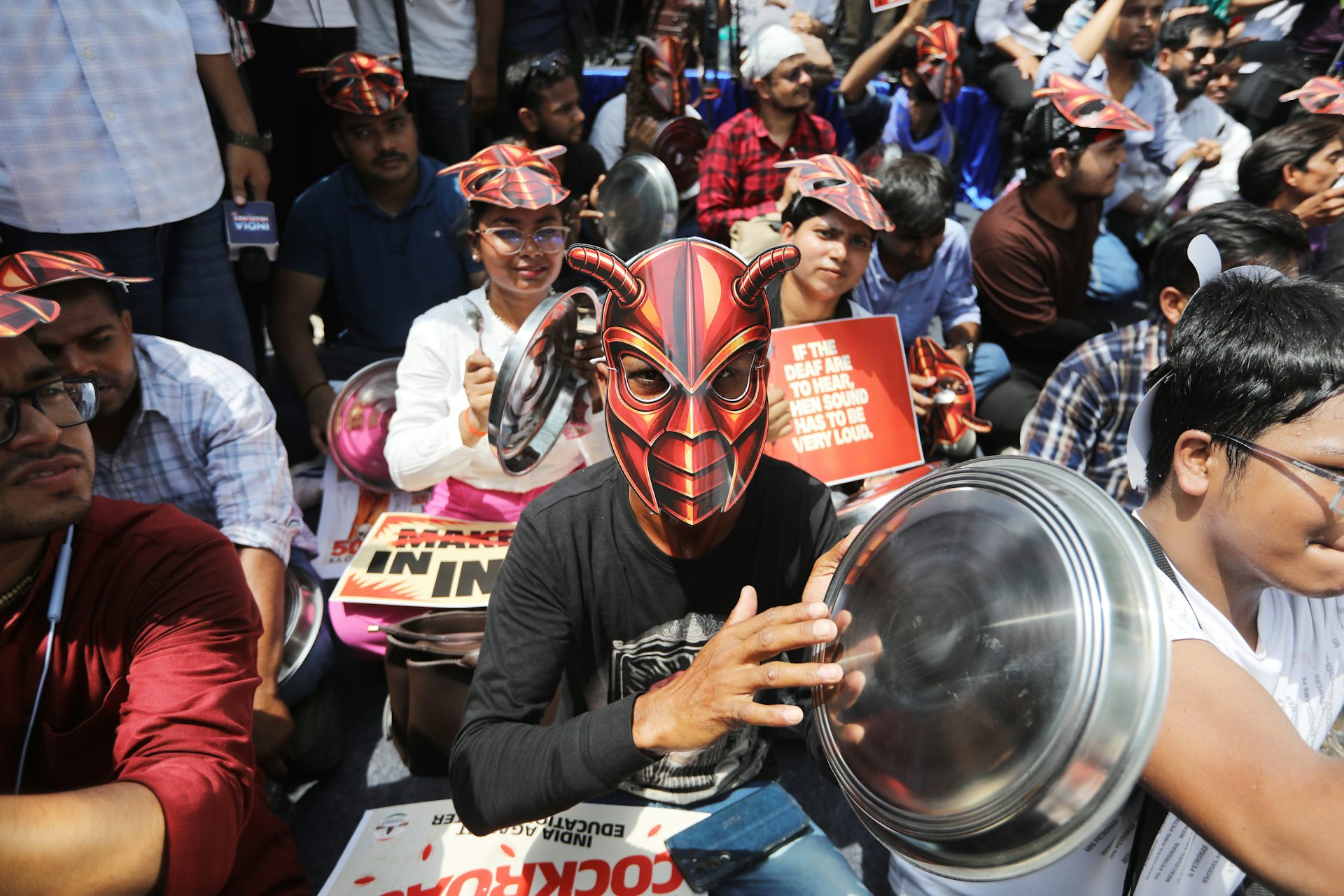
La crisis de empleo juvenil que alimenta las protestas del Partido Janta Cucarachas de la India
The youth jobs crisis fuelling India’s Cockroach Janta Party protests
Economist Rosa Abraham talks to The Conversation Weekly podcast about a new youth protest movement whose symbol is a cockroach.
La economista Rosa Abraham habla en el pódcast The Conversation Weekly sobre un nuevo movimiento de protesta juvenil cuyo símbolo es una cucaracha.
A new youth protest movement in India that started as online satire is now staging an ongoing sit-in in New Delhi calling for the resignation of India’s education minister.
Un nuevo movimiento de protesta juvenil en la India que comenzó como sátira en línea está llevando a cabo actualmente una sentada en Nueva Delhi exigiendo la renuncia del ministro de educación de la India.
The Cockroach Janta Party (CJP) was launched in late May by Abhijeet Dipke, a graduate of Boston University, in response to alleged comments by India’s chief justice, Surya Kant, comparing unemployed young Indians to cockroaches. Kant later clarified his comments and said he’d been misquoted.
El Partido Janta Cucaracha (CJP) fue lanzado a finales de mayo por Abhijeet Dipke, graduado de la Universidad de Boston, en respuesta a supuestos comentarios del juez supremo de la India, Surya Kant, comparando a los jóvenes indios desempleados con cucarachas. Kant aclaró sus comentarios más tarde y dijo que había sido malinterpretado.
Dipke launched a parody political party, calling on all cockroaches to unite, which led to street protests in cities including Delhi, Pune, Jaipur and Bengaluru.
Dipke lanzó un partido político paródico, llamando a todas las cucarachas a unirse, lo que provocó protestas callejeras en ciudades como Delhi, Pune, Jaipur y Bengaluru.
The CJP latched onto mounting anger in India at a series of issues affecting exams, including the secondary school leaving exam, which has affected thousands of people and been linked to suicides. But the movement has also tapped into the anger of a generation of graduates who’ve done everything right but still can’t find work that matches their aspirations.
El CJP se aprovechó de la creciente ira en la India por una serie de problemas que afectan a los exámenes, incluido el examen de graduación de secundaria, lo que ha afectado a miles de personas y se ha relacionado con suicidios. Pero el movimiento también ha explotado la rabia de una generación de graduados que han hecho todo bien pero aún no pueden encontrar un trabajo que coincida con sus aspiraciones.
In this episode of The Conversation Weekly, economist Rosa Abraham at Azim Premji University in Bengaluru, explains how India’s jobs crisis is fuelling this new youth protest movement.
En este episodio de The Conversation Weekly, la economista Rosa Abraham de la Universidad Azim Premji en Bengaluru explica cómo la crisis laboral de la India está alimentando a este nuevo movimiento de protesta juvenil.
Lead author of the State of Working India report, an annual review of labour issues in the country, Abraham says the comparison with cockroaches “was seen as an insult to a generation which has felt like institutions, the state, the private sector has failed them”.
La autora principal del informe State of Working India, una revisión anual de los problemas laborales en el país, afirma que la comparación con las cucarachas “fue vista como un insulto para una generación que ha sentido que instituciones, el estado y el sector privado les han fallado”.
There were 63 million graduates in India between the ages of 20-29 in 2023, and around 11 million of them were unemployed. Abraham says that the lack of political response to the jobs crisis means “you’re seeing this kind of simmering discontent, which has always been in the background, which is now finding these release valves through movements like … the CJP”.
En 2023 hubo 63 millones de graduados en la India entre los 20 y 29 años, y alrededor de 11 millones estaban desempleados. Abraham dice que la falta de respuesta política a la crisis laboral significa “que estás viendo este tipo de descontento latente, que siempre ha estado en segundo plano, y que ahora está encontrando estas válvulas de escape a través de movimientos como… el CJP”.
Listen to Abraham talk about the reasons behind India’s youth jobs crisis on The Conversation Weekly podcast.
Escuche a Abraham hablar sobre las razones detrás de la crisis laboral juvenil de la India en el pódcast The Conversation Weekly.
This episode of The Conversation Weekly was written and produced by Gemma Ware and Mend Mariwany. Mixing by Eleanor Brezzi and theme music by Neeta Sarl.
Este episodio de The Conversation Weekly fue escrito y producido por Gemma Ware y Mend Mariwany. Mezcla por Eleanor Brezzi y música temática por Neeta Sarl.
Newsclips in this episode from WI ON, DW News, CNA, BBC News India, CNN-News18, NDTV, peeinghuman via Instagram and The Indian Express.
Fragmentos de noticias en este episodio de WI ON, DW News, CNA, BBC News India, CNN-News18, NDTV, peeinghuman vía Instagram y The Indian Express.
Listen to The Conversation Weekly via any of the apps listed above, download it directly via our RSS feed or find out how else to listen here. A transcript of this episode is available via the Apple Podcasts or Spotify apps.
Escuche The Conversation Weekly a través de cualquiera de las aplicaciones mencionadas anteriormente, descárguelo directamente a través de nuestro feed RSS o averigüe cómo escucharlo de otra manera aquí. Una transcripción de este episodio está disponible a través de las aplicaciones Apple Podcasts o Spotify.
Rosa Abraham has received funding from the Institute for What Works to Advance Gender Equality and from the National Council for Applied Economic Research.
Rosa Abraham ha recibido financiación del Instituto para lo que Funciona para Avanzar la Igualdad de Género y del Consejo Nacional de Investigación Económica Aplicada.
Read more
-

Por qué se burlan los cánticos de la Copa Mundial de EE. UU. – y qué hace que uno sea genial
Why the US World Cup chants are being mocked – and what makes a great one
-

Messi está viejo, bajo y lento. ¿Cómo sigue dominando en el Mundial?
Messi is old, short and slow. How is he still dominating at the World Cup?