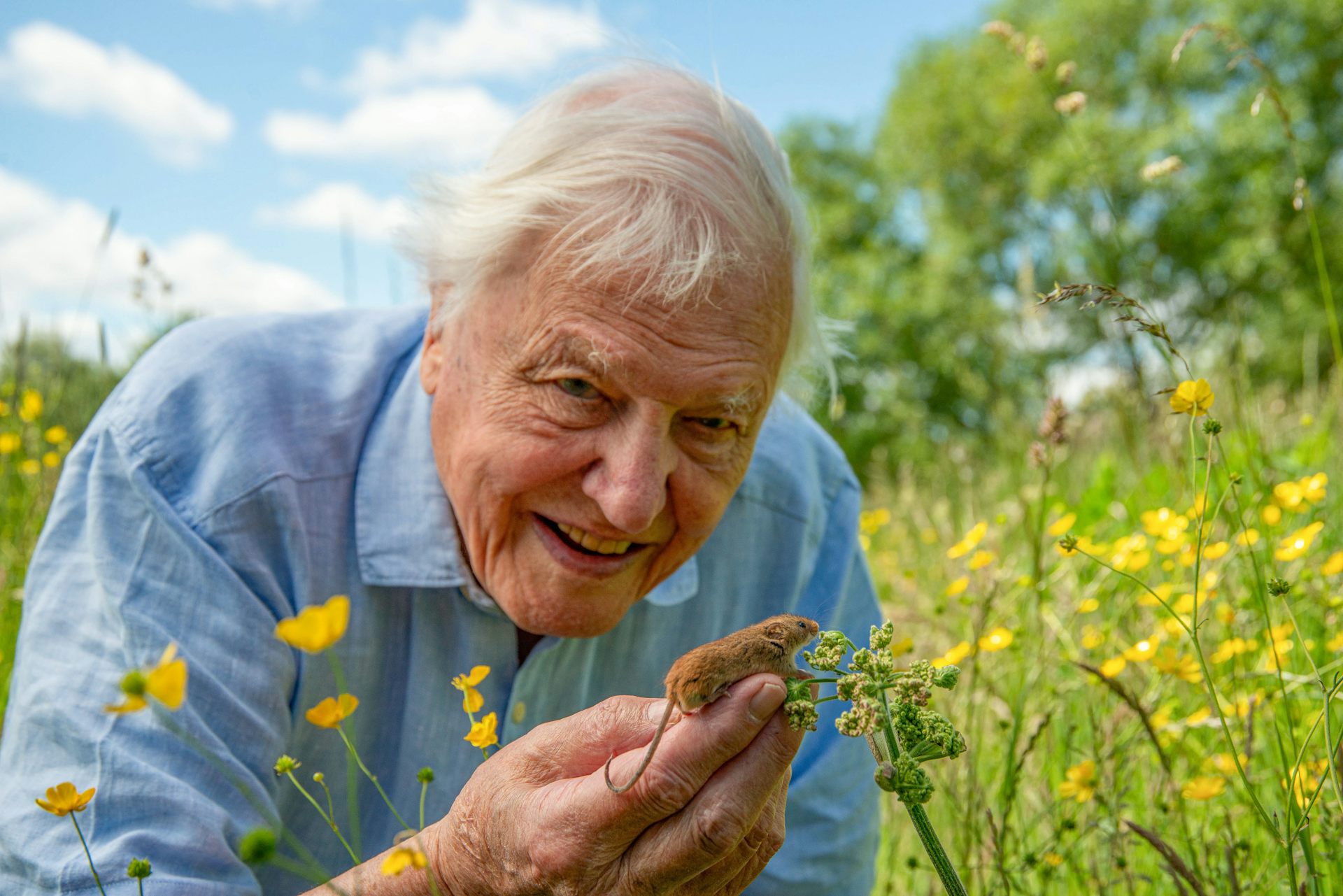
Al cumplir David Attenborough los 100 años, cuatro expertos exploran su legado, desde la ciencia hasta la narración de historias
As David Attenborough turns 100, four experts explore his legacy, from science to storytelling
Attenborough has influenced everything from conservation and documentary production to the communication of the biggest story of all – climate change.
Attenborough ha influido en todo, desde la conservación y la producción de documentales hasta la comunicación de la historia más grande de todas: el cambio climático.
Sir David Attenborough has mastered the craft of storytelling. He has undoubtedly inspired generations of people around the globe to love and care for the natural world. And in doing so, he’s become one of the most recognisable – and most trusted – faces on our screens.
Sir David Attenborough ha dominado el arte de contar historias. Sin duda, ha inspirado a generaciones de personas alrededor del mundo a amar y cuidar el mundo natural. Y al hacerlo, se ha convertido en una de las caras más reconocibles y más confiables de nuestras pantallas.
Now, he’s celebrating his 100th birthday and a lifetime of wildlife filmmaking. As part of The Conversation UK’s climate storytelling strand, four experts critique how he has influenced everything from conservation and documentary production to the communication of the biggest story of all – climate change.
Ahora, celebra su cumpleaños número 100 y una vida de cine de vida silvestre. Como parte de la sección de narración climática de The Conversation UK, cuatro expertos critican cómo ha influido en todo, desde la conservación y la producción de documentales hasta la comunicación de la historia más grande de todas: el cambio climático.
Scientific insight
Perspicacia científica
Ben Garrod, science broadcaster and Professor of Evolutionary Biology and Science Engagement at the University of East Anglia, has presented alongside Attenborough in several landmark documentaries. Here he reflects on Attenborough’s passion for furthering our scientific understanding of the natural world.
Ben Garrod, divulgador científico y Profesor de Biología Evolutiva y Participación Científica de la Universidad de East Anglia, ha participado junto a Attenborough en varios documentales emblemáticos. Aquí reflexiona sobre la pasión de Attenborough por profundizar nuestra comprensión científica del mundo natural.
I once sat on a remote beach with Attenborough, near the very tip of South America. I can still clearly remember the warmth of the rounded, flat stones beneath me. We sat only a metre or so apart. We’d just spent the morning filming the excavation of the largest dinosaur ever discovered.
Una vez me senté en una playa remota con Attenborough, cerca de la punta de Sudamérica. Todavía recuerdo claramente el calor de las piedras redondeadas y planas bajo mí. Estábamos sentados a solo un metro de distancia. Acabábamos de pasar la mañana filmando la excavación del dinosaurio más grande jamás descubierto.
Over lunch, Attenborough had recalled we were close to a beach he’d filmed at years before, where grey whale mothers drew in close to shore with their calves to rub against the stone in the shallows to exfoliate their skin. As luck would have it, it was the perfect time of year and before long, there we were watching a mother and calf just a few metres offshore.
Durante el almuerzo, Attenborough recordó que estábamos cerca de una playa que había filmado años antes, donde las madres ballenas grises acercaban a la orilla con sus crías para frotarse contra las piedras en las aguas poco profundas y exfoliar su piel. Como suerte, era la época perfecta y poco después, allí estábamos viendo a una madre y una cría a pocos metros de la costa.
Facts and figures bubbled out of Attenborough excitedly, not at all like the calm and more measured way we’re all so used to. For those few minutes, he was childlike in his wonder and excitement at the scene in front of us and I marvelled at how he has not only maintained that love for the natural world for so long but how he has always so passionately shared it with the rest of us.
Los datos y cifras brotaban de Attenborough con entusiasmo, nada parecido a la calma y la mesura a las que todos estamos acostumbrados. Durante esos pocos minutos, fue infantil en su asombro y emoción ante la escena que teníamos delante, y me maravilló cómo no solo ha mantenido ese amor por el mundo natural durante tanto tiempo, sino cómo lo ha compartido siempre con tanta pasión con el resto de nosotros.
For a century now, Attenborough’s life has been intimately interwoven not only with humanity’s growing scientific understanding of the natural world but also its accelerating loss. Spanning over 70 years, Attenborough has been our most trusted and prolific mediator between scientific knowledge and the public.
Durante un siglo, la vida de Attenborough ha estado íntimamente entrelazada no solo con la creciente comprensión científica de la humanidad sobre el mundo natural, sino también con su acelerada pérdida. A lo largo de más de 70 años, Attenborough ha sido nuestro mediador más confiable y prolífico entre el conocimiento científico y el público.
His early landmark BBC series Life on Earth: A Natural History (1979) did something few academic texts ever could. It made the complexity of evolutionary biology accessible. Across his work, natural selection, adaptation, ecology and behaviour are not presented as intangible concepts but as organic processes shaping form, function and ultimately survival across the natural world.
Su primera serie emblemática de la BBC, Life on Earth: A Natural History (1979) , hizo algo que pocos textos académicos pudieron hacer. Hizo accesible la complejidad de la biología evolutiva. A lo largo de su trabajo, la selección natural, la adaptación, la ecología y el comportamiento no se presentan como conceptos intangibles, sino como procesos orgánicos que dan forma, función y, en última instancia, supervivencia en todo el mundo natural.
In doing so, Attenborough helped normalise evolutionary thinking for hundreds of millions of viewers worldwide, embedding complex scientific principles into popular culture, right in our living rooms.
Al hacerlo, Attenborough ayudó a normalizar el pensamiento evolutivo para cientos de millones de espectadores en todo el mundo, incrustando complejos principios científicos en la cultura popular, directamente en nuestros hogares.
Central to his work has been a commitment to scientific accuracy. Attenborough’s programmes have been developed in close collaboration with academics and field researchers, ensuring narratives about animal behaviour, ecosystems and biodiversity reflect current evidence.
Fundamental en su trabajo ha sido el compromiso con la precisión científica. Los programas de Attenborough se han desarrollado en estrecha colaboración con académicos e investigadores de campo, asegurando que las narrativas sobre el comportamiento animal, los ecosistemas y la biodiversidad reflejen la evidencia actual.
This relationship between science and storytelling has been crucial because rather than dumbing down complexity, Attenborough’s “everyday” approach demonstrates audiences can engage with content that could all too easily be written off as belonging to more academic and scientifically literate viewers.
Esta relación entre la ciencia y la narración ha sido crucial porque, en lugar de simplificar la complejidad, el enfoque «cotidiano» de Attenborough demuestra que las audiencias pueden interactuar con contenido que podría considerarse demasiado fácil de asignar solo a espectadores más académicos y científicamente cultos.
The Insights section is committed to high-quality longform journalism. Our editors work with academics from many different backgrounds who are tackling a wide range of societal and scientific challenges.
La sección Insights está comprometida con el periodismo de formato largo de alta calidad. Nuestros editores trabajan con académicos de muchos orígenes diferentes que abordan una amplia gama de desafíos sociales y científicos.
Yet the tone of his work has changed. His early documentaries were characterised by a sense of abundance and discovery. Over time, as scientific evidence for biodiversity loss and climate change mounted, his work shifted accordingly. More recently, his documentaries increasingly shine a light on human impact, habitat destruction and extinction risk. This evolution of change in his own tone mirrors the science itself, highlighting Attenborough’s credibility as a communicator willing to adjust his message as the evidence demands.
Sin embargo, el tono de su trabajo ha cambiado. Sus primeros documentales se caracterizaron por una sensación de abundancia y descubrimiento. Con el tiempo, a medida que aumentaba la evidencia científica de la pérdida de biodiversidad y el cambio climático, su trabajo cambió en consecuencia. Más recientemente, sus documentales iluminan cada vez más el impacto humano, la destrucción del hábitat y el riesgo de extinción. Esta evolución del cambio en su propio tono refleja la ciencia misma, destacando la credibilidad de Attenborough como comunicador dispuesto a ajustar su mensaje a medida que lo exige la evidencia.
Attenborough’s contribution to conservation has not come through activism alone. Research shows that an emotional connection to nature precedes any behavioural change. Attenborough has actively helped build the public conditions necessary for conservation policy and action by fostering wonder, curiosity and empathy for the natural world. His influence can be traced in the generations of scientists, conservationists and educators who cite his programmes as formative experiences.
La contribución de Attenborough a la conservación no ha venido solo a través del activismo. La investigación muestra que una conexión emocional con la naturaleza precede a cualquier cambio de comportamiento. Attenborough ha ayudado activamente a crear las condiciones públicas necesarias para la política y la acción de conservación al fomentar la maravilla, la curiosidad y la empatía por el mundo natural. Su influencia se puede rastrear en las generaciones de científicos, conservacionistas y educadores que citan sus programas como experiencias formativas.
For many, particularly those without access to wild spaces, Attenborough’s work provides an opportunity and gateway to encounter wild animals and remote ecosystems but also local habitats, helping give us all access to the wonder he perceives in the world around him.
Para muchos, particularmente aquellos sin acceso a espacios silvestres, el trabajo de Attenborough proporciona una oportunidad y una puerta de entrada para encontrar animales salvajes y ecosistemas remotos, pero también hábitats locales, ayudándonos a todos a acceder a la maravilla que él percibe en el mundo que lo rodea.
As he turns 100, Attenborough’s legacy is surely inseparable from the global environmental challenges we now face. He has helped society understand not only how life evolved, but, more importantly, why it matters that we protect it now. In an era defined by ecological crisis, his work reminds us that scientific knowledge is most powerful when it connects people to the living world so strongly, it compels us to care enough to protect it, so that we might carry on his legacy and, just like him, act as stewards.
Al cumplir 100 años, el legado de Attenborough es seguramente inseparable de los desafíos ambientales globales que enfrentamos ahora. Ha ayudado a la sociedad a comprender no solo cómo evolucionó la vida, sino, más importante aún, por qué es crucial que la protejamos ahora. En una era definida por la crisis ecológica, su trabajo nos recuerda que el conocimiento científico es más poderoso cuando conecta a las personas con el mundo vivo de manera tan fuerte que nos obliga a preocuparnos lo suficiente como para protegerlo, para que podamos continuar su legado y, al igual que él, actuar como guardianes.
Natural history filmmaking
El cine de historia natural
Jean-Baptiste Gouyon, Professor of Science Communication at the UCL Department of Science and Technology Studies, explains the impact Attenborough has had on natural history television.
Jean-Baptiste Gouyon, profesor de Comunicación Científica del Departamento de Estudios de Ciencia y Tecnología de la UCL, explica el impacto que ha tenido Attenborough en la televisión de historia natural.
In the early 1950s, television was taking off across Britain, but the BBC was still finding its visual voice. Its controller, Cecil McGivern, warned in June 1952 that there was “far too much emphasis…on the spoken word and far too little on the thing seen”. Most early television producers had come from BBC radio and initially made programmes that resembled radio with pictures.
A principios de la década de 1950, la televisión despegaba en Gran Bretaña, pero la BBC aún estaba encontrando su voz visual. Su director, Cecil McGivern, advirtió en junio de 1952 que había “demasiado énfasis… en la palabra hablada y muy poco en lo que se veía”. La mayoría de los primeros productores de televisión provenían de la radio de la BBC y inicialmente hacían programas que parecían radio con imágenes.
Into this world stepped a young David Attenborough, unencumbered by a career in sound, ready to invent a new language for television and, in the process, reshape natural history filmmaking. At 26, he earned his first natural history credit as producer of The Coelacanth (1953) , a 20-minute programme prompted by the capture of a live coelacanth “living fossil” fish off Madagascar.
A este mundo llegó un joven David Attenborough, sin ataduras de una carrera en sonido, listo para inventar un nuevo lenguaje para la televisión y, en el proceso, remodelar el cine de historia natural. A los 26 años, obtuvo su primer crédito de historia natural como productor de The Coelacanth (1953) , un programa de 20 minutos basado en la captura de un pez coelacanth, un “fósil viviente”, frente a Madagascar.
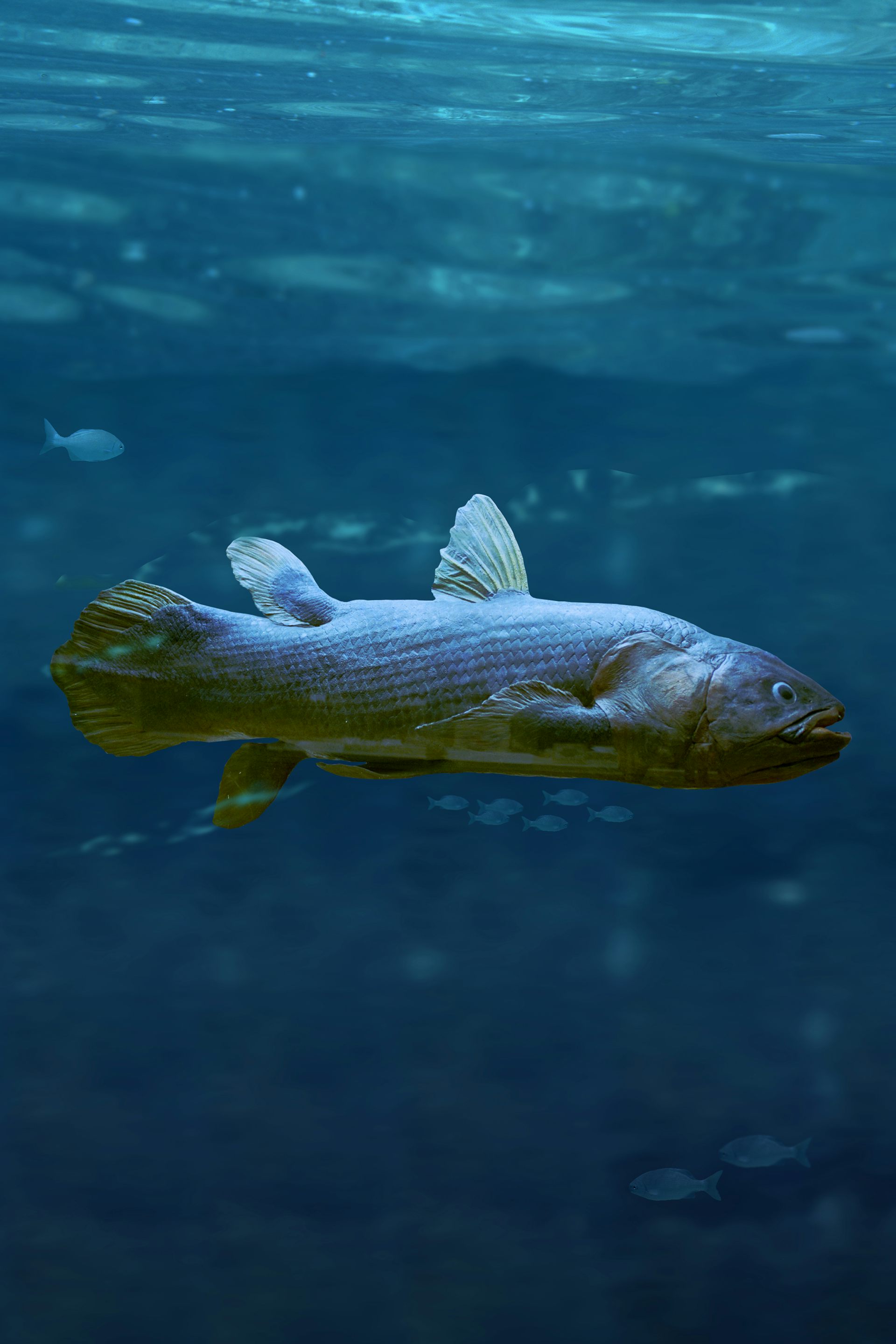
Eschewing sensationalism, Attenborough tied the story to Darwin’s theory of evolution. This use of wildlife programmes to communicate scientific ideas became his trademark.
Al evitar el sensacionalismo, Attenborough vinculó la historia a la teoría de la evolución de Darwin. Este uso de programas de vida silvestre para comunicar ideas científicas se convirtió en su sello distintivo.
The programme blended prerecorded footage with live studio sequences featuring evolutionary biologist Julian Huxley, who used the coelacanth to illustrate life’s transition from sea to land.
El programa combinaba imágenes pregrabadas con secuencias en vivo en el estudio con el biólogo evolutivo Julian Huxley, quien utilizó el coelacanth para ilustrar la transición de la vida del mar a la tierra.
With the Zoo Quest series (1954) , Attenborough began reshaping wildlife television. For these programmes, he travelled to exotic places with staff from the London Zoo to capture animals for the collection. Each episode relied on prerecorded film linked by live studio sequences, allowing tighter narrative control. The hero in the films, shot by Charles Lagus, was Attenborough himself, who back in London also presented the studio sequences. By assuming all the roles of hero, producer, narrator and presenter, Attenborough became the central performer in the story.
Con la serie Zoo Quest (1954) , Attenborough comenzó a remodelar la televisión de vida silvestre. Para estos programas, viajaba a lugares exóticos con personal del Zoológico de Londres para capturar animales para la colección. Cada episodio dependía de películas pregrabadas enlazadas por secuencias en vivo en el estudio, lo que permitía un control narrativo más ajustado. El héroe de las películas, filmado por Charles Lagus, era Attenborough mismo, quien también presentaba las secuencias del estudio en Londres. Al asumir todos los roles de héroe, productor, narrador y presentador, Attenborough se convirtió en el artista central de la historia.
From then on, Attenborough’s fluid on-screen performances gained him much acclaim. A very hard worker, he put much effort in producing highly detailed scripts, which left little to chance. Indeed, by the early 1960s, he had all but lost faith in live television, writing to a BBC colleague:
A partir de entonces, las fluidas actuaciones de Attenborough en pantalla le valieron gran reconocimiento. Trabajador incansable, dedicó mucho esfuerzo a producir guiones muy detallados, dejando poco al azar. De hecho, a principios de la década de 1960, había perdido casi la fe en la televisión en directo, escribiendo a un colega de la BBC:
To begin with I got a tremendous kick out of the excitement of putting out programmes live. But it wore off after a bit and really, except for challenging interviews with lots of ‘immediacy’, I’m for film or some other sort of controlled recording process every time. It is so maddening to miss an effect because of some small mechanical hitch, as so often happens live.
Para empezar, me dio una emoción tremenda la emoción de emitir programas en directo. Pero eso pasó después de un tiempo y, en realidad, excepto por entrevistas desafiantes con mucha ‘inmediatez’, prefiero el cine o algún otro tipo de proceso de grabación controlado. Es tan exasperante perder un efecto debido a un pequeño fallo mecánico, como suele ocurrir en directo.
Consistently high ratings encouraged others to emulate his method, and live formats became less fashionable. Film-based production also allowed programmes to be stockpiled, repeated and sold, supporting a more sustainable business model.
Las calificaciones consistentemente altas animaron a otros a emular su método, y los formatos en directo se volvieron menos populares. La producción basada en cine también permitió acumular, repetir y vender programas, lo que apoyó un modelo de negocio más sostenible.
After Attenborough moved into BBC management in 1965, his goal was to turn natural history television into a science communication genre. He argued that it was “important” to move away from programmes that simply showcased the beauty of nature and instead engage viewers “to examine in a serious and critical way new trends and ideas in zoology”. Returning to hands-on programme-making a decade later, he embedded this vision in his magnum opus, Life on Earth (1979) .
Después de que Attenborough pasara a la dirección de la BBC en 1965, su objetivo fue convertir la televisión de historia natural en un género de comunicación científica. Argumentó que era “importante” alejarse de los programas que simplemente mostraban la belleza de la naturaleza y, en cambio, involucrar a los espectadores “a examinar de manera seria y crítica nuevas tendencias e ideas en zoología”. Al volver a la creación de programas práctica una década después, incrustó esta visión en su obra magna, Life on Earth (1979) .
In the early 1950s, when Attenborough joined the BBC, natural history television had been mostly conceived of as a specialist genre catering for amateur naturalists to share in the aesthetic and emotional enjoyment of nature. By the 1980s, he had helped transform it into one of the most popular genres of TV programming and a powerful conduit for science communication. This influence continues in his later work, including Planet Earth II, Blue Planet II and Our Planet, which combine cinematic storytelling with urgent environmental themes.
A principios de la década de 1950, cuando Attenborough se unió a la BBC, la televisión de historia natural se había concebido en su mayoría como un género especializado destinado a aficionados naturalistas para compartir el disfrute estético y emocional de la naturaleza. Para la década de 1980, había ayudado a transformarlo en uno de los géneros más populares de la programación televisiva y un poderoso conducto para la comunicación científica. Esta influencia continúa en su trabajo posterior, incluyendo Planet Earth II, Blue Planet II y Our Planet, que combinan la narración cinematográfica con temas ambientales urgentes.
As he celebrates his 100th birthday, Attenborough’s legacy endures, defining natural history television as one of the most powerful forms of science communication and inspiring generations to look at the living world with wonder and understanding.
Al celebrar su cumpleaños número 100, el legado de Attenborough perdura, definiendo la televisión de historia natural como una de las formas más poderosas de comunicación científica e inspirando a generaciones a mirar el mundo vivo con asombro y comprensión.
Communicating research
Comunicación de la investigación
Saffron O’Neill researches climate communication and public engagement. She explains the ways Attenborough has shaped climate communication techniques across the world.
Saffron O’Neill investiga la comunicación climática y la participación pública. Explica las formas en que Attenborough ha moldeado las técnicas de comunicación climática en todo el mundo.
Attenborough is one of the few voices on climate change that almost everyone is willing to listen to. Over seven decades, his work has transformed how scientific knowledge is communicated, combining advances in broadcasting with powerful storytelling.
Attenborough es una de las pocas voces sobre el cambio climático que casi todo el mundo está dispuesto a escuchar. A lo largo de siete décadas, su trabajo ha transformado la forma en que se comunica el conocimiento científico, combinando los avances en la radiodifusión con una poderosa narrativa.
Research by Climate Outreach in 2020 found that Attenborough is trusted by people across the political spectrum, from “progressive activists” to “backbone conservatives”. More than 95% of people surveyed recognise him and his programmes reach an exceptionally diverse audience, even in today’s competitive media landscape.
Una investigación de Climate Outreach en 2020 encontró que Attenborough es confiable para personas de todo el espectro político, desde «activistas progresistas» hasta «conservadores de la vieja guardia.» Más del 95% de las personas encuestadas lo reconocen y sus programas llegan a una audiencia excepcionalmente diversa, incluso en el competitivo panorama mediático de hoy.
My colleague, PhD researcher Kate Holden, is exploring how young people engage with marine sustainability through online video, from traditional nature documentaries to YouTubers like MrBeast. Attenborough still stands out as an expert young people take seriously.
Mi colega, la investigadora de doctorado Kate Holden, está explorando cómo los jóvenes se relacionan con la sostenibilidad marina a través de videos en línea, desde documentales de naturaleza tradicionales hasta YouTubers como MrBeast. Attenborough sigue destacando como un experto que los jóvenes se toman en serio.
Part of his appeal lies in his willingness to meet audiences where they are, adapting to changing media habits. He joined Instagram in 2020 (breaking the Guinness World Record for the fastest time to reach one million followers) and has collaborated with Netflix to stream shows.
Parte de su atractivo radica en su disposición a encontrarse con las audiencias donde están, adaptándose a los hábitos mediáticos cambiantes. Se unió a Instagram en 2020 (rompiendo el Récord Mundial de Guinness por el tiempo más rápido para alcanzar un millón de seguidores) y ha colaborado con Netflix para transmitir programas.
Attenborough has shown the power of the media to shape how we see the natural world. Although there is little evidence for the appealing notion that watching a documentary like Blue Planet II directly drives behavioural change (such as reducing peoples’ plastic consumption) , nature documentaries can certainly drive both public and policy interest via increased media attention.
Attenborough ha demostrado el poder de los medios para moldear nuestra visión del mundo natural. Aunque hay poca evidencia de la atractiva noción de que ver un documental como Blue Planet II impulsa directamente el cambio de comportamiento (como reducir el consumo de plástico de las personas) , los documentales de naturaleza ciertamente pueden impulsar el interés público y político mediante una mayor atención mediática.
Engaging the public on climate and nature requires moving beyond a simple notion of “getting the message across” and towards recognising the complexity and power of storytelling. For this, Attenborough’s success is an invaluable model.
Involucrar al público en el clima y la naturaleza requiere ir más allá de la simple noción de «transmitir el mensaje» y hacia el reconocimiento de la complejidad y el poder de la narrativa. Para esto, el éxito de Attenborough es un modelo invaluable.
His programmes combine top-class storytelling with pioneering technology. The visual appeal of his richly crafted documentaries is matched by compelling stories about little-known species. His work forms a substantial archive of success – many of the most popular TV programmes of all time are his nature documentaries.
Sus programas combinan una narrativa de primer nivel con tecnología pionera. El atractivo visual de sus documentales ricamente elaborados está a la altura de las historias convincentes sobre especies poco conocidas. Su trabajo forma un archivo sustancial de éxito: muchos de los programas de televisión más populares de todos los tiempos son sus documentales de naturaleza.
In a highly cited paper from 2007, a team led by environmental social scientist Irene Lorenzoni defined engagement with climate change. They claimed that: “It is not enough for people to know about climate change in order to be engaged; they also need to care about it, be motivated and able to take action.”
En un artículo muy citado de 2007, un equipo dirigido por la científica social ambiental Irene Lorenzoni definió el compromiso con el cambio climático. Afirmaron que: «No basta con que la gente sepa sobre el cambio climático para estar comprometida; también deben preocuparse por ello, estar motivados y ser capaces de actuar.»
Early Attenborough programming focused on increasing peoples’ knowledge about the natural world and as part of this, implicitly providing a reason to care about it. Increasingly though, he has moved to a more explicit stance about the climate emergency and our moral and ethical duty to act. An analysis of Attenborough’s use of language carried out in the late 2010s demonstrates this. It shows how he now uses emotional appeals to action. During an appearance on the Outrage + Optimism podcast he said: “we have an obligation on our shoulders and it would be to our deep eternal shame if we fail to acknowledge that.”
Los primeros programas de Attenborough se centraron en aumentar el conocimiento de las personas sobre el mundo natural y, como parte de esto, proporcionaron implícitamente una razón para preocuparse. Sin embargo, cada vez más, ha pasado a una postura más explícita sobre la emergencia climática y nuestro deber moral y ético de actuar. Un análisis del uso del lenguaje de Attenborough realizado a finales de la década de 2010 demuestra esto. Muestra cómo ahora utiliza apelaciones emocionales a la acción. Durante una aparición en el pódcast Outrage + Optimism dijo: «tenemos una obligación sobre nuestros hombros y sería de nuestra profunda vergüenza eterna si no reconocemos eso.»
When a communicator like activist Greta Thunberg makes an appeal to morality, it can polarise audiences. Attenborough’s broad popularity makes his message reach wider audiences. His trustworthiness, storytelling mastery and innovative use of technology helps explain why he continues to have such a lasting impact on science and environmental communication, seven decades after his first broadcast.
Cuando un comunicador como la activista Greta Thunberg hace un llamamiento a la moralidad, puede polarizar a las audiencias. La amplia popularidad de Attenborough hace que su mensaje llegue a audiencias más amplias. Su confiabilidad, maestría narrativa y uso innovador de la tecnología ayudan a explicar por qué continúa teniendo un impacto tan duradero en la ciencia y la comunicación ambiental, siete décadas después de su primera emisión.
Speaking up about climate change
Hablar sobre el cambio climático
Chloe Brimicombe, Climate Scientist at the University of Oxford, explores whether Attenborough’s on-screen attention to the climate crisis could have started earlier.
Chloe Brimicombe, científica climática de la Universidad de Oxford, explora si la atención de Attenborough sobre la crisis climática en pantalla podría haber comenzado antes.
In his early documentaries, Attenborough focused on the wonder of the natural world.
En sus primeros documentales, Attenborough se centró en la maravilla del mundo natural.
He did go on to warn of the dangers of how humans were damaging the environment, but much of his early messaging reflected the belief that climate change can be linked to overpopulation. This is not demonstrated by the evidence. In fact, the richest in society are the most polluting but the smallest population group.
Sí advirtió sobre los peligros de cómo los humanos estaban dañando el medio ambiente, pero gran parte de su mensaje inicial reflejó la creencia de que el cambio climático puede estar vinculado a la sobrepoblación. Esto no lo demuestra la evidencia. De hecho, los más ricos de la sociedad son el grupo poblacional más pequeño y el más contaminante.
However, in recent years his beliefs changed with the science and more of his films started to cover climate change directly. For example, Climate Change: The Facts in 2019 and Perfect Planet 2021.
Sin embargo, en años recientes sus creencias cambiaron con la ciencia y la mayoría de sus películas comenzaron a cubrir el cambio climático directamente. Por ejemplo, Climate Change: The Facts en 2019 y Perfect Planet en 2021.
Attenborough’s works are part of the culture of the UK and the world. In my own life Attenborough’s works have always been present. During my undergraduate degree at Aberystwyth University, I was shown Frozen Planet in a lecture about glaciers and ice sheets because my lecturer was featured in the series. That moment stuck with me as I started my career as a climate scientist.
Las obras de Attenborough son parte de la cultura del Reino Unido y del mundo. En mi propia vida, las obras de Attenborough siempre han estado presentes. Durante mi grado en la Universidad de Aberystwyth, me mostraron Frozen Planet en una conferencia sobre glaciares y capas de hielo porque mi profesor estaba en la serie. Ese momento se quedó conmigo cuando comencé mi carrera como científica climática.
During my PhD in environmental sciences at the University of Reading, my fellow researchers were all big fans of Attenborough and of what could be achieved through the power of documentary film-making. In 2025, I was lucky enough to attend the film premier of Ocean with David Attenborough, something I consider a once-in-a-lifetime opportunity.
Durante mi doctorado en ciencias ambientales en la Universidad de Reading, mis compañeros investigadores eran grandes admiradores de Attenborough y de lo que se podía lograr con el poder de la realización de documentales. En 2025, tuve la suerte de asistir al estreno de la película Ocean with David Attenborough, algo que considero una oportunidad única en la vida.
As well as inspiring audiences with awe and wonder, documentaries can be an important way to communicate what is happening to our changing climate. They reach audiences that might not otherwise engage on the subject. Documentary making has drawn critique for focusing on a producer’s interest instead of capturing the scientific background behind a certain issue.
Además de inspirar a las audiencias con asombro y maravilla, los documentales pueden ser una forma importante de comunicar lo que está sucediendo con nuestro clima cambiante. Alcanzan a audiencias que de otro modo podrían no interesarse por el tema. La realización de documentales ha sido objeto de críticas por centrarse en el interés de un productor en lugar de capturar el trasfondo científico detrás de un determinado problema.
This has led to schemes such as the Wellcome Trust Public Engagement Scheme being setup to help bring scientists and documentary makers together.
Esto ha llevado a esquemas como el Wellcome Trust Public Engagement Scheme para ayudar a reunir a científicos y realizadores de documentales.
In Attenborough’s A Life on Our Planet (2020) , he talks about the changes he has seen in the natural environment and his concern for the future of the planet. In the film Ocean with David Attenborough, the 2025 premier took place just before the UN’s ocean summit in Nice, France. This helped lead to real policy discussions and changes. That includes supporting the global ocean’s treaty, a landmark international agreement which creates a network of protected ocean sanctuaries.
En A Life on Our Planet de Attenborough (2020) , habla de los cambios que ha visto en el medio ambiente natural y su preocupación por el futuro del planeta. En la película Ocean with David Attenborough, el estreno de 2025 tuvo lugar justo antes de la cumbre oceánica de la ONU en Niza, Francia. Esto ayudó a generar debates y cambios políticos reales. Esto incluye el apoyo al tratado global de los océanos, un acuerdo internacional histórico que crea una red de santuarios oceánicos protegidos.
Attenborough may have been late in communicating specifically on climate change. But, in recent years he has changed to being a strong advocate. Now, it’s time to make sure that message is heard and acted upon so that the world’s wonders remain for many generations to come.
Attenborough puede haber sido tardío en comunicar específicamente sobre el cambio climático. Pero, en años recientes ha cambiado a ser un fuerte defensor. Ahora, es momento de asegurarse de que ese mensaje se escuche y se actúe para que las maravillas del mundo permanezcan para muchas generaciones venideras.
The climate crisis has a communications problem. How do we tell stories that move people – not just to fear the future, but to imagine and build a better one? This article is part of Climate Storytelling, a series exploring how arts and science can join forces to spark understanding, hope and action.
La crisis climática tiene un problema de comunicación. ¿Cómo contamos historias que mueven a la gente, no solo a temer el futuro, sino a imaginar y construir uno mejor? Este artículo forma parte de Climate Storytelling, una serie que explora cómo el arte y la ciencia pueden unirse para despertar la comprensión, la esperanza y la acción.
Chloe BrimicombeI is part-funded by the ESRC research council and she is a heat ambassador for shade the UK.
Chloe Brimicombe I es cofinanciada por el consejo de investigación ESRC y es embajadora de calor para Shade the UK.
Jean-Baptiste Gouyon received funding from The Leverhulme Trust and the AHRC
Jean-Baptiste Gouyon recibió financiación de The Leverhulme Trust y la AHRC
Saffron O’Neill receives funding from the ESRC (UKRI3360 and ES/W00805X/1) . She also receives funding for C3DS (Centre for Climate Communication and Data Science) from the Children’s Investment Fund Foundation (grant: 2210–08101) and the University of Exeter. The funders had no role in the conceptualization, design, data collection, analysis, decision to publish, or preparation of the manuscript and therefore the findings and conclusions are those of the author and do not necessarily reflect the positions or policies of the funders.
Saffron O’Neill recibe financiación del ESRC (UKRI3360 y ES/W00805X/1) . También recibe financiación para C3DS (Centre for Climate Communication and Data Science) del Children’s Investment Fund Foundation (subvención: 2210–08101) y la Universidad de Exeter. Los financiadores no tuvieron ningún papel en la conceptualización, el diseño, la recopilación de datos, el análisis, la decisión de publicar o la preparación del manuscrito, por lo que los hallazgos y conclusiones son de la autora y no reflejan necesariamente las posturas o políticas de los financiadores.
Ben Garrod does not work for, consult, own shares in or receive funding from any company or organisation that would benefit from this article, and has disclosed no relevant affiliations beyond their academic appointment.
Ben Garrod no trabaja para, no asesora, no posee acciones en ni recibe financiación de ninguna empresa u organización que se beneficiaría de este artículo, y no ha revelado afiliaciones relevantes más allá de su nombramiento académico.
Read more
-

AuDHD significa ser autista y tener TDAH. Y puede verse muy diferente a un diagnóstico único.
AuDHD means being autistic and having ADHD. And it can look very different to a single diagnosis
-
¿Si la IA puede traducir instantáneamente, por qué aprender otro idioma?
If AI can translate instantly, why learn another language?