La tripulación de Artemis II soportará 3.000°C al reingresar. Un experto en hipersonica explica cómo sobrevivirán
Artemis II crew will endure 3,000°C on re-entry. A hypersonics expert explains how they will survive
The high-speed, hypersonic and extremely hot re-entry is the last challenge the Artemis II crew will have to endure on their epic 10-day mission.
El reingreso de alta velocidad, hipersónico y extremadamente caliente es el último desafío que la tripulación de Artemis II tendrá que soportar en su épica misión de 10 días.
After successfully completing their mission to the Moon, the Artemis II crew is about to return to Earth.
Después de completar con éxito su misión a la Luna, la tripulación de Artemis II está a punto de regresar a la Tierra.
The four astronauts set a new record for how far humans have travelled from Earth, reaching a maximum distance of 406,771 kilometres from our home planet.
Los cuatro astronautas establecieron un nuevo récord de la distancia que los humanos han recorrido desde la Tierra, alcanzando una distancia máxima de 406.771 kilómetros de nuestro planeta natal.
Their journey back will culminate in a high-speed, hypersonic and extremely hot re-entry into Earth’s atmosphere before their spacecraft splashes down in the Pacific Ocean off the coast of California at roughly 8pm April 10 local time.
Su viaje de regreso culminará con una reentrada hipersónica, de alta velocidad y extremadamente caliente a la atmósfera de la Tierra, antes de que su nave espacial aterrice en el Océano Pacífico frente a la costa de California alrededor de las 8 p. m. del 10 de abril, hora local.
The re-entry will be the last challenge the crew will have to endure on their epic ten-day mission. It comes with many dangers – but their spacecraft is equipped with an array of technology to keep them safe.
La reentrada será el último desafío que la tripulación tendrá que soportar en su épica misión de diez días. Conlleva muchos peligros, pero su nave espacial está equipada con una serie de tecnología para mantenerlos a salvo.
A speedy re-entry
Reingreso rápido
The Orion capsule carrying the Artemis II astronauts will be travelling at more than 11 km/s (40,000 km/h) when it reaches Earth’s atmosphere. This is 40 times faster than a passenger jet travels.
La cápsula Orion que transporta a los astronautas de Artemis II viajará a más de 11 km/s (40.000 km/h) cuando llegue a la atmósfera de la Tierra. Esto es 40 veces más rápido que un avión de pasajeros.
If we instead consider kinetic energy, which is the energy an object possesses due to its motion, upon re-entry the Orion capsule will have almost 2,000 times as much kinetic energy per kilogram of vehicle as a passenger jet.
Si consideramos la energía cinética, que es la energía que posee un objeto debido a su movimiento, al reingresar la cápsula Orion tendrá casi 2.000 veces más energía cinética por kilogramo de vehículo que un avión de pasajeros.
Like any spacecraft returning home, it will have to slow down and reduce its kinetic energy to almost zero so parachutes can be deployed and it can land safely on Earth.
Como cualquier nave espacial que regresa a casa, tendrá que reducir la velocidad y disminuir su energía cinética a casi cero para que se puedan desplegar los paracaídas y pueda aterrizar de forma segura en la Tierra.
Spacecraft reduce their kinetic energy by performing a controlled re-entry through Earth’s upper atmosphere, where they use aerodynamic drag against the atmosphere as a brake to decelerate.
Las naves espaciales reducen su energía cinética realizando un reingreso controlado a través de la atmósfera superior de la Tierra, donde utilizan la resistencia aerodinámica contra la atmósfera como freno para desacelerar.
Unlike an aeroplane, which is generally designed to be aerodynamic and minimise drag forces to reduce fuel consumption, re-entering spacecraft do the opposite. They are designed to be as un-aerodynamic as possible to maximise drag and help them slow down.
A diferencia de un avión, que generalmente está diseñado para ser aerodinámico y minimizar las fuerzas de arrastre para reducir el consumo de combustible, las naves espaciales en reentrada hacen lo contrario. Están diseñadas para ser lo menos aerodinámicas posible para maximizar el arrastre y ayudarles a reducir la velocidad.
This deceleration during re-entry can be extremely harsh.
Esta desaceleración durante el reingreso puede ser extremadamente dura.
Deceleration and acceleration are generally discussed in g-forces – or “g’s” for short. This is the deceleration or acceleration force divided by the standard acceleration we all feel from Earth’s gravity. A Formula One driver will experience over 5 g’s while cornering, which is close to the maximum g-forces a human can sustain without passing out.
La desaceleración y la aceleración se discuten generalmente en fuerzas G, o «g» por sus siglas. Esta es la fuerza de desaceleración o aceleración dividida por la aceleración estándar que todos sentimos de la gravedad de la Tierra. Un piloto de Fórmula Uno experimentará más de 5 g al tomar una curva, lo que está cerca de las fuerzas G máximas que un humano puede soportar sin desmayarse.
Small, uncrewed re-entry capsules such as NASA’s OSIRIS-REx capsule which brought back samples from asteroid Bennu, just barrel into the atmosphere and rapidly decelerate. These entries occur very quickly, in less than a minute. But g-forces in that case can be upwards of 100 – fine for robotic vehicles, but not for humans.
Pequeñas cápsulas de reingreso no tripuladas, como la cápsula OSIRIS-REx de la NASA que trajo muestras del asteroide Bennu, simplemente se lanzan a la atmósfera y desaceleran rápidamente. Estas entradas ocurren muy rápido, en menos de un minuto. Pero las fuerzas G en ese caso pueden superar los 100, lo cual es adecuado para vehículos robóticos, pero no para humanos.
Crewed vehicles such as NASA’s Orion capsule use lift forces to slow the entry down in time. This lowers the g-forces down to more manageable levels that humans can survive and makes re-entry last for several minutes.
Los vehículos tripulados, como la cápsula Orion de la NASA, utilizan fuerzas de sustentación para reducir la velocidad de la entrada con tiempo. Esto reduce las fuerzas G a niveles más manejables que los humanos pueden sobrevivir y hace que el reingreso dure varios minutos.
A very hot re-entry
Una reentrada muy caliente
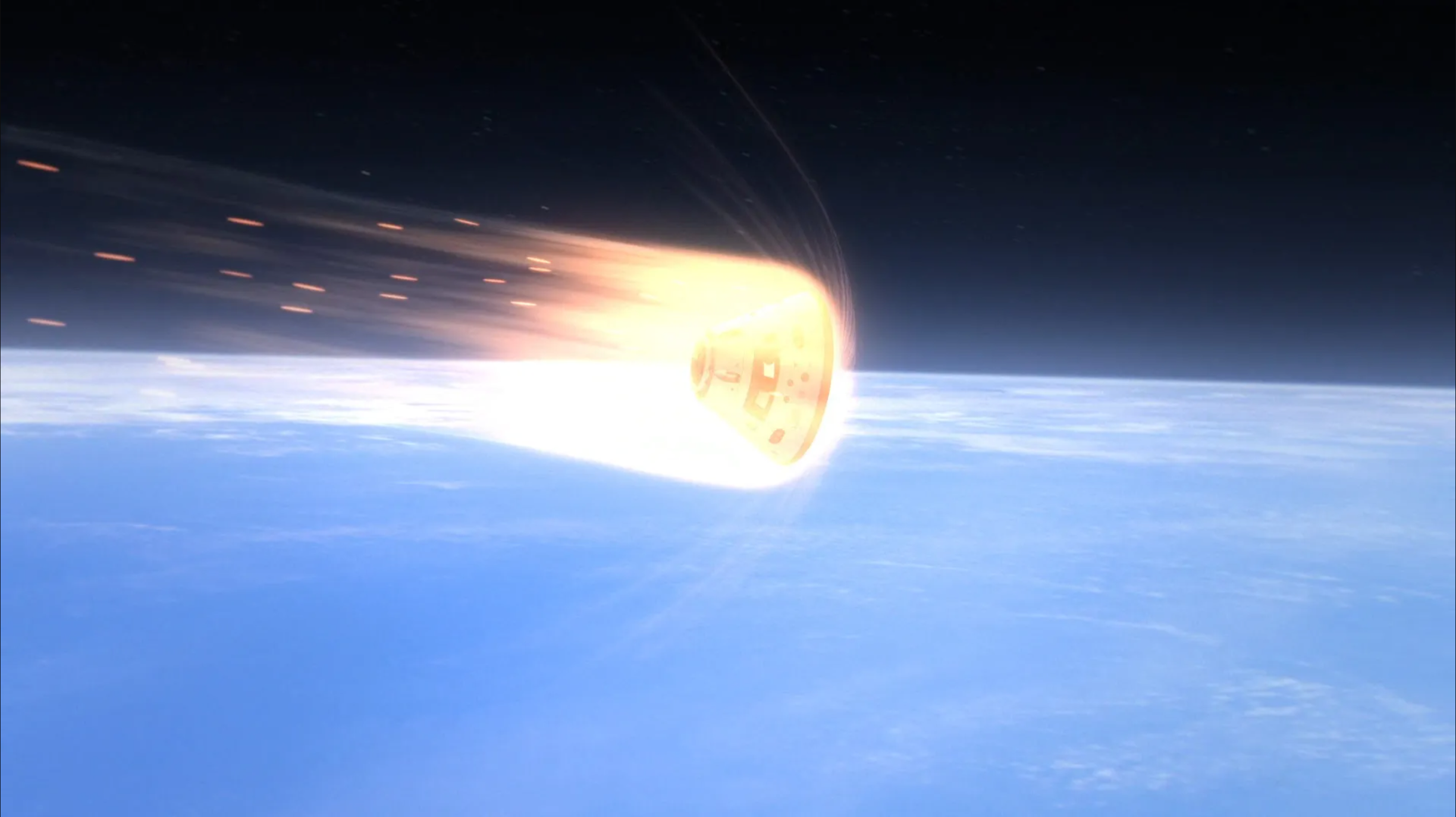
The Orion capsule will re-enter the atmosphere moving at more than 30 times the speed of sound.
La cápsula Orion volverá a entrar en la atmósfera moviéndose a más de 30 veces la velocidad del sonido.
A shock wave will envelop the spacecraft, creating air temperatures of 10,000°C or more – about twice the temperature of the surface of the Sun.
Una onda de choque envolverá la nave espacial, creando temperaturas del aire de 10.000 °C o más, aproximadamente el doble de la temperatura de la superficie del Sol.
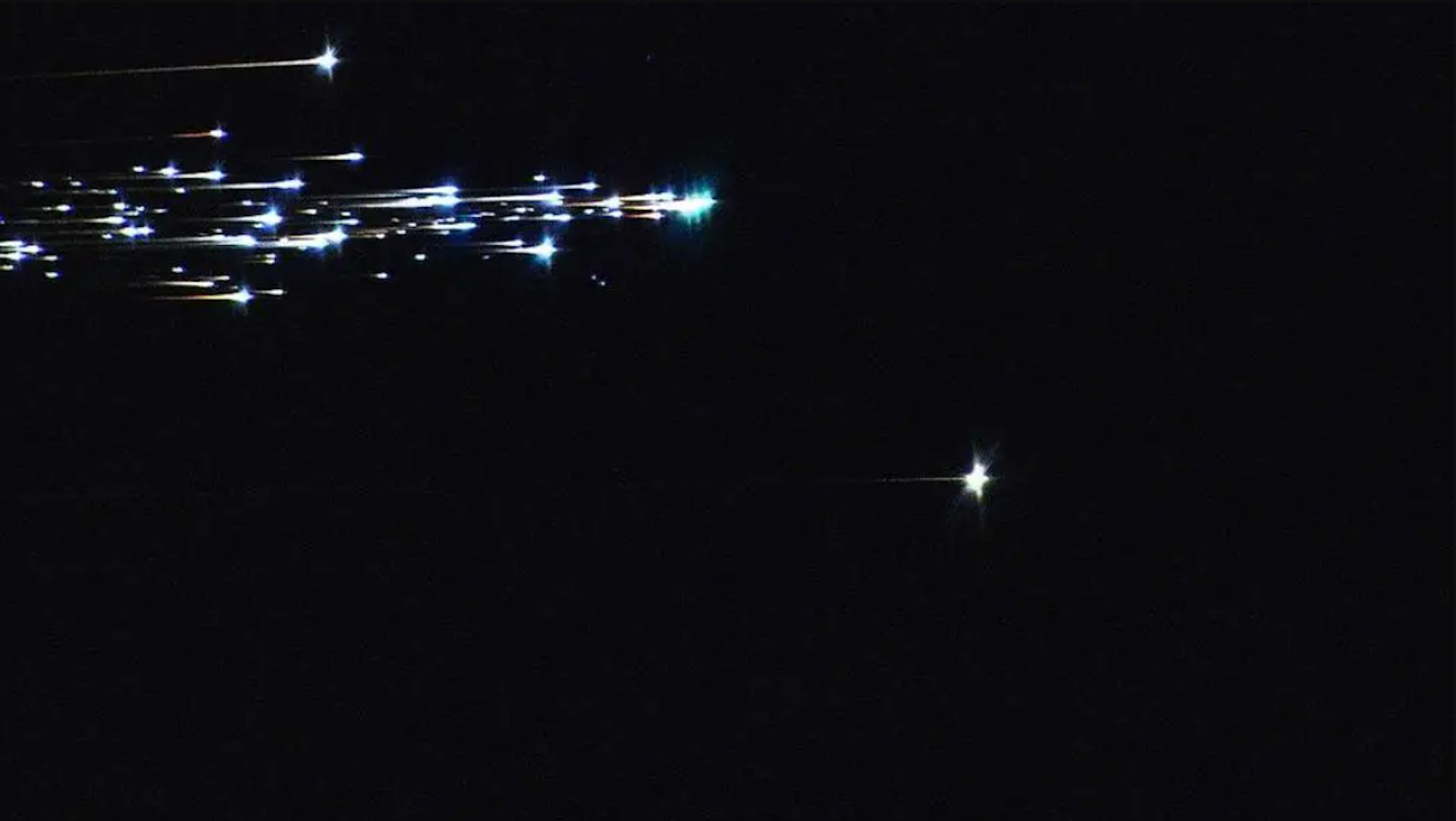
The extreme heat turns the air that crosses over the shock wave into an electrically charged plasma. This temporarily blocks radio signals, so the astronauts will be unable to communicate during the harshest parts of their descent.
El calor extremo convierte el aire que cruza la onda de choque en un plasma cargado eléctricamente. Esto bloquea temporalmente las señales de radio, por lo que los astronautas no podrán comunicarse durante las partes más duras de su descenso.
Making sure it’s a safe re-entry
Asegurando un reingreso seguro
Spacecraft survive the extremely harsh re-entry environment through careful design of their trajectories to minimise heating as much as they can.
Las naves espaciales sobreviven al extremadamente duro entorno de reingreso mediante un cuidadoso diseño de sus trayectorias para minimizar el calentamiento tanto como pueden.
The craft also carries a thermal protection system. It’s effectively an insulating blanket which protects the spacecraft and its crew or cargo from the harsh hypersonic flow occurring outside.
La nave también lleva un sistema de protección térmica. Es efectivamente una manta aislante que protege la nave espacial y su tripulación o carga del duro flujo hipersónico que ocurre en el exterior.
The thermal protection system is tailored precisely for the vehicle and its mission. Materials that can take more heat are put on the surfaces where the environment is expected to be harshest, and thicknesses are precisely adjusted too.
El sistema de protección térmica está diseñado con precisión para el vehículo y su misión. Se colocan materiales que pueden soportar más calor en las superficies donde se espera que el entorno sea más duro, y también se ajustan con precisión los grosores.
These materials are designed to glow red hot and degrade during the entry – but they will survive. The red-hot glow also radiates heat back out to the atmosphere instead of allowing it to be absorbed by the spacecraft.
Estos materiales están diseñados para brillar en rojo vivo y degradarse durante la entrada, pero sobrevivirán. El resplandor rojo también irradia calor de vuelta a la atmósfera en lugar de permitir que sea absorbido por la nave espacial.
This precise design is how Artemis is to able to pass through air at 10,000°C while maintaining a maximum heat shield surface temperature of only around 3,000°C.
Este diseño preciso es cómo Artemis puede atravesar el aire a 10.000 °C manteniendo una temperatura superficial máxima del escudo térmico de solo alrededor de 3.000 °C.
Most spacecraft are protected by materials called ablatives. These are generally made out of carbon fibre and a type of glue known as phenolic resin.
La mayoría de las naves espaciales están protegidas por materiales llamados ablativos. Estos están generalmente hechos de fibra de carbono y un tipo de pegamento conocido como resina fenólica.
These ablative heat shields absorb energy and inject a relatively cool gas into the flow along the surface of the vehicle, helping to cool everything down.
Estos escudos térmicos ablativos absorben energía e inyectan un gas relativamente frío en el flujo a lo largo de la superficie del vehículo, ayudando a enfriar todo.
The ablative heat shield material used on the Orion capsule is called AVCOAT. It is a version of the material which protected the Apollo capsule when it returned from the Moon in the late 1960s and early 1970s.
El material del escudo térmico ablativo utilizado en la cápsula Orion se llama AVCOAT. Es una versión del material que protegió la cápsula Apolo cuando regresó de la Luna a finales de la década de 1960 y principios de la de 1970.
While the Artemis I mission – an uncrewed test flight – was a great success, the heat shield ablation during re-entry was much larger than expected. Large chunks of material separated from the heat shield in some places.
Si bien la misión Artemis I, un vuelo de prueba sin tripulación, fue un gran éxito, la ablación del escudo térmico durante el reingreso fue mucho mayor de lo esperado. Grandes trozos de material se separaron del escudo térmico en algunos lugares.
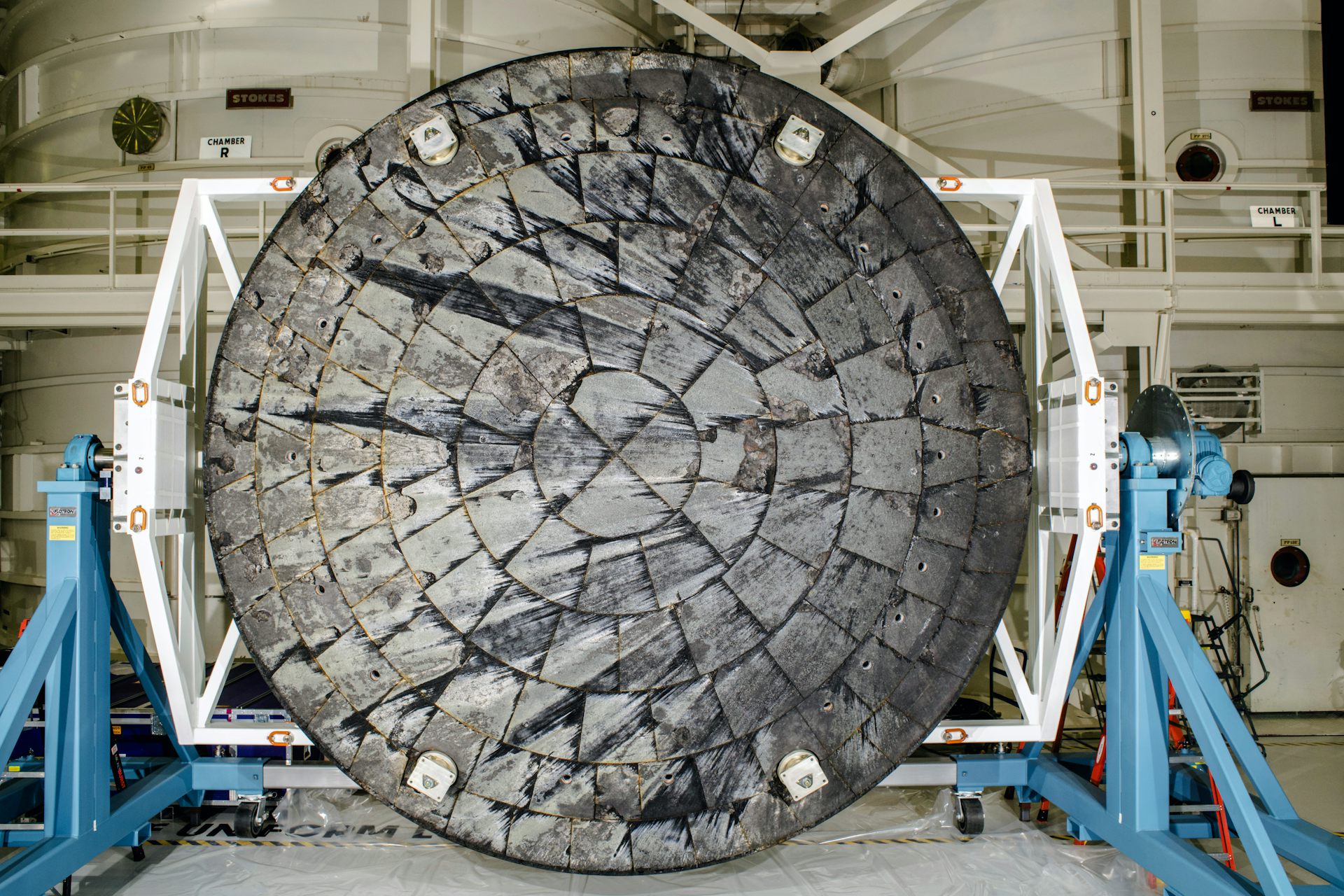
After lengthy inspections and analysis, engineers did decide to go ahead with the same type of heat shield on the Artemis II mission.
Después de largas inspecciones y análisis, los ingenieros decidieron seguir adelante con el mismo tipo de escudo térmico en la misión Artemis II.
They believe Artemis I lost chunks of its heat shield due to a pressure buildup inside the material during the “skip” part of its entry, where the spacecraft exited the atmosphere to cool down before performing a second entry where it landed.
Creen que Artemis I perdió trozos de su escudo térmico debido a una acumulación de presión dentro del material durante la parte de «salto» de su entrada, donde la nave espacial salió de la atmósfera para enfriarse antes de realizar una segunda entrada donde aterrizó.
For Artemis II, the engineers have instead decided to modify the trajectory slightly to still use lift, but include a less defined “skip”.
Para Artemis II, los ingenieros han decidido en su lugar modificar ligeramente la trayectoria para seguir utilizando sustentación, pero incluyendo un «salto» menos definido.
It is amazing to see what NASA and the astronauts have achieved on this mission so far. But like many others, I’ll be relieved when I see them welcomed safely home on Earth.
Es increíble ver lo que la NASA y los astronautas han logrado en esta misión hasta ahora. Pero como muchos otros, estaré aliviado cuando los vea bienvenidos de vuelta en la Tierra.
Chris James receives funding from the Australian Research Council, the Commonwealth Defence Science and Technology Group, the US Office of Naval Research, and the US Air Force Office of Scientific Research.
Chris James recibe financiación del Australian Research Council, el Commonwealth Defence Science and Technology Group, la US Office of Naval Research y la US Air Force Office of Scientific Research.
Read more
-

¿Qué es el hantavirus, la enfermedad que ha matado a 3 pasajeros de un crucero?
What is hantavirus, the disease that has killed 3 cruise ship passengers?
-

En un orden mundial fracturado, ¿dónde encaja el sur global?
In a fractured world order, where does the global south fit in?