Por que o presidente da Polônia está invocando história de guerra em uma disputa com Volodymyr Zelensky
Why Poland’s president is invoking wartime history in a dispute with Volodymyr Zelensky
This row is more about domestic Polish politics than any diplomatic incident.
Essa briga é mais sobre a política interna polonesa do que qualquer incidente diplomático.
There have long been tensions, political, economic and cultural, between Poland and Ukraine. But that hasn’t prevented Poland from being the biggest supporter of its neighbour, taking in millions of Ukrainians fleeing the war, about 1 million of whom have remained.
Há muito tempo existem tensões políticas, econômicas e culturais entre Polônia e Ucrânia. Mas isso não impediu que a Polônia fosse o maior apoiador de seu vizinho, acolhendo milhões de ucranianos fugindo da guerra, cerca de 1 milhão dos quais permaneceram.
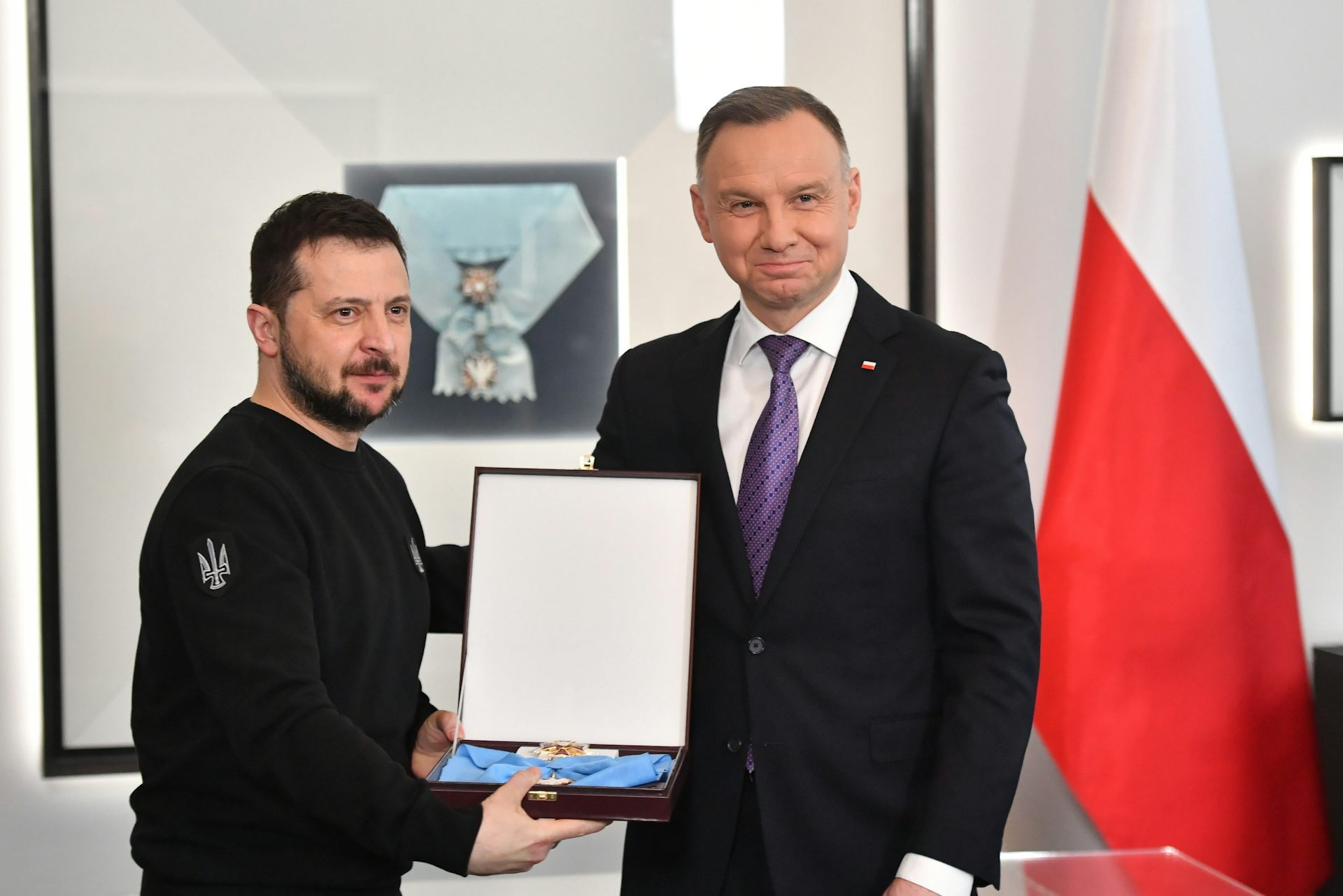
And in 2023, Poland conferred its highest honour, the Order of the White Eagle, on Ukraine’s president Volodymyr Zelensky. At the time, then-president Andrzej Duda told the Ukrainian president: “It is difficult to hide the tears of emotion watching your service to your homeland.”
E em 2023, a Polônia concedeu sua mais alta honraria, a Ordem da Águia Branca, ao presidente da Ucrânia, Volodymyr Zelensky. Na época, o então presidente Andrzej Duda disse ao presidente ucraniano: “É difícil esconder as lágrimas de emoção ao ver seu serviço à sua pátria.”
But on June 19, the current president, Karol Nawrocki, announced he was rescinding the order and stripping Zelensky of the honour. He did so after Zelensky awarded the honorary title “Heroes of the UPA” to an elite unit of Ukraine’s special forces. Zelensky said he had awarded the honour at the unit’s request. He said it was his duty as commander-in-chief, who “must provide them with everything they need to protect our people and our land”. He added: “And if they are motivated by our heroes … and if this is very important to them, I must do whatever they tell me.”
Mas em 19 de junho, o atual presidente, Karol Nawrocki, anunciou que estava revogando a ordem e despojando Zelensky da honraria. Ele fez isso depois que Zelensky concedeu o título honorário “Heróis da UPA” a uma unidade de elite das forças especiais ucranianas. Zelensky disse que havia outorgado a honraria a pedido da unidade. Ele afirmou que era seu dever como comandante-chefe, que “deve fornecer tudo o que eles precisam para proteger nosso povo e nossa terra”. Ele acrescentou: “E se eles são motivados por nossos heróis… e se isso é muito importante para eles, devo fazer o que eles me disserem.”
Political spats between the two countries over historical memory are nothing new. But this is the first since Russia’s full-scale invasion of Ukraine to escalate to this degree. And the fact is that it has more to do with domestic Polish politics than any long-term rift between Poland and Ukraine.
Os desentendimentos políticos entre os dois países sobre a memória histórica não são nada de novo. Mas este é o primeiro desde a invasão em grande escala da Rússia à Ucrânia que escala a este grau. E o fato é que tem mais a ver com a política doméstica polonesa do que com qualquer cisma de longo prazo entre Polônia e Ucrânia.
First, some background. The Ukrainian Insurgent Army (UPA) was a Ukrainian nationalist formation that fought against the Soviets during the second world war. After harsh Soviet rule in Ukraine many in the UPA saw the German military invasion as liberating them from Soviet repression.
Primeiro, algum contexto. O Exército Insurgente Ucraniano (UPA) foi uma formação nacionalista ucraniana que lutou contra os soviéticos durante a segunda guerra mundial. Após o duro domínio soviético na Ucrânia, muitos membros da UPA viram a invasão militar alemã como um libertação da repressão soviética.
But it turned out that the Nazis were even worse than the Soviets. For the Poles, though, memories of the massacre of ethnic Poles in Volhynia, now Volyn, in Ukraine, by members of the UPA, remain raw.
Mas acabou que os nazistas foram ainda piores que os soviéticos. Para os poloneses, no entanto, as memórias do massacre de poloneses étnicos em Volhínia, hoje Volyn, na Ucrânia, por membros da UPA, permanecem dolorosas.
As American historian Timothy Snyder has written: “Ukrainians think about the UPA mainly through … the struggle against the Red Army after 1945. Poles remember … 1943, when the UPA killed tens of thousands of Poles in Volhynia.”
Como o historiador americano Timothy Snyder escreveu: “Os ucranianos pensam sobre a UPA principalmente através… da luta contra o Exército Vermelho após 1945. Os poloneses lembram… de 1943, quando a UPA matou dezenas de milhares de poloneses em Volhínia.”
These memories lead to different interpretations which are used to serve often divergent domestic political purposes in the two countries. Despite the UPA’s history, Ukraine continues to award UPA-related honours because the nationalist movement has become a symbol of resistance to Soviet and Russian rule, which fits with the broader post-2014 campaign to rid Ukraine of vestiges of its communist past.
Essas memórias levam a diferentes interpretações que são usadas para servir a propósitos políticos domésticos frequentemente divergentes nos dois países. Apesar da história da UPA, a Ucrânia continua a conceder honrarias relacionadas à UPA porque o movimento nacionalista se tornou um símbolo de resistência ao domínio soviético e russo, o que se encaixa na campanha mais ampla pós-2014 para livrar a Ucrânia dos vestígios de seu passado comunista.
Russia’s invasion of Ukraine has reinforced this trend, making such honours less about revisiting the past than about mobilising contemporary symbols of national resistance in Ukraine – even if they remain deeply controversial in Poland.
A invasão da Rússia à Ucrânia reforçou essa tendência, fazendo com que tais honrarias fossem menos sobre revisitar o passado do que sobre mobilizar símbolos contemporâneos de resistência nacional na Ucrânia – mesmo que permaneçam profundamente controversos na Polônia.
Nawrocki claims he revoked Zelensky’s award because “his countrymen’s pain threshold has been crossed”. It’s a strong reaction, which drastically contrasts with Nawrocki’s own previous position as head of the Institute of National Remembrance in 2023, when he stated that Ukraine was free to honour its own historical figures, including the UPA’s leaders.
Nawrocki afirma que revogou o prêmio de Zelensky porque “o limite da dor de seus compatriotas foi ultrapassado”. É uma reação forte, que contrasta drasticamente com a própria posição anterior de Nawrocki como chefe do Instituto de Memória Nacional em 2023, quando ele afirmou que a Ucrânia era livre para homenagear suas próprias figuras históricas, incluindo os líderes da UPA.
The Polish prime minister, Donald Tusk, was more restrained, urging both countries to stop quarrelling about the past for the sake of the future. His deputy Radosław Sikorski, who is also Poland’s minister of foreign affairs, pointed out that while Zelensky’s decree was inappropriate, that Nawrocki’s reaction was disproportionate and had been welcomed in Moscow.
O primeiro-ministro polonês, Donald Tusk, foi mais contido, exortando ambos os países a pararem de discutir o passado em nome do futuro. Seu vice, Radosław Sikorski, que também é ministro das Relações Exteriores da Polônia, apontou que, embora o decreto de Zelensky fosse inapropriado, a reação de Nawrocki foi desproporcional e havia sido bem-vinda em Moscou.
Jockeying for political advantage
Disputando vantagem política
This contrast between the responses of Nawrocki, a rightwing populist, and the centre-left government suggests that the dispute cannot be explained by history alone. It illustrates the friction between the right-leaning president and the left-leaning government. Nawrocki has unofficially started a campaign for next year’s parliamentary election and is rallying for his Law and Justice party (PiS) by playing up anti-Ukrainian sentiment.
Este contraste entre as respostas de Nawrocki, um populista de direita, e o governo centro-esquerda sugere que a disputa não pode ser explicada apenas pela história. Isso ilustra o atrito entre o presidente de tendência de direita e o governo de tendência de esquerda. Nawrocki iniciou informalmente uma campanha para as eleições parlamentares do próximo ano e está mobilizando seu partido Lei e Justiça (PiS) ao explorar o sentimento antiucraniano.
Before being elected, Nawrocki promised to block Ukraine’s accession to Nato. He has also been against Ukraine’s membership of the EU. Zelensky has given him an opportunity to capitalise on anti-Ukrainian narratives that play well to Poles disaffected by the war.
Antes de ser eleito, Nawrocki prometeu bloquear o acesso da Ucrânia à OTAN. Ele também foi contra a adesão da Ucrânia à UE. Zelensky deu a ele uma oportunidade para capitalizar em narrativas antiucranianas que agradam aos poloneses descontentes com a guerra.
Additionally, by revoking Zelensky’s honour, Nawrocki has laid down a challenge to Tusk. The prime minister’s countersignature is required to validate the decision – and this would put him in a difficult political situation domestically.
Além disso, ao revogar a honra de Zelensky, Nawrocki lançou um desafio a Tusk. A contrassinatura do primeiro-ministro é necessária para validar a decisão – e isso o colocaria em uma difícil situação política internamente.
Following the dispute, Nawrocki’s approval ranking is at a historic high of 54.8% – up by 8.4 percentage points from a month before.
Após a disputa, o índice de aprovação de Nawrocki está em um nível histórico de 54,8% – subindo 8,4 pontos percentuais em relação ao mês anterior.
While anti-Ukrainian rhetoric falls on fertile soil in Poland due to popular fatigue at supporting so many refugees, there is still strong support for Ukraine.
Embora a retórica antiucraniana encontre terreno fértil na Polônia devido ao cansaço popular de apoiar tantos refugiados, ainda há forte apoio à Ucrânia.
Jerzy Wójcik, a prominent Polish journalist and media executive, who has led major humanitarian campaigns like Warmth from Poland for Kyiv, initiated a petition to present Zelenskyy with Citizen’s Order of the Future award. He said that “the Polish right wing has launched a campaign ahead of the parliamentary elections and is ruthlessly exploiting the Volhynia tragedy for political gain”.
Jerzy Wójcik, um jornalista polonês proeminente e executivo de mídia, que liderou grandes campanhas humanitárias como “Warmth from Poland for Kyiv”, iniciou uma petição para apresentar a Zelenskyy o prêmio Ordem do Cidadão do Futuro. Ele disse que “a direita polonesa lançou uma campanha antes das eleições parlamentares e está explorando impiedosamente a tragédia de Volhínia para ganho político”.
UPA’s past links to genocide are felt by most Poles. But there is still a strong tension when it comes to Nawrocki’s revocation of Zelensky’s order. This, along with Polish public support for Ukraine, suggests that the dispute is more complex than the political rhetoric implies.
Os laços passados da UPA com o genocídio são sentidos pela maioria dos poloneses. Mas ainda há uma forte tensão quando se trata da revogação da ordem de Zelensky por Nawrocki. Isso, juntamente com o apoio público polonês à Ucrânia, sugere que a disputa é mais complexa do que a retórica política implica.
The dispute is not primarily about the UPA – nor is it evidence of a fundamental shift in Polish foreign policy. While it has the potential to become a bigger diplomatic challenge for the two countries, it illustrates a broader phenomenon: political leaders mobilising contested history to solve present-day domestic political problems.
A disputa não é primariamente sobre a UPA – nem é evidência de uma mudança fundamental na política externa polonesa. Embora tenha o potencial de se tornar um desafio diplomático maior para os dois países, ela ilustra um fenômeno mais amplo: líderes políticos mobilizando história contestada para resolver problemas políticos domésticos atuais.
Similar dynamics can be seen in relations between Serbia and Kosovo. Their political leaders regularly invoke competing historical narratives surrounding the 14th-century Battle of Kosovo to strengthen their domestic political standing, often at the expense of dialogue between the two sides.
Dinâmicas semelhantes podem ser vistas nas relações entre a Sérvia e o Kosovo. Seus líderes políticos invocam regularmente narrativas históricas concorrentes sobre a Batalha de Kosovo do século XIV para fortalecer sua posição política interna, muitas vezes em detrimento do diálogo entre os dois lados.
These strategies may generate short-term domestic political gains. But they risk undermining strategically important relationships.
Estas estratégias podem gerar ganhos políticos domésticos de curto prazo. Mas elas correm o risco de minar relacionamentos estrategicamente importantes.
Artur Nadiiev does not work for, consult, own shares in or receive funding from any company or organisation that would benefit from this article, and has disclosed no relevant affiliations beyond their academic appointment.
Artur Nadiiev não trabalha para, presta consultoria, possui ações em ou recebe financiamento de qualquer empresa ou organização que se beneficiaria deste artigo, e não divulgou afiliações relevantes além do seu vínculo acadêmico.
Read more
-
Ridicularizar e degradar civis em conflito armado é uma clara violação do direito internacional
Taunting and degrading civilians in armed conflict is a clear violation of international law
-

Analisamos 14 milhões de posts do Reddit para revelar uma mudança marcante em como falamos sobre saúde mental
We analysed 14 million Reddit posts to reveal a striking shift in how we talk about mental health