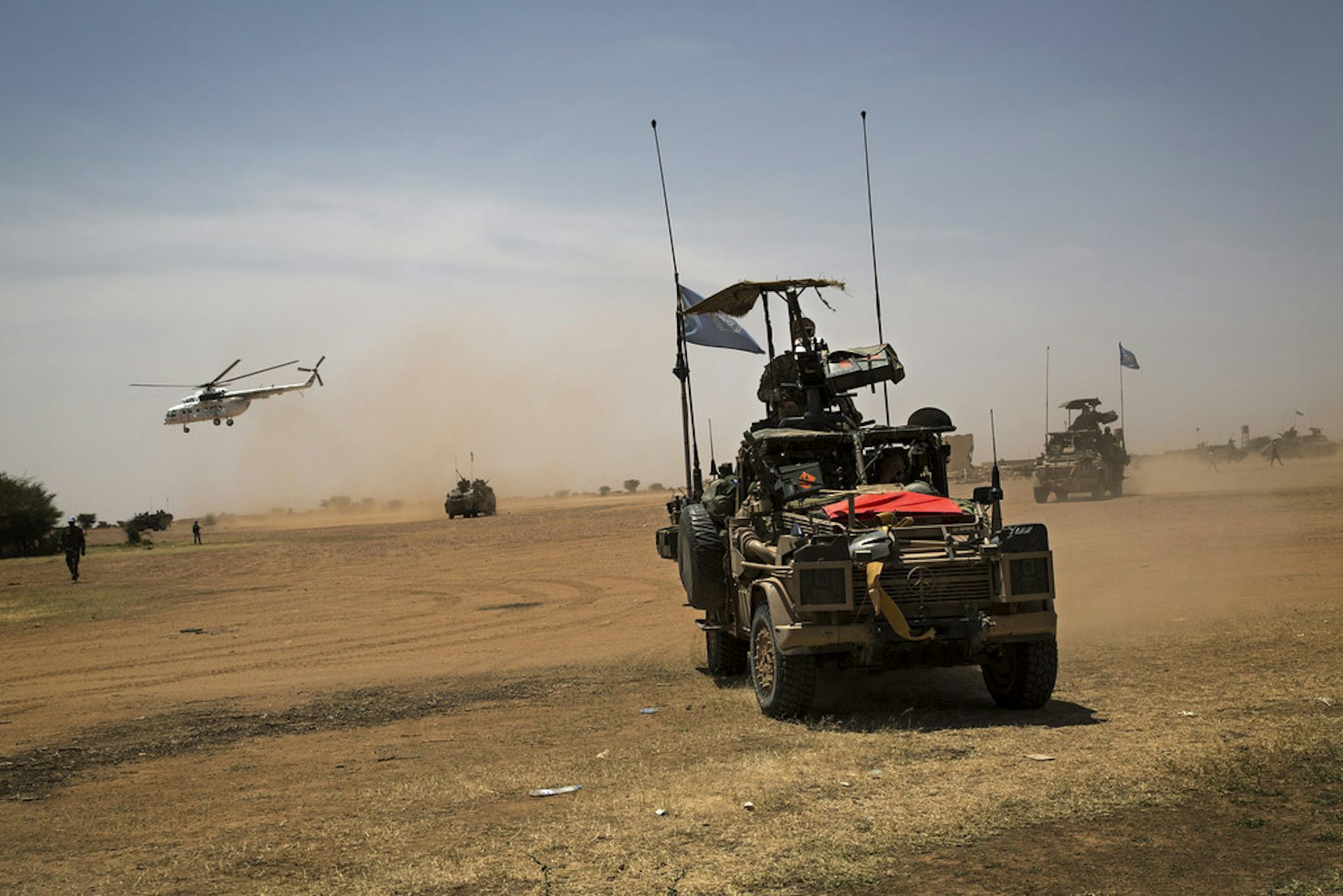
马里武装团体填补了政府的真空地带——解决这个问题是结束暴力的关键。
Mali’s armed groups fill a government vacuum – addressi…
The strength of armed groups doesn’t come only from weapons but also from how deeply they are embedded in local realities.
武装团体的力量不仅来自武器,还来自它们在当地现实中根深蒂固的程度。
Mali has been in a state of political turmoil since 2012. That year saw a military coup as well as armed groups taking over northern regions of the west African country. In the intervening years, efforts at establishing transitional governments have failed, culminating in the military junta dissolving and banning all political parties in May 2025.
马里自2012年以来一直处于政治动荡状态。那一年发生了军事政变,武装团体也占领了该西非国家的北部地区。在随后的几年里,建立过渡政府的努力均告失败,最终导致军事政权于2025年5月解散并禁止了所有政党。
In addition, the country has seen waves of military interventions by outside players like France, the US and most recently Russia. All have invested heavily in trying to contain the extremist threat in Mali.
此外,该国还经历了法国、美国和最近的俄罗斯等外部势力进行军事干预的浪潮。所有这些势力都投入巨资,试图遏制马里存在的极端主义威胁。
But groups linked to al-Qaeda and the Islamic State have continued to expand their influence. And in late April 2026 the military government found itself having to fend off coordinated attacks from separatists and jihadists across the country. The defence minister, General Sadio Camara, was killed.
然而,与基地组织和伊斯兰国有关的团体持续扩大着其影响力。到了2026年4月下旬,军政府发现自己不得不抵御来自全国各地的分离主义者和圣战分子的协同攻击。国防部长萨迪奥·卡马拉将军被杀。
Foreign interventions over the past decade have often misunderstood what was happening on the ground. Extremist groups have capitalised on issues such as land disputes, corruption, and resource competition to gain legitimacy, often aligning with the community’s tensions. The weakness of state institutions and security forces has allowed groups such as Jamaat Nusrat al-Islam wal-Muslimin (JNIM) and the Islamic State in the Greater Sahara (ISGS) to consolidate power.
过去十年的外部干预往往误解了当地的实际情况。极端组织利用了土地纠纷、腐败和资源竞争等问题来获取合法性,并经常与社区的紧张局势相勾结。国家机构和安全部队的薄弱,使得如“伊斯兰信仰与穆斯林联合阵线”(JNIM)和“大撒哈拉伊斯兰国”(ISGS)等团体得以巩固权力。
These groups have adapted by forming alliances and tailoring their narratives to local grievances, prioritising immediate issues over ideological objectives.
这些团体通过结盟和根据当地的诉求调整其叙事,将优先事项放在了眼前的议题上,而非意识形态目标。
We are political scientists who have researched the security situation in Mali and the Sahel. Our recently published paper showed that non-state armed groups in the Sahel, particularly in Mali, have emerged as key power brokers, shaping local governance by filling gaps left by weak state institutions.
我们是研究马里和萨赫勒地区安全局势的政治科学家。我们最近发表的论文显示,萨赫勒地区的非国家武装团体,特别是在马里,已成为关键的权力掮客,通过填补国家机构留下的空白来塑造地方治理。
While external actors such as France, the US and Russia have prioritised counter-terrorism and state-building, they often overlook the governance functions of non-state armed groups. These groups often provide essential services and gain local legitimacy.
虽然法国、美国和俄罗斯等外部行为体将重点放在了反恐和国家建设上,但他们往往忽略了非国家武装团体的治理功能。这些团体经常提供必要的服务,并获得了当地的合法性。
Recognising the role of armed groups as local power holders does not mean accepting or legitimising their actions. However, ignoring this reality has led to policies that miss the mark. When interventions focus only on military solutions, they risk misunderstanding why people interact with these groups in the first place.
承认武装团体作为地方权力持有者的角色,并不意味着接受或使其行为合法化。然而,忽视这一现实导致了政策的偏差。当干预措施只关注军事解决方案时,它们就有可能误解人们最初与这些团体互动的原因。
Our findings challenge conventional interventions that focus solely on defeating non-state armed groups or reinstating centralised state control. We argue that security solutions alone are insufficient. We advocate for a more nuanced approach that integrates the potential for non-state armed groups when it comes to governance, legitimacy and local agency. Non-state armed groups have provided governance over territories in countries like Colombia, Syria and South Sudan, among others.
我们的研究结果挑战了那些只关注击败非国家武装团体或恢复中央集权国家控制的传统干预模式。我们认为,仅有安全解决方案是远远不够的。我们提倡一种更细致入微的方法,在治理、合法性和地方能动性方面整合非国家武装团体的潜力。非国家武装团体曾在哥伦比亚、叙利亚和南苏丹等国家提供了过地方治理。
Armed groups as de facto authorities
武装团体作为事实上的权力机构
Armed groups in Mali are not just fighting forces. In many parts of the country, they play a more complex role. It is difficult to estimate the exact number of groups operating within Mali. The largest and best known, Jama’at Nusrat al-Islam wa al-Muslimeen, is a coalition of five organisations and claims to have over 10,000 fighters in the country.
马里武装团体不仅仅是战斗力量。在该国的许多地区,它们扮演着更复杂的角色。很难估计在马里运营的团体确切数量。规模最大、最知名的“伊斯兰信仰与穆斯林联合组织”(Jama’at Nusrat al-Islam wa al-Muslimeen)是一个由五个组织组成的联盟,声称在国家拥有超过1万名战斗人员。
In central and northern Mali, bordering Algeria, the state is often distant, absent or mistrusted. Armed groups step into this vacuum. They settle disputes, enforce rules, collect taxes, and sometimes provide a basic sense of order.
在与阿尔及利亚接壤的马里中部和北部,国家往往遥远、缺位或不受信任。武装团体便填补了这一真空。它们解决争端、执行规则、征收税款,有时甚至提供基本的秩序感。
For communities living with daily insecurity, these functions are not abstract; they shape everyday life.
对于生活在日常不安全环境中的社区来说,这些功能并非抽象概念;它们塑造着日常生活。
Our study established that this does not necessarily mean the population agrees with these groups or supports their ideology. Many do not. However, when there are few alternatives, people adapt. They follow the rules because they need to survive, not because they believe in them.
我们的研究表明,这并不一定意味着当地人口同意这些团体或支持其意识形态。许多人并不支持。然而,当缺乏其他选择时,人们就会适应。他们遵守规则,不是因为相信这些规则,而是因为需要生存。
This distinction is important. This helps explain why these groups are so difficult to dislodge. Their strength does not come only from weapons but also from how deeply they are embedded in local realities.
这种区别非常重要。它有助于解释为什么这些团体如此难以瓦解。它们的强大力量不仅来自武器,更来自它们在当地现实中根深蒂固的程度。
Why military strategies fall short
军事战略为何失效
International efforts have largely focused on fighting these groups and rebuilding the authority of the Malian state. Although well intentioned, these kinds of interventions often overlook something essential: what happens to the spaces these groups leave behind?
国际努力主要集中在打击这些组织和重建马里国家权威。尽管初衷良好,但这类干预往往忽略了一件至关重要的事情:这些组织离开后留下的空间会发生什么?
An example is France’s 2013 intervention. The French army helped the Malian army to regain control of the northern part of the country from advancing Islamists during Operation Serval. The aim was to stop extremist forces from advancing to Bamako. This did not end the conflict. Many fighters moved to rural areas where the state had little presence and built ties with local communities.
一个例子是法国在2013年的干预。在“服务行动”期间,法国军队帮助马里军队从不断推进的伊斯兰主义分子手中夺回了该北部地区的控制权。目的是阻止极端势力推进到巴马科。但这并没有结束冲突。许多战斗人员转移到了国家存在感较弱的农村地区,并与当地社区建立了联系。
In central Mali, where cattle farming is a key source of income, this dynamic contributed to the spread of violence between Fulani and Dogon communities, reinforcing grievances exploited by extremist groups.
在马里中部,畜牧业是主要的收入来源,这种动态加剧了富拉尼族和多贡族社区之间的暴力冲突,并强化了极端组织所利用的不满情绪。
Simultaneously, attempts to strengthen state institutions have struggled. In some places, security forces are seen as ineffective and even abusive.
与此同时,加强国家机构的尝试也遇到了困难。在一些地方,安全部队被认为效率低下,甚至滥用职权。
Faced with this reality, people often turn to whoever can offer some level of predictability and protection, even if that actor is an armed group.
面对这一现实,人们往往会转向任何能够提供一定可预测性和保护的人,即使这个行为主体是一个武装团体。
External involvement has also become increasingly fragmented. France’s withdrawal, rising anti-western sentiment, and the arrival of Russian-linked forces have created a crowded and sometimes conflicting intervention landscape.
外部参与也变得越来越碎片化。法国的撤离、日益高涨的反西方情绪,以及俄罗斯关联势力的到来,造成了一个拥挤且有时相互冲突的干预格局。
Different actors bring different agendas, and their presence does not always translate into greater security. In some cases, it can even worsen things by reinforcing tensions or weakening trust in already fragile institutions.
不同行为体带来了不同的议程,他们的存在并不总能带来更大的安全。在某些情况下,它甚至可能通过加剧紧张局势或削弱对本已脆弱的机构的信任而使情况恶化。
Caught in the middle, civilians make difficult choices daily. Their decisions are rarely ideological but rather about survival.
被夹在中间的平民每天都在做出艰难的选择。他们的决定很少是出于意识形态,而更多是出于生存。
Rethinking the response
重新思考应对措施
We conclude from our findings that a more grounded approach would begin by listening to local realities. It would address the gaps that allow armed groups to take root. This means improving access to justice and security, supporting local institutions, and taking grievances seriously. It also means recognising that legitimacy is built from the ground up, not imposed from above.
根据我们的研究结果,我们得出结论:更扎根于当地的方针应首先从倾听当地现实出发。它需要解决允许武装团体滋生的漏洞。这意味着改善司法和安全的可及性,支持地方机构,并认真对待民众的诉求。这也意味着要认识到,合法性是自下而上建立起来的,而不是自上而下强加的。
Mali’s experience shows that there are clear limits to what military force can achieve on its own. As long as interventions overlook the everyday realities of governance and survival, they are unlikely to bring about lasting change. Until that shift happens, armed groups will remain hard to dislodge, not only because they can fight but also because, in many places, they have become part of how life is organised.
马里(Mali)的经验表明,军事力量本身在实现方面存在明显的局限性。只要干预措施忽视了治理和生存的日常现实,它们就不太可能带来持久的改变。在这一转变发生之前,武装团体将难以清除,不仅因为它们可以战斗,而且在许多地方,它们已经成为生活组织的一部分。
Norman Sempijja is affiliated with Mohammed VI polytechnic University and based at the Faculty of Governance Economics and Social Sciences.
Norman Sempijja隶属于穆罕默德六世理工大学,并在治理经济与社会科学学院任职。
Mouhammed Ndiaye does not work for, consult, own shares in or receive funding from any company or organisation that would benefit from this article, and has disclosed no relevant affiliations beyond their academic appointment.
Mouhammed Ndiaye不为任何可能从本文中受益的公司或组织工作、提供咨询、拥有股份或接受资金,并且除了其学术任命之外,未披露任何相关任职关系。