伊朗如何利用广告牌进行战时宣传——我们挑选了5个来解释其含义
How Iran uses billboards as wartime propaganda – we sel…
The provocative images in the most visible parts of Tehran are intended to be photographed, posted and shared widely on social media.
德黑兰最显眼区域的这些挑衅性图像,其目的就是为了被拍照、发布并在社交媒体上广泛传播。
Since the US–Israel war against Iran began in late February, images of giant billboards in Tehran have been ubiquitous across traditional and social media. These billboards have been placed in some of the busiest and most visible parts of the city, and are constantly being updated to reflect current events.
自美国-以色列针对伊朗的战争于二月下旬开始以来,德黑兰巨大的广告牌图像已在传统媒体和社交媒体上无处不在。这些广告牌设置在城市最繁忙、最显眼的地方,并不断更新以反映当前事件。
Iran has long used public spaces as a tool of political communication. Since the 1979 Islamic Revolution – and especially during the Iran–Iraq War – the regime has erected murals and billboards to display revolutionary imagery, war memorials and ideological messages.
伊朗长期以来一直将公共空间用作政治传播的工具。自1979年伊斯兰革命以来——尤其是在伊朗-伊拉克战争期间——政权一直竖立壁画和广告牌,展示革命图像、战争纪念和意识形态信息。
Today, these billboards are designed not only for local audiences, but also for global digital circulation. Depicting powerful imagery, slogans and symbolic representations, they serve a dual function:
如今,这些广告牌的设计不仅面向本地受众,也面向全球数字传播。它们描绘着强烈的图像、口号和象征性表述,发挥着双重功能:
to reinforce a sense of collective identity, national unity and shared emotion during a time of crisis
增强危机时期集体认同感、民族团结和共同情感。
to serve as a tool of propaganda for the state, at times featuring Hebrew and English alongside Farsi (Persian) .
作为国家宣传工具,有时将希伯来文和英文与波斯文并置。
Researchers argue these billboards are part of a broader visual communication strategy on the part of the state. They are intended to be photographed, posted and shared widely on social media as a way of projecting power and resistance to a global audience (even with a months-long internet blackout in place) .
研究人员认为,这些广告牌是国家更广泛视觉传播战略的一部分。它们旨在被拍摄、发布并在社交媒体上广泛分享,以此向全球受众展示力量和抵抗(即使在实施了长达数月的互联网停电的情况下)。
So, what do the billboards say, and what’s the deeper symbolism behind the imagery? We’ve chosen five samples from Tehran to analyse.
那么,这些广告牌说了什么?其图像背后隐藏着怎样的深层象征意义?我们从德黑兰选择了五个样本进行分析。
1. The Epstein missile
埃普斯坦导弹
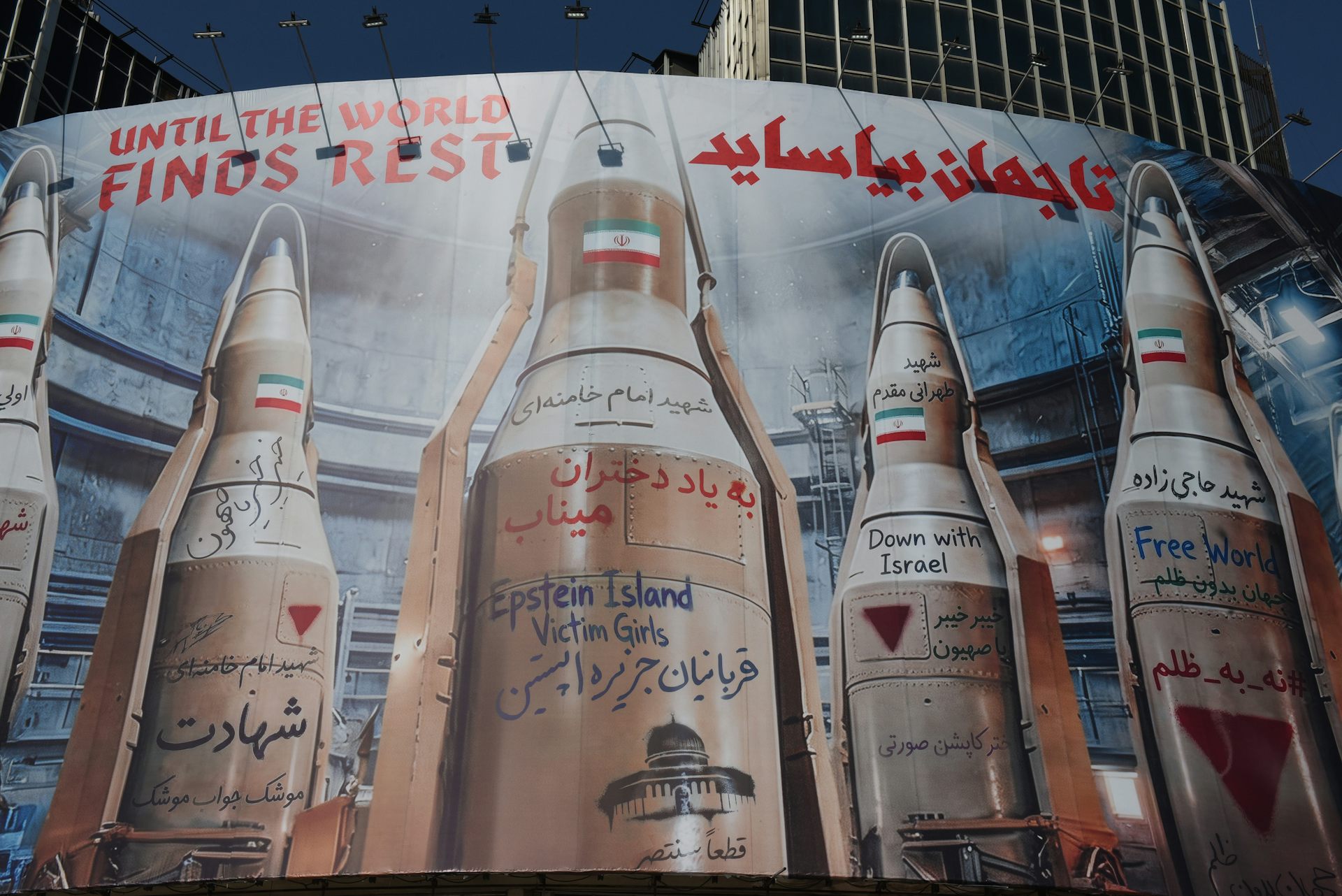
One of the billboards that circulated widely in recent months depicted Iranian missiles covered with handwritten messages and symbolic phrases.
近几个月来流传的广告牌中,有牌描绘了覆盖着手写信息和象征性短语的伊朗导弹。
Among the most striking inscriptions is the phrase “To the girls of Minab”, written in bold, red Farsi script. This is a reference to a strike on a girls’ school in the opening days of the war that Iranian officials say killed 175 girls and teachers. Reports indicate US forces were likely responsible.
其中最引人注目的铭文是“致米纳布的女孩们”(To the girls of Minab),用粗体红色波斯文书写。这指的是战争初期对一所女学校的袭击,伊朗官员称该袭击造成了175名女学生和教师的死亡。有报道指出,美国军队可能负有责任。
Directly below that, written in English, are the words “Epstein Island victim girls”, a reference to the island owned by convicted sex offender Jeffrey Epstein where young women were allegedly sexually assaulted.
在其正下方,用英文写着“埃普斯坦岛受害者女孩们”(Epstein Island victim girls),这指的是由被定罪的性犯罪者杰弗里·埃普斯坦拥有的岛屿,据称年轻女性在那里遭受了性侵犯。
On another missile is the phrase “the girl with the pink jacket”. This is a deeply emotional reference to a young Iranian girl killed in a terror attack in 2024, who was identified by her pink jacket and heart-shaped earrings.
在另一枚导弹上写着“穿着粉色夹克的女孩”(the girl with the pink jacket)。这是对一位2024年恐怖袭击中遇难的年轻伊朗女孩的深情致敬,她曾因其粉色夹克和心形耳环而被识别。
The intention is to connect these disparate events through a narrative of vulnerable young women affected by violence, exploitation and political power. Rather than presenting missiles only as weapons of destruction, the image reframes them as symbols of grief, revenge, memory and defence.
其意图是通过一个关于受暴力、剥削和政治权力影响的脆弱年轻女性的叙事,将这些不相关的事件联系起来。图像没有将导弹仅仅呈现为毁灭的武器,而是将其重新构建为悲痛、复仇、记忆和防御的象征。
In this narrative, Iran is portrayed not as seeking war. It is responding to injustice and protecting its people.
在这个叙事中,伊朗被描绘的不是一个寻求战争的国家。它是在回应不公正,并保护其人民。
2. ‘Masters of war’
2. “战争大师”
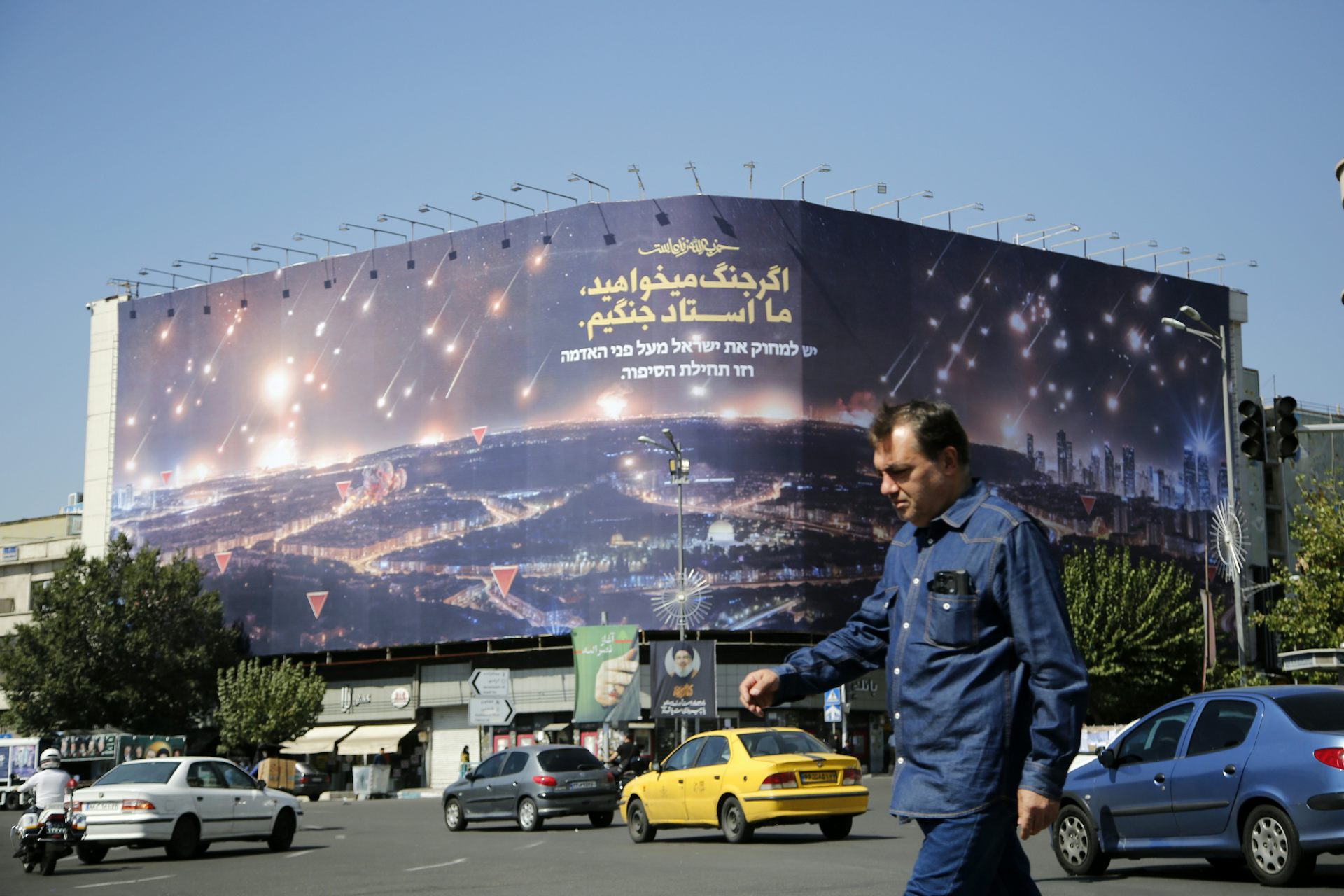
Another billboard that gained significant attention in 2024 depicted the Farsi phrase “If you want war, we are masters of war” above a Hebrew message saying “Israel must be wiped from the face of the earth”.
2024年另一块引起广泛关注的广告牌,上面描绘了波斯语短语“如果你想要战争,我们就是战争大师”,其上方还有一段希伯来文信息,写着“以色列必须从地球上抹去”。
The billboard portrays the sky over Israel illuminated by waves of incoming missiles, almost resembling a meteor shower or rain of fire. The imagery is highly stylised and cinematic, with the missiles transforming the night sky into a scene of overwhelming force.
这块广告牌描绘了以色列上空被来袭导弹波浪照亮的景象,几乎酷似流星雨或火焰之雨。其意象高度风格化和电影化,导弹将夜空变成了一幅压倒性力量的场景。
By directly addressing Hebrew-speaking viewers, the billboard functions as both a direct warning to Israelis and a symbolic projection of power, designed to have psychological impact. Language becomes a tool of warfare itself.
通过直接面向说希伯来语的观众,这块广告牌既充当了对以色列人的直接警告,也是一种象征性的权力投射,旨在产生心理冲击。语言本身成为了战争的工具。
This multilingual strategy reveals an important shift in Tehran’s urban propaganda. These billboards, which have become more prominent in recent years, are no longer designed solely for Iranian pedestrians and motorists. The regime is aware photographs will circulate instantly across the internet, reaching intended audiences in Israel.
这种多语种策略揭示了德黑兰城市宣传的重要转变。这些近年来日益突出的广告牌,不再仅仅是为伊朗的行人和驾车者设计的。政权深知照片会瞬间在互联网上传播,触及到以色列的目标受众。
3. Trump’s sutured mouth
3. 缝合的特朗普的嘴巴
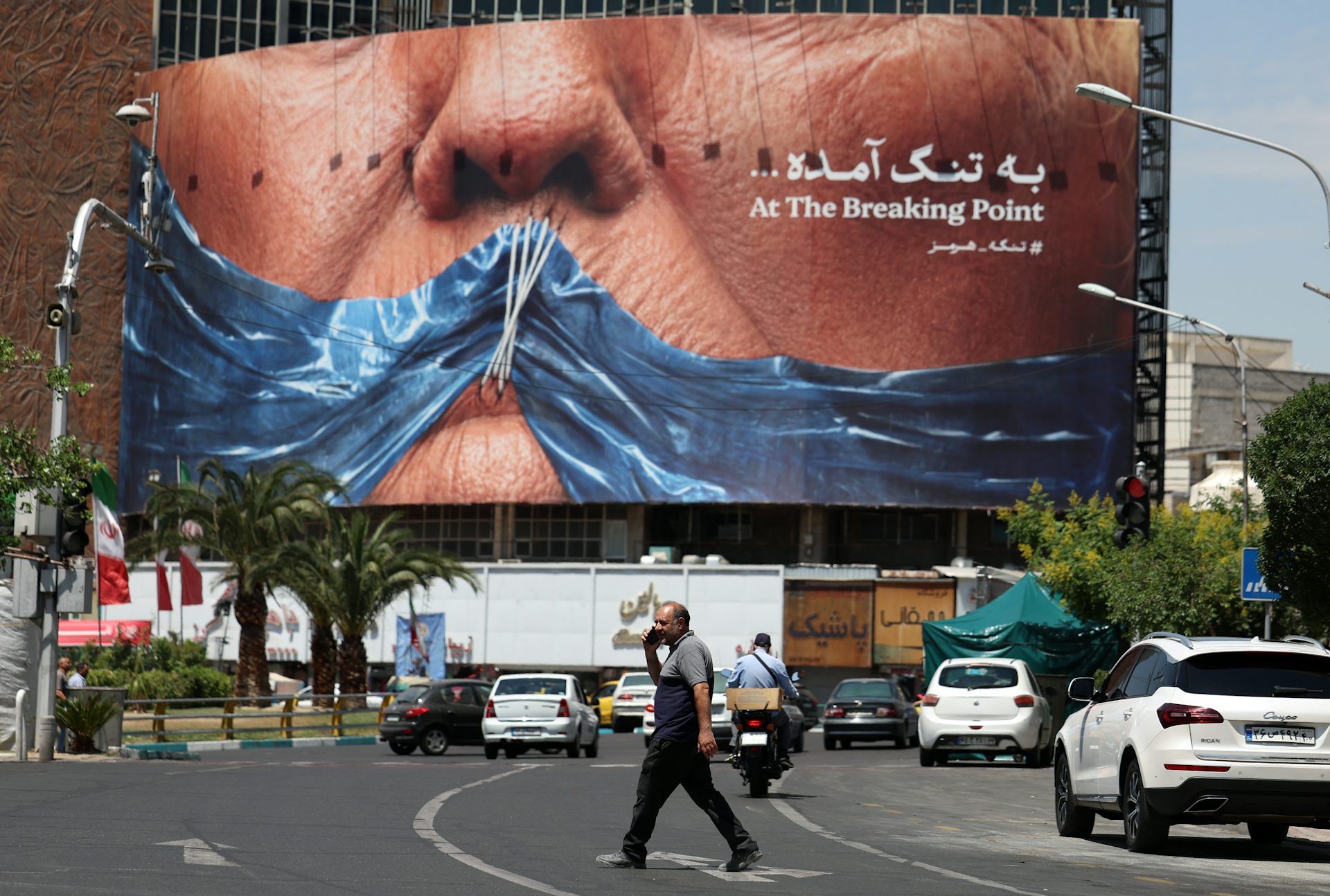
Another bilingual billboard is targeted to Western – and specifically American – audiences. It features US President Donald Trump’s mouth with a rendering of the Strait of Hormuz sutured on top, alongside the English phrase “The Breaking Point.”
另一个双语广告牌针对西方——特别是美国——受众。它展示了美国总统唐纳德·特朗普的嘴巴,上面缝合着霍尔木兹海峡的描绘,旁边还有英文短语“The Breaking Point”(临界点)。
The Farsi text roughly translates to “its patience has run out”. It also contains a literary pun: the word tang in Farsi can refer both to “narrowness” or “constraint” and to the Strait (tangeh) of Hormuz itself. This creates a double meaning linking the geopolitical tensions in the Strait of Hormuz with the idea of reaching a psychological or political breaking point.
波斯语文本大致翻译为“它的耐心已经耗尽”。它还包含了一个文学双关语:波斯语中的“tangeh”一词既可以指“狭窄”或“限制”,也可以指霍尔木兹海峡本身。这创造了一个双重含义,将霍尔木兹海峡的地缘政治紧张局势与达到心理或政治临界点的概念联系起来。
The image also critiques Trump’s constant political rhetoric and media presence. The sutures placed across his mouth symbolise silencing, constraint and the loss of Trump’s authority or influence in relation to Iran and the Strait of Hormuz.
这张图片也批评了特朗普持续的政治言辞和媒体曝光度。缝合在他嘴上的线象征着沉默、限制,以及特朗普与伊朗和霍尔木兹海峡相关的权威或影响力的丧失。
4. Arash the Archer
4. 射手阿拉什
Another billboard draws on the famous Persian myth of Arash the Archer. In the image, Arash places an arrow into his bow in the heat of battle, surrounded by missiles. The reference comes from the ancient story in which Arash sacrifices his life after shooting an arrow during a mythological war between Iran and neighbouring Turan.
另一个广告牌借鉴了著名的波斯神话——射手阿拉什。在图像中,阿拉什在激战中将箭射入弓弦,周围环绕着导弹。这一典故来源于古代故事,讲述了阿拉什在伊朗与邻国图兰之间一场神话战争中,射出箭矢后献出生命。
The billboard suggests modern Iranian soldiers, like Arash, are willing to sacrifice their lives to defend their homeland.
该广告牌暗示,像阿拉什一样的现代伊朗士兵,愿意为保卫家园而牺牲生命。
More broadly, the image also reflects how poetry, mythology and heroic storytelling are deeply embedded in Iranian history and culture. It connects the contemporary conflict to centuries of struggle.
更广义地说,这张图片也反映了诗歌、神话和英雄叙事如何在伊朗的历史和文化中深深植根。它将当代冲突与几个世纪的斗争联系起来。
5. The fishermen
5. 渔民
Another billboard demonstrates Iranian military power through the image of a massive fishing net spread across the Persian Gulf. Inside the net are captured American aircraft, drones and naval vessels.
另一块广告牌通过一张横跨波斯湾的巨大渔网的图像,展示了伊朗的军事力量。渔网内捕获了美国飞机、无人机和海军舰艇。
The imagery is accompanied by the phrase, “The entire Persian Gulf is our hunting ground” in Farsi, connoting it is under direct Iranian control and surveillance. The image also emphasises the strategic importance of the Strait of Hormuz, indicating the power to open or close this vital waterway ultimately lies with Iran.
该图像配有波斯语短语:“整个波斯湾是我们的狩猎场”,暗示该地区处于伊朗的直接控制和监视之下。该图像还强调了霍尔木兹海峡的战略重要性,表明开通或关闭这条重要水道的权力最终掌握在伊朗手中。
At the same time, the fishing net operates as a cultural metaphor. Like fishing itself, Iran’s warfare strategy is based on patience, resilience, careful strategy and long-term determination, rather than sheer force alone.
同时,这张渔网也充当了一种文化隐喻。与捕鱼本身一样,伊朗的战争战略并非仅仅依赖于纯粹武力,而是基于耐心、韧性、周密战略和长期决心。
The authors do not work for, consult, own shares in or receive funding from any company or organisation that would benefit from this article, and have disclosed no relevant affiliations beyond their academic appointment.
作者并未受雇于、咨询、拥有任何受益于本文的公司或组织股份,也未获得任何此类资金支持,并且除了其学术职位外,未披露任何相关隶属关系。