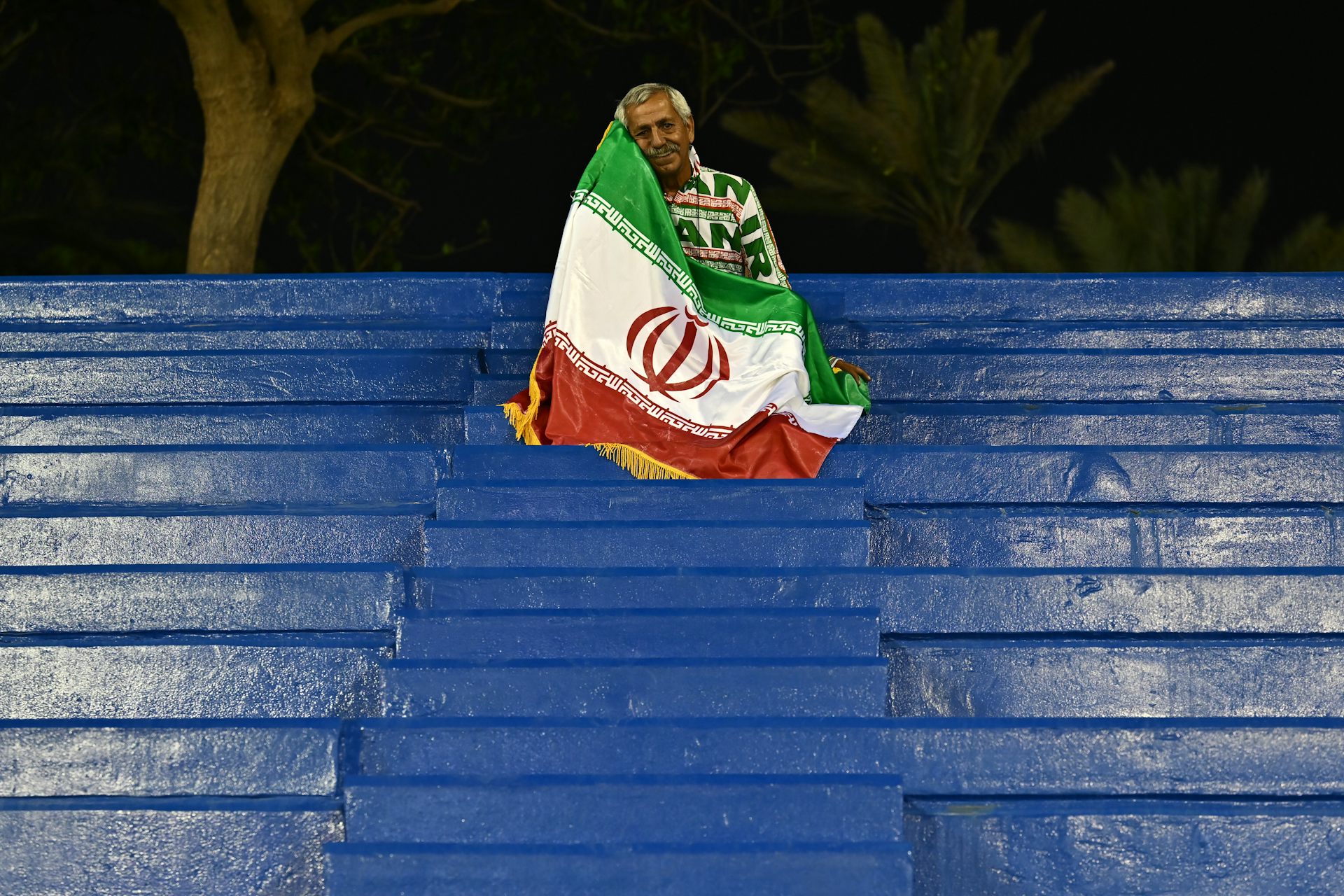
Pour la diaspora iranienne, un appel délicat concernant le Mondial : soutenir l’équipe nationale ou manifester – ou faire les deux ?
For Iran’s diaspora, a tough World Cup call: To support the national team or protest – or both?
Iran’s team faces a hostile reception from the US government and some of its brethren in the diaspora. Yet others hope the event will trump politics — for now.
L’équipe iranienne fait face à une réception hostile de la part du gouvernement américain et de certains membres de sa diaspora. Pourtant, d’autres espèrent que l’événement prendra le pas sur la politique – pour l’instant.
When Iran’s national soccer team walks onto American soil this summer for the 2026 FIFA World Cup, it will do so against the backdrop of an Iranian government crackdown against protesters in January, an ongoing war launched by the U.S. and Israel in February, and a four-month digital blackout affecting some 92 million people. It has left many Iranian fans feeling conflicted about who exactly they’ll be cheering for.
Lorsque l’équipe nationale de football iranienne foulera le sol américain cet été pour la Coupe du Monde FIFA 2026, ce sera dans un contexte marqué par les répressions gouvernementales iraniennes contre les manifestants en janvier, une guerre en cours lancée par les États-Unis et Israël en février, et un blackout numérique de quatre mois affectant environ 92 millions de personnes. Cela a laissé de nombreux fans iraniens se sentir tiraillés quant à qui ils encourageront exactement.
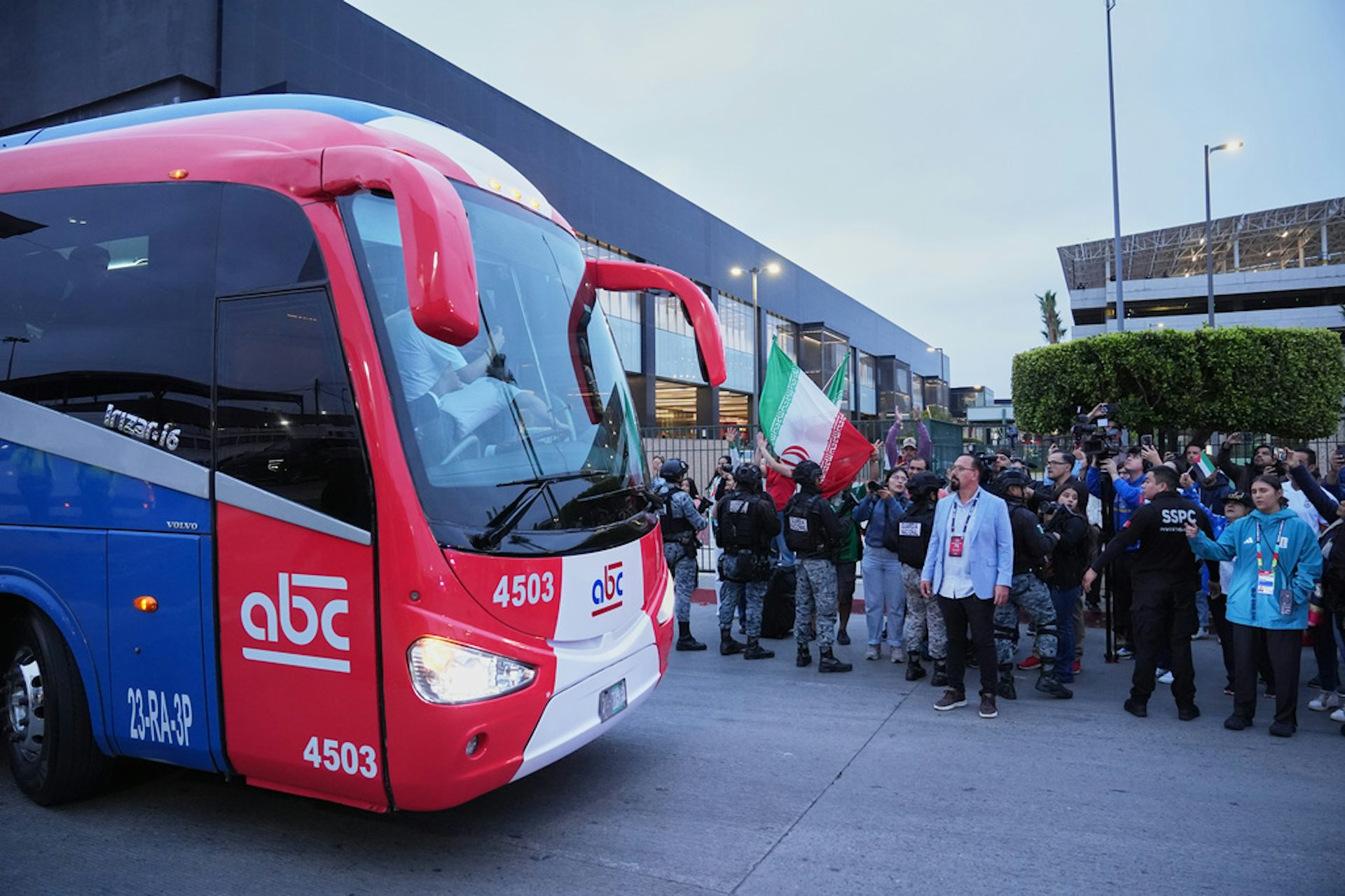
Even before a ball has been kicked, the tension has been clear among not only supporters but team members, too. Iranian players were issued visas to the United States at the 11th hour, and the team only arrived at their training base in Tijuana, Mexico, days before the tournament kicks off.
Avant même qu’un ballon ne soit frappé, la tension était palpable non seulement parmi les supporters, mais aussi au sein des membres de l’équipe. Les joueurs iraniens ont reçu leurs visas pour les États-Unis au dernier moment, et l’équipe n’est arrivée à sa base d’entraînement à Tijuana, au Mexique, que quelques jours avant le début du tournoi.
That came after a request to move their camp from Arizona, citing concerns over unfair treatment on U.S. soil, a move that required the formal endorsement of FIFA before it could proceed. Even with the team finally getting settled, however, multiple Iranian soccer fans have been denied visas to the U.S. Iran’s soccer association has also said its ticket allocation had been denied, leaving fans who had made the trek disappointed.
Cela faisait suite à une demande de déplacer leur camp d’Arizona, citant des préoccupations concernant un traitement injuste sur le sol américain, un mouvement qui nécessitait l’approbation formelle de la FIFA pour pouvoir se concrétiser. Même si l’équipe s’est finalement installée, plusieurs fans de football iraniens ont cependant vu leurs visas refusés pour les États-Unis. L’association de football iranienne a également annoncé que son allocation de billets avait été rejetée, laissant des fans qui avaient fait le voyage déçus.
With a host nation actively at war with a competing one for the first time in World Cup history, the pitch will be a stage not just for soccer but for grief, resistance and competing nationalism. The Iranian diaspora, buffeted by the one-two punch of internal crackdowns and external interventions, now faces a deeply unsettling question: How do you express pride in one’s national team without tacitly supporting the government that it represents?
Avec une nation hôte en guerre active contre un pays concurrent pour la première fois dans l’histoire de la Coupe du Monde, le terrain sera une scène non seulement pour le football, mais aussi pour le deuil, la résistance et les nationalismes rivaux. La diaspora iranienne, secouée par le coup double des répressions internes et des interventions externes, est désormais confrontée à une question profondément troublante: comment exprimer sa fierté pour son équipe nationale sans soutenir tacitement le gouvernement qu’elle représente?
Diasporic identity crises
Crises d’identité diasporiques
Along with many Iranians, mainly expatriates in the U.S., I plan to attend Iran’s opening game against New Zealand on June 15 in Los Angeles. The location is important – Los Angeles is a city that is home to the largest Iranian diaspora, so much so that it is often referred to as “Tehrangeles” within the community.
Avec de nombreux Iraniens, principalement des expatriés aux États-Unis, je prévois d’assister au match d’ouverture de l’Iran contre la Nouvelle-Zélande le 15 juin à Los Angeles. Le lieu est important – Los Angeles est une ville qui abrite la plus grande diaspora iranienne, au point qu’elle est souvent surnommée « Tehrangeles » au sein de la communauté.
It is also a community among whom feelings toward the Islamic Republic run deep, with many of them having left Iran during or following the Iranian Revolution of 1979. Many in the community have remained loyal to the deposed Pahlavi regime and the crown prince, Reza, and going so far as celebrating the joint U.S.-Israeli led war on Iran.
C’est également une communauté parmi laquelle les sentiments envers la République islamique sont profonds, beaucoup d’entre eux ayant quitté l’Iran pendant ou après la Révolution iranienne de 1979. Beaucoup dans la communauté sont restés fidèles au régime Pahlavi renversé et au prince héritier, Reza, allant même jusqu’à célébrer la guerre conjointe menée par les États-Unis et Israël contre l’Iran.
It is in this community that the Iranian national team – colloquially known as Team Melli to reflect the Farsi word for national – will face battle not only against New Zealand, but also the conflicted emotions of its ethnic brethren.
C’est au sein de cette communauté que l’équipe nationale iranienne – connue familièrement sous le nom de Team Melli pour refléter le mot farsi du national – affrontera non seulement la Nouvelle-Zélande, mais aussi les émotions conflictuelles de ses frères ethniques.
With the memory of the January protests still raw, calls have been circulating among some Iranian Americans to formally protest and boycott the occasion. Proposals range from purchasing tickets, only to leave seats conspicuously empty, to booing the national anthem and withholding any celebration of Iranian goals.
Avec le souvenir des manifestations de janvier encore vif, des appels circulent parmi certains Américains d’origine iranienne pour protester et boycotter officiellement l’événement. Les propositions vont de l’achat de billets uniquement pour laisser les sièges visiblement vides, au hûler l’hymne national et à s’abstenir de toute célébration des buts iraniens.
Supporters have also been urged within Iranian American communities to resist FIFA’s attempts to prohibit non-Islamic Republic flags inside stadiums, with some Iranian expats suggesting on social media of spray-painting over the symbols on the current flag, carrying plain green, white and red alternatives into the ground, or wearing clothing bearing political slogans. Others have proposed exposing politically motivated tattoos or using stuffed animals to caricature Iranian leaders.
Les partisans ont également été exhortés au sein des communautés américaines d’origine iranienne à résister aux tentatives de la FIFA d’interdire les drapeaux non islamiques dans les stades, certains expatriés iraniens suggérant sur les réseaux sociaux de recouvrir les symboles du drapeau actuel par de la peinture en bombe, d’apporter des alternatives simples vert, blanc et rouge, ou de porter des vêtements arborant des slogans politiques. D’autres ont proposé d’exposer des tatouages à motivation politique ou d’utiliser des peluches pour caricaturer les dirigeants iraniens.
In return, Mehdi Taj, the president of the Iranian Football Association, issued a statement demanding respect, stating: “We need a guarantee there, for our trip, that they have no right to insult the symbols of our system, especially the Islamic Revolutionary Guard Corps.”
En retour, Mehdi Taj, président de l’Association de football iranien, a publié une déclaration exigeant le respect, déclarant: « Nous avons besoin là-bas d’une garantie, pour notre voyage, qu’ils n’ont pas le droit d’insulter les symboles de notre système, en particulier la Garde révolutionnaire islamique. »
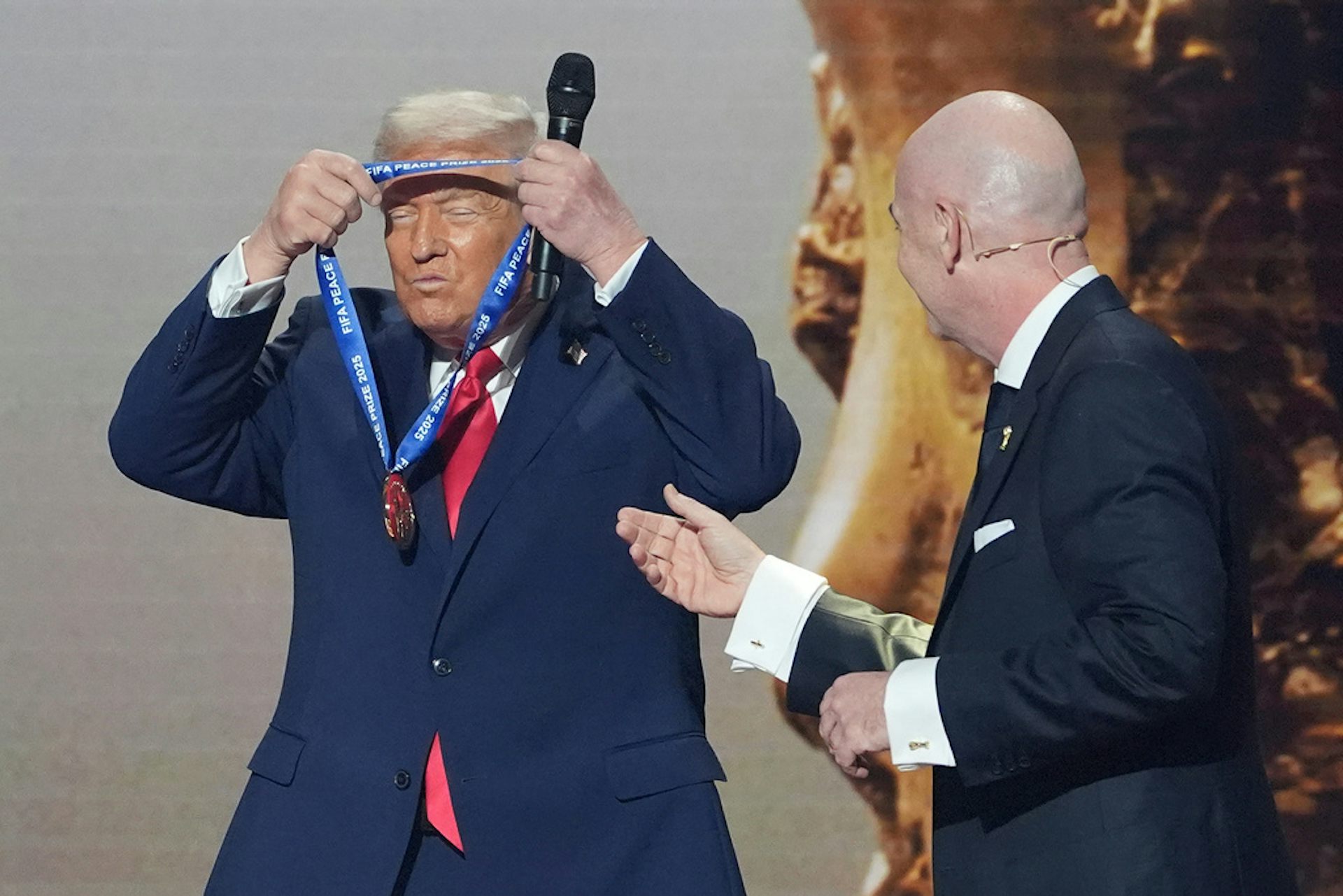
There is a broader question that Iran’s World Cup appearance forces into view, and it sits uncomfortably alongside FIFA’s own record. While the governing body of world soccer awarded President Donald Trump its inaugural Peace Prize ahead of the tournament, it is now looking the other way as the U.S. remains at war and denies visas to would-be participants and spectators. The collision of sport and statecraft is nothing new, from the 1936 Berlin Olympics to the Soviet boycott of Los Angeles in 1984. But it has rarely been managed with such apparent indifference to its own contradictions.
Il y a une question plus large que la participation de l’Iran au Mondial qui vient éclairer, et elle se situe mal à l’aise avec les propres records de la FIFA. Alors que l’organe directeur du football mondial a décerné son Prix de la Paix inaugural au président Donald Trump avant le tournoi, il fait maintenant la sourde oreille alors que les États-Unis sont toujours en guerre et refusent des visas aux participants et spectateurs potentiels. La collision entre sport et politique n’est rien de nouveau, des Jeux olympiques de Berlin en 1936 au boycott soviétique de Los Angeles en 1984. Mais elle a rarement été gérée avec une indifférence apparente face à ses propres contradictions.
When sport becomes a theater for competing political claims, it is the integrity of the game itself that is diminished. One is entitled to ask whether the notion of sport existing purely on its own terms — especially on the global stage — has ever been anything more than a convenient fiction.
Lorsque le sport devient un théâtre pour des revendications politiques concurrentes, c’est l’intégrité du jeu lui-même qui est diminuée. On a le droit de se demander si la notion de sport existant purement selon ses propres termes — surtout sur la scène mondiale — n’a jamais été plus qu’une fiction commode.
Collision of politics and sport
La collision entre la politique et le sport
Yet here lies the puzzle. Soccer occupies a place in Iranian life that borders on the sacred. One need only look to the fierce devotion surrounding Tehran’s great rival teams Persepolis and Esteghlal, a contest that ranks among the most intense club rivalries in world soccer, or to the scenes of street celebration that have swept Iran whenever the national team has won games at previous World Cups.
Pourtant, voici l’énigme. Le football occupe une place dans la vie iranienne qui confine au sacré. Il suffit de regarder la dévotion féroce entourant les grandes équipes rivales de Téhéran, Persépolis et Esteglal, une compétition qui figure parmi les rivalités de clubs les plus intenses du football mondial, ou les scènes de célébrations dans la rue qui ont envahi l’Iran chaque fois que l’équipe nationale a remporté des matchs lors des Coupes du Monde précédentes.
The memory of defeating the U.S. at the 1998 World Cup in France and the rematch in 2022 speaks to how deeply the game is woven into the fabric of Iranian culture. Supporting Team Melli has long been a source of collective pride, a point of unity that transcends politics and generation, regardless of religion, political views and social class. This creates the dilemma for the fans watching in Los Angeles and Seattle for Iran’s three group games.
Le souvenir de la défaite des États-Unis lors de la Coupe du Monde de 1998 en France et le match de revanche en 2022 témoignent à quel point le football est profondément tissé dans le tissu culturel iranien. Soutenir l’équipe Melli est depuis longtemps une source de fierté collective, un point d’unité qui transcende la politique et les générations, quelle que soit la religion, les opinions politiques ou la classe sociale. Cela crée le dilemme pour les supporters qui regardent à Los Angeles et Seattle les trois matchs de groupe de l’Iran.
In Arizona, where I teach global politics at Arizona State University, several members of the Iranian diaspora articulated this dilemma to me, capturing the tension at the heart of current events. One person invoked the sporting rivalries of the Cold War as a reminder of soccer’s capacity to transcend conflict, yet acknowledged that the wounds of the January protests remained too raw for many in the diaspora to set aside. Another was more straightforwardly hopeful, expressing a wish to see Iran progress in the tournament and a belief that success on the pitch might, however tentatively, cut across political divisions.
En Arizona, où j’enseigne la politique mondiale à l’Arizona State University, plusieurs membres de la diaspora iranienne m’ont exposé ce dilemme, saisissant la tension au cœur des événements actuels. Une personne a évoqué les rivalités sportives de la Guerre Froide comme un rappel de la capacité du football à transcender le conflit, tout en reconnaissant que les blessures des manifestations de janvier restaient trop vives pour beaucoup dans la diaspora. Un autre était plus directement optimiste, exprimant le souhait de voir l’Iran progresser dans le tournoi et la conviction qu’un succès sur le terrain pourrait, quoique timidement, traverser les clivages politiques.
Yet for those who have watched the events of recent years with grief and fury, cheering on a team that represents the Islamic Republic feels, to some, like an act of complicity. For its part, the Iranian government – as well as some Iranian critics – would argue that the national team stands apart from politics entirely. From this vantage point, soccer is a matter of national identity and cultural heritage that belongs to all Iranians regardless of their views on those in power. It is, moreover, a moment of proud participation, according to one Iranian official, and that to deny the players their support is to punish athletes for the decisions of politicians.
Pourtant, pour ceux qui ont suivi les événements des dernières années avec chagrin et fureur, encourager une équipe représentant la République islamique ressemble, selon certains, à un acte de complicité. Pour sa part, le gouvernement iranien – ainsi que certains critiques iraniens – soutiendra que l’équipe nationale est totalement séparée de la politique. De ce point de vue, le football est une question d’identité nationale et de patrimoine culturel qui appartient à tous les Iraniens, quelles que soient leurs opinions sur ceux au pouvoir. C’est, de plus, un moment de participation fière, selon un responsable iranien, et priver les joueurs de leur soutien revient à punir des athlètes pour les décisions de politiciens.
The protests that shook Iran, and the complex political landscape that followed, have left the diaspora navigating questions that go far beyond soccer.
Les protestations qui ont secoué l’Iran, et le paysage politique complexe qui a suivi, ont laissé la diaspora devoir naviguer des questions qui vont bien au-delà du football.
The Islamic Republic, whatever one’s view of its conduct, remains the sovereign government of a nation with a rich and fiercely proud culture, and the players on the pitch represent that culture as much as they represent the state.
Quelle que soit l’opinion de sa conduite, la République islamique demeure le gouvernement souverain d’une nation dotée d’une culture riche et farouchement fière, et les joueurs sur le terrain représentent cette culture autant qu’ils ne représentent l’État.
That they do so on the soil of a country with which Iran is actively at war renders this perhaps the most politically charged sporting occasion in living memory – one in which every goal, every flag and every empty seat carries a meaning that extends well beyond the 90 minutes. In that sense, the World Cup has not created a division so much as it has given an existing one a global stage.
Le fait qu’ils fassent cela sur le sol d’un pays avec lequel l’Iran est en guerre active rend cet événement sportif peut-être le plus politiquement chargé de la mémoire vivante – un événement où chaque but, chaque drapeau et chaque siège vide porte une signification qui dépasse largement les 90 minutes. Dans ce sens, la Coupe du Monde n’a pas créé de division, mais plutôt donné une scène mondiale à une division qui existait déjà.
Shirvin Zeinalzadeh does not work for, consult, own shares in or receive funding from any company or organization that would benefit from this article, and has disclosed no relevant affiliations beyond their academic appointment.
Shirvin Zeinalzadeh n’est employé par, ne consulte pas, ne détient pas d’actions dans et ne reçoit aucun financement de la part d’aucune entreprise ou organisation qui bénéficierait de cet article, et n’a divulgué aucune affiliation pertinente au-delà de sa fonction universitaire.
Read more
-
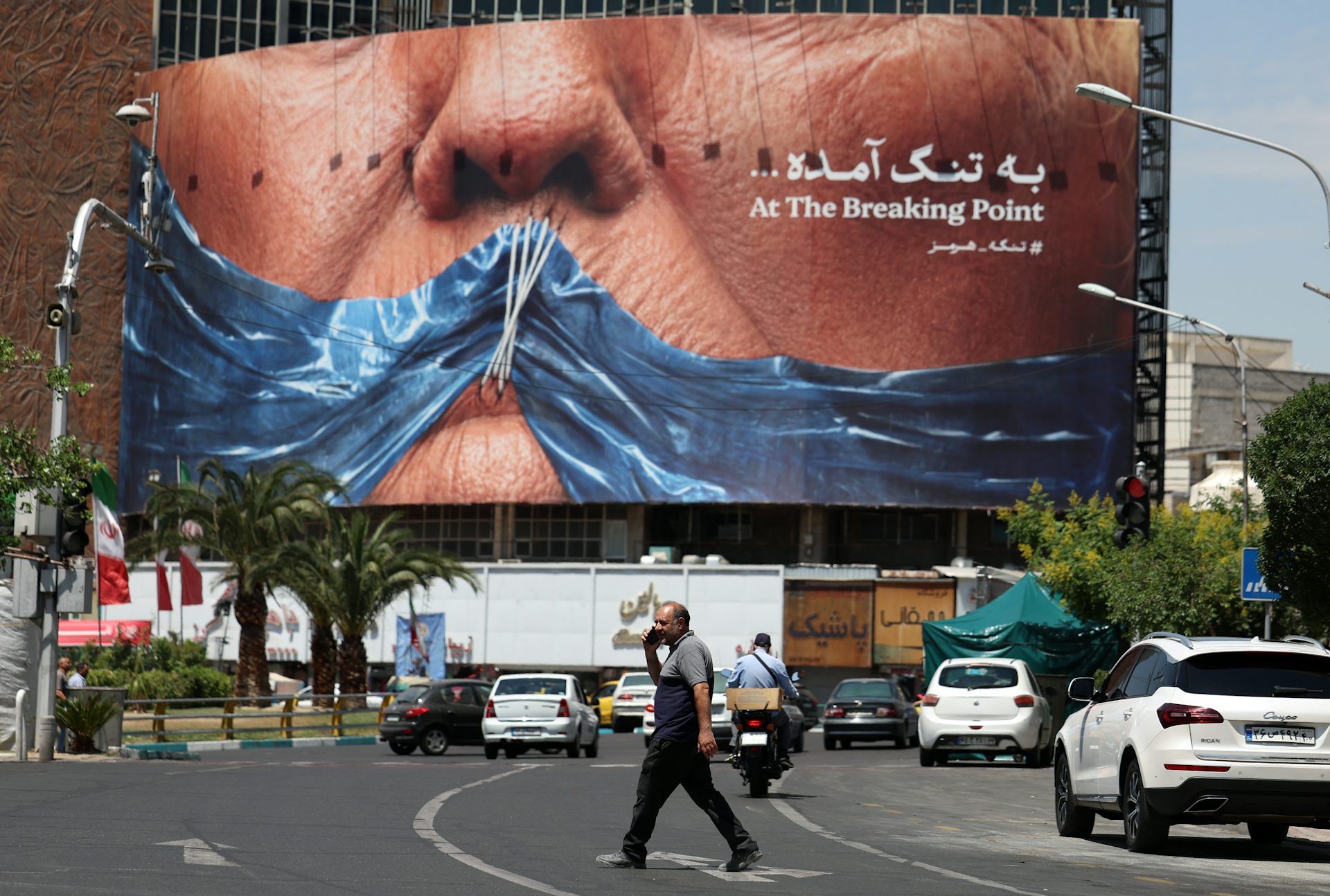
Comment l’Iran utilise les panneaux d’affichage comme propagande de guerre – nous en avons sélectionné 5 pour expliquer leur signification
How Iran uses billboards as wartime propaganda – we selected 5 to explain what they mean
-

Une coopération internationale accrue est nécessaire pour atteindre les objectifs mondiaux des Nations Unies en matière de forêts
Greater international co-operation is needed to achieve the UN’s global forest goals