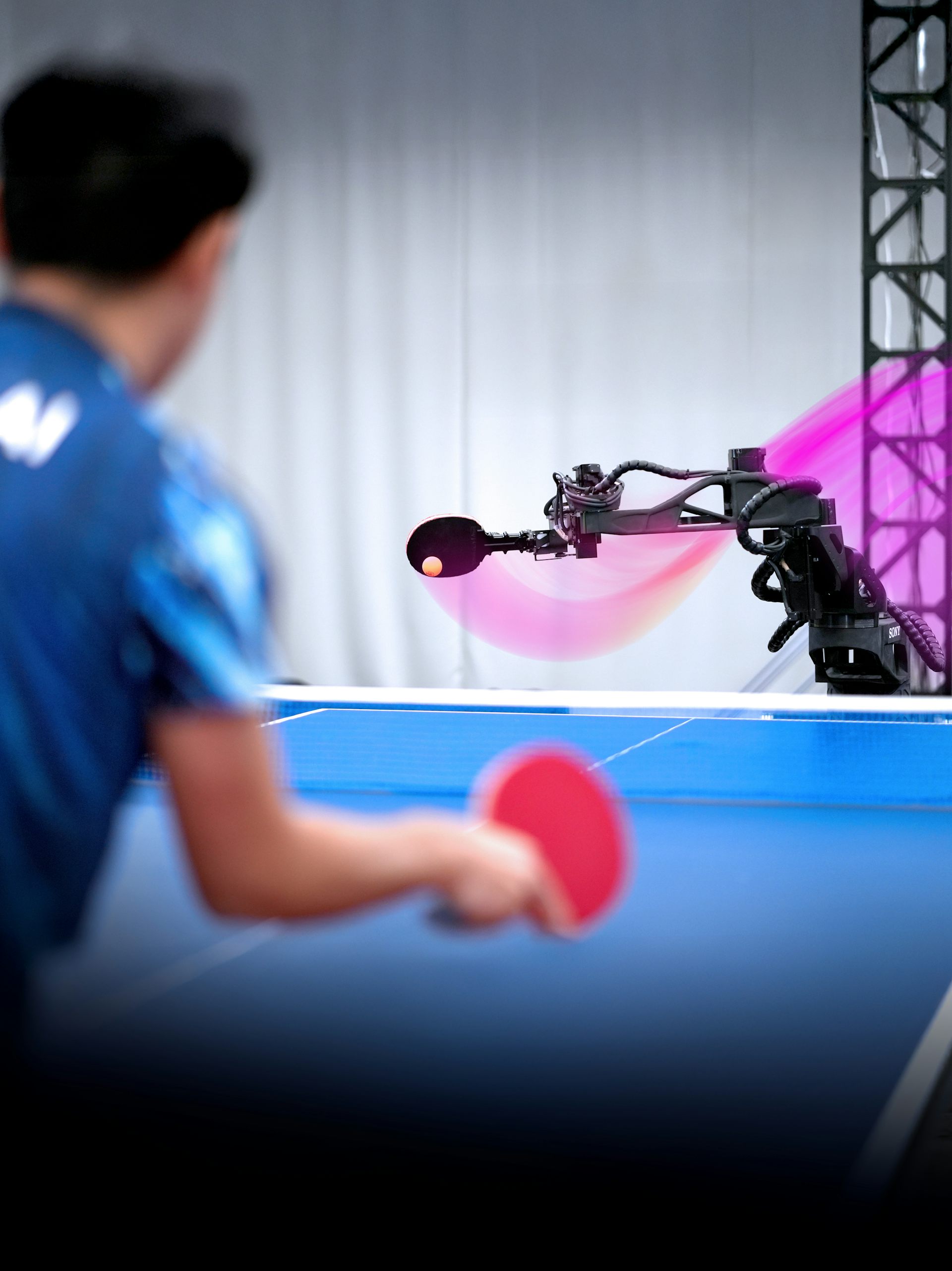
Los robots pueden correr un maratón y jugar ping pong. ¿Pero alguna vez lograrán una verdadera grandeza deportiva?
Robots can run a marathon and play ping pong. But will they ever achieve true sporting greatness?
The real opportunity is not to build robot champions, but to better understand human performance.
La verdadera oportunidad no es construir campeones robot, sino comprender mejor el rendimiento humano.
A humanoid robot recently made headlines around the world for running a half-marathon and beating the human world record. Around the same time, an AI-powered robot defeated an elite human player in table tennis. What the robot lacked in experience, it made up for by reacting faster and more consistently than any person could.
Un robot humanoide generó recientemente titulares en todo el mundo por correr medio maratón y superar el récord mundial humano. Alrededor del mismo tiempo, un robot impulsado por IA derrotó a un jugador humano de élite en tenis de mesa. Lo que al robot le faltó en experiencia, lo compensó reaccionando más rápido y de manera más consistente que cualquier persona.
These moments feel like milestones. Finally, it seems machines are stepping into one of the most human arenas – sports.
Estos momentos se sienten como hitos. Finalmente, parece que las máquinas están entrando en una de las arenas más humanas: el deporte.
But while it is tempting to frame this as robots versus humans, sport robotics isn’t really about competition. It’s about how machines can learn to move, react and interact in dynamic, unpredictable environments – and what that means for human performance.
Pero si bien es tentador enmarcar esto como robots contra humanos, la robótica deportiva no se trata realmente de competencia. Se trata de cómo las máquinas pueden aprender a moverse, reaccionar e interactuar en entornos dinámicos e impredecibles, y lo que eso significa para el rendimiento humano.
How do you train a robot to play sport?
¿Cómo se entrena a un robot para practicar un deporte?
Training a robot to play sport is fundamentally different from training a human athlete.
Entrenar a un robot para practicar un deporte es fundamentalmente diferente a entrenar a un atleta humano.
People learn through practice, coaching and experience, constantly adjusting to changing conditions. In sport science, this is often described as a tight coupling between perception and action. That is, seeing, deciding, and moving in one continuous loop.
Las personas aprenden mediante la práctica, el entrenamiento y la experiencia, ajustándose constantemente a las condiciones cambiantes. En la ciencia del deporte, esto se describe a menudo como un acoplamiento estrecho entre la percepción y la acción. Es decir, ver, decidir y moverse en un bucle continuo.
Robots, by contrast, are trained using a combination of simulation, data and control algorithms. Engineers build detailed virtual environments where robots can “practice” millions of times. They learn how to track objects, predict motion and coordinate their bodies. Sometimes, motion analysis techniques are used to track athletes doing the specific movements the robot needs to emulate.
Los robots, por el contrario, se entrenan utilizando una combinación de simulación, datos y algoritmos de control. Los ingenieros construyen entornos virtuales detallados donde los robots pueden «practicar» millones de veces. Aprenden a rastrear objetos, predecir movimientos y coordinar sus cuerpos. A veces, se utilizan técnicas de análisis de movimiento para seguir a atletas que realizan los movimientos específicos que el robot necesita emular.
For fast-paced sports such as table tennis, the challenge is extreme. A robot must detect the ball, predict its trajectory and execute a precise movement within fractions of a second. This requires close integration between computer vision, machine learning and real-time control.
Para deportes de ritmo rápido como el tenis de mesa, el desafío es extremo. Un robot debe detectar la pelota, predecir su trayectoria y ejecutar un movimiento preciso en fracciones de segundo. Esto requiere una estrecha integración entre la visión por computadora, el aprendizaje automático y el control en tiempo real.
One of the biggest advances in recent years has been the ability to train robots in simulation and then transfer those skills into the real world – a process known as “sim-to-real”. Combined with rapid improvements in sensors and computing, this has dramatically accelerated progress.
Uno de los mayores avances en los últimos años ha sido la capacidad de entrenar robots en simulación y luego transferir esas habilidades al mundo real, un proceso conocido como «sim-to-real.» Combinado con las rápidas mejoras en sensores y computación, esto ha acelerado drásticamente el progreso.
We’ve seen similar developments in robot basketball and robot soccer, where systems have evolved from simply locating the ball to coordinating as teams, making tactical decisions and adapting to opponents.
Hemos visto desarrollos similares en el baloncesto robótico y el fútbol robótico, donde los sistemas han evolucionado desde simplemente localizar la pelota hasta coordinarse como equipos, tomar decisiones tácticas y adaptarse a los oponentes.
Beyond entertainment
Más allá del entretenimiento
While robot athletes make for compelling demonstrations, their greatest impact will likely be behind the scenes where they can be used to train human athletes.
Si bien los atletas robóticos son demostraciones convincentes, su mayor impacto probablemente será tras bambalinas, donde pueden utilizarse para entrenar a atletas humanos.
One of the central challenges in sport is designing effective practice. Athletes need repetition to build skill. But they also need variability to reflect real competition. Too much repetition becomes predictable; too much variability becomes chaotic.
Uno de los desafíos centrales en el deporte es diseñar prácticas efectivas. Los atletas necesitan repetición para desarrollar habilidades. Pero también necesitan variabilidad para reflejar la competencia real. Demasiada repetición se vuelve predecible; demasiada variabilidad se vuelve caótica.
Robotics offers a potential way to balance both.
La robótica ofrece una forma potencial de equilibrar ambas.
A robotic training partner can deliver highly repeatable actions at elite intensity, while also introducing carefully controlled variation. For example, a robotic tennis server could replicate the motion of a world-class player while systematically varying ball speed, flight and placement.
Un compañero de entrenamiento robótico puede ejecutar acciones altamente repetibles con intensidad de élite, al tiempo que introduce una variación cuidadosamente controlada. Por ejemplo, un servidor de tenis robótico podría replicar el movimiento de un jugador de clase mundial mientras varía sistemáticamente la velocidad, el vuelo y la colocación de la pelota.
From a sport science perspective, this creates what is known as a “representative learning environment”. The key benefit is it replicates the key perceptual and decision-making demands of elite competition, which is difficult for coaches to recreate in the training environment.
Desde una perspectiva de la ciencia deportiva, esto crea lo que se conoce como un «entorno de aprendizaje representativo.» El beneficio clave es que replica las principales exigencias perceptivas y de toma de decisiones de la competición de élite, algo difícil de recrear para los entrenadores en el entorno de entrenamiento.
In our work, we’ve been exploring how robotics could support sports such as tennis, cricket and the football codes. The goal is to combine realism, repeatability, variability, and data to enhance skill development and link technique to outcomes.
En nuestro trabajo, hemos estado explorando cómo la robótica podría apoyar deportes como el tenis, el críquet y los códigos de fútbol. El objetivo es combinar el realismo, la repetibilidad, la variabilidad y los datos para mejorar el desarrollo de habilidades y vincular la técnica con los resultados.
Robots may also help manage training load. They can reduce the physical demands on coaches and training partners while still exposing athletes to high-quality game-like scenarios.
Los robots también pueden ayudar a gestionar la carga de entrenamiento. Pueden reducir las exigencias físicas para los entrenadores y compañeros de entrenamiento, al tiempo que exponen a los atletas a escenarios de juego de alta calidad.
Beyond performance, there are opportunities for fan engagement. Interactive robots at live events or demonstrations of elite skills could offer new ways for audiences to experience sport.
Más allá del rendimiento, existen oportunidades para la participación de los aficionados. Los robots interactivos en eventos en vivo o demostraciones de habilidades de élite podrían ofrecer nuevas formas para que el público experimente el deporte.
Will robots ever be ‘great’?
¿Serán los robots alguna vez ‘grandes’?
Over the next decade, robots will likely become more agile, more robust and better able to operate in complex environments. Tasks that robots currently find difficult, such as running on uneven terrain and catching or throwing balls, will become increasingly achievable.
Durante la próxima década, es probable que los robots se vuelvan más ágiles, más robustos y más capaces de operar en entornos complejos. Tareas que actualmente resultan difíciles para los robots, como correr por terrenos irregulares y atrapar o lanzar pelotas, serán cada vez más alcanzables.
But even as robots improve, there are important limits.
Pero incluso a medida que los robots mejoran, existen límites importantes.
Sporting greatness is not just about executing movements perfectly. It involves creativity, decision-making under pressure, and the ability to adapt in ways shaped by experience, emotion and context.
La grandeza deportiva no se trata solo de ejecutar movimientos a la perfección. Implica creatividad, toma de decisiones bajo presión y la capacidad de adaptarse de maneras moldeadas por la experiencia, la emoción y el contexto.
From a sport science perspective, elite performance emerges from the interaction between the athlete, the task and the environment. Robots can be engineered to perform specific tasks extremely well, but they do not experience this interaction in the same embodied, meaningful way.
Desde una perspectiva de la ciencia deportiva, el rendimiento de élite surge de la interacción entre el atleta, la tarea y el entorno. Los robots pueden ser diseñados para realizar tareas específicas extremadamente bien, pero no experimentan esta interacción de manera encarnada y significativa.
This means robots may surpass humans in tightly defined challenges – such as bowling a cricket ball with perfect consistency – but they are unlikely to achieve greatness in the holistic human sense.
Esto significa que los robots pueden superar a los humanos en desafíos muy definidos – como lanzar una bola de críquet con perfecta consistencia – pero es poco probable que logren la grandeza en el sentido humano holístico.
A new role for robots in sport
Un nuevo papel para los robots en el deporte
Rather than replacing athletes, robots are more likely to become part of the sporting ecosystem.
Más que reemplazar a los atletas, es más probable que los robots se conviertan en parte del ecosistema deportivo.
In the same way that video analysis and wearable sensors have transformed training, robotics offers a new tool for coaches and sport scientists. It enables practice environments that can be precisely controlled, repeated, and adapted to individual needs.
De la misma manera que el análisis de video y los sensores vestibles han transformado el entrenamiento, la robótica ofrece una nueva herramienta para entrenadores y científicos deportivos. Permite entornos de práctica que pueden ser controlados, repetidos y adaptados con precisión a las necesidades individuales.
The real opportunity is not to build robot champions, but to better understand human performance, and help athletes reach higher levels.
La verdadera oportunidad no es construir campeones robot, sino comprender mejor el rendimiento humano y ayudar a los atletas a alcanzar niveles más altos.
Jonathan Roberts receives funding from the Australian Research Council.
Jonathan Roberts recibe financiación del Consejo Australiano de Investigación.
Marc Portus does not work for, consult, own shares in or receive funding from any company or organisation that would benefit from this article, and has disclosed no relevant affiliations beyond their academic appointment.
Marc Portus no trabaja para, asesora, posee acciones de, ni recibe financiación de ninguna empresa u organización que se beneficiaría de este artículo, y no ha revelado afiliaciones relevantes más allá de su nombramiento académico.
Read more
-

La Vía Láctea fue reestructurada por una colisión cataclísmica hace miles de millones de años. Ahora está en camino a otra.
The Milky Way was rewired by a cataclysmic collision billions of years ago. Now it is on course for another
-
Copa Mundial 2026: por qué mover los partidos a la noche no es suficiente para abordar el problema del calor extremo
World Cup 2026: why moving games to evenings isn’t enough to tackle extreme heat problem