Como o Irã usa outdoors como propaganda de guerra – selecionamos 5 para explicar o que significam
How Iran uses billboards as wartime propaganda – we selected 5 to explain what they mean
The provocative images in the most visible parts of Tehran are intended to be photographed, posted and shared widely on social media.
As imagens provocativas nas partes mais visíveis de Teerã têm o objetivo de serem fotografadas, postadas e compartilhadas amplamente nas redes sociais.
Since the US–Israel war against Iran began in late February, images of giant billboards in Tehran have been ubiquitous across traditional and social media. These billboards have been placed in some of the busiest and most visible parts of the city, and are constantly being updated to reflect current events.
Desde que a guerra EUA-Israel contra o Irã começou no final de fevereiro, imagens de gigantescos painéis publicitários em Teerã têm sido onipresentes na mídia tradicional e nas redes sociais. Esses painéis foram colocados em algumas das áreas mais movimentadas e visíveis da cidade, e estão sendo constantemente atualizados para refletir eventos atuais.
Iran has long used public spaces as a tool of political communication. Since the 1979 Islamic Revolution – and especially during the Iran–Iraq War – the regime has erected murals and billboards to display revolutionary imagery, war memorials and ideological messages.
O Irã sempre utilizou espaços públicos como ferramenta de comunicação política. Desde a Revolução Islâmica de 1979 – e especialmente durante a Guerra Irã-Iraque – o regime erigiu murais e painéis publicitários para exibir imagens revolucionárias, memoriais de guerra e mensagens ideológicas.
Today, these billboards are designed not only for local audiences, but also for global digital circulation. Depicting powerful imagery, slogans and symbolic representations, they serve a dual function:
Hoje, esses painéis são projetados não apenas para o público local, mas também para a circulação digital global. Representando imagens poderosas, slogans e representações simbólicas, eles servem a uma função dupla:
to reinforce a sense of collective identity, national unity and shared emotion during a time of crisis
* reforçar um senso de identidade coletiva, unidade nacional e emoção compartilhada durante um período de crise
to serve as a tool of propaganda for the state, at times featuring Hebrew and English alongside Farsi (Persian) .
* servir como ferramenta de propaganda para o estado, apresentando às vezes hebraico e inglês ao lado do farsi (persa) .
Researchers argue these billboards are part of a broader visual communication strategy on the part of the state. They are intended to be photographed, posted and shared widely on social media as a way of projecting power and resistance to a global audience (even with a months-long internet blackout in place) .
Pesquisadores argumentam que esses painéis fazem parte de uma estratégia de comunicação visual mais ampla por parte do estado. Eles são destinados a serem fotografados, postados e compartilhados amplamente nas redes sociais como forma de projetar poder e resistência para um público global (mesmo com um apagão de internet de meses em vigor) .
So, what do the billboards say, and what’s the deeper symbolism behind the imagery? We’ve chosen five samples from Tehran to analyse.
Então, o que os painéis dizem, e qual é o simbolismo mais profundo por trás das imagens? Escolhemos cinco amostras de Teerã para analisar.
1. The Epstein missile
O míssil Epstein
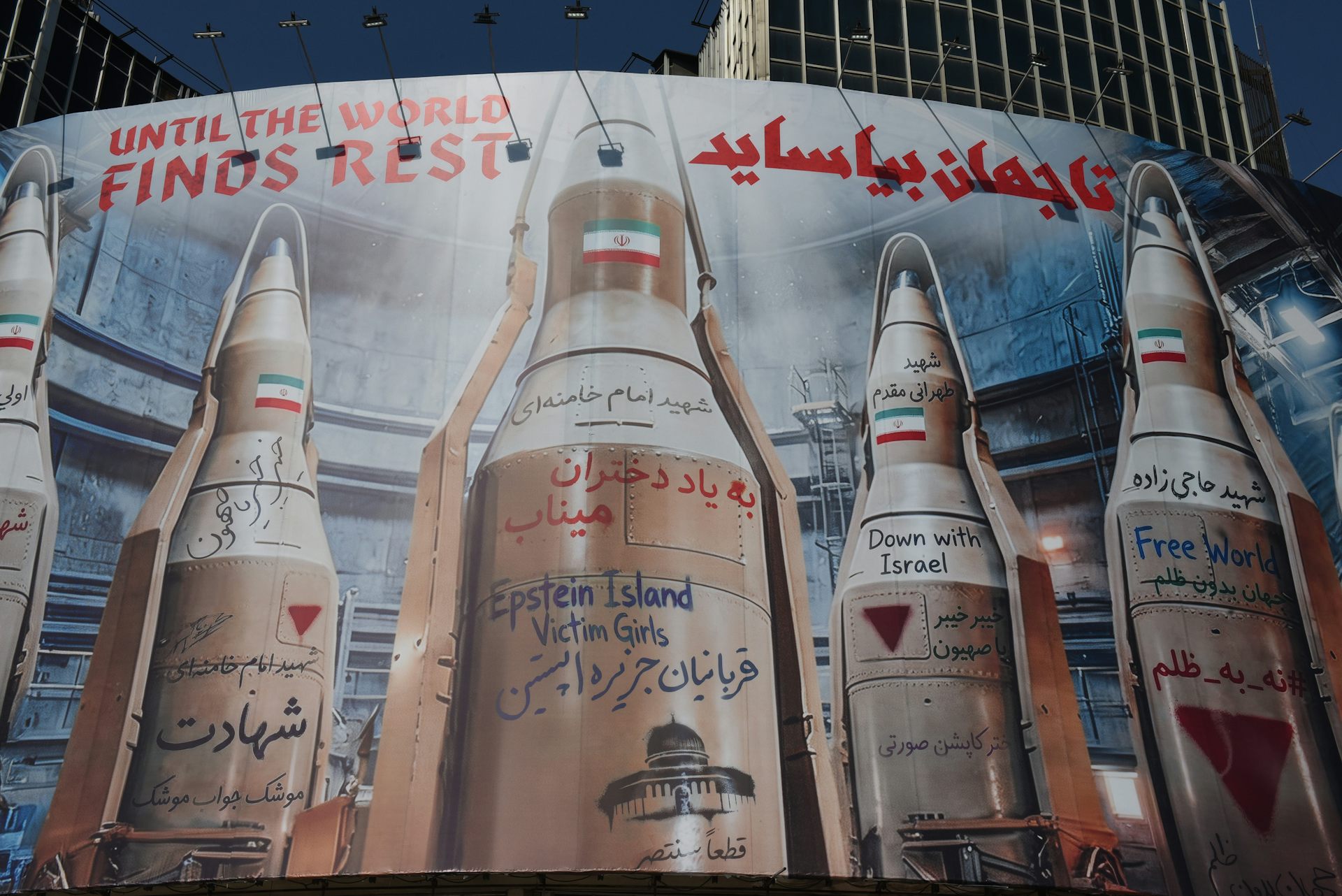
One of the billboards that circulated widely in recent months depicted Iranian missiles covered with handwritten messages and symbolic phrases.
Um dos painéis que circularam amplamente nos últimos meses retratava mísseis iranianos cobertos com mensagens manuscritas e frases simbólicas.
Among the most striking inscriptions is the phrase “To the girls of Minab”, written in bold, red Farsi script. This is a reference to a strike on a girls’ school in the opening days of the war that Iranian officials say killed 175 girls and teachers. Reports indicate US forces were likely responsible.
Entre as inscrições mais marcantes está a frase “Às meninas de Minab”, escrita em farsi vermelho e em negrito. Esta é uma referência a um ataque a uma escola de meninas nos primeiros dias da guerra, que, segundo autoridades iranianas, matou 175 meninas e professoras. Relatórios indicam que as forças dos EUA foram provavelmente responsáveis.
Directly below that, written in English, are the words “Epstein Island victim girls”, a reference to the island owned by convicted sex offender Jeffrey Epstein where young women were allegedly sexually assaulted.
Diretamente abaixo, escrito em inglês, estão as palavras “Epstein Island victim girls”, uma referência à ilha de propriedade do condenado agressor sexual Jeffrey Epstein, onde jovens mulheres teriam sido sexualmente agredidas.
On another missile is the phrase “the girl with the pink jacket”. This is a deeply emotional reference to a young Iranian girl killed in a terror attack in 2024, who was identified by her pink jacket and heart-shaped earrings.
Em outro míssil está a frase “the girl with the pink jacket”. Esta é uma referência profundamente emocional a uma jovem iraniana morta em um ataque terrorista em 2024, que foi identificada por sua jaqueta rosa e brincos em formato de coração.
The intention is to connect these disparate events through a narrative of vulnerable young women affected by violence, exploitation and political power. Rather than presenting missiles only as weapons of destruction, the image reframes them as symbols of grief, revenge, memory and defence.
A intenção é conectar esses eventos díspares através de uma narrativa de jovens mulheres vulneráveis afetadas pela violência, exploração e poder político. Em vez de apresentar os mísseis apenas como armas de destruição, a imagem os reformula como símbolos de luto, vingança, memória e defesa.
In this narrative, Iran is portrayed not as seeking war. It is responding to injustice and protecting its people.
Nesta narrativa, o Irã é retratado não como buscando guerra. Ele está respondendo à injustiça e protegendo seu povo.
2. ‘Masters of war’
2. ‘Mestres da guerra’
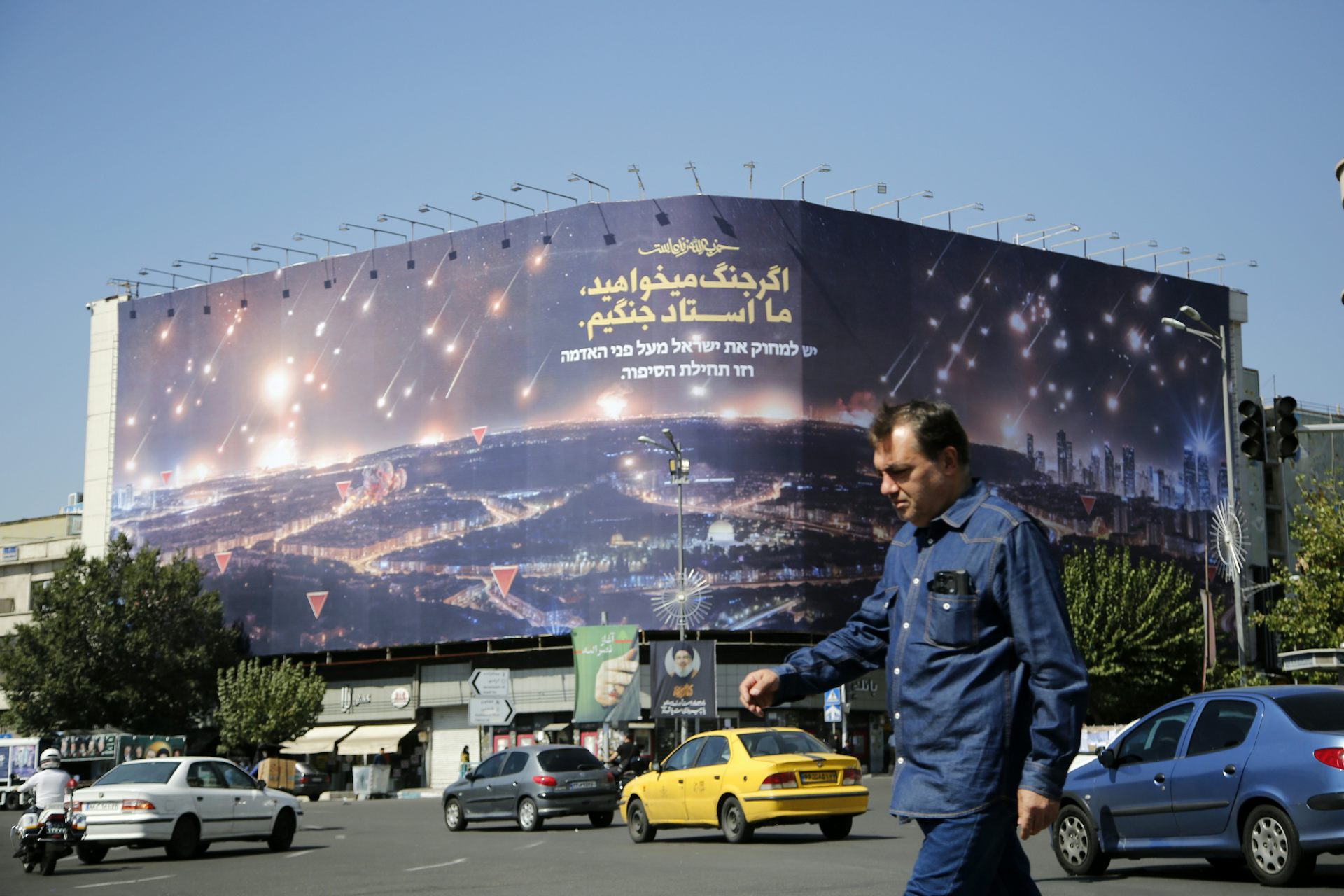
Another billboard that gained significant attention in 2024 depicted the Farsi phrase “If you want war, we are masters of war” above a Hebrew message saying “Israel must be wiped from the face of the earth”.
Outro outdoor que ganhou atenção significativa em 2024 exibiu a frase em persa “Se você quer guerra, nós somos mestres da guerra” acima de uma mensagem em hebraico dizendo “Israel deve ser varrido da face da terra”.
The billboard portrays the sky over Israel illuminated by waves of incoming missiles, almost resembling a meteor shower or rain of fire. The imagery is highly stylised and cinematic, with the missiles transforming the night sky into a scene of overwhelming force.
O outdoor retrata o céu sobre Israel iluminado por ondas de mísseis em aproximação, quase assemelhando-se a uma chuva de meteoros ou chuva de fogo. A imagem é altamente estilizada e cinematográfica, com os mísseis transformando o céu noturno em uma cena de força avassaladora.
By directly addressing Hebrew-speaking viewers, the billboard functions as both a direct warning to Israelis and a symbolic projection of power, designed to have psychological impact. Language becomes a tool of warfare itself.
Ao se dirigir diretamente aos espectadores falantes de hebraico, o outdoor funciona tanto como um aviso direto aos israelenses quanto como uma projeção simbólica de poder, projetada para ter impacto psicológico. A linguagem se torna uma ferramenta de guerra em si mesma.
This multilingual strategy reveals an important shift in Tehran’s urban propaganda. These billboards, which have become more prominent in recent years, are no longer designed solely for Iranian pedestrians and motorists. The regime is aware photographs will circulate instantly across the internet, reaching intended audiences in Israel.
Esta estratégia multilíngue revela uma mudança importante na propaganda urbana de Teerã. Esses outdoors, que se tornaram mais proeminentes nos últimos anos, não são mais projetados apenas para pedestres e motoristas iranianos. O regime está ciente de que as fotografias circularão instantaneamente pela internet, alcançando públicos pretendidos em Israel.
3. Trump’s sutured mouth
3. Boca suturada de Trump
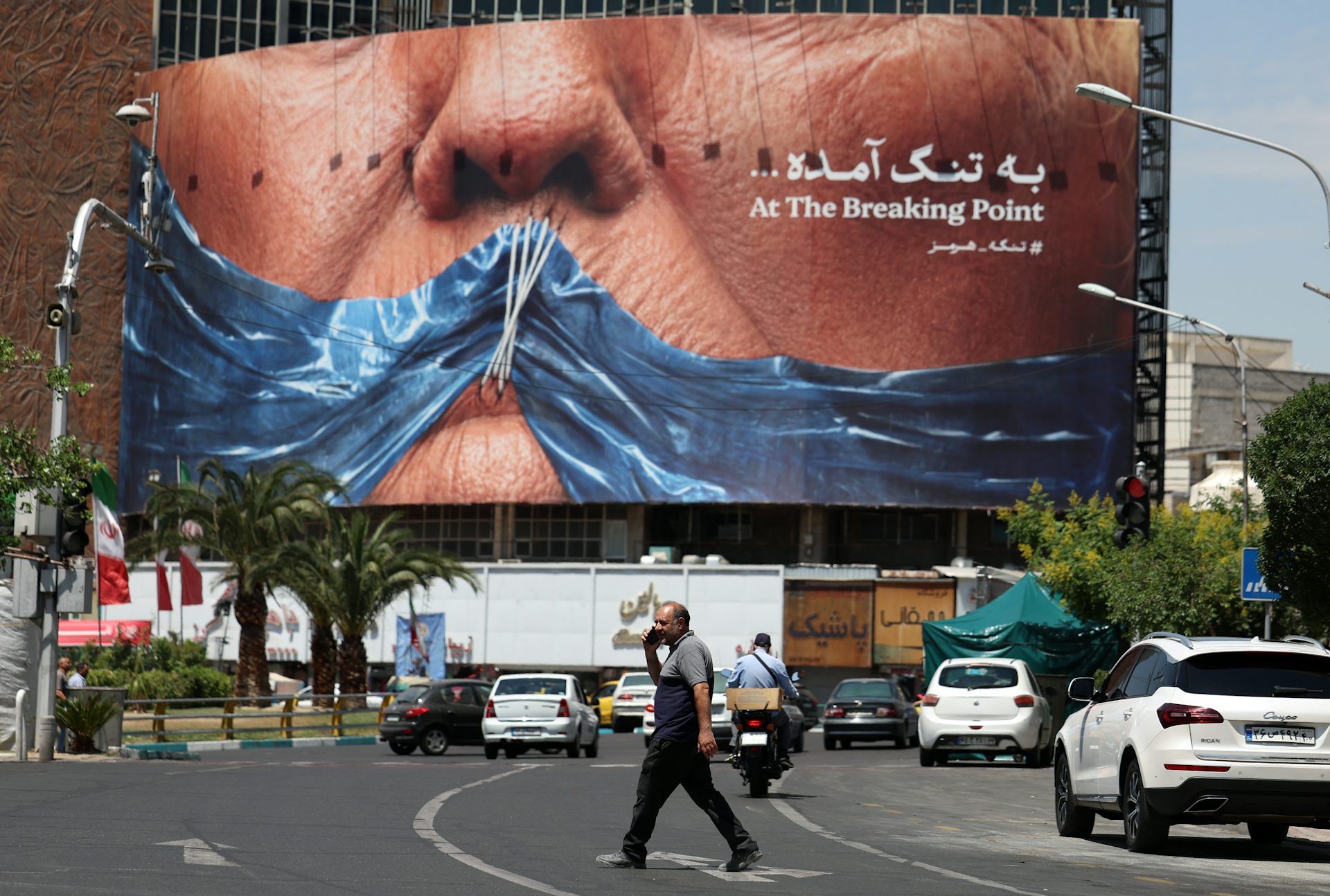
Another bilingual billboard is targeted to Western – and specifically American – audiences. It features US President Donald Trump’s mouth with a rendering of the Strait of Hormuz sutured on top, alongside the English phrase “The Breaking Point.”
Outra placa bilíngue é direcionada a públicos ocidentais – e especificamente americanos. Ela apresenta a boca do presidente dos EUA, Donald Trump, com uma representação do Estreito de Ormuz suturada em cima, ao lado da frase em inglês “The Breaking Point.”
The Farsi text roughly translates to “its patience has run out”. It also contains a literary pun: the word tang in Farsi can refer both to “narrowness” or “constraint” and to the Strait (tangeh) of Hormuz itself. This creates a double meaning linking the geopolitical tensions in the Strait of Hormuz with the idea of reaching a psychological or political breaking point.
O texto em farsi traduz-se aproximadamente como “sua paciência acabou”. Ele também contém um trocadilho literário: a palavra tangeh em farsi pode se referir tanto a “estreitamento” ou “restrição” quanto ao próprio Estreito de Ormuz. Isso cria um duplo sentido ligando as tensões geopolíticas no Estreito de Ormuz à ideia de atingir um ponto de ruptura psicológico ou político.
The image also critiques Trump’s constant political rhetoric and media presence. The sutures placed across his mouth symbolise silencing, constraint and the loss of Trump’s authority or influence in relation to Iran and the Strait of Hormuz.
A imagem também critica a retórica política constante e a presença midiática de Trump. As suturas colocadas em sua boca simbolizam o silenciamento, a restrição e a perda da autoridade ou influência de Trump em relação ao Irã e ao Estreito de Ormuz.
4. Arash the Archer
4. Arash o Arqueiro
Another billboard draws on the famous Persian myth of Arash the Archer. In the image, Arash places an arrow into his bow in the heat of battle, surrounded by missiles. The reference comes from the ancient story in which Arash sacrifices his life after shooting an arrow during a mythological war between Iran and neighbouring Turan.
Outro outdoor se baseia no famoso mito persa de Arash o Arqueiro. Na imagem, Arash coloca uma flecha em seu arco no calor da batalha, cercado por mísseis. A referência vem da antiga história na qual Arash sacrifica sua vida após disparar uma flecha durante uma guerra mitológica entre o Irã e o vizinho Turan.
The billboard suggests modern Iranian soldiers, like Arash, are willing to sacrifice their lives to defend their homeland.
O outdoor sugere que soldados iranianos modernos, como Arash, estão dispostos a sacrificar suas vidas para defender sua pátria.
More broadly, the image also reflects how poetry, mythology and heroic storytelling are deeply embedded in Iranian history and culture. It connects the contemporary conflict to centuries of struggle.
De forma mais ampla, a imagem também reflete como a poesia, a mitologia e a narrativa heroica estão profundamente enraizadas na história e cultura iranianas. Ela conecta o conflito contemporâneo a séculos de luta.
5. The fishermen
5. Os pescadores
Another billboard demonstrates Iranian military power through the image of a massive fishing net spread across the Persian Gulf. Inside the net are captured American aircraft, drones and naval vessels.
Outro painel demonstra o poder militar iraniano através da imagem de uma enorme rede de pesca espalhada pelo Golfo Pérsico. Dentro da rede estão capturados aviões americanos, drones e navios navais.
The imagery is accompanied by the phrase, “The entire Persian Gulf is our hunting ground” in Farsi, connoting it is under direct Iranian control and surveillance. The image also emphasises the strategic importance of the Strait of Hormuz, indicating the power to open or close this vital waterway ultimately lies with Iran.
A imagem é acompanhada pela frase, “Todo o Golfo Pérsico é nosso campo de caça” em farsi, sugerindo que está sob controle e vigilância iranianos diretos. A imagem também enfatiza a importância estratégica do Estreito de Ormuz, indicando que o poder de abrir ou fechar esta via navegável vital reside, em última instância, no Irã.
At the same time, the fishing net operates as a cultural metaphor. Like fishing itself, Iran’s warfare strategy is based on patience, resilience, careful strategy and long-term determination, rather than sheer force alone.
Ao mesmo tempo, a rede de pesca opera como uma metáfora cultural. Assim como a pesca em si, a estratégia de guerra do Irã é baseada na paciência, resiliência, estratégia cuidadosa e determinação de longo prazo, em vez de apenas força bruta.
The authors do not work for, consult, own shares in or receive funding from any company or organisation that would benefit from this article, and have disclosed no relevant affiliations beyond their academic appointment.
Os autores não trabalham, consultam, possuem ações ou recebem financiamento de nenhuma empresa ou organização que se beneficiaria deste artigo, e não divulgaram afiliações relevantes além de seus cargos acadêmicos.
Read more
-
O pianista Abdullah Ibrahim criou uma cultura magnífica e nova para a África do Sul
Pianist Abdullah Ibrahim crafted a magnificent new culture for South Africa
-
O que as pausas de hidratação da Copa do Mundo revelam sobre quem governa o futebol masculino?
What the World Cup hydration breaks reveal about who governs men’s football