Qué habría sido la experiencia de vivir el armagedón del asteroide que mató a los dinosaurios: un relato paso a paso
What it would have been like to experience the dinosaur-killing asteroid armageddon: a blow-by-blow account
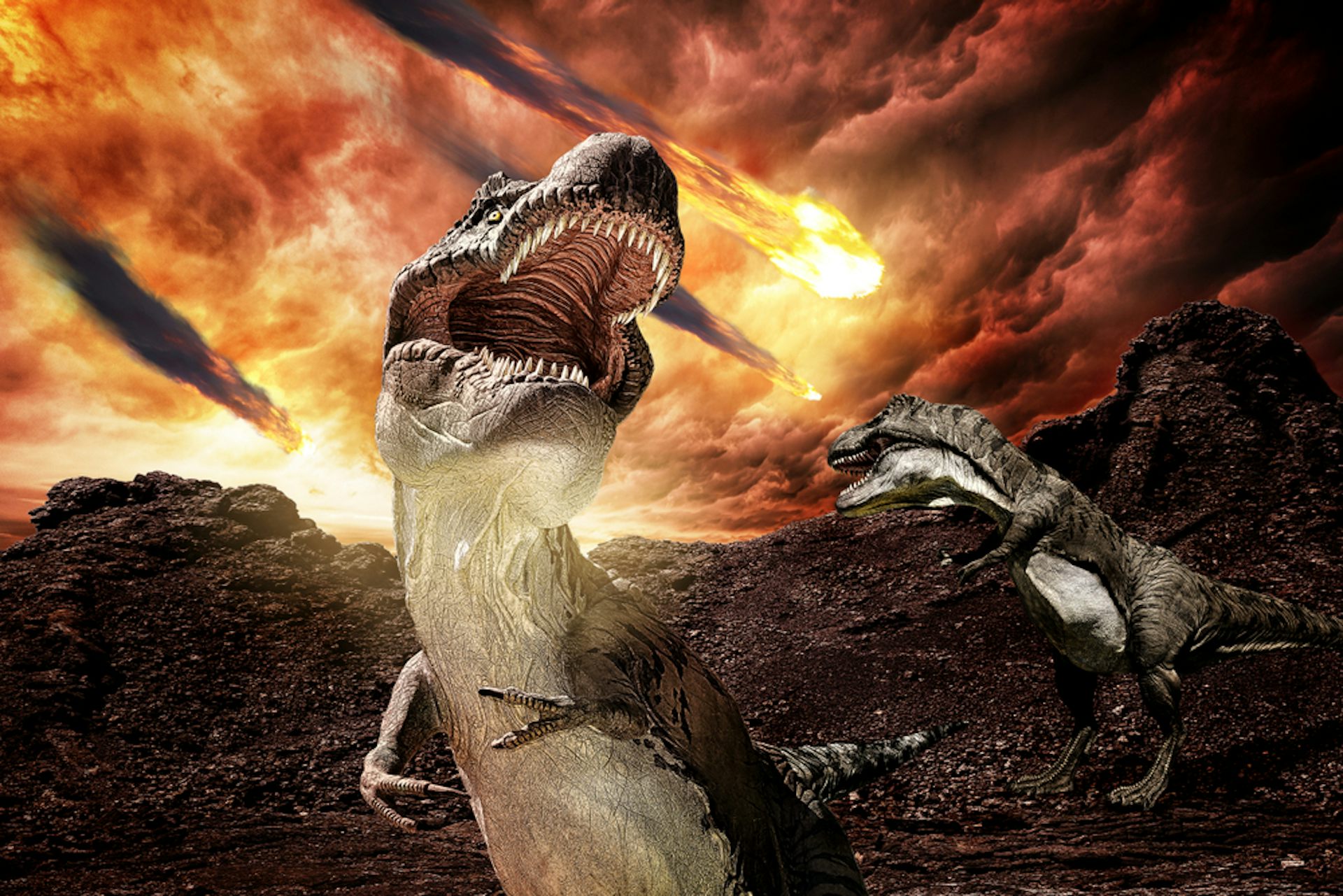
A week after the asteroid impact, rotting vegetation, smoke and sulphur create a stinky planet. Plant and animal survivors succumb to the corrosive acid rain.
Una semana después del impacto del asteroide, la vegetación en descomposición, el humo y el azufre crean un planeta apestoso. Los supervivientes de plantas y animales sucumben a la lluvia ácida corrosiva.
A great Tyrannosaurus rex strides through the conifer trees of her territory, sniffing the air. She picks up the scent from the carcass of a dead horned dinosaur, Triceratops, that she was feeding on yesterday. She walks over and strips off some more shreds of meat, but the smell is foul even for her.
Un gran Tyrannosaurus rex avanza por los árboles de coníferas de su territorio, olfateando el aire. Captura el olor del cadáver de un dinosaurio con cuernos muerto, Triceratops, que había estado alimentándose ayer. Camina y se quita más restos de carne, pero el olor es fétido incluso para ella.
She goes down to the lake to drink and small crocodiles and turtles scuttle into the water. But she hardly sees them. Of more interest is an armoured dinosaur, Ankylosaurus, lurking nearby. However, she knows this dinosaur won’t be an easy kill and she isn’t desperate enough for food to risk a fight. Little does she know there are bigger dangers ahead. She looks up and sees a bright light racing downwards accompanied by faint crackling and sizzling noises.
Baja al lago a beber y pequeños cocodrilos y tortugas se arrastran al agua. Pero apenas los ve. De más interés es un dinosaurio blindado, Ankylosaurus, acechando cerca. Sin embargo, sabe que este dinosaurio no será una muerte fácil y no está lo suficientemente desesperada por comida como para arriesgar una pelea. Poco sabe ella que hay peligros mayores por delante. Mira hacia arriba y ve una luz brillante corriendo hacia abajo acompañada de débiles ruidos de crepitación y chisporroteo.
Our T. rex has excellent hearing for low frequency sounds and she is disturbed by the vibrations she can feel. But her upset only lasts for a moment. In a flash, she has been burnt to a crisp and her world changed forever.
Nuestro T. rex tiene un excelente oído para sonidos de baja frecuencia y se siente perturbada por las vibraciones que puede sentir. Pero su malestar solo dura un momento. En un instante, ha sido quemada hasta las brasas y su mundo cambió para siempre.
This all happened 66 million years ago, when a huge asteroid famously hit the Earth in the area of what is now the Caribbean. At the end of the Cretaceous period, sea levels were 100–200 metres higher than today, so the shores of the Caribbean lay far inland over eastern Mexico and the southern United States. The impact happened entirely within these waters.
Todo esto sucedió hace 66 millones de años, cuando un enorme asteroide golpeó la Tierra famosamente en la zona de lo que ahora es el Caribe. Al final del período Cretácico, los niveles del mar estaban entre 100 y 200 metros más altos que hoy, por lo que las costas del Caribe se encontraban muy al interior sobre el este de México y el sur de Estados Unidos. El impacto ocurrió enteramente dentro de estas aguas.
The event triggered instant changes to our planet and its atmosphere and led to the extinction of the dinosaurs and about half Earth’s other species. But what would it have been like to experience such a gargantuan impact? What would you have seen, heard or smelled? And how would you have died – or survived?
El evento desencadenó cambios instantáneos en nuestro planeta y su atmósfera y condujo a la extinción de los dinosaurios y de otras medio de la vida de la Tierra. Pero ¿cómo habría sido experimentar un impacto tan gigantesco? ¿Qué habrías visto, oído o olido? ¿Y cómo habrías muerto, o sobrevivido?
The Insights section is committed to high-quality longform journalism. Our editors work with academics from many different backgrounds who are tackling a wide range of societal and scientific challenges.
La sección de Perspectivas está comprometida con el periodismo de larga duración y de alta calidad. Nuestros editores trabajan con académicos de muchos orígenes diferentes que están abordando una amplia gama de desafíos sociales y científicos.
As experts on meteoritics and palaeontology, respectively, we’ve created a detailed timeline, based on decades of research, to take you right there. So let’s start by travelling back in time to the very last day of the Cretaceous.
Como expertos en meteorítica y paleontología, respectivamente, hemos creado una línea de tiempo detallada, basada en décadas de investigación, para llevarte allí. Así que comencemos viajando en el tiempo hasta el último día del Cretácico.
T-minus one day
T-menos un día
All is calm and the Cretaceous day proceeds as usual. In what will soon be ground zero, it is pleasantly warm, about 26°C, and wet. It often is. For about a week, the asteroid has been visible only at night. Because the giant rock is heading straight towards Earth, it looks like a motionless star. There is no dramatic tail; this is a rocky asteroid rather than a comet.
Todo está tranquilo y el día Cretácico transcurre como de costumbre. En lo que pronto será el punto cero, hace agradable calor, unos 26°C, y está húmedo. A menudo lo está. Durante aproximadamente una semana, el asteroide solo había sido visible de noche. Debido a que la roca gigante se dirige directamente hacia la Tierra, parece una estrella inmóvil. No hay una cola dramática; es un asteroide rocoso en lugar de un cometa.
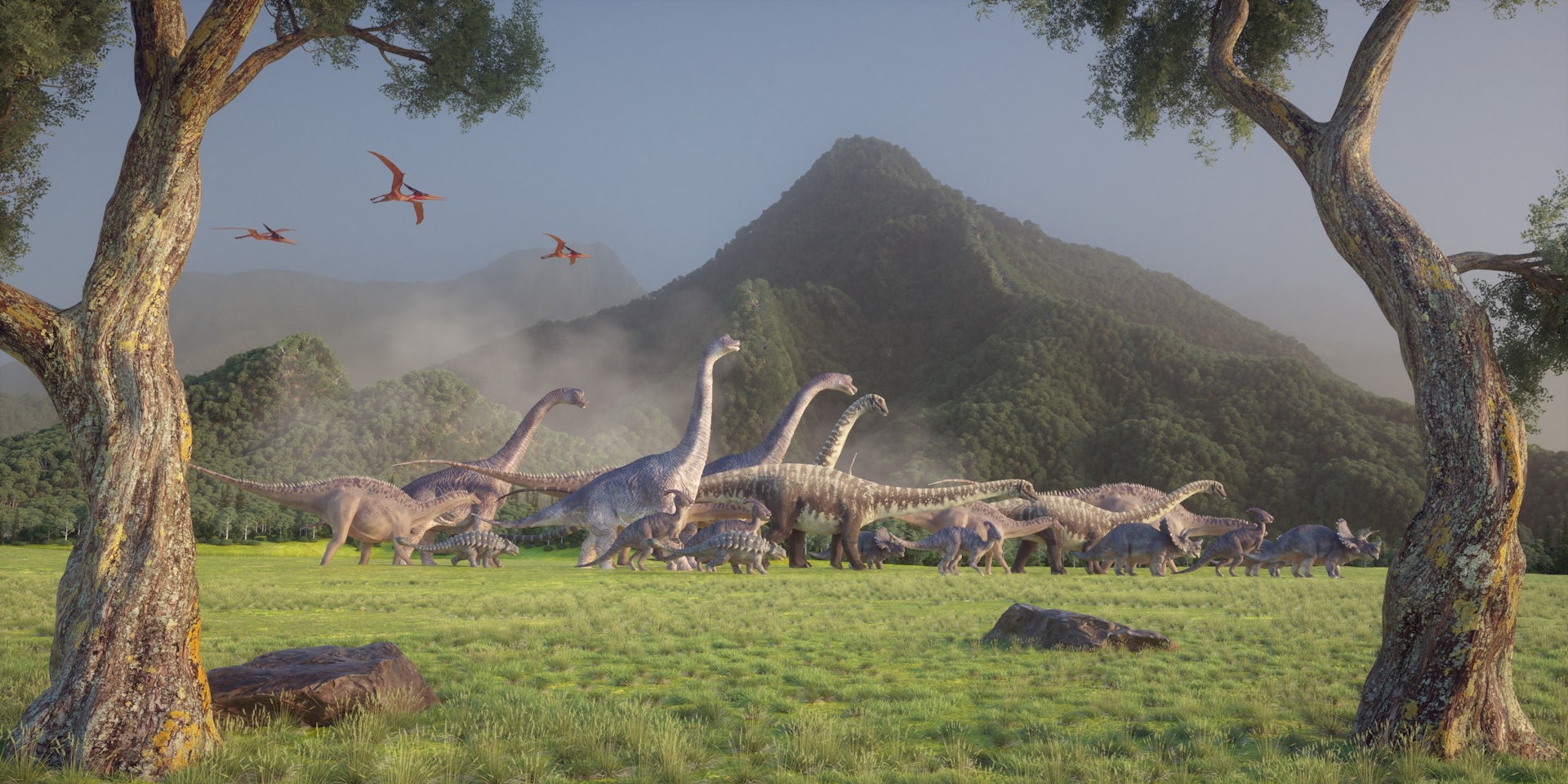
In the last 24 hours, the light becomes visible during the daytime. But it still looks like a star or planet, getting brighter in the final few hours before impact.
En las últimas 24 horas, la luz se vuelve visible durante el día. Pero todavía parece una estrella o un planeta, volviéndose más brillante en las últimas horas antes del impacto.
T equals 0: the impact
T igual a 0: el impacto
If you were close by, you would first have experienced a brief light and sound show. Minutes to seconds before the impact, you’d have seen the bright fireball, and its accompanying crackling or fizzing noises. This sizzling sound is a result of the photo-acoustic effect: the intense light of the fireball warms the ground, which then heats the air above it, causing pressure waves, or sound.
Si estuvieras cerca, primero habrías experimentado un breve espectáculo de luces y sonidos. Minutos antes del impacto, habrías visto la brillante bola de fuego y los ruidos de crepitación o siseo que la acompañaban. Este sonido chisporroteante es el resultado del efecto fotoacústico: la luz intensa de la bola de fuego calienta el suelo, que a su vez calienta el aire que la rodea, causando ondas de presión, o sonido.
Next, a deafening sonic boom, which occurs because the asteroid is travelling faster than the speed of sound. But the asteroid is so huge, perhaps 10km in diameter, that it almost certainly hits the ground before any living creature near the impact zone has time to run for cover.
Luego, un estruendo sónico ensordecedor, que ocurre porque el asteroide se mueve más rápido que la velocidad del sonido. Pero el asteroide es tan enorme, quizás de 10 km de diámetro, que casi con certeza golpea el suelo antes de que cualquier criatura viva cerca de la zona de impacto tenga tiempo de buscar refugio.
The asteroid’s enormous energy forms a crater through a series of processes that together take only a few seconds. As the asteroid collides with the surface, its kinetic (movement) energy is instantly transferred to the surface as a combination of kinetic, thermal (heat) and seismic energy (released during earthquakes) . This results in a series of shock waves that heat and compress both the asteroid and its target.
La enorme energía del asteroide forma un cráter a través de una serie de procesos que en conjunto tardan solo unos pocos segundos. Cuando el asteroide colisiona con la superficie, su energía cinética (movimiento) se transfiere instantáneamente a la superficie como una combinación de energía cinética, térmica (calor) y sísmica (liberada durante los terremotos) . Esto da como resultado una serie de ondas de choque que calientan y comprimen tanto al asteroide como a su objetivo.
As the shock waves propagate, rocks fracture, break up and are ejected, producing a bowl-shaped depression, or transient cavity, about ten seconds after impact. The heat and compression also melt and vaporise large volumes of material, including the asteroid itself, releasing a fountain of incandescent vapour (its temperature is more than 10,000 K, or 9726.85°C) .
A medida que las ondas de choque se propagan, las rocas se fracturan, se rompen y son expulsadas, produciendo una depresión con forma de cuenco, o cavidad transitoria, aproximadamente diez segundos después del impacto. El calor y la compresión también derriten y vaporizan grandes volúmenes de material, incluido el propio asteroide, liberando una fuente de vapor incandescente (su temperatura es de más de 10.000 K, o 9726,85 °C) .
Over the next few seconds, the cavity increases in size to many times the diameter of the original asteroid. Simulations suggest that around 20 seconds after impact, the transient cavity is at least 30km deep – deeper than the deepest depth currently known on Earth, the 11km Challenger Deep valley, part of the Pacific Ocean’s Marianas Trench. The rim of the crater is over 20km high – more than twice the height of 8,900m Mount Everest.
Durante los siguientes pocos segundos, la cavidad aumenta de tamaño a muchas veces el diámetro del asteroide original. Las simulaciones sugieren que aproximadamente 20 segundos después del impacto, la cavidad transitoria tiene al menos 30 km de profundidad, más profunda que la profundidad más grande conocida actualmente en la Tierra, el valle Challenger Deep de 11 km, parte de la Fosa de las Marianas del Océano Pacífico. El borde del cráter tiene más de 20 km de altura, más del doble de la altura del Monte Everest de 8.900 m.
But this enormous feature lasts for less than a minute before it starts to collapse. Within three minutes of the impact, the centre of the crater has rebounded to form a peak several kilometres high. The peak only lasts about two minutes before collapsing back into the crater.
Pero esta enorme característica dura menos de un minuto antes de que comience a colapsar. Dentro de los tres minutos del impacto, el centro del cráter ha rebotado para formar un pico de varios kilómetros de altura. El pico solo dura unos dos minutos antes de colapsar de nuevo en el cráter.
Whether a dinosaur or a dung beetle, if you were near the transient cavity you would have been incinerated instantly by the blast. But even if you were up to 2,000km from the epicentre, you’d likely have been killed quickly by the thermal radiation and supersonic winds now spreading out from the impact site.
Ya sea un dinosaurio o un escarabajo pelotero, si estuvieras cerca de la cavidad transitoria, habrías sido incinerado instantáneamente por la explosión. Pero incluso si estuvieras a 2.000 km del epicentro, es probable que hubieras sido asesinado rápidamente por la radiación térmica y los vientos supersónicos que ahora se extienden desde el lugar del impacto.
T-plus 5 minutes
T-plus 5 minutos
Five minutes after the impact, the winds have “eased” to those of a category 5 hurricane, flattening everything within about 1,500km of the impact. Destroying everything, that is, which has not already been burnt. Atmospheric temperatures in the region rise to over 500K (226.85°C) . This would feel like being inside an oven – causing burns, heatstroke and death. Wood and plant matter ignite, creating fires everywhere.
Cinco minutos después del impacto, los vientos se han “calmado” a los de un huracán categoría 5, aplanando todo dentro de unos 1,500 km del impacto. Destruyendo todo, es decir, lo que aún no se ha quemado. Las temperaturas atmosféricas en la región suben a más de 500K (226.85°C) . Esto se sentiría como estar dentro de un horno, causando quemaduras, golpe de calor y la muerte. La madera y la materia vegetal se incendian, creando fuegos por todas partes.
Because the asteroid struck the sea, the atmosphere is also filled with super-heated steam, making the hurricane-force winds even deadlier.
Como el asteroide golpeó el mar, la atmósfera también está llena de vapor supercalentado, lo que hace que los vientos huracanados sean aún más mortales.
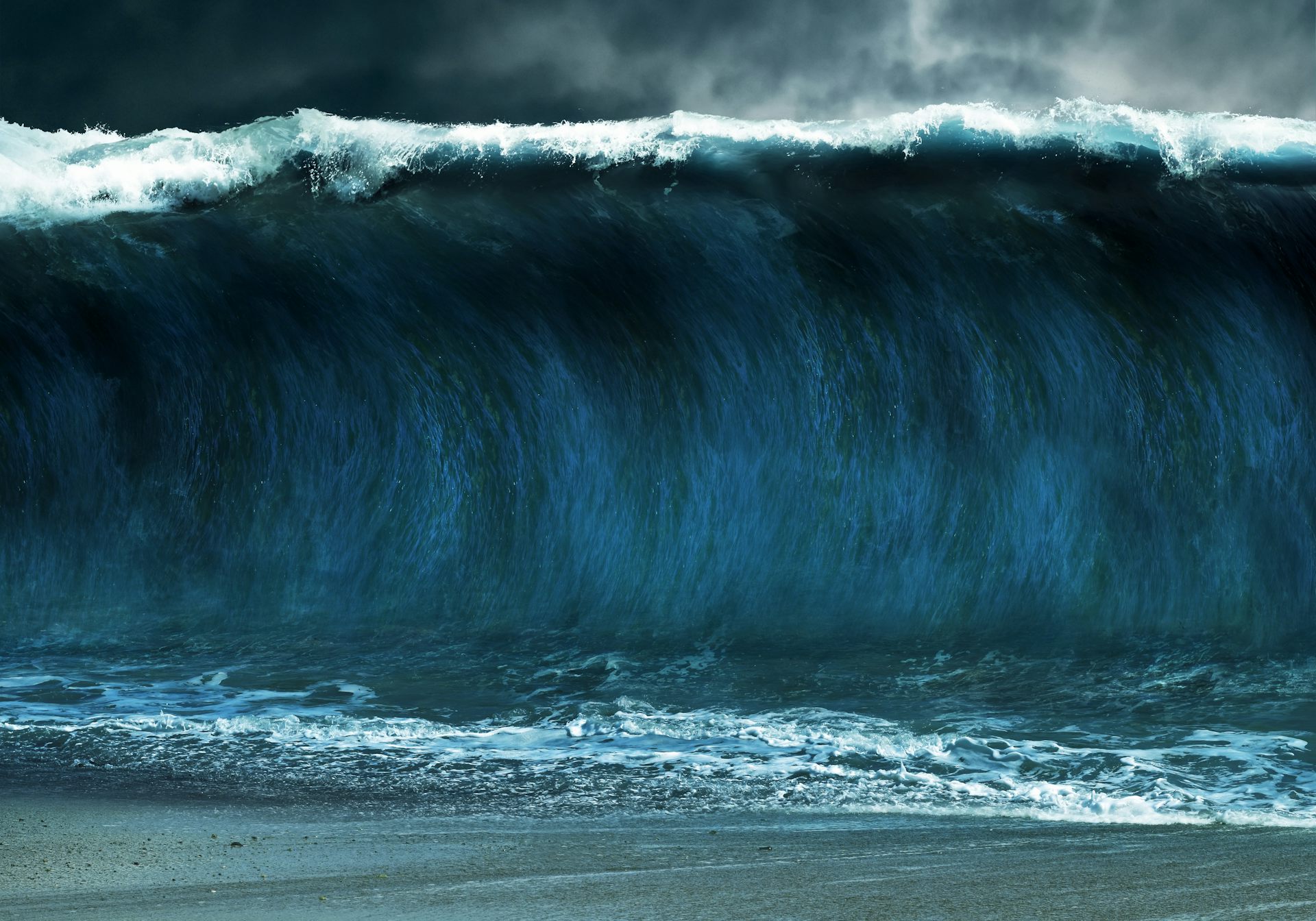
Next come the tidal waves, triggered by the vast quantities of displaced rock and water. These 100-metre megatsunamis first strike the shores of what is now the Gulf of Mexico, engulfing the land before depositing huge amounts of debris as they retreat.
Luego vienen las olas de marea, desencadenadas por las vastas cantidades de roca y agua desplazadas. Estos megtsunamis de 100 metros golpean primero las costas de lo que ahora es el Golfo de México, cubriendo la tierra antes de depositar enormes cantidades de escombros al retirarse.
By now, the crater has almost reached its final dimensions – 180km across and 20km deep. But making an enormous hole in the ground isn’t the only outcome of the impact. All the rock and vapour displaced during the collision has to go somewhere. Several locations in Northern America show that metre-sized blocks of debris from the impact were thrown distances of hundreds of kilometres.
Para ahora, el cráter ha casi alcanzado sus dimensiones finales: 180 km de ancho y 20 km de profundidad. Pero hacer un agujero enorme en el suelo no es el único resultado del impacto. Toda la roca y el vapor desplazados durante la colisión tienen que ir a algún lugar. Varias ubicaciones en Norteamérica muestran que bloques de escombros del tamaño de un metro del impacto fueron lanzados a distancias de cientos de kilómetros.
So if you were 2,000km to 3,000km from the epicentre and survived the first few seconds, you’d most likely die from overheating, earthquakes, hurricanes, fires, tsunami-driven floods or being hit by impact melt.
Así que si estuvieras a 2,000 a 3,000 km del epicentro y sobreviviste a los primeros segundos, lo más probable es que mueras por el sobrecalentamiento, los terremotos, los huracanes, los incendios, las inundaciones causadas por tsunamis o por ser golpeado por el derretimiento del impacto.
But what is happening much further away? In the first five minutes after impact, dinosaurs roaming the Cretaceous forests of what are now China or New Zealand are so far undisturbed.
¿Pero qué está sucediendo mucho más lejos? En los primeros cinco minutos después del impacto, los dinosaurios que deambulan por los bosques del Cretácico de lo que ahora son China o Nueva Zelanda permanecen tan indemnes.
But it won’t be long before that changes.
Pero no tardará en cambiar eso.
T-plus one hour
T-plus una hora
Shockwaves on land and sea are only minor inconveniences compared with the fire that is still radiating down from the sky. Some of the impact energy has been transferred into the atmosphere, heating the air and dust to incandescence.
Las ondas de choque en tierra y mar son solo inconvenientes menores en comparación con el fuego que todavía irradia desde el cielo. Parte de la energía del impacto se ha transferido a la atmósfera, calentando el aire y el polvo hasta la incandescencia.
An hour after impact, a belt of dust has circled the globe. Deposits of solidified molten droplets (impact spherules) and mineral grains have been found in numerous locations from New Zealand in the south to Denmark in the north. In these locations, you would not have been aware of the tsunamis around the Americas or the wildfires, but the skies would certainly have begun to darken.
Una hora después del impacto, un cinturón de polvo ha rodeado el globo. Se han encontrado depósitos de gotas fundidas solidificadas (esferulitas de impacto) y granos minerales en numerosas ubicaciones desde Nueva Zelanda en el sur hasta Dinamarca en el norte. En estos lugares, no habrías sido consciente de los tsunamis alrededor de las Américas o de los incendios forestales, pero los cielos ciertamente habrían comenzado a oscurecerse.
T-plus one day
T-plus un día
By now, huge tsunamis are moving east across the Atlantic and west across the Pacific, entering the Indian Ocean from both sides.
Para ahora, tsunamis enormes se están moviendo hacia el este a través del Atlántico y hacia el oeste a través del Pacífico, entrando en el Océano Índico desde ambos lados.
They are still around 50m high – causing death and destruction across many coasts around the world. By comparison, the 2004 Boxing Day tsunami reached heights of up to 30 metres. Tsunamis kill fishes and marine life that are washed high on the shore and then dumped, just as they kill coastal trees and drown land animals. But the tsunamis gradually fade away and probably don’t wipe out any entire species – at least on their own.
Todavía tienen alrededor de 50 m de altura, causando muerte y destrucción en muchas costas de todo el mundo. En comparación, el tsunami del Día de Boxing de 2004 alcanzó alturas de hasta 30 metros. Los tsunamis matan a peces y vida marina que son arrastrados a la orilla y luego desechados, al igual que matan árboles costeros y ahogan a los animales terrestres. Pero los tsunamis se desvanecen gradualmente y probablemente no aniquilan a ninguna especie entera, al menos por sí mismos.
The hurricane force winds have also died down, but tropical storm strength winds are whipping up debris and causing further chaos and destruction across the tsunami-affected areas. The burning sky is also triggering wildfires across the globe – which, in turn, carry ever more soot into the atmosphere. The sooty signature of these wildfires has been found deposited as carbon particles in sediments from the K-Pg boundary – a 66-million-year-old thin clay layer.
Los vientos de fuerza huracanada también han disminuido, pero los vientos de fuerza de tormentas tropicales están levantando escombros y causando más caos y destrucción en las áreas afectadas por el tsunami. El cielo ardiente también está provocando incendios forestales en todo el mundo, los cuales, a su vez, transportan cada vez más hollín a la atmósfera. La firma con hollín de estos incendios forestales ha sido encontrada depositada como partículas de carbono en sedimentos del límite K-Pg, una delgada capa de arcilla de 66 millones de años.
Further away, in what is modern Europe and Asia, the skies continue to fill up with dust and soot, as they do everywhere. Temperatures start to drop as sunlight is blocked. Trees and plants in general, including phytoplankton, close down as if for winter, unable to photosynthesise. Any animals that rely on warm conditions ultimately hunker down and die.
Más lejos, en lo que es la moderna Europa y Asia, los cielos siguen llenándose de polvo y hollín, como en todas partes. Las temperaturas comienzan a bajar a medida que la luz solar es bloqueada. Los árboles y las plantas en general, incluidos los fitoplancton, se cierran como si fuera el invierno, incapaces de fotosintetizar. Cualquier animal que dependa de condiciones cálidas finalmente se acurruca y muere.
T-plus one week
T-más una semana
It’s getting darker and darker. Simulations of solar radiation reaching the Earth’s surface following the impact indicate that, after about a week, the solar flux (the amount of heat and light per a certain area) is just one thousandth of that prior to the impact. This is caused by particles of dust and soot in the atmosphere.
Se está oscureciendo cada vez más. Las simulaciones de la radiación solar que llega a la superficie de la Tierra después del impacto indican que, después de aproximadamente una semana, el flujo solar (la cantidad de calor y luz por una determinada área) es solo milésima parte de lo que fue antes del impacto. Esto es causado por partículas de polvo y hollín en la atmósfera.
The continued decrease in light levels is accompanied by a global drop in surface temperatures of at least 5°C. This means that most of the dinosaurs and other large flying and swimming reptiles probably die from freezing within the course of this first week (smaller reptiles with slower metabolisms or more flexible diets could survive longer) . Cooling temperatures and cloud cover also lead to rain. But not just any rain. Storms of acid rain fall across the Earth.
La disminución continua de los niveles de luz va acompañada de una caída global de las temperaturas superficiales de al menos 5°C. Esto significa que la mayoría de los dinosaurios y otros grandes reptiles voladores y nadadores probablemente mueren por congelación durante el transcurso de esta primera semana (los reptiles más pequeños con metabolismos más lentos o dietas más flexibles podrían sobrevivir más tiempo) . Las temperaturas más frías y la cobertura de nubes también provocan lluvia. Pero no cualquier lluvia. Tormentas de lluvia ácida caen sobre la Tierra.
Two separate mechanisms generate acid rain. The first is down to the geology of the impact region. The asteroid happened to hit an area of sediments rich in sulphur, which vaporised and caused sulphur oxides (acidic and pungent gas compounds composed of sulphur and oxygen) to be part of the plume of plasma blasted into the atmosphere. Second, the energy of the collision was sufficient to turn nitrogen and oxygen into nitrogen oxides – highly reactive gases that can form smog.
Dos mecanismos separados generan lluvia ácida. El primero se debe a la geología de la región del impacto. El asteroide tuvo la desgracia de golpear un área de sedimentos rica en azufre, que se vaporizó y provocó que los óxidos de azufre (compuestos gaseosos ácidos y pungentes compuestos de azufre y oxígeno) formaran parte del penacho de plasma disparado a la atmósfera. Segundo, la energía de la colisión fue suficiente para convertir el nitrógeno y el oxígeno en óxidos de nitrógeno, gases altamente reactivos que pueden formar esmog.
The dropping temperature ultimately allows water vapour to condense into drops, and the sulphur and nitrogen oxides dissolve to form sulphuric and nitric acids. This is sufficient to generate a rapid drop in pH. Early models suggest that the pH of the rain might be as low as 1 – the same acidity as battery acid.
La temperatura descendente finalmente permite que el vapor de agua se condense en gotas, y los óxidos de azufre y nitrógeno se disuelven para formar ácidos sulfúrico y nítrico. Esto es suficiente para generar una caída rápida del pH. Los modelos iniciales sugieren que el pH de la lluvia podría ser tan bajo como 1, la misma acidez que el ácido de las baterías.
At this point, Earth is not a great place to be. Rotting vegetation, choking smoke and sulphur aerosols combine to make the planet stink. Plants and animals on land and in shallow seas that have survived the darkness and cold succumb to the corrosive acid rain and ocean acidification. Acid rain also kills trees by leaching nutrients such as calcium, magnesium and potassium from the soil. Shallow marine shellfish, crustaceans and corals also die as acid seawater destroys their skeletons.
En este punto, la Tierra no es un gran lugar para estar. La vegetación en descomposición, el humo sofocante y los aerosoles de azufre se combinan para hacer que el planeta huela mal. Las plantas y los animales en tierra y en mares poco profundos que han sobrevivido a la oscuridad y al frío sucumben a la lluvia ácida corrosiva y a la acidificación del océano. La lluvia ácida también mata a los árboles al lixiviar nutrientes como el calcio, el magnesio y el potasio del suelo. Los mariscos, crustáceos y corales marinos poco profundos también mueren ya que el agua de mar ácida destruye sus esqueletos.
T-plus one year
T más un año
Winds die down, wildfires are extinguished and the oceans are once again calm. It might appear that the asteroid collision is just a scar on the ocean floor. But its effects are still destructive. The atmosphere is still filled with dust and the Sun hasn’t shone for a year. Temperatures have continued to drop, with the average surface temperature now 15°C lower than before the impact. Winter has come.
Los vientos se calman, los incendios forestales se extinguen y los océanos están tranquilos una vez más. Puede parecer que la colisión del asteroide es solo una cicatriz en el fondo del océano. Pero sus efectos siguen siendo destructivos. La atmósfera todavía está llena de polvo y el Sol no ha brillado durante un año. Las temperaturas han continuado bajando, con la temperatura promedio de la superficie ahora 15°C más baja que antes del impacto. Ha llegado el invierno.
Any dinosaurs or marine reptiles that survived the first week of freezing conditions would have died very soon after. A year after the impact, only rotted skeletons of these behemoths remain. Here and there, smaller animals like mammals the size of rats and insects would be nestling in crevices, barely surviving on their reserves and decaying plants.
Cualquier dinosaurio o reptil marino que sobreviviera a la primera semana de condiciones de congelación habría muerto muy poco después. Un año después del impacto, solo quedan esqueletos en descomposición de estos colosos. Aquí y allá, animales más pequeños como mamíferos del tamaño de ratas e insectos se estarían acurrucando en grietas, sobreviviendo apenas con sus reservas y las plantas en descomposición.
Indeed, it has not been a good year for life on Earth: over 50% of plants have died out because of the cold and lack of sunlight. And similar losses have occurred among terrestrial animals and species in the acidified, shallow sea waters.
De hecho, no ha sido un buen año para la vida en la Tierra: más del 50% de las plantas han muerto debido al frío y la falta de luz solar. Y se han producido pérdidas similares entre los animales y especies terrestres en las aguas marinas poco profundas y acidificadas.
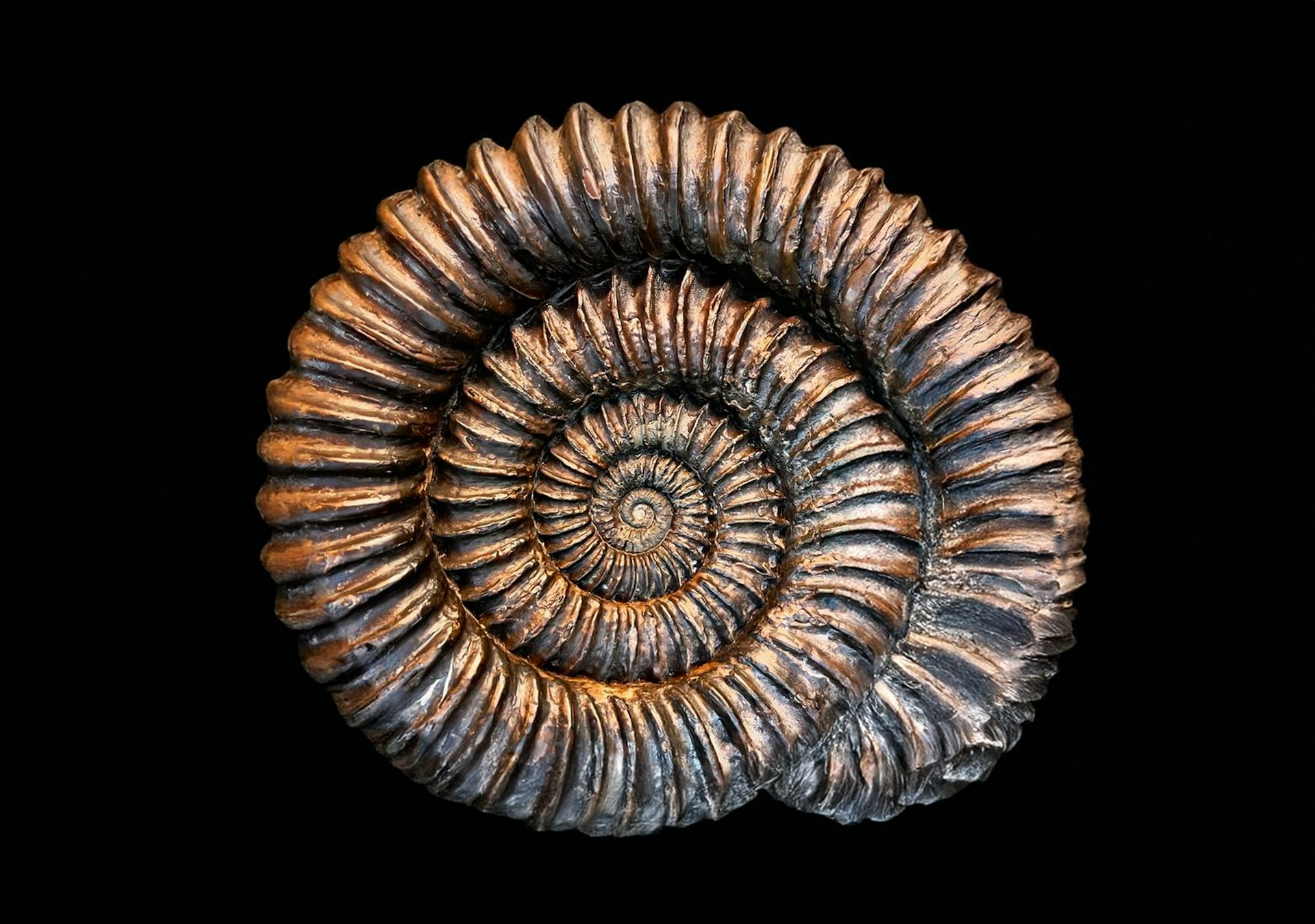
While most plant groups and many of the modern groups of insects, fishes, reptiles, birds and mammals recover reasonably rapidly, things don’t look great for other species. Dinosaurs and pterosaurs living on land are extinct, as are many marine reptiles, ammonites, belemnites and rudist bivalves in the oceans. Ammonites and belemnites are high in their food chains, and so suffer not only from the cold and acidification but also from the loss of abundant food resources, such as smaller marine organisms.
Mientras que la mayoría de los grupos de plantas y muchos de los grupos modernos de insectos, peces, reptiles, aves y mamíferos se recuperan bastante rápido, las cosas no se ven bien para otras especies. Los dinosaurios y pterosaurios que vivían en tierra están extintos, al igual que muchos reptiles marinos, amonites, belemnites y bivalvos rudistas en los océanos. Los amonites y los belemnites están en la cima de sus cadenas alimentarias y, por lo tanto, sufren no solo por el frío y la acidificación, sino también por la pérdida de abundantes recursos alimentarios, como los organismos marinos más pequeños.
T-plus ten years
T-más diez años
The Earth is still in the grip of a fierce winter. Although most of the sulphur has rained out of the atmosphere, dust and soot particles remain. The average surface temperature is still about 5°C lower than before the impact. The main oceans have not frozen, but inland lakes and rivers around the world are iced over.
La Tierra todavía está bajo el yugo de un invierno feroz. Aunque la mayor parte del azufre ha caído a la atmósfera, persisten las partículas de polvo y hollín. La temperatura superficial promedio sigue estando aproximadamente 5°C más baja que antes del impacto. Los océanos principales no se han congelado, pero los lagos y ríos interiores de todo el mundo están cubiertos de hielo.
Clearly, there were no humans about at this time – there weren’t even any larger mammals. But given the only species that survived were those that could burrow or live below water, it is unlikely that you could have survived this long.
Claramente, no había humanos en ese momento; ni siquiera había mamíferos más grandes. Pero dado que las únicas especies que sobrevivieron fueron aquellas que podían excavar o vivir bajo el agua, es poco probable que se hubieran podido sobrevivir tanto tiempo.
Surviving plant and animal groups such as turtles, smaller crocodiles, lizards, snakes, some ground-dwelling birds and small mammals repopulate the Earth at this point. But they are forced back to limited areas of relative safety a long way from the impact site. These areas are now receiving sufficient sunlight for plants and phytoplankton to photosynthesise again. As leaves and seeds provide the basis for the food chains on land and in the sea, life begins to rebuild.
Grupos de plantas y animales supervivientes, como tortugas, cocodrilos más pequeños, lagartos, serpientes, algunas aves terrestres y pequeños mamíferos, repoblan la Tierra en este punto. Pero son forzados a regresar a áreas limitadas de relativa seguridad, lejos del sitio del impacto. Estas áreas están recibiendo ahora suficiente luz solar para que las plantas y el fitoplancton puedan fotosintetizar de nuevo. Como las hojas y las semillas proporcionan la base de las cadenas alimentarias en tierra y en el mar, la vida comienza a reconstruirse.
Eventually, life returns to the devastated landscapes, but ecosystems are very different and the dinosaurs are no more.
Eventualmente, la vida regresa a los paisajes devastados, pero los ecosistemas son muy diferentes y los dinosaurios ya no están.
T-plus 66 million years
T-más 66 millones de años
Today, 66 million years after the impact, the scars of the collision are hidden within geological strata – and scientists have started deciphering them. It was in 1980 that researchers first reported evidence of the impact. In their classic paper, Luis Alvarez, a Nobel-prize-winning physicist, and co-authors, described a sudden enrichment in the element iridium in a specific clay layer in Denmark and in Italy.
Hoy, 66 millones de años después del impacto, las cicatrices de la colisión están ocultas dentro de las capas geológicas, y los científicos han comenzado a descifrarlas. Fue en 1980 cuando los investigadores reportaron por primera vez evidencia del impacto. En su artículo clásico, Luis Alvarez, un físico ganador del Premio Nobel, y sus coautores, describieron un enriquecimiento repentino del elemento iridio en una capa específica de arcilla en Dinamarca e Italia.
Iridium is rare in surface rocks because most of it was sequestered in Earth’s core when the planet first formed. However, iridium is found in meteorites, and Alvarez and colleagues inferred that the rate of accumulation of the metal in the sediments was so high that it could only have been produced by impact of a gigantic meteorite.
El iridio es raro en las rocas superficiales porque la mayor parte se secuestró en el núcleo de la Tierra cuando el planeta se formó por primera vez. Sin embargo, el iridio se encuentra en los meteoritos, y Alvarez y sus colegas infirieron que la tasa de acumulación del metal en los sedimentos fue tan alta que solo pudo haberse producido por el impacto de un meteorito gigantesco.
Because the scientists had only observed the iridium spike in two locations, the impact hypothesis was rejected by many scientists at the time. However, through the 1980s, iridium spikes were identified in clay layers at more and more locations – in muds laid down on land, in lakes, in the sea.
Debido a que los científicos solo habían observado el pico de iridio en dos ubicaciones, la hipótesis del impacto fue rechazada por muchos científicos en ese momento. Sin embargo, a lo largo de la década de 1980, se identificaron picos de iridio en capas de arcilla en más y más lugares: en lodos depositados en tierra, en lagos, en el mar.
Support for an impact hypothesis strengthened when a crater of the correct age was found in 1991. The crater is buried beneath younger rocks, but clearly visible in geophysical surveys, lying half on land in the Yucatán Peninsula of Mexico, and half offshore. Since 1990, evidence for the impact has increased, not least when scientists discovered that there was indeed a sharp cooling event at the end of the Cretaceous.
El apoyo a una hipótesis de impacto se fortaleció cuando se encontró un cráter de la edad correcta en 1991. El cráter está enterrado bajo rocas más jóvenes, pero es claramente visible en los estudios geofísicos, situado medio en tierra en la Península de Yucatán, México, y medio en alta mar. Desde 1990, la evidencia del impacto ha aumentado, no menos cuando los científicos descubrieron que de hecho hubo un evento de enfriamiento brusco al final del Cretácico.
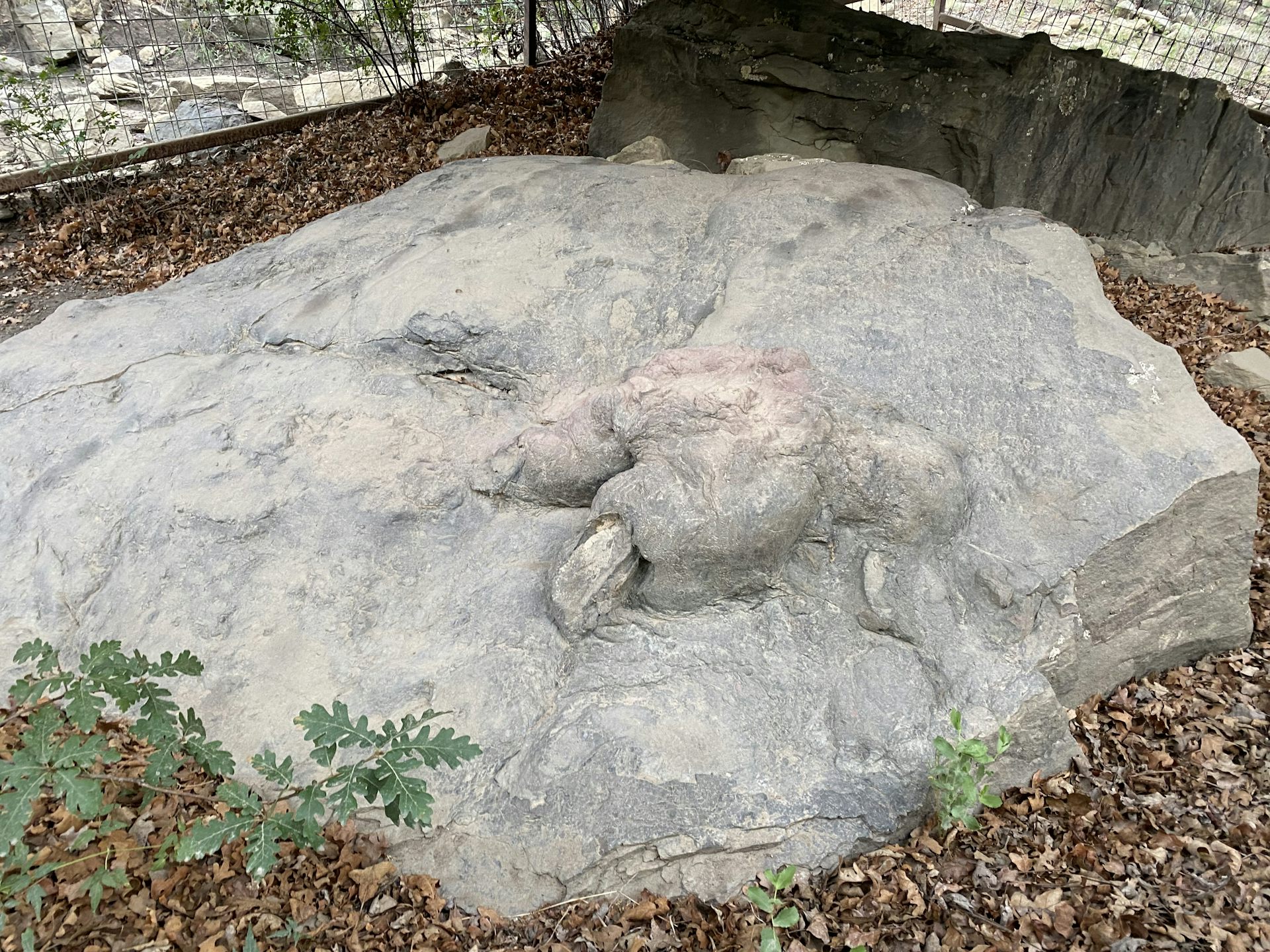
In total, it is estimated that half the species of plants and animals alive at the end of the Cretaceous disappeared. It was once thought that surviving groups such as many plants, insects, molluscs, lizards, birds and mammals somehow escaped unscathed. But detailed study shows that this is not the case – they were all hit hard.
En total, se estima que la mitad de las especies de plantas y animales vivas al final del Cretácico desaparecieron. Una vez se pensó que los grupos supervivientes, como muchas plantas, insectos, moluscos, lagartos, aves y mamíferos, habían escapado ilesos. Pero el estudio detallado muestra que este no es el caso: todos fueron golpeados duramente.
But, by chance or luck, enough individuals and species were able to survive the cold and absence of food, or were in parts of the world where the effects were less extreme. As the world returned to normal, they had the opportunity to expand rapidly into their old niches, but also to occupy the space vacated by extinct groups. In fact, one important consequence of the extinction of the dinosaurs, apex predators in their heyday, was the successful spread and evolution of mammals.
Pero, por casualidad o suerte, suficientes individuos y especies pudieron sobrevivir al frío y la ausencia de alimentos, o se encontraban en partes del mundo donde los efectos fueron menos extremos. A medida que el mundo volvía a la normalidad, tuvieron la oportunidad de expandirse rápidamente a sus nichos antiguos, pero también de ocupar el espacio dejado por los grupos extintos. De hecho, una consecuencia importante de la extinción de los dinosaurios, depredadores ápice en su apogeo, fue la propagación y evolución exitosa de los mamíferos.
When Alvarez and colleagues first described the drop in temperature following the impact, they called it a “nuclear winter”, reflecting the political climate of the early 1980s. Now we might be more inclined to describe the effects as a global climate change – similar events are currently resulting from increased carbon dioxide in the atmosphere (flooding, temperature fluctuations) .
Cuando Alvarez y sus colegas describieron por primera vez la caída de la temperatura después del impacto, la llamaron «invierno nuclear», reflejando el clima político de principios de la década de 1980. Ahora podríamos estar más inclinados a describir los efectos como un cambio climático global: eventos similares están resultando actualmente del aumento del dióxido de carbono en la atmósfera (inundaciones, fluctuaciones de temperatura) .
It is salutary to think that without the asteroid collision, primates might never have reached the level we are at today. But it is equally salutary to consider that modern humans are causing some of the same changes to the atmosphere that ultimately killed our reptilian forbears and may one day also lead to our own demise.
Es saludable pensar que sin la colisión del asteroide, los primates nunca habrían alcanzado el nivel en el que estamos hoy. Pero es igualmente saludable considerar que los humanos modernos están causando algunos de los mismos cambios en la atmósfera que finalmente mataron a nuestros antepasados reptiles y que un día también pueden llevar a nuestra propia desaparición.
For you: more from our Insights series:
Para ti: más de nuestra serie Insights:
‘It ain’t no unicorn’: meet the researchers who’ve interviewed 130 Bigfoot hunters
‘No es un unicornio’: conoce a los investigadores que entrevistaron a 130 cazadores de Bigfoot
The truth about child IQ: research shows it fluctuates and may be an unreliable predictor of future success
La verdad sobre el coeficiente intelectual infantil: la investigación muestra que fluctúa y puede ser un predictor poco fiable del éxito futuro
Is time a fundamental part of reality? A quiet revolution in physics suggests not
¿Es el tiempo una parte fundamental de la realidad? Una tranquila revolución en la física sugiere que no
Underground data fortresses: the nuclear bunkers, mines and mountains being transformed to protect our ‘new gold’ from attack
Fortalezas de datos subterráneos: los búnkeres nucleares, minas y montañas transformadas para proteger nuestro ‘nuevo oro’ del ataque
Inside Porton Down: what I learned during three years at the UK’s most secretive chemical weapons laboratory
Dentro de Porton Down: lo que aprendí durante tres años en el laboratorio de armas químicas más secreto del Reino Unido
To hear about new Insights articles, join the hundreds of thousands of people who value The Conversation’s evidence-based news. Subscribe to our newsletter.
Para escuchar nuevos artículos de Insights, únete a los cientos de miles de personas que valoran las noticias basadas en evidencia de The Conversation. Suscríbete a nuestro boletín.
Monica Grady receives funding from the Leverhulme Trust for an Emeritus Fellowship and from the STFC. She is affiliated with The Open University, Liverpool Hope University and the Natural History Museum, London.
Mónica Grady recibe financiación de la Leverhulme Trust para un Beca Honorífica y del STFC. Está afiliada a la Universidad Abierta, Liverpool Hope University y el Museo de Historia Natural de Londres.
Michael J. Benton does not work for, consult, own shares in or receive funding from any company or organisation that would benefit from this article, and has disclosed no relevant affiliations beyond their academic appointment.
Michael J. Benton no trabaja para, asesora, posee acciones en o recibe financiación de ninguna empresa u organización que se beneficiaría de este artículo, y no ha revelado ninguna afiliación relevante más allá de su nombramiento académico.
Read more
-
«Es una desgracia»: EE. UU. ha abandonado a los kurdos de nuevo, y esta vez, Trump además los está insultando.
‘It’s a disgrace’: the US has abandoned the Kurds again – and this time, Trump is insulting them to boot
-
¿Se puede poseer una voz? El último movimiento legal de Taylor Swift plantea grandes preguntas para la IA y los derechos de autor
Can you own a voice? Taylor Swift’s latest legal move raises big questions for AI and copyright