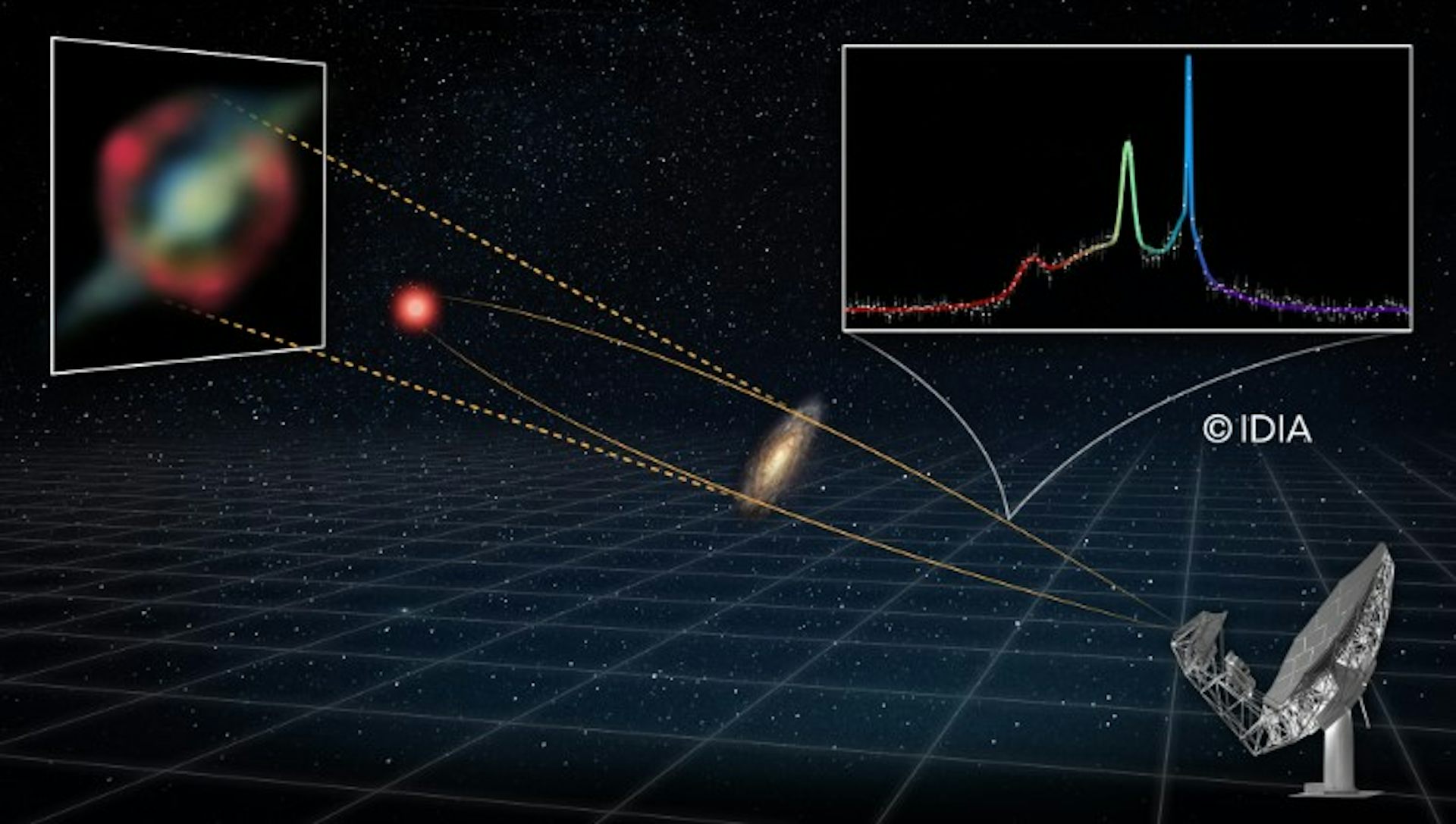
Scientists have discovered the most distant hydroxyl megamaser ever detected. This is a natural space laser.
科学家们发现了迄今为止最遥远的羟基巨甚振子。这是一种天然太空激光器。
Astronomers using the MeerKAT radio telescope in South Africa have discovered the most distant hydroxyl megamaser ever detected, opening a new radio astronomy frontier. A hydroxyl megamaser is a natural space laser, and this one is located in a violently merging galaxy more than 8 billion light-years away.
使用南非MeerKAT射电望远镜的天文学家们发现了有史以来最遥远的羟基巨型余辉天线,开辟了新的电波天文学前沿。羟基巨型余辉天线是一种天然的太空激光器,而这一个位于一个剧烈合并的星系中,距离超过80亿光年。
We spoke to the astronomers, Thato Manamela, a postdoctoral researcher at the University of Pretoria, and Roger Deane, director of the Inter-University Institute for Data Intensive Astronomy and a professor at the universities of Cape Town and Pretoria, about their study.
我们采访了这些天文学家,包括比勒陀利亚大学的博士后研究员Thato Manamela,以及跨大学数据密集天文学研究所主任、开普敦和比勒陀利亚大学教授Roger Deane,了解了他们的这项研究。
What you’ve found has been described as a ‘new frontier’ in space research. Why is it extraordinary?
您发现的这一事物被描述为空间研究中的“新前沿”。它为何如此非凡?
This discovery is extraordinary because of the record distance at which we’ve detected it, over eight billion light-years away. That places it deep into the early universe. This means that we aren’t seeing the galaxy as it exists today. We are seeing it as it was 8 billion years ago. Since the Big Bang happened about 13.8 billion years ago, we are looking at a “toddler” version of the universe. At that stage where the maser signal was transmitted by the host galaxy, galaxies were much more “chaotic”, they collided more often and were much more active than the stable, mature galaxies we see nearby today.
这项发现之所以非凡,是因为我们探测到了创纪录的距离——超过八十亿光年。这使它深处处于早期宇宙。这意味着我们看到的不是银河系今天的样子。我们看到的是它在八十亿年前的样子。自大爆炸发生于大约138亿年前以来,我们所观察到的是一个“婴儿期”的宇宙。在星系宿主发出射电放大信号的那个阶段,星系要“混乱”得多,它们碰撞得更频繁,而且比我们今天附近看到的稳定、成熟的星系活跃得多。
It gives us a rare glimpse of galaxy interactions and extreme star-forming environments when the cosmos was less than half its current age. Think of light like a letter in the mail. If a friend sends a letter from overseas, by the time you read it, the news is old. In space, light is the letter. The “news” from this galaxy took 8 billion years to reach us. We see the galaxy as a “toddler” even though, in its own time, it has already grown up or changed.
它让我们得以罕见地窥视了宇宙在不到当前年龄一半时期的星系相互作用和极端恒星形成环境。想象光就像一封信件。如果朋友从海外寄来一封信,等你读到的时候,里面的消息就已经过时了。在太空中,光就是这封信。来自这个星系的“新闻”花了八十亿年才传到我们这里。我们看到的它像一个“婴儿”,尽管在其自身的时间里,它已经成长或改变了。
We detected this megamaser, which operates on a scale of power millions of times greater than a typical galactic maser. Both megamasers and gigamasers are cosmic radio lasers. While a megamaser is a million times more luminous than a standard maser found in the local universe, a gigamaser is a billion times more luminous, making it 1,000 times more powerful than a megamaser.
我们探测到了这个超放大射电天线(megamaser),它的功率规模比典型的银河放大射电天线大了数百万倍。无论是超放大射电天线还是巨型放大射电天线,都是宇宙无线电激光器。虽然超放大射电天线比局部宇宙中发现的标准放大射电天线明亮一百万倍,但巨型放大射电天线则明亮了十亿倍,使其功率是超放大射电天线的1000倍。
In just five hours of observing time we found a signal that typically requires hundreds of hours of observation, given its distance and rarity. But gravitational lensing boosted the signal enough to detect it. Additionally, while we were targeting neutral hydrogen, MeerKAT’s wide bandwidth enabled the surprise discovery of the megamaser signal in the same data.
仅用了五个小时的观测时间,我们就找到了一个通常需要数百小时才能探测到的信号,考虑到它的距离和稀有性。但是引力透镜效应增强了足够的信号,从而使我们得以探测到它。此外,当我们瞄准中性氢时,MeerKAT宽带宽还使得我们在同一数据中意外发现了超放大射电天线信号。
This rapid detection suggests that future surveys with MeerKAT and the upcoming SKA Observatory could uncover many more such distant, extreme objects. Its ability to find this so quickly proves that we finally have the technology to see faint signals from the very distant past. It’s a preview of what the upcoming Square Kilometre Array (SKA) , a unique, one-of-a-kind international mega-project, might achieve.
这种快速的探测表明,未来使用MeerKAT和即将投入使用的SKA天文台进行的巡天可能会发现更多此类遥远、极端的物体。它能如此迅速地找到这些信号的能力证明了我们终于拥有了观测来自极其遥远过去的微弱信号的技术。这是即将到来的平方公里阵列(SKA)——一个独特的国际大型项目——可能取得成就的预告。
But a highly complementary next-generation facility called the next-generation Very Large Array (ngVLA) is being planned and designed for construction in the US. The SKA Observatory (SKA-Low and SKA-Mid) focuses on low-to-mid radio frequencies. The ngVLA will operate at much higher frequencies. Together, they will form two of the major pillars of next-generation global radio astronomy. The finding gives astronomers a new way to study how galaxies evolved in the early universe.
但美国正在规划和设计建造另一个高度互补的下一代设施,名为下一代甚大阵列(ngVLA)。SKA天文台(SKA-Low和SKA-Mid)专注于低至中频无线电频率。而ngVLA将在更高的频率下运行。两者结合起来,将构成下一代全球射电天文学的两大支柱。这一发现为天文学家提供了一种研究早期宇宙星系如何演化的新方法。
What technologies or capabilities made this possible?
哪些技术或能力使得这成为可能?
The discovery was made possible by the sensitivity and wide frequency coverage of the MeerKAT radio telescope. Its ability to detect faint signals over a broad frequency range allows us to search for spectral lines across large cosmic volumes. A spectral line is a cosmic chemical fingerprint. Every atom or molecule emits electromagnetic waves at specific frequencies. Detecting those frequencies tells astronomers what the gas is made of.
这项发现得益于美尔卡特(MeerKAT)射电望远镜的灵敏度和宽频率覆盖范围。它能够在宽频率范围内探测到微弱的信号,使我们能够在大尺度的宇宙体积中搜索光谱线。光谱线是一种宇宙化学指纹。每个原子或分子都会在特定的频率发出电磁波。探测这些频率可以告诉天文学家气体的组成成分。
In this case, MeerKAT’s wide bandwidth allowed us to detect both the hydroxyl line and neutral hydrogen absorption in a single observation. Previously, with older technology, this would have taken two separate observations.
在本例中,MeerKAT 的宽带宽使我们能够在一次观测中同时探测到羟基谱线和中性氢吸收。此前,使用旧技术需要进行两次单独的观测。
Equally important are advances in data processing and computing. The data were processed using high-performance computing resources at the Inter-University Institute for Data Intensive Astronomy (IDIA) .
数据处理和计算的进展同样重要。这些数据是在跨大学数据密集天文学研究所(IDIA)利用高性能计算资源处理的。
Processing such massive amounts of data is like trying to drink from a firehose. MeerKAT collects gigabytes of information every second, resulting in files far too large for a standard computer to handle. To find a signal from 8 billion years ago, which is millions of times fainter than a cell phone signal, we must use robust calibration pipelines. These act like an automated high-tech car wash to scrub away digital noise and sharpen the telescope’s focus. This “cleaning” process requires trillions of mathematical calculations, necessitating the use of supercomputers that work for days to transform raw radio interference into a clear scientific discovery.
处理如此海量的数据,就像试图从消防栓里喝水。MeerKAT每秒收集数GB的信息,生成的文件对于标准计算机来说过于庞大。为了找到来自80亿年前的信号——这个信号比手机信号微弱数百万倍——我们必须使用稳健的校准流程。这些流程就像自动化的高科技洗车机,用于清除数字噪声并锐化望远镜的焦点。这个“清洁”过程需要万亿次的数学计算,因此需要使用超级计算机工作数天时间,将原始无线电干扰转化为清晰的科学发现。
Gravitational lensing also played a key role. A massive foreground object, like a star or galaxy, for example, amplified the signal from the distant galaxy, effectively acting as a natural telescope and boosting our ability to detect it.
引力透镜效应也发挥了关键作用。例如,一个大质量的前景天体(如恒星或星系)放大了来自遥远星系的信号,有效地充当了一个天然望远镜,从而增强了我们探测它的能力。
How does what you’ve found change our understanding of the universe?
你发现的这些东西如何改变我们对宇宙的理解?
It’s rare that a single astrophysical system, a collection of celestial objects, in this case, two galaxies forming a lens system, can change our understanding of the universe. We typically need large sample sizes to do that. But the combination of the recording-breaking distance and the speed of the discovery was impressive.
很少有单个天体物理系统,即一组天体,在本例中是形成透镜系统的两个星系,能够改变我们对宇宙的理解。通常我们需要大型样本量才能做到这一点。但这次记录破纪录的距离和发现的速度令人印象深刻。
It suggests that systematic searches – such as those conducted by deep MeerKAT surveys – could convert these once-rare finds into powerful probes of extreme, yet highly obscured star formation in the distant universe. As a result of this observation, the SKA Observatory and other future telescopes won’t just be looking for more of the same; they will be looking for hidden history.
这表明,像深空MeerKAT巡天这样的系统性搜索,可以将这些曾经罕见的发现转化为强大的探测工具,用于研究遥远宇宙中极端但高度被遮蔽的恒星形成过程。由于这项观测,SKA天文台和其他未来望远镜将不会仅仅寻找更多类似的东西;它们将寻找隐藏的历史。
Hydroxyl megamasers are usually associated with galaxy mergers. We expect some galaxy mergers to host pairs of supermassive black holes. Almost every large galaxy has a supermassive black hole at its centre. When galaxies merge, the supermassive black holes at their centres can eventually spiral towards each other, producing gravitational waves, ripples in space-time. Finding systems like this helps astronomers study an important stage in galaxy evolution and the environments where these extreme events occur.
羟基超类气增能天体(Hydroxyl megamasers)通常与星系并合相关联。我们预计一些星系并合会包含一对超大质量黑洞。几乎所有大型星系在其中心都有一个超大质量黑洞。当星系合并时,它们中心的超大质量黑洞最终可能会螺旋靠近,产生引力波,即时空中的涟漪。发现这样的系统有助于天文学家研究星系演化过程中的一个重要阶段以及这些极端事件发生的环境。
By using megamasers to find these pairs, we can study the final stages of how the largest objects in the universe are built. This is a major milestone in a galaxy’s life. By finding these galaxies now, we are catching them at a key evolutionary stage, the final countdown before they collide and release a massive burst of energy that our next generation of detectors will be able to hear.
通过利用超类气增能天体来寻找这些对子,我们可以研究宇宙中最大物体形成过程的最后阶段。这是星系生命周期中的一个重大里程碑。现在找到这些星系,我们是在捕捉它们处于关键演化阶段——在它们碰撞并释放出下一代探测器能够接收到的巨大能量爆发之前的倒计时时刻。
The strength of the MeerKAT-detected hydroxyl signal after such a short observation time therefore implies that astronomers will be able to detect large numbers of these systems across most of cosmic time.
因此,在如此短的观测时间内检测到羟基信号的强度意味着,天文学家将能够在大部分宇宙时间跨度内检测到大量这样的系统。
What does the discovery say about South Africa’s place in data-intensive radio astronomy?
这项发现说明了南非在数据密集型电波天文学领域的地位如何?
This discovery highlights South Africa’s leading role in radio astronomy. Facilities such as MeerKAT, combined with data-intensive platforms like IDIA, provide world-class capabilities for both observation and analysis. It also demonstrates strong local expertise in handling large, complex datasets.
这项发现突显了南非在电波天文学领域的领先作用。像MeerKAT这样的设施,结合IDIA等数据密集型平台,为观测和分析提供了世界一流的能力。它还展示了处理大型、复杂数据集的强大本地专业知识。
Discoveries like this rely on advanced data processing, signal extraction and scientific interpretation. These are all key strengths within the South African research community. As we move from using current scout telescopes like MeerKAT to building and operating the world’s largest radio observatory, the SKAO, South Africa is well positioned to remain a hub for data-intensive astronomy. Results like this reinforce the country’s role in shaping the future of the field.
像这样的发现依赖于先进的数据处理、信号提取和科学解读。这些都是南非研究社区的关键优势。当我们从使用MeerKAT等当前的先遣望远镜转向建造和运营世界上最大的射电天文台SKAO时,南非处于有利地位,能够继续成为数据密集型天文学的中心。像这样的成果巩固了该国在塑造该领域未来方面的作用。
Thato Manamela works for the University of Pretoria. He receives funding from the National Research Foundation (NRF SARAO) . He is affiliated with UP and IDIA.
Thato Manamela在比勒陀利亚大学工作。他获得国家研究基金会(NRF SARAO)的资助。他隶属于UP和IDIA。
Roger P. Deane previously held an SKA Research Chair in Radio Astronomy, funded by the South African Radio Astronomy Observatory, which is a facility of the National Research Foundation (NRF) , an agency of the Department of Science, Technology and Innovation (DSTI) .
Roger P. Deane曾担任射电天文学SKA研究席位,该席位由南非射电天文台资助,而后者是国家研究基金会(NRF)的一个设施,属于科学、技术和创新部(DSTI)。