避免被AI内容误导的三种方法
Three ways to avoid being fooled by AI slop
Fact-checking can take hours or days while fakes can be created in seconds. So, what do we do?
事实核查可能需要数小时甚至数天,而虚假内容可以在几秒钟内创建。那么,我们该怎么办呢?
Global society makes billions of images and uploads hundreds of thousands of hours of video on the internet every day.
全球社会每天都在互联网上生成数十亿张图片,并上传数十万小时的视频。
The problem is, some of this content is misleading or downright wrong. And when it’s in visual form, it can be particularly convincing.
问题在于,其中一些内容具有误导性,甚至是完全错误的。当这些内容以视觉形式呈现时,它们尤其具有说服力。
Take the Met Gala that happened earlier this month in New York. While photographers snapped photos of Rhianna, Beyoncé and Nicole Kidman as they strutted their stuff, others saw “photos” of celebrities, such as Rosalía, Lady Gaga and Jacob Elordi, who were actually elsewhere (the images in the below Instagram carousel are AI generated) .
以本月纽约举行的红毯盛典(Met Gala)为例。摄影师们拍摄了瑞茜雅拉(Rihanna)、碧昂丝(Beyoncé)和妮可·基德曼(Nicole Kidman)展示风采的照片,而其他人看到的却是关于罗莎莉亚(Rosalía)、Lady Gaga和雅各布·埃洛迪(Jacob Elordi)等名人的“照片”,但他们实际上身处别处(下方Instagram轮播图中的图片是AI生成的)。
While this type of AI slop might seem harmless and can be easily verified, other “media fakery” is becoming far more problematic and demands more robust techniques to verify.
虽然这类AI产物可能看似无害且易于核实,但其他“媒体造假”的现象正变得更加棘手,需要更强大的技术来进行验证。
Traditional verification techniques are falling short as AI becomes increasingly convincing and the line between authentic and synthetic blurs. This is true across all content, from still images to moving ones and audio deepfakes.
随着AI越来越具有说服力,真实与合成之间的界限日益模糊,传统的验证技术正在力不从心。这适用于所有内容,从静态图像到动态图像,再到音频深度伪造。
The volume of content and the speed at which it travels doesn’t help. It also doesn’t help that fact-checking can take hours or days while fakes can be created in seconds.
内容量和传播速度的加快也加剧了问题。此外,事实核查可能需要数小时甚至数天,而伪造内容却可以在几秒钟内创建出来,这也令人担忧。
First, equip yourself
首先,武装自己
Guides on detecting AI-generated content suggest multiple strategies and acknowledge there are no perfect solutions. But there are helpful things you can do.
关于检测AI生成内容的指南提出了多种策略,并承认没有完美的解决方案。但仍有一些有用的方法可以采取。
Familiarise yourself with examples of fakes and study how they were fact-checked. This helps you understand what is possible and learn how fact-checkers sort real from fake.
熟悉虚假内容的示例,并研究它们是如何进行事实核查的。这有助于你了解哪些是可能的,并学习事实核查员如何区分真假。
Look deeply. Zoom in. Pause the content or watch it frame-by-frame. Inspect the small details. Look out for inconsistencies, textures that are flat when they shouldn’t be, or patterns that are too perfect or are inexplicably off. Does the location shown match with where the scene is purported to be? Do shadows fall naturally and do lines follow the rules of perspective?
深入观察。放大。暂停内容或逐帧观看。检查微小细节。留意不一致之处、本不该平坦的纹理,或过于完美或莫名其妙的瑕疵。显示的地点是否与声称的场景地点匹配?阴影是否自然落下,线条是否遵循透视规则?
Look widely. Are you familiar with the source? What else does it publish and how long has it been around? What do other trusted sources say? How does this depiction compare to others that are available? Or if there aren’t others available, should that give you pause?
广度观察。你是否熟悉该来源?它还发布了什么内容,以及运营了多久?其他可信来源说了什么?这种描绘与现有其他描绘相比如何?或者,如果找不到其他来源,这是否应该让你警惕?
Then, apply your learnings
然后,应用你的所学知识
Let’s take an example and work through it together.
让我们举一个例子,一起分析。
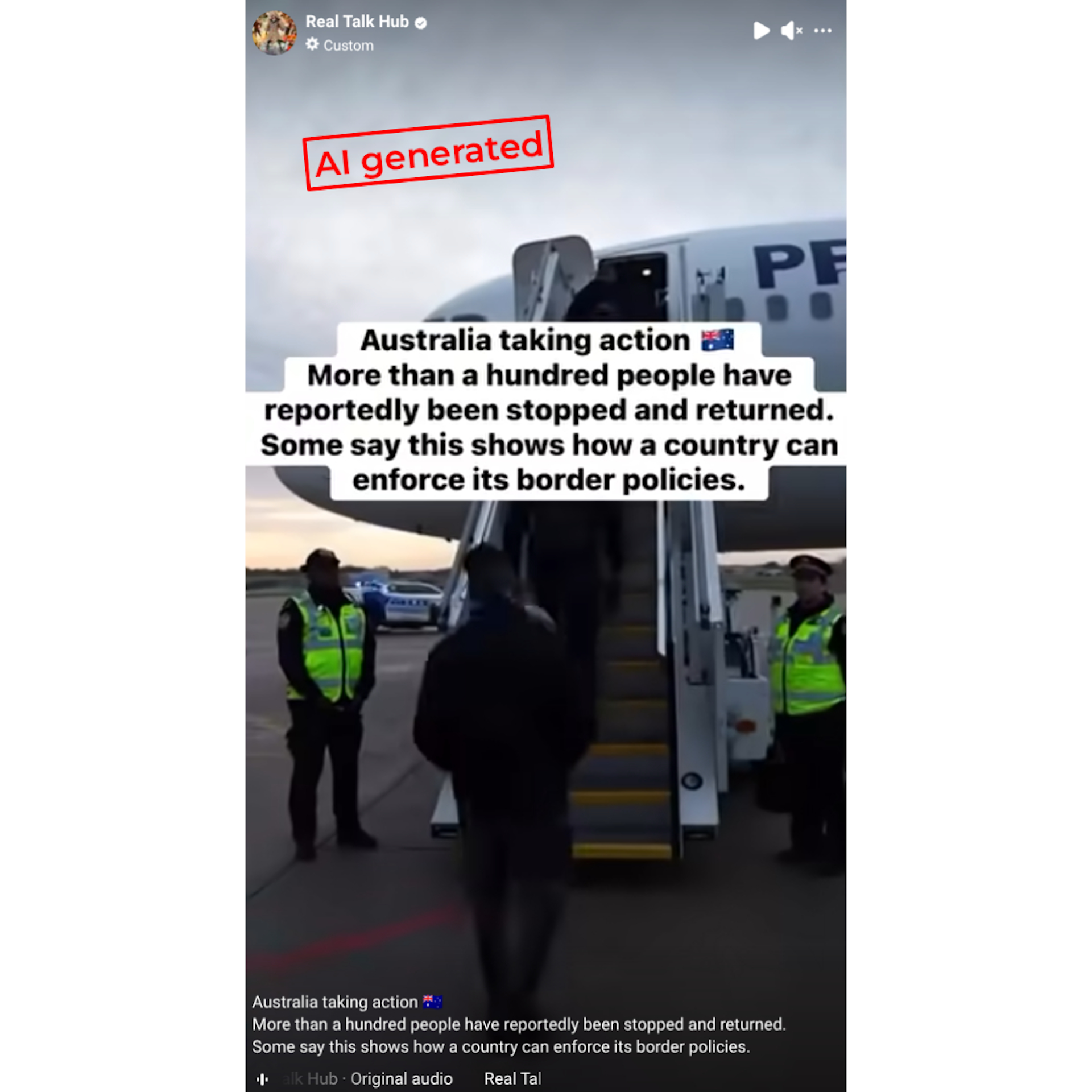
This Facebook reel, posted by an account called “Real Talk Hub”, purports to show migrants being stopped and returned by Australian police at an airport.
这段由名为“Real Talk Hub”的账号发布的Facebook短视频,声称展示了澳大利亚警方在机场拦下并遣返移民的过程。
Before getting too granular, let’s take stock of the opening image.
在深入细节之前,我们先观察一下开头的画面。
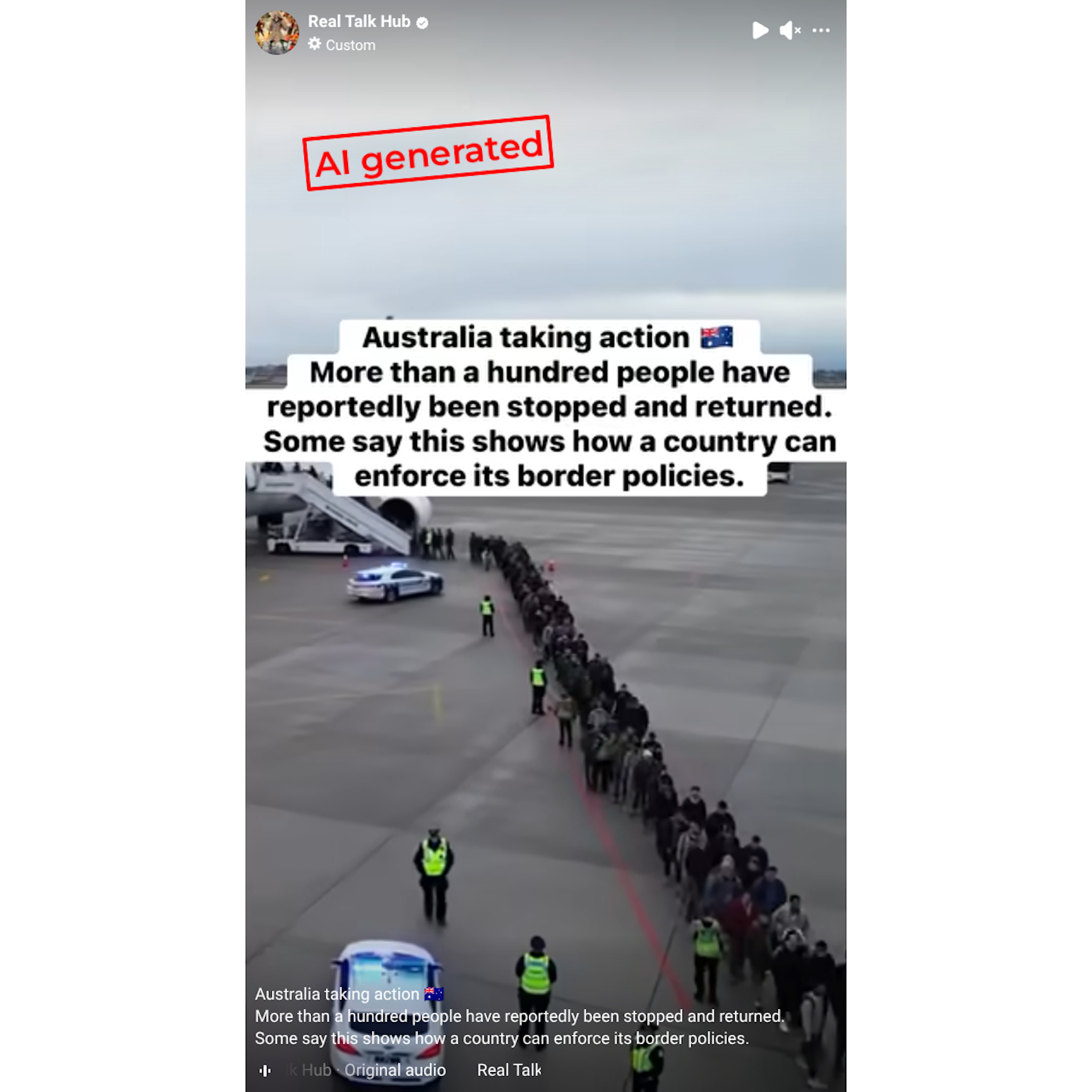
The video uses scale to show what appears to be a long stream of passengers. Some are moving toward and some are moving away from a plane. It is difficult to identify specifics in the video. The superimposed text blocks almost all of the horizon line. Shallow depth of field makes aspects in the distance blurry and hard to discern.
视频利用透视效果展示了一长串乘客。有些人正走向飞机,有些人正远离飞机。视频中很难识别出具体细节。叠加的文字块几乎占据了整个地平线。浅景深使得远处的景物模糊,难以辨认。
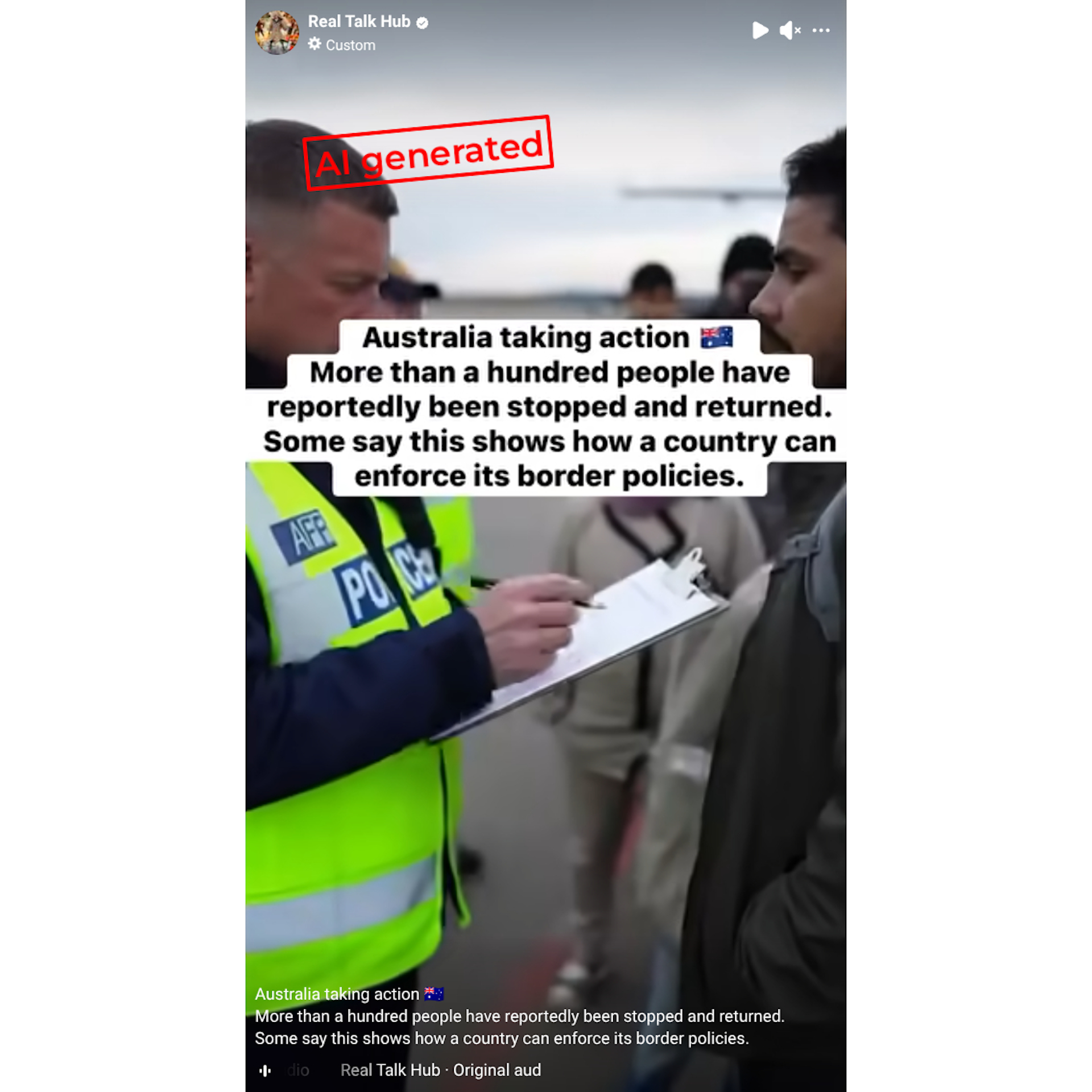
Many of the passengers have darker skin and are visually coded as “other”. They interact with a light-skinned police officer who takes notes on a clipboard.
许多乘客皮肤较深,在视觉上被标记为“其他群体”。他们与一名皮肤白皙的警察互动,该警察正在剪贴板上做笔记。
The vertical video is framed carefully to not reveal identifiers like the name of the airline that seems to start with the letter “P”. This makes it difficult to search the airline’s name and whether credible sources corroborate the story that’s told.
这段垂直视频的拍摄角度经过精心设计,没有透露出航空公司名称等识别信息,该名称似乎以字母“P”开头。这使得搜索该航空公司的名称,以及是否有可靠来源证实所讲述的故事变得困难。
Even though the people and scenes look realistic at first glance, the video’s integrity unravels when we slow down and look closer. People in the passenger line morph and transform.
尽管人物和场景乍一看很真实,但当我们放慢速度仔细观察时,视频的完整性就开始瓦解。乘客队伍中的人会发生变形和变化。
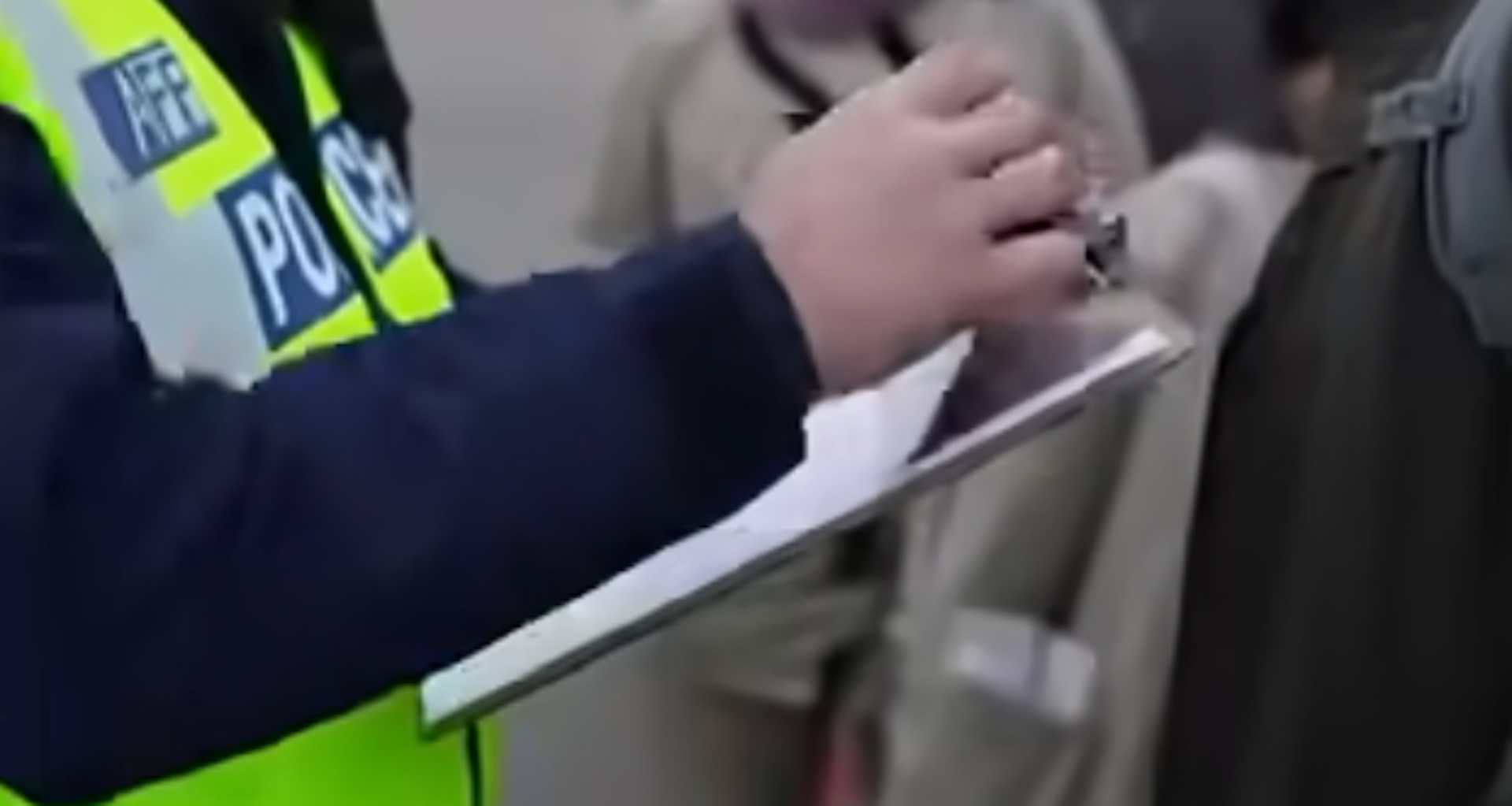
The officer is able to single-handedly remove the paper from the clipboard and it appears to inexplicably leave white strips behind. The police vests look different to images you can find in verified media photos of the Australian Federal Police.
该警官能够单手从剪贴板上取下纸张,但纸张似乎莫名其妙地留下了白色的条痕。警服的样式与你在澳大利亚联邦警察的可靠媒体照片中看到的图像不同。
Taken together, all these clues suggest the video is AI-generated.
综合来看,所有这些线索都表明该视频是人工智能生成的。
Think like a fact-checker
像事实核查员一样思考
Many AI-generated videos can trick you and create a very compelling narrative. So, fact-checkers have developed triangulated methodologies that examine elements beyond just what you see in the video.
许多AI生成的视频可能会欺骗你,并构建出非常引人入胜的叙事。因此,事实核查员开发了三角验证方法论,用于检查视频中可见元素之外的要素。
One way to do this is to systematically check contextual factors – the other things surrounding the content. Our team’s research has found professional fact-checkers usually pay attention to the type of social media accounts or websites distributing suspicious media.
一种方法是系统地检查背景因素——即围绕内容的其他事物。我们团队的研究发现,专业的核查员通常会关注传播可疑媒体的社交媒体账户或网站的类型。
For this AAP verification on a video about banning dogs on the beach, it was crucial to inspect the user’s activity and posting patterns.
对于关于禁止海滩上携带狗的视频的AAP验证,检查用户的活动和发布模式至关重要。
In addition to visual anomalies, the fact-checkers also found an invisible watermark that helped them determine the content was AI-generated.
除了视觉异常外,核查员还发现了一个隐形水印,帮助他们确定该内容是AI生成的。
Other things to check are how long a social media account has been operating, how often the social media account posts, and whether the account is transparent about its use of AI.
其他需要检查的因素包括社交媒体账户运营了多久、发布频率,以及该账户在使用AI方面是否透明。
These aren’t fool-proof indicators of authenticity, though. The migrant example above comes from an account that is about five years old. It also comes from a “verified” account, which might make it feel more credible. But both Facebook and X now let users pay for this verification.
不过,这些都不是证明真实性的万无一失的指标。上面提到的移民例子来自一个大约五年的账户。它还来自一个“认证”账户,这可能会让人感觉更可信。但现在Facebook和X都允许用户付费进行认证。
Overall, when it comes to suspect images or video, don’t just look deeply. Also look widely.
总的来说,当遇到可疑的图片或视频时,不要只深入查看。也要广度地观察。
AI-generated content can increasingly fool our eyes, so you also have to look beyond what’s in the video. Taking a mixed-methods approach that considers visual and contextual clues can help. By training your ability to think like a fact-checker, you can stay safer online.
AI生成的内容越来越容易欺骗我们的眼睛,因此你也必须超越视频本身的内容进行观察。采用考虑视觉和背景线索的混合方法可以提供帮助。通过训练自己像事实核查员一样思考的能力,你可以更安全地上网。
Silvia Montaña-Niño is also associate investigator of the ARC Centre of Excellence for Automated Decision-Making & Society and the Fact Check Research Team at this centre.
Silvia Montaña-Niño也是ARC自动化决策与社会卓越中心和该中心事实核查研究小组的助理调查员。
T.J. Thomson receives funding from the Australian Research Council. He is an affiliate with the ARC Centre of Excellence for Automated Decision Making & Society.
T.J. Thomson获得澳大利亚研究理事会的资助。他是ARC自动化决策与社会卓越中心的附属成员。