Siguen llegando señales misteriosas desde el espacio. Hemos encontrado su ‘piedra de Rosetta’.
Mysterious signals keep coming from space. We have found their ‘Rosetta stone’
Seeing a signal in different kinds of light is like having a text written in several forms of writing – it makes it easier to decipher.
Ver una señal en diferentes tipos de luz es como tener un texto escrito en varias formas de escritura: esto facilita su desciframiento.
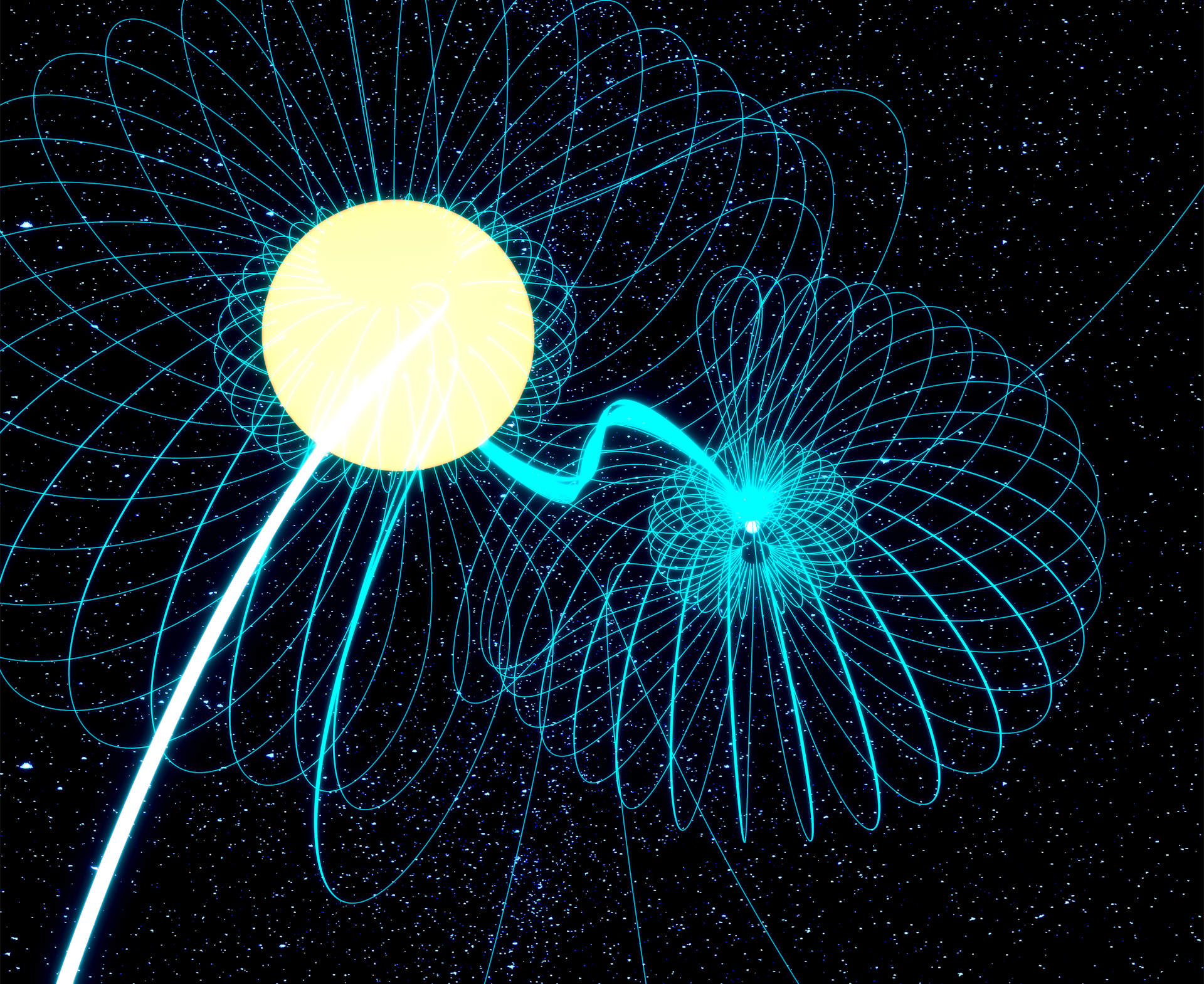
A pair of stars spiralling around each other. That’s the origin of a new source of repeating radio bursts we’ve detected, called ASKAP J1745.
Un par de estrellas en espiral alrededor de otras. Ese es el origen de una nueva fuente de ráfagas de radio repetitivas que hemos detectado, llamada ASKAP J1745.
In recent years, astronomers have been puzzling over mysterious bursts of radio signals, known as long-period transients because of how slowly they repeat. They were first discovered by chance with telescopes scanning large chunks of the sky.
En años recientes, los astrónomos han estado desconcertados por misteriosas ráfagas de señales de radio, conocidas como transitorios de período largo debido a la lentitud con la que se repiten. Fueron descubiertas por casualidad con telescopios que escanean grandes porciones del cielo.
To date, astronomers have only found a dozen of these weird sources, and we’re still trying to understand exactly what they are.
Hasta la fecha, los astrónomos solo han encontrado una docena de estas extrañas fuentes, y todavía estamos tratando de entender exactamente qué son.
In a new study published today in Nature Astronomy, we describe a first-of-its-kind detection – both radio and X-ray bursts repeating with each orbit.
En un nuevo estudio publicado hoy en Nature Astronomy, describimos una detección sin precedentes: ráfagas tanto de radio como de rayos X que se repiten con cada órbita.
ASKAP J1745 is exciting because we’ve figured out what it is, unlike 10 of the 12 known long-period transients. Even better, we were able to detect it with a bunch of different telescopes that observe all different kinds of light.
ASKAP J1745 es emocionante porque hemos descubierto qué es, a diferencia de 10 de los 12 transitorios de período largo conocidos. Mejor aún, pudimos detectarlo con un conjunto de telescopios diferentes que observan todo tipo de luz.
Bearing the same message in three forms of writing, the famous Rosetta stone once helped scholars decipher ancient Egyptian hieroglyphs. Similarly, this extra information we found about ASKAP J1745 will help astronomers better understand the mystery of all long-period transients.
Llevando el mismo mensaje en tres formas de escritura, la famosa piedra de Rosetta ayudó una vez a los eruditos a descifrar jeroglíficos egipcios antiguos. De manera similar, esta información adicional que encontramos sobre ASKAP J1745 ayudará a los astrónomos a comprender mejor el misterio de todos los transitorios de período largo.
What do long-period radio transients look like?
¿Cómo son los transitorios de radio de período largo?
Long-period transients are things in space that produce bright, repeating bursts of light at radio wavelengths. Little is known about the origins of most long-period transients. In addition, many have been discovered close to the dusty region in the middle of our galaxy, so it can be hard to see them with visible-light telescopes.
Los transitorios de período largo son objetos en el espacio que producen ráfagas de luz brillantes y repetitivas en longitudes de onda de radio. Se sabe poco sobre los orígenes de la mayoría de los transitorios de período largo. Además, muchos han sido descubiertos cerca de la región polvorienta en el centro de nuestra galaxia, por lo que puede ser difícil verlos con telescopios de luz visible.
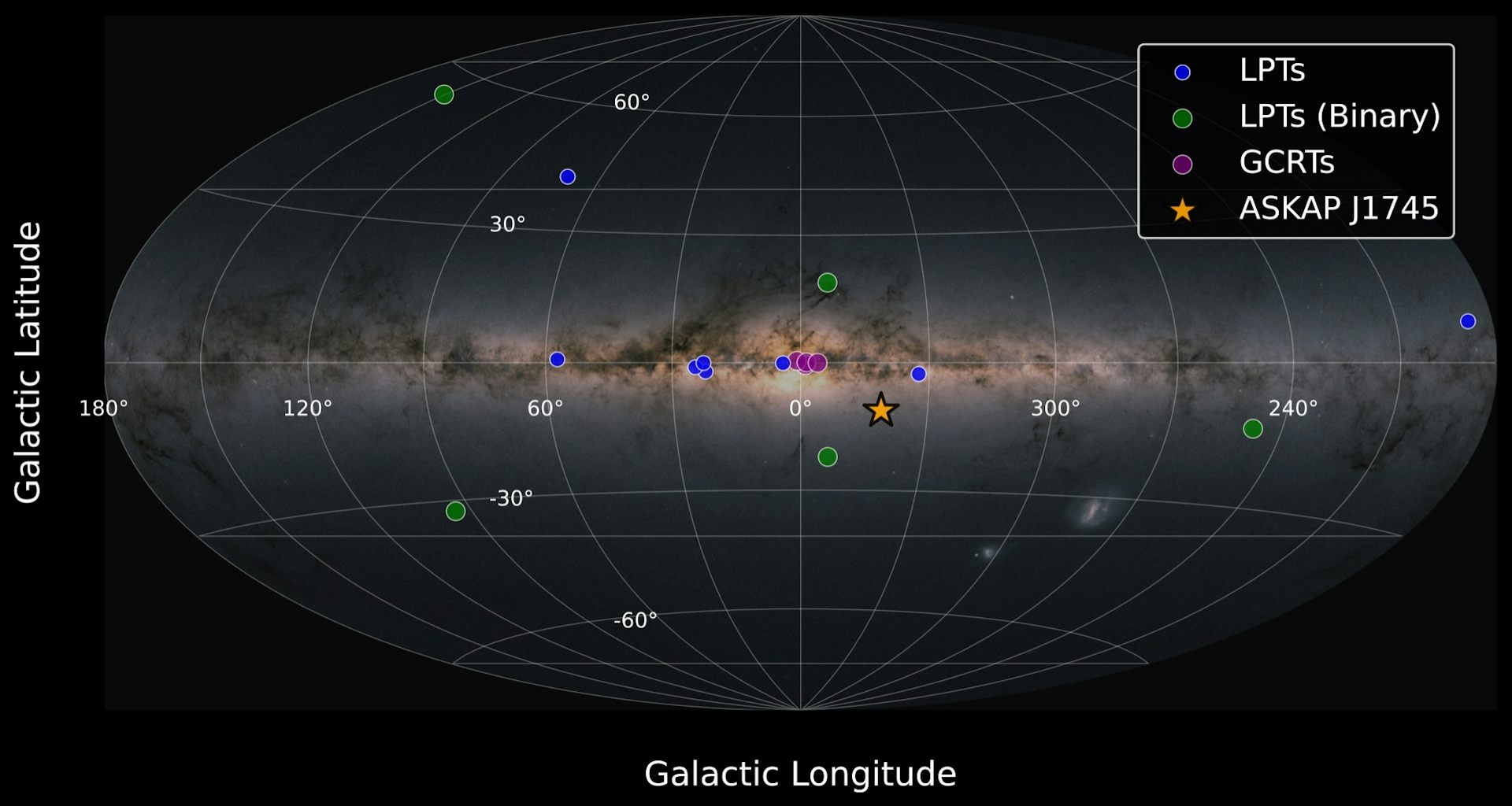
Even with just a dozen of these strange sources discovered so far, they seem to come in a few different shapes and sizes. Their radio bursts repeat on timescales of minutes to hours.
Incluso con solo una docena de estas extrañas fuentes descubiertas hasta ahora, parecen tener varias formas y tamaños diferentes. Sus ráfagas de radio se repiten en escalas de tiempo de minutos a horas.
Some have been making regular pulses for more than 30 years, while others turn off for days at a time or go permanently radio-silent.
Algunos han estado emitiendo pulsos regulares durante más de 30 años, mientras que otros se apagan por días o pasan a estar permanentemente silenciosos en radio.
Where do they come from?
¿De dónde vienen?
Astronomers initially thought long-period transients were just very slowly spinning neutron stars, called pulsars. These are the fast-rotating dense cores left after the supernova explosions of massive stars.
Los astrónomos inicialmente pensaron que los transitorios de período largo eran simplemente estrellas de neutrones que giraban muy lentamente, llamadas púlsares. Estos son los núcleos densos de rotación rápida que quedan después de las explosiones de supernova de estrellas masivas.
The first few of these radio transients discovered were repeating roughly every 20 minutes. That’s much slower than the average pulsar, which repeats every few seconds.
Los primeros transitorios de radio descubiertos se repetían aproximadamente cada 20 minutos. Esto es mucho más lento que el púlsar promedio, que se repite cada pocos segundos.
Furthermore, when pulsars slow down their spin, they should stop producing radio light. This means we shouldn’t see radio bursts from neutron stars rotating so slowly.
Además, cuando los púlsares disminuyen su giro, deberían dejar de producir luz de radio. Esto significa que no deberíamos ver ráfagas de radio de estrellas de neutrones que giran tan lentamente.
So astronomers investigated other theories involving white dwarfs – the slowly cooling dead centres of less massive stars. And recently we discovered some long-period transients in binary systems (two stars in a close orbit) with evidence of both a white dwarf and a lower-mass red dwarf star.
Así que los astrónomos investigaron otras teorías que involucraban enanas blancas, los centros muertos que se enfrían lentamente de estrellas de menor masa. Y recientemente descubrimos algunos transitorios de período largo en sistemas binarios (dos estrellas en una órbita cercana) con evidencia tanto de una enana blanca como de una estrella enana roja de menor masa.
The discovery of ASKAP J1745
El descubrimiento de ASKAP J1745
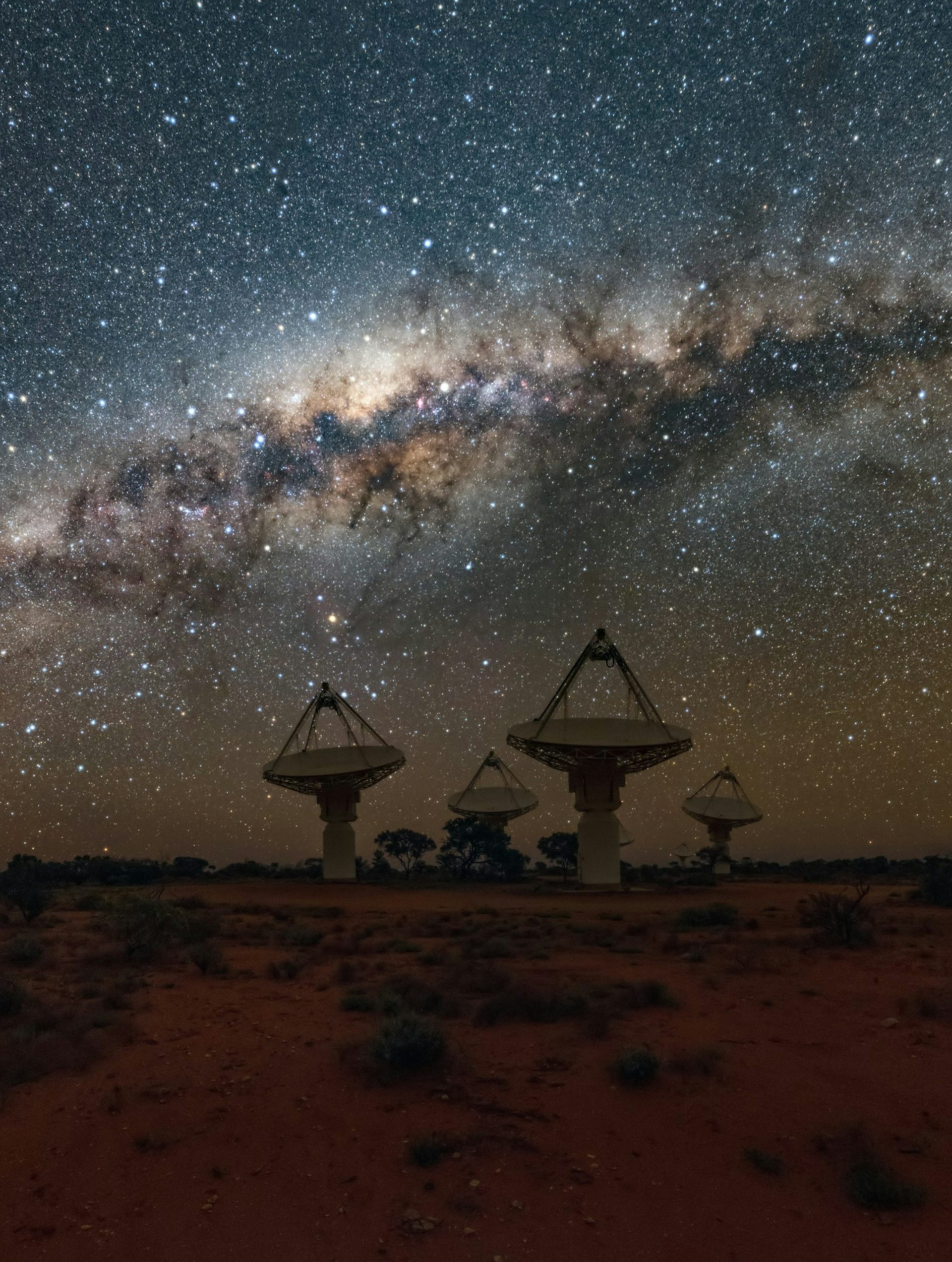
ASKAP J1745 is a new long-period radio transient we found with the ASKAP radio telescope, owned and operated by CSIRO, Australia’s national science agency. It’s the first one of these strange sources that we’ve identified as a “cataclysmic variable”.
ASKAP J1745 es un nuevo transitorio de radio de período largo que encontramos con el radiotelescopio ASKAP, propiedad y operado por CSIRO, la agencia científica nacional de Australia. Es la primera de estas extrañas fuentes que hemos identificado como una «variable cataclísmica.»
Cataclysmic variables are systems with two stars – one of them a white dwarf – that orbit each other closely enough to interact. If the stars are close enough, the white dwarf’s gravity can pull (or “accrete”) material from the other star. That’s why these systems are also known as accreting white dwarf binaries.
Las variables cataclísmicas son sistemas con dos estrellas —una de ellas una enana blanca— que orbitan lo suficientemente cerca para interactuar. Si las estrellas están lo suficientemente cerca, la gravedad de la enana blanca puede atraer (o «acreción») material de la otra estrella. Por eso estos sistemas también se conocen como binarias de enanas blancas en acreción.
Another long-period radio transient was recently discovered with X-ray bursts, repeating with the same regularity as the radio. However, the origin of the bursts and their shared timing remained unclear.
Otro transitorio de radio de período largo fue descubierto recientemente con ráfagas de rayos X, repitiéndose con la misma regularidad que la radio. Sin embargo, el origen de las ráfagas y su sincronización compartida seguían sin estar claras.
Now, for the first time, we have combined observations from radio, X-ray and optical telescopes to find that ASKAP J1745 produces both X-ray and radio bursts with each orbit of its two stars.
Ahora, por primera vez, hemos combinado observaciones de telescopios de radio, rayos X y ópticos para encontrar que ASKAP J1745 produce ráfagas tanto de rayos X como de radio con cada órbita de sus dos estrellas.

In these rapidly orbiting systems, the X-ray light is thought to come from the material heating up as it streams onto the white dwarf.
En estos sistemas de órbita rápida, se cree que la luz de rayos X proviene del material que se calienta al fluir hacia la enana blanca.
The bright radio bursts were a bit more of a mystery. But knowing that this is an accreting binary system helped us figure things out.
Las brillantes ráfagas de radio fueron un poco más misteriosas. Pero saber que se trata de un sistema binario en acreción nos ayudó a entenderlo.
The type of pulsed radio light we detected is typically caused by energetic particles interacting with strong magnetic fields. Here, we have the perfect combination: two stars with strong magnetic fields (typically thousands of times stronger than an MRI machine) , with charged particles flowing towards the white dwarf from the other star.
El tipo de luz de radio pulsada que detectamos es típicamente causado por partículas energéticas que interactúan con fuertes campos magnéticos. Aquí, tenemos la combinación perfecta: dos estrellas con fuertes campos magnéticos (típicamente miles de veces más fuertes que una máquina de resonancia magnética) , con partículas cargadas fluyendo hacia la enana blanca desde la otra estrella.
What this means for the future of astronomy
Lo que esto significa para el futuro de la astronomía
This discovery is unique because we have more information and at more different wavelengths than any other previous long-period transient.
Este descubrimiento es único porque tenemos más información y en más longitudes de onda diferentes que cualquier otro transitorio de período largo anterior.
Just like the Rosetta stone was key to decoding ancient Egyptian symbols, ASKAP J1745 will be key to deciphering the origins of other long-period radio transients that lack information at other wavelengths.
Al igual que la piedra de Rosetta fue clave para decodificar símbolos egipcios antiguos, ASKAP J1745 será clave para descifrar los orígenes de otros transitorios de radio de período largo que carecen de información en otras longitudes de onda.
ASKAP J1745 is the first long-period transient showing signs of accretion across the spectrum of light – from radio waves to visible to X-rays. And this stream of charged material is a crucial ingredient for making the radio light we detect from these systems.
ASKAP J1745 es el primer transitorio de período largo que muestra signos de acreción a lo largo del espectro de la luz, desde ondas de radio hasta visible y rayos X. Y este flujo de material cargado es un ingrediente crucial para generar la luz de radio que detectamos de estos sistemas.
Exploring the mechanism that produces long-period radio bursts gives us a new laboratory to learn about extreme physics such as plasma flows and magnetic fields in conditions we can’t recreate on Earth.
Explorar el mecanismo que produce ráfagas de radio de período largo nos da un nuevo laboratorio para aprender sobre física extrema, como flujos de plasma y campos magnéticos en condiciones que no podemos recrear en la Tierra.
We acknowledge the Wajarri Yamaji as the Traditional Owners and Native Title Holders of Inyarrimanha Ilgari Bundara, the CSIRO Murchison Radio-astronomy Observatory where ASKAP is located.
Reconocemos a Wajarri Yamaji como Propietarios Tradicionales y Titulares de Título Indígena de Inyarrimanha Ilgari Bundara, el Observatorio de Radioastronomía Murchison del CSIRO donde se encuentra ASKAP.
Kovi Rose does not work for, consult, own shares in or receive funding from any company or organisation that would benefit from this article, and has disclosed no relevant affiliations beyond their academic appointment.
Kovi Rose no trabaja para, asesora, posee acciones de, ni recibe financiación de ninguna empresa u organización que se beneficiaría de este artículo, y no ha revelado afiliaciones relevantes más allá de su nombramiento académico.
Read more
-

Nicole Kidman está entrenando para ser una ‘doula de la muerte’. ¿Qué es una doula de la muerte?
Nicole Kidman is training to be a ‘death doula’. What is a death doula?
-

Fenian: la historia antiirlandesa detrás del desafiante nuevo título de álbum de Kneecap
Fenian: the anti-Irish history behind Kneecap’s defiant new album title