Teleskop Afrika Selatan mendeteksi sinyal rekor dari alam semesta awal
South African telescope detects record-breaking signal from the early universe
Scientists have discovered the most distant hydroxyl megamaser ever detected. This is a natural space laser.
Para ilmuwan telah menemukan megamaser hidroksil paling jauh yang pernah terdeteksi. Ini adalah laser ruang alami.
Astronomers using the MeerKAT radio telescope in South Africa have discovered the most distant hydroxyl megamaser ever detected, opening a new radio astronomy frontier. A hydroxyl megamaser is a natural space laser, and this one is located in a violently merging galaxy more than 8 billion light-years away.
Astronom menggunakan teleskop radio MeerKAT di Afrika Selatan telah menemukan megamaser hidroksil paling jauh yang pernah terdeteksi, membuka batas baru dalam astronomi radio. Megamaser hidroksil adalah laser ruang alami, dan yang ini terletak di galaksi yang bertabrakan secara dahsyat lebih dari 8 miliar tahun cahaya jauhnya.
We spoke to the astronomers, Thato Manamela, a postdoctoral researcher at the University of Pretoria, and Roger Deane, director of the Inter-University Institute for Data Intensive Astronomy and a professor at the universities of Cape Town and Pretoria, about their study.
Kami berbicara dengan para astronom, Thato Manamela, seorang peneliti pascadoktoral di University of Pretoria, dan Roger Deane, direktur Inter-University Institute for Data Intensive Astronomy sekaligus profesor di universitas Cape Town dan Pretoria, mengenai penelitian mereka.
What you’ve found has been described as a ‘new frontier’ in space research. Why is it extraordinary?
Apa yang Anda temukan telah digambarkan sebagai ‘perbatasan baru’ dalam penelitian antariksa. Mengapa ini luar biasa?
This discovery is extraordinary because of the record distance at which we’ve detected it, over eight billion light-years away. That places it deep into the early universe. This means that we aren’t seeing the galaxy as it exists today. We are seeing it as it was 8 billion years ago. Since the Big Bang happened about 13.8 billion years ago, we are looking at a “toddler” version of the universe. At that stage where the maser signal was transmitted by the host galaxy, galaxies were much more “chaotic”, they collided more often and were much more active than the stable, mature galaxies we see nearby today.
Penemuan ini luar biasa karena jarak rekor di mana kita mendeteksinya, lebih dari delapan miliar tahun cahaya jauhnya. Itu menempatkannya jauh ke masa alam semesta awal. Ini berarti bahwa kita tidak melihat galaksi seperti yang ada hari ini. Kita melihatnya seperti saat 8 miliar tahun yang lalu. Sejak Big Bang terjadi sekitar 13,8 miliar tahun yang lalu, kita sedang melihat versi “bayi” dari alam semesta. Pada tahap di mana sinyal maser ditransmisikan oleh galaksi induk, galaksi-galaksi jauh lebih “kacau”, mereka bertabrakan lebih sering dan jauh lebih aktif daripada galaksi stabil dan matang yang kita lihat di dekat sini hari ini.
It gives us a rare glimpse of galaxy interactions and extreme star-forming environments when the cosmos was less than half its current age. Think of light like a letter in the mail. If a friend sends a letter from overseas, by the time you read it, the news is old. In space, light is the letter. The “news” from this galaxy took 8 billion years to reach us. We see the galaxy as a “toddler” even though, in its own time, it has already grown up or changed.
Ini memberi kita pandangan langka tentang interaksi galaksi dan lingkungan pembentukan bintang ekstrem ketika kosmos masih kurang dari setengah usia saat ini. Bayangkan cahaya seperti surat di kantor pos. Jika seorang teman mengirim surat dari luar negeri, pada saat Anda membacanya, beritanya sudah usang. Di ruang angkasa, cahaya adalah surat itu. “Berita” dari galaksi ini membutuhkan waktu 8 miliar tahun untuk mencapai kita. Kita melihat galaksi itu sebagai “bayi” meskipun, di masanya sendiri, ia sudah tumbuh atau berubah.
We detected this megamaser, which operates on a scale of power millions of times greater than a typical galactic maser. Both megamasers and gigamasers are cosmic radio lasers. While a megamaser is a million times more luminous than a standard maser found in the local universe, a gigamaser is a billion times more luminous, making it 1,000 times more powerful than a megamaser.
Kami mendeteksi megamaser ini, yang beroperasi pada skala daya jutaan kali lebih besar daripada maser galaksi biasa. Baik megamaser maupun gigamaser adalah laser radio kosmik. Sementara megamaser seribu kali lebih bercahaya daripada maser standar yang ditemukan di alam semesta lokal, gigamaser seribu miliar kali lebih bercahaya, membuatnya 1.000 kali lebih kuat dari megamaser.
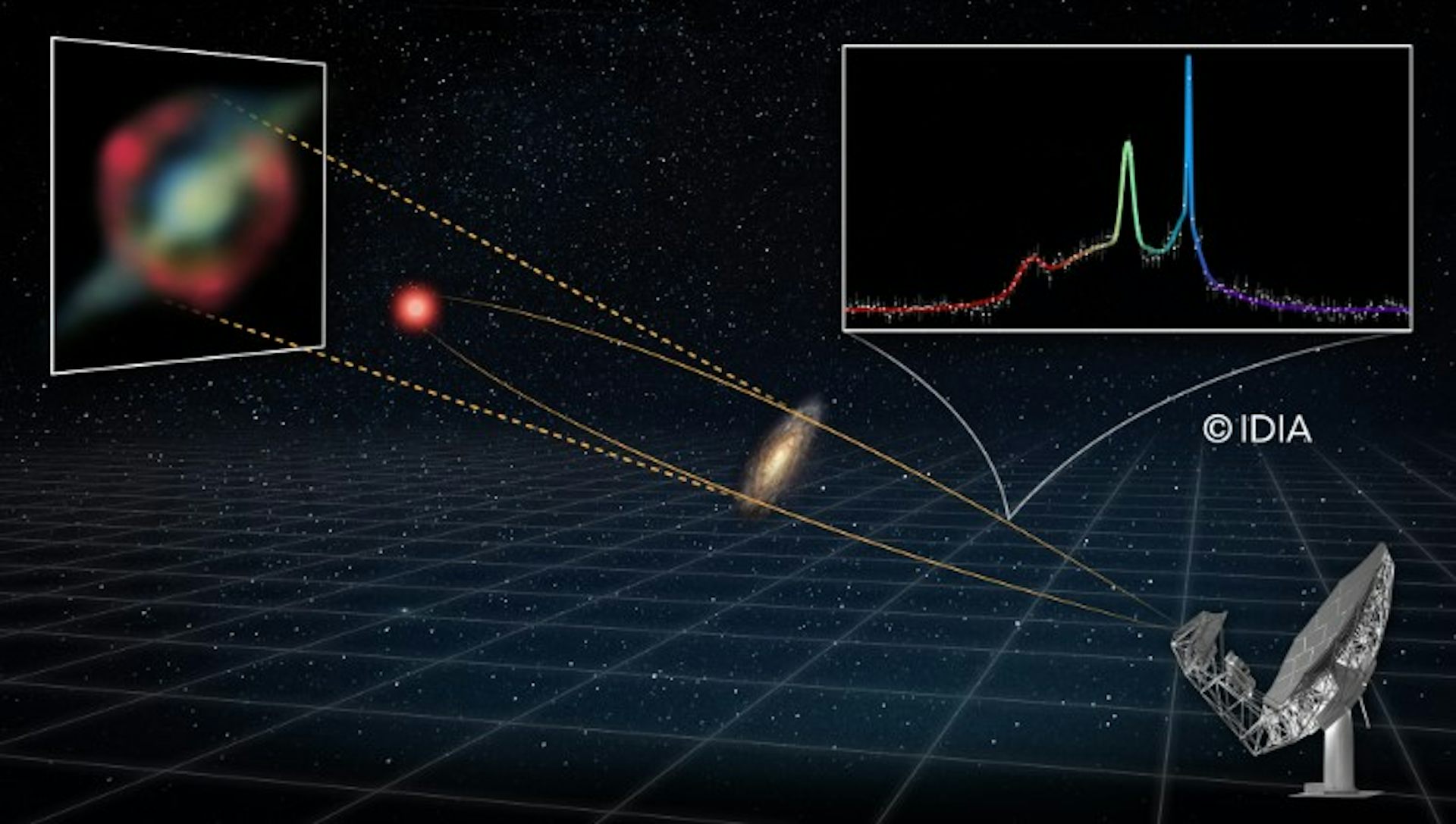
In just five hours of observing time we found a signal that typically requires hundreds of hours of observation, given its distance and rarity. But gravitational lensing boosted the signal enough to detect it. Additionally, while we were targeting neutral hydrogen, MeerKAT’s wide bandwidth enabled the surprise discovery of the megamaser signal in the same data.
Hanya dalam waktu pengamatan lima jam kami menemukan sinyal yang biasanya membutuhkan ratusan jam observasi, mengingat jarak dan kelangkaannya. Namun, lensa gravitasi memperkuat sinyalnya cukup untuk mendeteksinya. Selain itu, saat kami menargetkan hidrogen netral, bandwidth lebar MeerKAT memungkinkan penemuan kejutan sinyal megamaser dalam data yang sama.
This rapid detection suggests that future surveys with MeerKAT and the upcoming SKA Observatory could uncover many more such distant, extreme objects. Its ability to find this so quickly proves that we finally have the technology to see faint signals from the very distant past. It’s a preview of what the upcoming Square Kilometre Array (SKA) , a unique, one-of-a-kind international mega-project, might achieve.
Deteksi cepat ini menunjukkan bahwa survei di masa depan dengan MeerKAT dan Observatorium SKA yang akan datang dapat mengungkap banyak objek jauh dan ekstrem serupa. Kemampuannya untuk menemukan ini begitu cepat membuktikan bahwa kita akhirnya memiliki teknologi untuk melihat sinyal samar dari masa lalu yang sangat jauh. Ini adalah pratinjau tentang apa yang mungkin dicapai oleh Square Kilometre Array (SKA) yang akan datang, sebuah mega-proyek internasional yang unik dan satu-satunya.
But a highly complementary next-generation facility called the next-generation Very Large Array (ngVLA) is being planned and designed for construction in the US. The SKA Observatory (SKA-Low and SKA-Mid) focuses on low-to-mid radio frequencies. The ngVLA will operate at much higher frequencies. Together, they will form two of the major pillars of next-generation global radio astronomy. The finding gives astronomers a new way to study how galaxies evolved in the early universe.
Namun, fasilitas generasi berikutnya yang sangat melengkapi bernama Very Large Array (ngVLA) sedang direncanakan dan dirancang untuk dibangun di AS. Observatorium SKA (SKA-Low dan SKA-Mid) berfokus pada frekuensi radio rendah hingga menengah. ngVLA akan beroperasi pada frekuensi yang jauh lebih tinggi. Bersama-sama, keduanya akan membentuk dua pilar utama astronomi radio global generasi berikutnya. Penemuan ini memberi para astronom cara baru untuk mempelajari bagaimana galaksi berevolusi di alam semesta awal.
What technologies or capabilities made this possible?
Teknologi atau kemampuan apa yang membuat ini mungkin?
The discovery was made possible by the sensitivity and wide frequency coverage of the MeerKAT radio telescope. Its ability to detect faint signals over a broad frequency range allows us to search for spectral lines across large cosmic volumes. A spectral line is a cosmic chemical fingerprint. Every atom or molecule emits electromagnetic waves at specific frequencies. Detecting those frequencies tells astronomers what the gas is made of.
Penemuan ini dimungkinkan oleh sensitivitas dan cakupan frekuensi yang luas dari teleskop radio MeerKAT. Kemampuannya untuk mendeteksi sinyal samar di rentang frekuensi yang luas memungkinkan kita mencari garis spektral di volume kosmik yang besar. Garis spektral adalah sidik jari kimia kosmik. Setiap atom atau molekul memancarkan gelombang elektromagnetik pada frekuensi tertentu. Mendeteksi frekuensi-frekuensi tersebut memberi tahu para astronom tentang komposisi gas itu.
In this case, MeerKAT’s wide bandwidth allowed us to detect both the hydroxyl line and neutral hydrogen absorption in a single observation. Previously, with older technology, this would have taken two separate observations.
Dalam kasus ini, bandwidth lebar MeerKAT memungkinkan kami mendeteksi garis hidroksil dan penyerapan hidrogen netral dalam satu pengamatan. Sebelumnya, dengan teknologi yang lebih tua, hal ini akan membutuhkan dua pengamatan terpisah.
Equally important are advances in data processing and computing. The data were processed using high-performance computing resources at the Inter-University Institute for Data Intensive Astronomy (IDIA) .
Sama pentingnya adalah kemajuan dalam pemrosesan data dan komputasi. Data tersebut diproses menggunakan sumber daya komputasi berkinerja tinggi di Inter-University Institute for Data Intensive Astronomy (IDIA) .
Processing such massive amounts of data is like trying to drink from a firehose. MeerKAT collects gigabytes of information every second, resulting in files far too large for a standard computer to handle. To find a signal from 8 billion years ago, which is millions of times fainter than a cell phone signal, we must use robust calibration pipelines. These act like an automated high-tech car wash to scrub away digital noise and sharpen the telescope’s focus. This “cleaning” process requires trillions of mathematical calculations, necessitating the use of supercomputers that work for days to transform raw radio interference into a clear scientific discovery.
Memproses jumlah data yang sangat besar ini seperti mencoba minum dari selang pemadam kebakaran. MeerKAT mengumpulkan gigabyte informasi setiap detik, menghasilkan berkas yang terlalu besar untuk ditangani oleh komputer standar. Untuk menemukan sinyal dari 8 miliar tahun lalu, yang jauh lebih redup daripada sinyal ponsel, kita harus menggunakan alur kalibrasi yang kuat. Ini bertindak seperti pencucian mobil berteknologi tinggi otomatis untuk menghilangkan kebisingan digital dan mempertajam fokus teleskop. Proses “pembersihan” ini membutuhkan triliunan perhitungan matematika, sehingga mengharuskan penggunaan superkomputer yang bekerja selama berhari-hari untuk mengubah interferensi radio mentah menjadi penemuan ilmiah yang jelas.
Gravitational lensing also played a key role. A massive foreground object, like a star or galaxy, for example, amplified the signal from the distant galaxy, effectively acting as a natural telescope and boosting our ability to detect it.
Lensa gravitasi juga memainkan peran kunci. Objek latar depan yang masif, seperti bintang atau galaksi, misalnya, memperkuat sinyal dari galaksi yang jauh, secara efektif bertindak sebagai teleskop alami dan meningkatkan kemampuan kita untuk mendeteksinya.
How does what you’ve found change our understanding of the universe?
Bagaimana apa yang Anda temukan mengubah pemahaman kita tentang alam semesta?
It’s rare that a single astrophysical system, a collection of celestial objects, in this case, two galaxies forming a lens system, can change our understanding of the universe. We typically need large sample sizes to do that. But the combination of the recording-breaking distance and the speed of the discovery was impressive.
Jarang sekali sebuah sistem astrofisika tunggal, kumpulan objek langit—dalam kasus ini, dua galaksi yang membentuk sistem lensa—dapat mengubah pemahaman kita tentang alam semesta. Biasanya kami membutuhkan ukuran sampel yang besar untuk melakukan itu. Namun, kombinasi antara jarak yang memecahkan rekor dan kecepatan penemuan ini sangat mengesankan.
It suggests that systematic searches – such as those conducted by deep MeerKAT surveys – could convert these once-rare finds into powerful probes of extreme, yet highly obscured star formation in the distant universe. As a result of this observation, the SKA Observatory and other future telescopes won’t just be looking for more of the same; they will be looking for hidden history.
Hal ini menunjukkan bahwa pencarian sistematis – seperti yang dilakukan oleh survei MeerKAT yang mendalam – dapat mengubah temuan langka ini menjadi alat uji kuat untuk pembentukan bintang ekstrem, namun sangat terhalang di alam semesta yang jauh. Sebagai hasil dari pengamatan ini, Observatorium SKA dan teleskop masa depan lainnya tidak hanya akan mencari lebih banyak hal serupa; mereka akan mencari sejarah tersembunyi.
Hydroxyl megamasers are usually associated with galaxy mergers. We expect some galaxy mergers to host pairs of supermassive black holes. Almost every large galaxy has a supermassive black hole at its centre. When galaxies merge, the supermassive black holes at their centres can eventually spiral towards each other, producing gravitational waves, ripples in space-time. Finding systems like this helps astronomers study an important stage in galaxy evolution and the environments where these extreme events occur.
Megamaser hidroksil biasanya dikaitkan dengan merger galaksi. Kami memperkirakan beberapa merger galaksi menampung pasangan lubang hitam supermasif. Hampir setiap galaksi besar memiliki lubang hitam supermasif di pusatnya. Ketika galaksi bergabung, lubang hitam supermasif di pusat mereka pada akhirnya dapat berputar menuju satu sama lain, menghasilkan gelombang gravitasi, riak dalam ruang-waktu. Menemukan sistem seperti ini membantu para astronom mempelajari tahap penting dalam evolusi galaksi dan lingkungan tempat peristiwa ekstrem ini terjadi.
By using megamasers to find these pairs, we can study the final stages of how the largest objects in the universe are built. This is a major milestone in a galaxy’s life. By finding these galaxies now, we are catching them at a key evolutionary stage, the final countdown before they collide and release a massive burst of energy that our next generation of detectors will be able to hear.
Dengan menggunakan megamaser untuk menemukan pasangan ini, kita dapat mempelajari tahapan akhir bagaimana objek terbesar di alam semesta dibangun. Ini adalah tonggak sejarah utama dalam kehidupan sebuah galaksi. Dengan menemukan galaksi-galaksi ini sekarang, kita menangkapnya pada tahap evolusi kunci, hitungan mundur terakhir sebelum mereka bertabrakan dan melepaskan ledakan energi masif yang akan dapat didengar oleh generasi detektor kita berikutnya.
The strength of the MeerKAT-detected hydroxyl signal after such a short observation time therefore implies that astronomers will be able to detect large numbers of these systems across most of cosmic time.
Oleh karena itu, kekuatan sinyal hidroksil yang terdeteksi MeerKAT setelah waktu observasi yang singkat menunjukkan bahwa para astronom akan mampu mendeteksi sejumlah besar sistem ini di sebagian besar waktu kosmik.
What does the discovery say about South Africa’s place in data-intensive radio astronomy?
Apa yang dikatakan penemuan ini tentang posisi Afrika Selatan dalam astronomi radio padat data?
This discovery highlights South Africa’s leading role in radio astronomy. Facilities such as MeerKAT, combined with data-intensive platforms like IDIA, provide world-class capabilities for both observation and analysis. It also demonstrates strong local expertise in handling large, complex datasets.
Penemuan ini menyoroti peran utama Afrika Selatan dalam astronomi radio. Fasilitas seperti MeerKAT, dikombinasikan dengan platform padat data seperti IDIA, menyediakan kemampuan kelas dunia untuk observasi dan analisis. Ini juga menunjukkan keahlian lokal yang kuat dalam menangani kumpulan data besar dan kompleks.
Discoveries like this rely on advanced data processing, signal extraction and scientific interpretation. These are all key strengths within the South African research community. As we move from using current scout telescopes like MeerKAT to building and operating the world’s largest radio observatory, the SKAO, South Africa is well positioned to remain a hub for data-intensive astronomy. Results like this reinforce the country’s role in shaping the future of the field.
Penemuan seperti ini bergantung pada pemrosesan data canggih, ekstraksi sinyal, dan interpretasi ilmiah. Semua ini adalah kekuatan utama dalam komunitas penelitian Afrika Selatan. Saat kita beralih dari menggunakan teleskop pengintai saat ini seperti MeerKAT ke pembangunan dan pengoperasian observatorium radio terbesar di dunia, SKAO, Afrika Selatan berada pada posisi yang baik untuk tetap menjadi pusat bagi astronomi padat data. Hasil seperti ini memperkuat peran negara tersebut dalam membentuk masa depan bidang ini.
Thato Manamela works for the University of Pretoria. He receives funding from the National Research Foundation (NRF SARAO) . He is affiliated with UP and IDIA.
Thato Manamela bekerja untuk University of Pretoria. Dia menerima pendanaan dari National Research Foundation (NRF SARAO) . Dia berafiliasi dengan UP dan IDIA.
Roger P. Deane previously held an SKA Research Chair in Radio Astronomy, funded by the South African Radio Astronomy Observatory, which is a facility of the National Research Foundation (NRF) , an agency of the Department of Science, Technology and Innovation (DSTI) .
Roger P. Deane sebelumnya memegang Kursi Penelitian SKA di bidang Astronomi Radio, yang didanai oleh South African Radio Astronomy Observatory, yang merupakan fasilitas dari National Research Foundation (NRF) , sebuah badan dari Department of Science, Technology and Innovation (DSTI) .
Read more
-
Spons laut dalam bertahan hidup dalam kegelapan total dengan cara yang sebelumnya tidak kita ketahui
Deep-sea sponges survive in complete darkness in ways we didn’t know before
-

Siapa saja pesaing utama untuk menggantikan Keir Starmer sebagai perdana menteri?
Who are the main contenders to replace Keir Starmer as prime minister?