Cómo utiliza Irán las vallas publicitarias como propaganda de guerra: seleccionamos 5 para explicar lo que significan
How Iran uses billboards as wartime propaganda – we selected 5 to explain what they mean
The provocative images in the most visible parts of Tehran are intended to be photographed, posted and shared widely on social media.
Las imágenes provocativas en las partes más visibles de Teherán están destinadas a ser fotografiadas, publicadas y compartidas ampliamente en las redes sociales.
Since the US–Israel war against Iran began in late February, images of giant billboards in Tehran have been ubiquitous across traditional and social media. These billboards have been placed in some of the busiest and most visible parts of the city, and are constantly being updated to reflect current events.
Desde que comenzó la guerra entre EE. UU. e Israel contra Irán a finales de febrero, las imágenes de gigantescos anuncios en Teherán han sido omnipresentes en los medios tradicionales y sociales. Estos anuncios han sido colocados en algunas de las partes más concurridas y visibles de la ciudad, y se actualizan constantemente para reflejar los acontecimientos actuales.
Iran has long used public spaces as a tool of political communication. Since the 1979 Islamic Revolution – and especially during the Iran–Iraq War – the regime has erected murals and billboards to display revolutionary imagery, war memorials and ideological messages.
Irán ha utilizado durante mucho tiempo los espacios públicos como herramienta de comunicación política. Desde la Revolución Islámica de 1979 —y especialmente durante la Guerra Irán-Irak— el régimen ha erigido murales y anuncios para exhibir imágenes revolucionarias, monumentos de guerra y mensajes ideológicos.
Today, these billboards are designed not only for local audiences, but also for global digital circulation. Depicting powerful imagery, slogans and symbolic representations, they serve a dual function:
Hoy en día, estos anuncios están diseñados no solo para audiencias locales, sino también para la circulación digital global. Al representar imágenes poderosas, eslóganes y representaciones simbólicas, cumplen una doble función:
to reinforce a sense of collective identity, national unity and shared emotion during a time of crisis
* reforzar un sentido de identidad colectiva, unidad nacional y emoción compartida durante un momento de crisis
to serve as a tool of propaganda for the state, at times featuring Hebrew and English alongside Farsi (Persian) .
* servir como herramienta de propaganda para el estado, mostrando en ocasiones hebreo e inglés junto con farsi (persa) .
Researchers argue these billboards are part of a broader visual communication strategy on the part of the state. They are intended to be photographed, posted and shared widely on social media as a way of projecting power and resistance to a global audience (even with a months-long internet blackout in place) .
Los investigadores argumentan que estos anuncios son parte de una estrategia de comunicación visual más amplia por parte del estado. Están destinados a ser fotografiados, publicados y compartidos ampliamente en las redes sociales como una forma de proyectar poder y resistencia ante una audiencia global (incluso con un apagón de internet de meses en vigor) .
So, what do the billboards say, and what’s the deeper symbolism behind the imagery? We’ve chosen five samples from Tehran to analyse.
Entonces, ¿qué dicen los anuncios y cuál es el simbolismo más profundo detrás de las imágenes? Hemos elegido cinco muestras de Teherán para analizar.
1. The Epstein missile
El misil Epstein
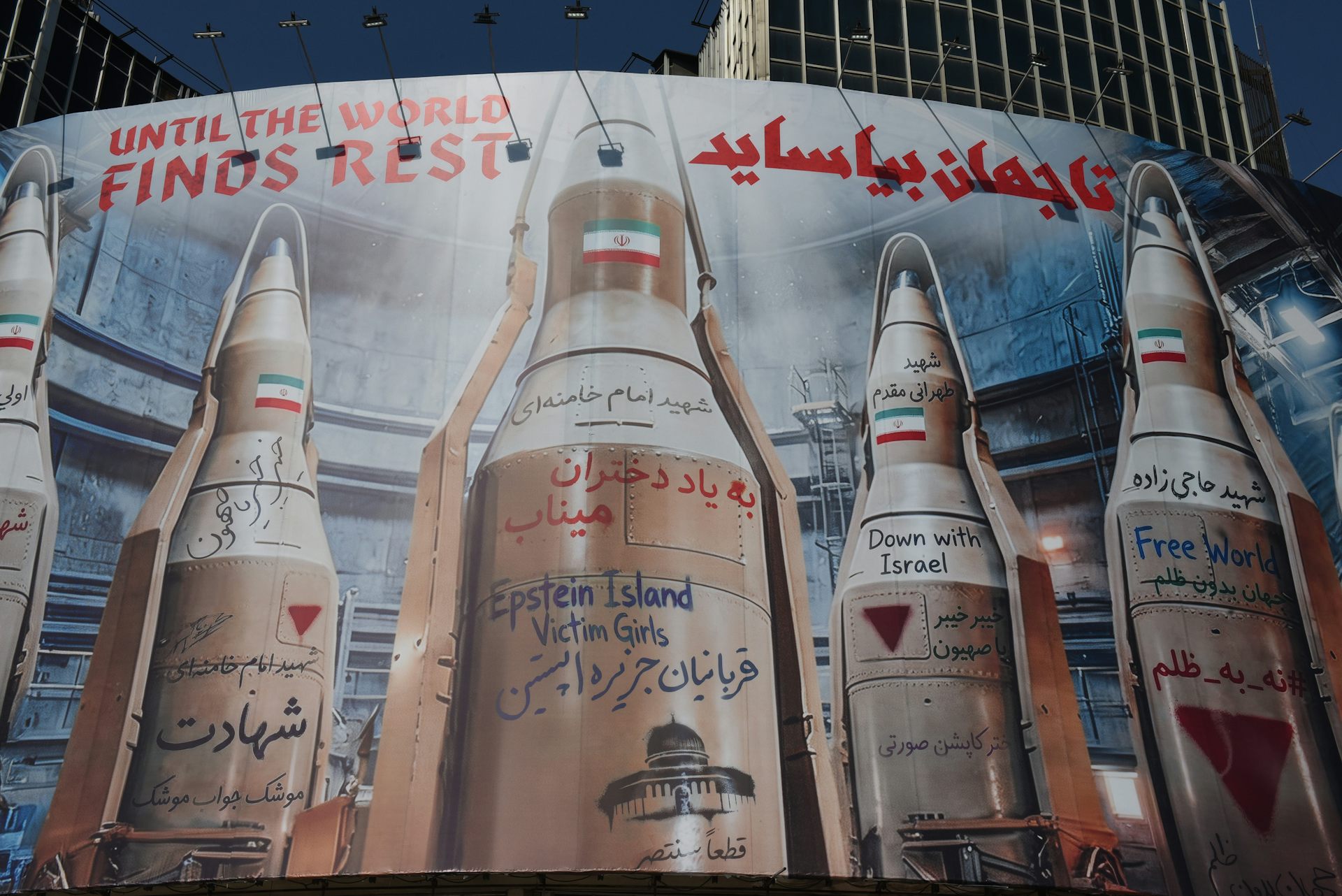
One of the billboards that circulated widely in recent months depicted Iranian missiles covered with handwritten messages and symbolic phrases.
Uno de los anuncios que circularon ampliamente en los últimos meses representaba misiles iraníes cubiertos con mensajes escritos a mano y frases simbólicas.
Among the most striking inscriptions is the phrase “To the girls of Minab”, written in bold, red Farsi script. This is a reference to a strike on a girls’ school in the opening days of the war that Iranian officials say killed 175 girls and teachers. Reports indicate US forces were likely responsible.
Entre las inscripciones más llamativas se encuentra la frase “A las chicas de Minab”, escrita en negrita y en escritura farsi roja. Esta es una referencia a un ataque contra una escuela de niñas en los primeros días de la guerra que, según funcionarios iraníes, mató a 175 niñas y maestras. Informes indican que las fuerzas estadounidenses fueron probablemente responsables.
Directly below that, written in English, are the words “Epstein Island victim girls”, a reference to the island owned by convicted sex offender Jeffrey Epstein where young women were allegedly sexually assaulted.
Directamente debajo, escrito en inglés, están las palabras “Epstein Island victim girls” (chicas víctimas de la Isla Epstein) , una referencia a la isla propiedad del condenado agresor sexual Jeffrey Epstein, donde presuntamente fueron agredidas sexualmente jóvenes mujeres.
On another missile is the phrase “the girl with the pink jacket”. This is a deeply emotional reference to a young Iranian girl killed in a terror attack in 2024, who was identified by her pink jacket and heart-shaped earrings.
En otro misil está la frase “la chica con la chaqueta rosa”. Esta es una referencia profundamente emotiva a una joven iraní asesinada en un ataque terrorista en 2024, quien fue identificada por su chaqueta rosa y sus pendientes en forma de corazón.
The intention is to connect these disparate events through a narrative of vulnerable young women affected by violence, exploitation and political power. Rather than presenting missiles only as weapons of destruction, the image reframes them as symbols of grief, revenge, memory and defence.
La intención es conectar estos eventos dispares a través de una narrativa de jóvenes vulnerables afectadas por la violencia, la explotación y el poder político. Más que presentar los misiles solo como armas de destrucción, la imagen los reformula como símbolos de dolor, venganza, memoria y defensa.
In this narrative, Iran is portrayed not as seeking war. It is responding to injustice and protecting its people.
En esta narrativa, Irán no es retratado como si buscara la guerra. Está respondiendo a la injusticia y protegiendo a su gente.
2. ‘Masters of war’
2. ‘Maestros de la guerra’
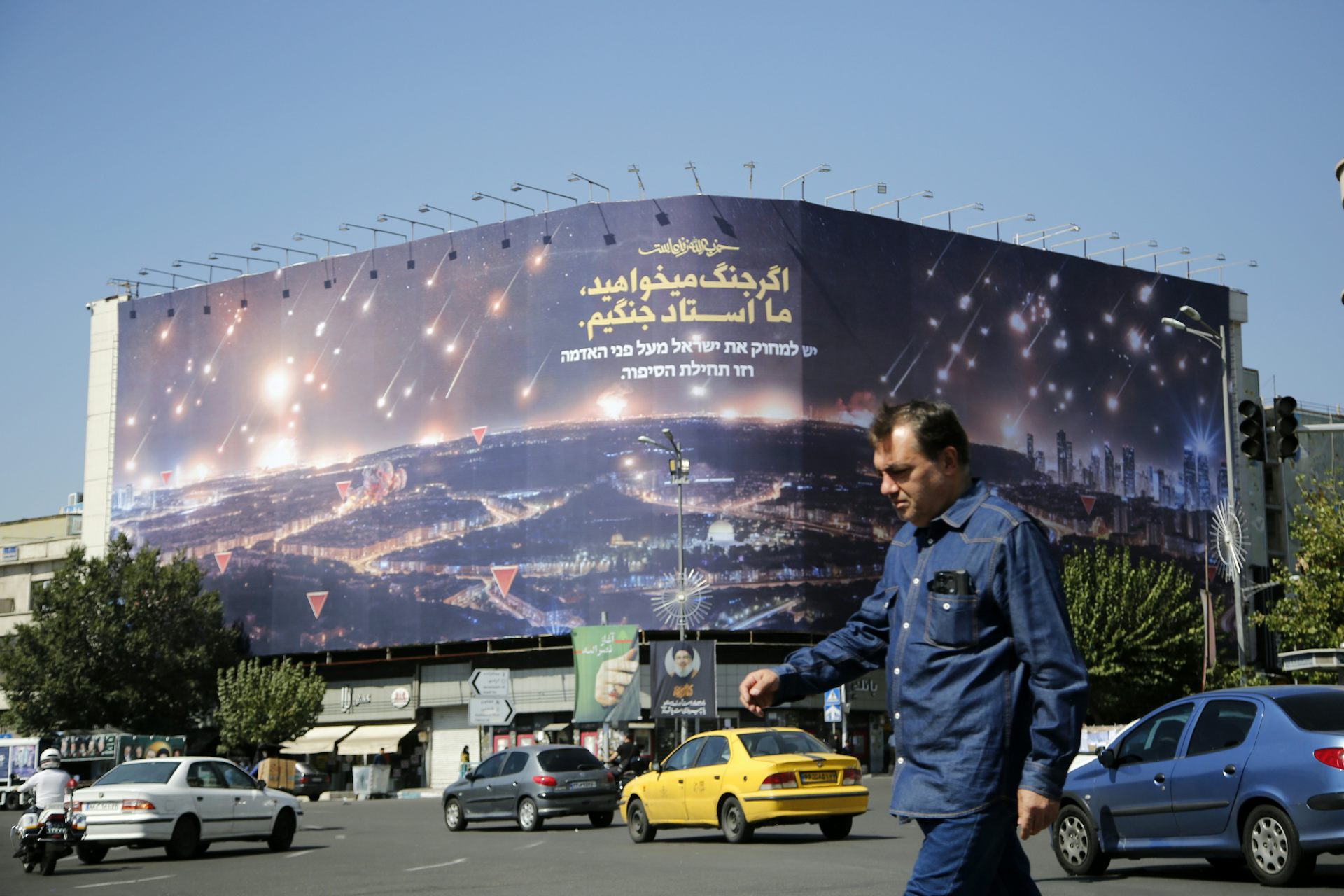
Another billboard that gained significant attention in 2024 depicted the Farsi phrase “If you want war, we are masters of war” above a Hebrew message saying “Israel must be wiped from the face of the earth”.
Otro anuncio que ganó gran atención en 2024 representaba la frase en farsi “Si quieres guerra, somos maestros de la guerra” sobre un mensaje hebreo que decía “Israel debe ser borrado de la faz de la tierra”.
The billboard portrays the sky over Israel illuminated by waves of incoming missiles, almost resembling a meteor shower or rain of fire. The imagery is highly stylised and cinematic, with the missiles transforming the night sky into a scene of overwhelming force.
El anuncio retrata el cielo sobre Israel iluminado por oleadas de misiles entrantes, asemejándose casi a una lluvia de meteoritos o a una lluvia de fuego. La imaginería es muy estilizada y cinematográfica, con los misiles transformando el cielo nocturno en una escena de fuerza abrumadora.
By directly addressing Hebrew-speaking viewers, the billboard functions as both a direct warning to Israelis and a symbolic projection of power, designed to have psychological impact. Language becomes a tool of warfare itself.
Al dirigirse directamente a los espectadores de habla hebrea, el anuncio funciona tanto como una advertencia directa a los israelíes como una proyección simbólica de poder, diseñada para tener un impacto psicológico. El lenguaje se convierte en una herramienta de guerra en sí misma.
This multilingual strategy reveals an important shift in Tehran’s urban propaganda. These billboards, which have become more prominent in recent years, are no longer designed solely for Iranian pedestrians and motorists. The regime is aware photographs will circulate instantly across the internet, reaching intended audiences in Israel.
Esta estrategia multilingüe revela un cambio importante en la propaganda urbana de Teherán. Estos anuncios, que se han vuelto más prominentes en los últimos años, ya no están diseñados únicamente para los peatones y conductores iraníes. El régimen es consciente de que las fotografías circularán instantáneamente por internet, llegando a las audiencias previstas en Israel.
3. Trump’s sutured mouth
3. La boca suturada de Trump
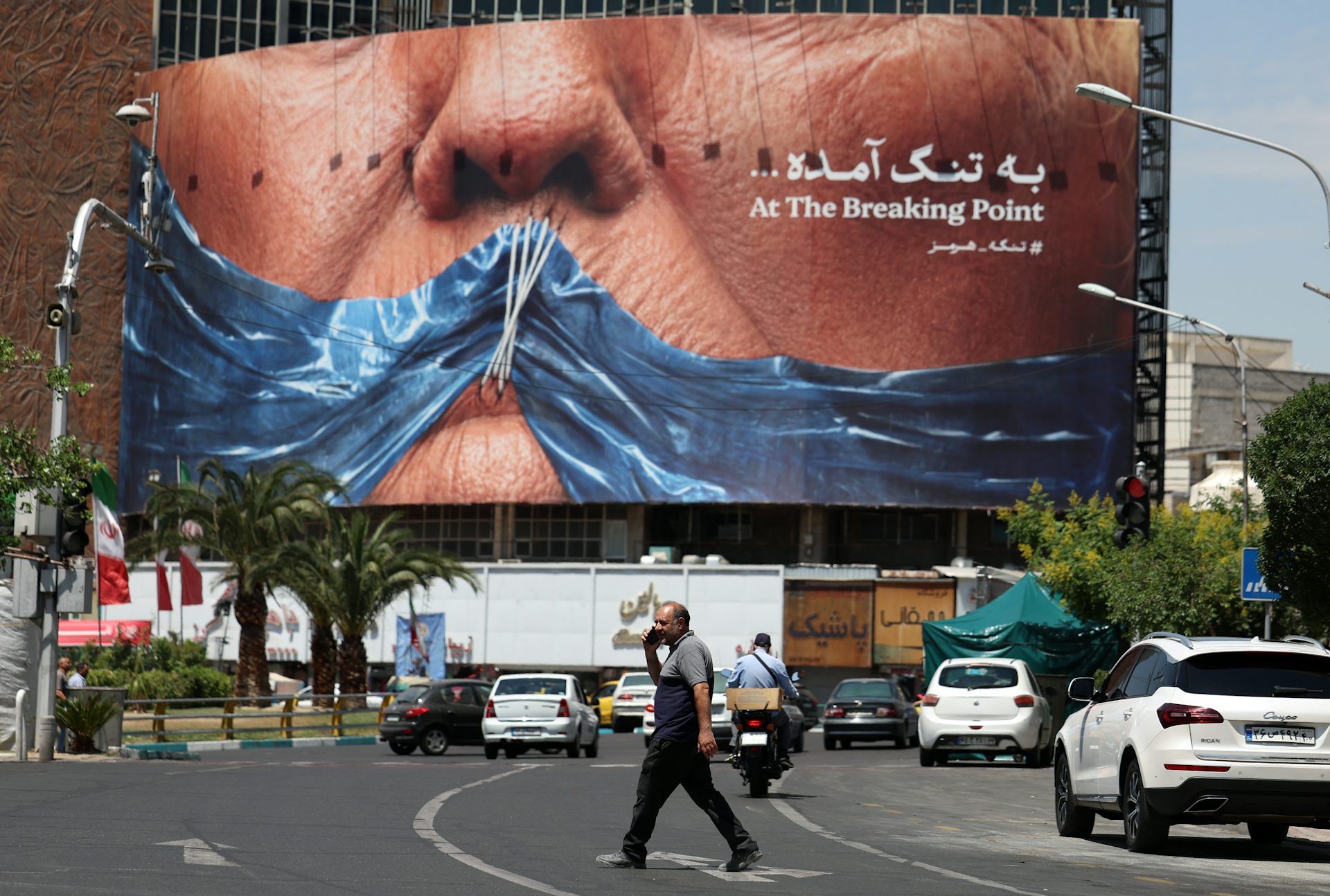
Another bilingual billboard is targeted to Western – and specifically American – audiences. It features US President Donald Trump’s mouth with a rendering of the Strait of Hormuz sutured on top, alongside the English phrase “The Breaking Point.”
Otro anuncio de vallas bilingüe está dirigido a audiencias occidentales, y específicamente estadounidenses. Muestra la boca del presidente de EE. UU., Donald Trump, con una representación del Estrecho de Ormuz suturada encima, junto con la frase en inglés “The Breaking Point”.
The Farsi text roughly translates to “its patience has run out”. It also contains a literary pun: the word tang in Farsi can refer both to “narrowness” or “constraint” and to the Strait (tangeh) of Hormuz itself. This creates a double meaning linking the geopolitical tensions in the Strait of Hormuz with the idea of reaching a psychological or political breaking point.
El texto en farsi se traduce aproximadamente como “su paciencia se ha agotado”. También contiene un juego de palabras literario: la palabra tangeh en farsi puede referirse tanto a “estrechez” o “restricción” como al propio Estrecho de Ormuz. Esto crea un doble significado que vincula las tensiones geopolíticas en el Estrecho de Ormuz con la idea de alcanzar un punto de quiebre psicológico o político.
The image also critiques Trump’s constant political rhetoric and media presence. The sutures placed across his mouth symbolise silencing, constraint and the loss of Trump’s authority or influence in relation to Iran and the Strait of Hormuz.
La imagen también critica la constante retórica política y la presencia mediática de Trump. Las suturas colocadas sobre su boca simbolizan el silenciamiento, la restricción y la pérdida de la autoridad o influencia de Trump en relación con Irán y el Estrecho de Ormuz.
4. Arash the Archer
4. Arash el Arquero
Another billboard draws on the famous Persian myth of Arash the Archer. In the image, Arash places an arrow into his bow in the heat of battle, surrounded by missiles. The reference comes from the ancient story in which Arash sacrifices his life after shooting an arrow during a mythological war between Iran and neighbouring Turan.
Otro anuncio se basa en el famoso mito persa de Arash el Arquero. En la imagen, Arash coloca una flecha en su arco en el fragor de la batalla, rodeado de misiles. La referencia proviene de la antigua historia en la que Arash sacrifica su vida después de disparar una flecha durante una guerra mitológica entre Irán y el vecino Turán.
The billboard suggests modern Iranian soldiers, like Arash, are willing to sacrifice their lives to defend their homeland.
El anuncio sugiere que los soldados iraníes modernos, como Arash, están dispuestos a sacrificar sus vidas para defender su patria.
More broadly, the image also reflects how poetry, mythology and heroic storytelling are deeply embedded in Iranian history and culture. It connects the contemporary conflict to centuries of struggle.
De manera más amplia, la imagen también refleja cómo la poesía, la mitología y la narración heroica están profundamente arraigadas en la historia y la cultura iraníes. Conecta el conflicto contemporáneo con siglos de lucha.
5. The fishermen
5. Los pescadores
Another billboard demonstrates Iranian military power through the image of a massive fishing net spread across the Persian Gulf. Inside the net are captured American aircraft, drones and naval vessels.
Otro cartel demuestra el poder militar iraní a través de la imagen de una enorme red de pesca extendida por el Golfo Pérsico. Dentro de la red hay aeronaves, drones y buques navales estadounidenses capturados.
The imagery is accompanied by the phrase, “The entire Persian Gulf is our hunting ground” in Farsi, connoting it is under direct Iranian control and surveillance. The image also emphasises the strategic importance of the Strait of Hormuz, indicating the power to open or close this vital waterway ultimately lies with Iran.
La imagen va acompañada de la frase, “Todo el Golfo Pérsico es nuestro campo de caza” en farsi, lo que implica que está bajo control y vigilancia iraníes directos. La imagen también enfatiza la importancia estratégica del Estrecho de Ormuz, indicando que el poder de abrir o cerrar esta vía navegable vital recae en última instancia en Irán.
At the same time, the fishing net operates as a cultural metaphor. Like fishing itself, Iran’s warfare strategy is based on patience, resilience, careful strategy and long-term determination, rather than sheer force alone.
Al mismo tiempo, la red de pesca funciona como una metáfora cultural. Al igual que la pesca misma, la estrategia bélica de Irán se basa en la paciencia, la resiliencia, la estrategia cuidadosa y la determinación a largo plazo, más que en la fuerza bruta por sí sola.
The authors do not work for, consult, own shares in or receive funding from any company or organisation that would benefit from this article, and have disclosed no relevant affiliations beyond their academic appointment.
Los autores no trabajan para, consultan, poseen acciones ni reciben financiación de ninguna empresa u organización que se beneficiaría de este artículo, y no han revelado afiliaciones relevantes más allá de su nombramiento académico.
Read more
-
Teorías de la conspiración que surgieron de un incidente de derechos civiles hace 60 años resuenan hoy
Conspiracy theories that emerged from a civil rights shooting 60 years ago resonate today
-
África en el Mundial: 10 equipos, entrenadores locales y profundidad táctica inauguran una nueva era
Africa at the World Cup: 10 teams, local coaches and tactical depth usher in a new era