As presas de aranha são uma das suas características mais assustadoras – fósseis novos revelam suas origens
Spider fangs are one of their scariest features – new fossils reveal their origins
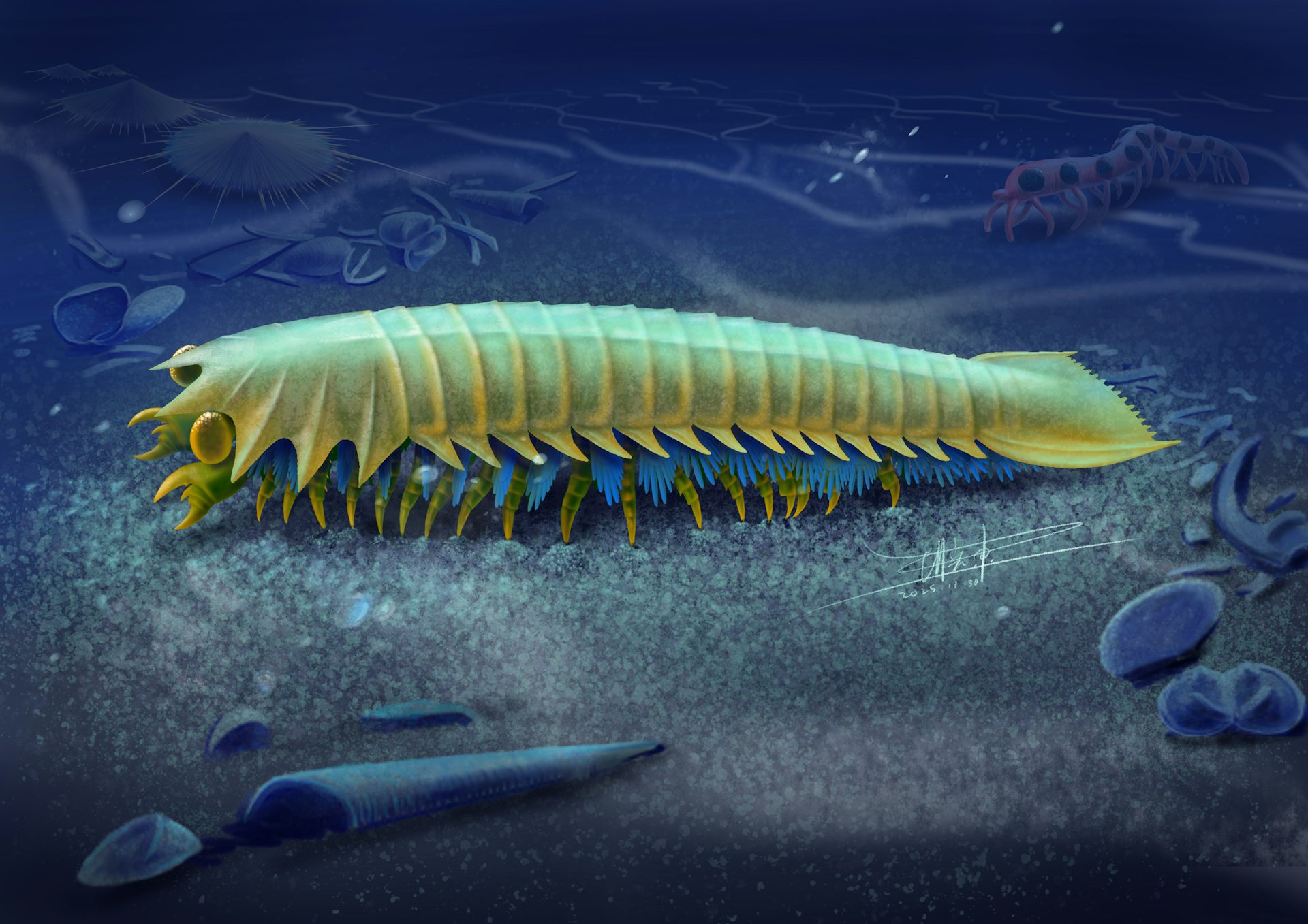
The 500 million year old shrimp-like Urokodia had pincer-like limbs emerging next to its eyes.
O Urokodia, semelhante a um camarão e com 500 milhões de anos, tinha membros em forma de pinça emergindo ao lado de seus olhos.
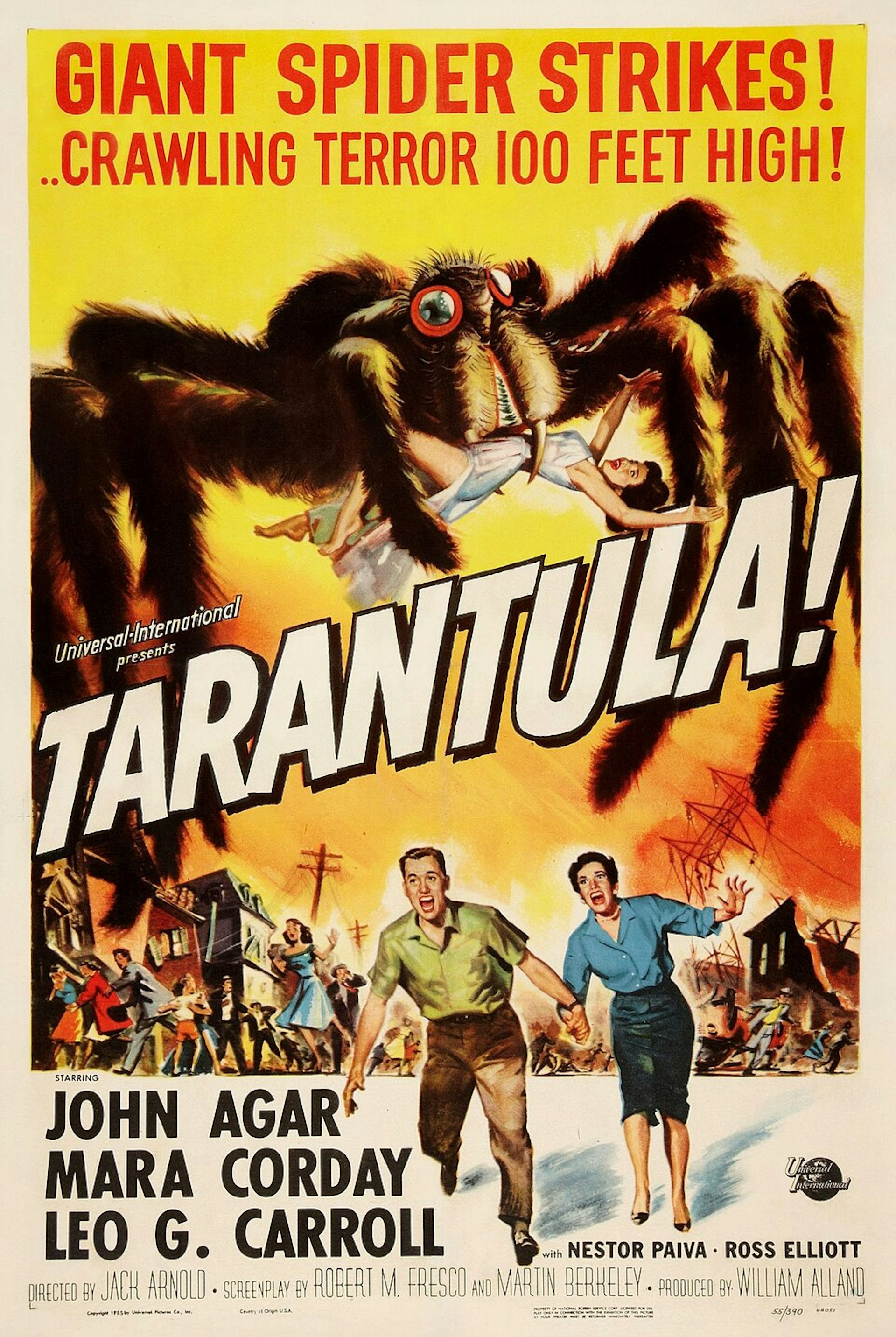
The publicity posters for the 1955 cult monster movie Tarantula! displayed a giant spider rampaging across the Arizona desert and clutching a poor human victim in its viciously long fangs. The film captured our fear of spiders, their creepy crawly motion and the hideous way they stab their prey to death, injecting a lethal venom.
Os cartazes de divulgação do filme monstro cult de 1955, Tarantula!, mostravam uma aranha gigante em frenesi pelo deserto do Arizona e agarrando uma pobre vítima humana com suas presas viciosamente longas. O filme capturou nosso medo das aranhas, seu movimento rastejante e a maneira horrível como elas esfaqueiam suas presas até a morte, injetando um veneno letal.
Spiders, like their cousins the scorpions, are some of nature’s most accomplished hunters. Our new research looks at remarkable fossils excavated from Yunnan, southern China. We have found evidence that helps reveal the earliest origins of fangs.
As aranhas, assim como seus primos os escorpiões, são alguns dos caçadores mais habilidosos da natureza. Nossa nova pesquisa analisa fósseis notáveis excavados em Yunnan, sul da China. Encontramos evidências que ajudam a revelar as origens mais antigas das presas.
Spiders and scorpions are chelicerates, part of a large group of animals called arthropods. Arthropods are characterised by their jointed limbs and skeletons that grow on the outside of their bodies. It’s that skeleton you hear scrunching if you accidentally step on one.
Aranhas e escorpiões são quelicerados, parte de um grande grupo de animais chamado artrópodes. Os artrópodes são caracterizados por seus membros articulados e esqueletos que crescem na parte externa do corpo. É aquele esqueleto que você ouve estalar se pisar acidentalmente em um.
Chelicerates also include mites, ticks, horseshoe crabs and sea spiders, all with specialised limbs at the front of the animal called chelicerae. It’s the chelicerae that are used as pincers or fangs for eating or stabbing prey. If you’ve ever been bitten by a tick, it’s the saw-like chelicerae that drew blood and got stuck in your skin.
Os quelicerados também incluem ácaros, carrapatos, cangrejos de ferradura e aranhas-do-mar, todos com membros especializados na frente do animal chamados quelíceras. São as quelíceras que são usadas como pinças ou presas para comer ou esfaquear a presa. Se você já foi mordido por um carrapato, foram as quelíceras em forma de serra que sangraram e ficaram presas na sua pele.
Chelicerates are among the most successful animals to live on land and in the sea, numbering well over 100,000 species. Fossils show that their ancestors have been hunting on land for more than 400 million years.
Os quelicerados estão entre os animais mais bem-sucedidos para viverem em terra e no mar, contando com mais de 100.000 espécies. Fósseis mostram que seus ancestrais caçam em terra há mais de 400 milhões de anos.
However, the earliest fossil evidence of chelicerates is not found on the land, but in the sea, in creatures that lived more than 500 million years ago during the Cambrian period. The Cambrian was a time of rapid evolution for animals that would one day lead to the amazing diversity of life in the oceans and on land. One of these Cambrian sea-creatures is called Urokodia, its name derived from the ancient Greek words for its shielded tail. It lived in the tropical seas that covered southern China about 518 million years ago.
No entanto, a evidência fóssil mais antiga dos quelicerados não é encontrada na terra, mas no mar, em criaturas que viveram há mais de 500 milhões de anos durante o Período Cambriano. O Cambriano foi um tempo de rápida evolução para animais que um dia levariam à incrível diversidade de vida nos oceanos e na terra. Uma dessas criaturas marinhas do Cambriano é chamada Urokodia, cujo nome deriva das palavras gregas antigas de sua cauda blindada. Ela viveu nos mares tropicais que cobriam o sul da China há cerca de 518 milhões de anos.
The beginnings of spider fangs
Os começos das garras de aranha
At first sight Urokodia – pictured at the top of this article – doesn’t seem like a contender for a distant relative of spiders or scorpions. It was a small animal 2-3 cm long with large eyes protruding on stalks from the front, and an elongate shrimp-like body, with jointed limbs strung from its underside. So, while Urokodia displays the tell-tale signs of arthropods, with its skeleton on the outside and jointed limbs, it doesn’t look much like a spider or a scorpion.
À primeira vista, Urokodia – ilustrado no topo deste artigo – não parece ser um concorrente para um parente distante de aranhas ou escorpiões. Era um animal pequeno, com 2-3 cm de comprimento, com grandes olhos protuberantes em hastes na frente e um corpo alongado e semelhante a camarão, com membros articulados pendurados por sua parte inferior. Assim, embora Urokodia exiba os sinais característicos dos artrópodes, com seu esqueleto externo e membros articulados, ele não se parece muito com uma aranha ou um escorpião.
But when we used X-rays to peer a little closer at the front end of Urokodia, we saw two pincer-like limbs emerging next to its eyes that are an ancient type of chelicerae. Some of the other legs of Urokodia bear finely layered structures that were probably used as gills for breathing in the sea. Modern aquatic chelicerates, like the horseshoe crab, have similar structures called “book gills” that literally look like the pages of a book.
Mas quando usamos raios-X para dar uma olhada mais de perto na extremidade frontal de Urokodia, vimos dois membros semelhantes a pinças emergindo ao lado de seus olhos que são um tipo antigo de quelíceras. Algumas das outras pernas de Urokodia exibem estruturas finamente laminadas que provavelmente eram usadas como brânquias para respirar no mar. Quelicerados aquáticos modernos, como o caranguejo-de-ferradura, têm estruturas semelhantes chamadas “brânquias em livro” que literalmente se parecem com as páginas de um livro.
Urokodia is an important link in the evolutionary chain, connecting forward to the incredible diversity of modern chelicerates like spiders, and also to other important Cambrian fossils, like Megachelicerax. That animal lived just a few million years after Urokodia in the tropical seas of ancient North America and its name means “big claw” honouring the awesome pair of chelicerae on its head.
Urokodia é um elo importante na cadeia evolutiva, conectando para a incrível diversidade dos quelicerados modernos, como aranhas, e também a outros fósseis importantes do Cambriano, como o Megachelicerax. Esse animal viveu apenas alguns milhões de anos depois de Urokodia nos mares tropicais da antiga América do Norte e seu nome significa “grande garra”, em homenagem ao incrível par de quelíceras em sua cabeça.
Urokodia, like Megachelicerax, was almost certainly a specialised predator. These fossils also hint at links to another group of ferocious Cambrian hunters, including the half-metre-long shrimp-like Anomalocaris, one of the planet’s first apex predators. Those animals bore formidable frontal limbs for grasping and catching prey and a circular mouth with plates that could tear apart a victim’s body.
Urokodia, assim como Megachelicerax, foi quase certamente um predador especializado. Esses fósseis também sugerem ligações com outro grupo de feroces caçadores do Cambriano, incluindo o Anomalocaris semelhante a camarão e de meio metro, um dos primeiros predadores de topo do planeta. Esses animais possuíam membros frontais formidáveis para agarrar e capturar presas e uma boca circular com placas que podiam rasgar o corpo de uma vítima.
In Urokodia we see the beginnings of the specialised limbs that would one-day evolve into the deadly fangs of spiders. We also see the beginnings of the lineage that would eventually produce some of the most formidable predators that have ever lived – though mercifully none as large as the spider in Tarantula.
Em Urokodia vemos os começos dos membros especializados que um dia evoluiriam para as mortais garras das aranhas. Também vemos os começos do linhagem que eventualmente produziria alguns dos predadores mais formidáveis que já viveram – embora, mercifulmente, nenhum tão grande quanto a aranha em Tarantula.
Yu Liu receives funding from the Department of Science and Technology of Yunnan Province (202401BC070012) , and is further funded by the Yunnan Revitalization Talent Support Program and the Chinese Scholarship Council to support his 1-year academic sabbatical at the University of Leicester. He works at the Yunnan Key Laboratory for Palaeobiology, Yunnan University, Kunming, China.
Yu Liu recebe financiamento do Departamento de Ciência e Tecnologia da Província de Yunnan (202401BC070012) e é ainda financiado pelo Programa de Apoio ao Talento de Revitalização de Yunnan e pelo Chinese Scholarship Council para apoiar seu sabático acadêmico de 1 ano na University of Leicester. Ele trabalha no Laboratório Chave de Paleobiologia de Yunnan, Universidade de Yunnan, Kunming, China.
Lorenzo Lustri, Mark Williams, and Tom Harvey do not work for, consult, own shares in or receive funding from any company or organisation that would benefit from this article, and have disclosed no relevant affiliations beyond their academic appointment.
Lorenzo Lustri, Mark Williams e Tom Harvey não trabalham, consultam, possuem ações ou recebem financiamento de nenhuma empresa ou organização que se beneficiaria deste artigo, e não divulgaram afiliações relevantes além de seu cargo acadêmico.
Read more
-

África na Copa do Mundo: 10 times, treinadores locais e profundidade tática inauguram uma nova era
Africa at the World Cup: 10 teams, local coaches and tactical depth usher in a new era
-

Três razões pelas quais Donald Trump não retirará os EUA da Nato
Three reasons Donald Trump won’t pull the US out of Nato