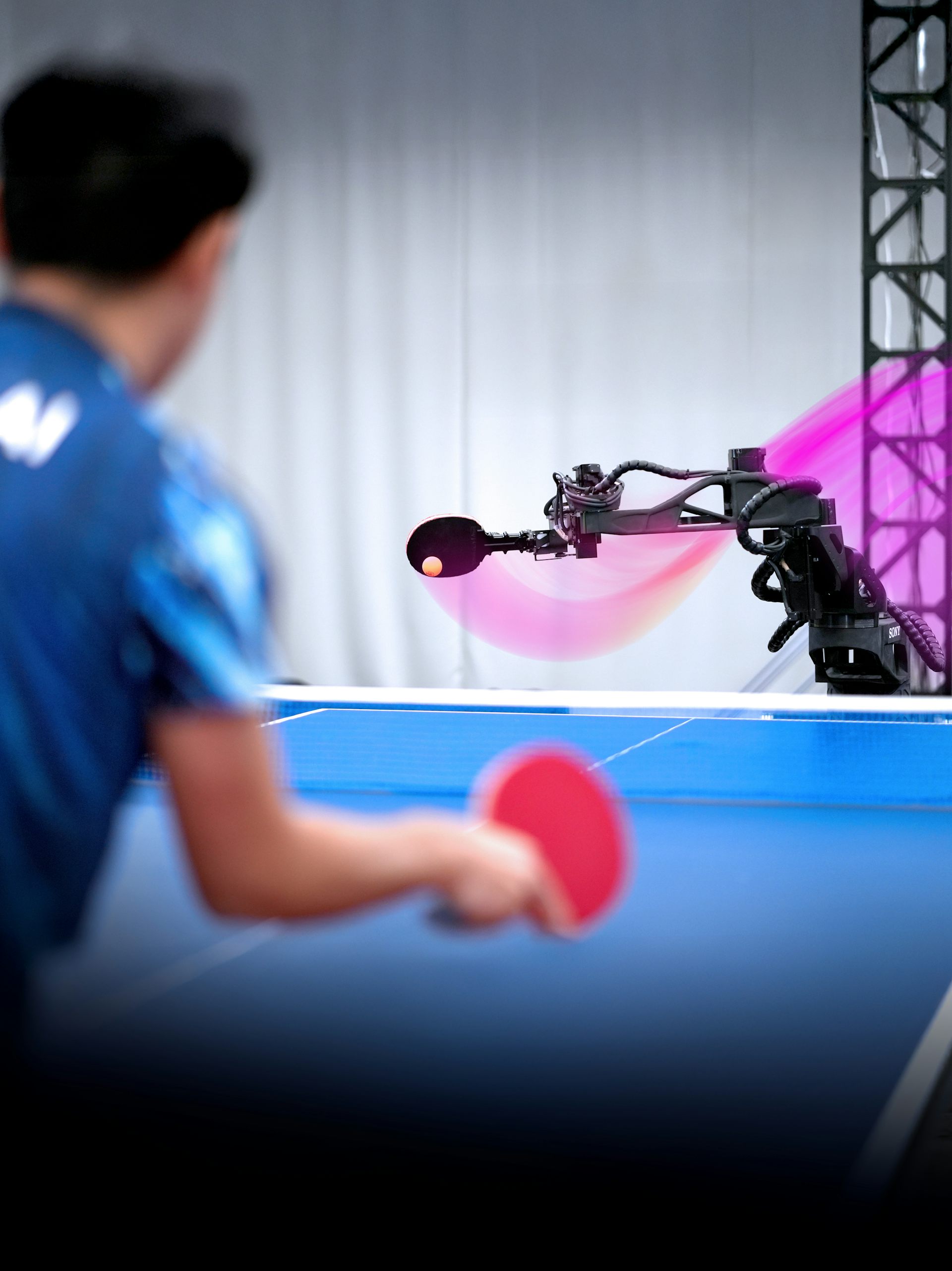
机器人可以跑马拉松和打乒乓球。但它们能达到真正的体育巅峰吗?
Robots can run a marathon and play ping pong. But will …
The real opportunity is not to build robot champions, but to better understand human performance.
真正的机会不是打造机器人冠军,而是更好地理解人类的表现。
A humanoid robot recently made headlines around the world for running a half-marathon and beating the human world record. Around the same time, an AI-powered robot defeated an elite human player in table tennis. What the robot lacked in experience, it made up for by reacting faster and more consistently than any person could.
一个人形机器人最近因跑半程马拉松并打破人类世界纪录而引起了全球关注。与此同时,一个人工智能驱动的机器人在一场乒乓球比赛中击败了一名顶尖人类选手。机器人缺乏的经验,它通过比任何人都更快、更稳定地反应来弥补。
These moments feel like milestones. Finally, it seems machines are stepping into one of the most human arenas – sports.
这些时刻让人感觉像是里程碑。最终,机器似乎正在进入人类最核心的领域之一——体育运动。
But while it is tempting to frame this as robots versus humans, sport robotics isn’t really about competition. It’s about how machines can learn to move, react and interact in dynamic, unpredictable environments – and what that means for human performance.
但虽然很容易将此框架化为机器人与人类的对抗,但运动机器人学真正的重点并非竞争。它关乎机器如何在动态、不可预测的环境中学习移动、反应和互动——以及这对人类表现意味着什么。
How do you train a robot to play sport?
如何训练机器人进行体育运动?
Training a robot to play sport is fundamentally different from training a human athlete.
训练机器人进行体育运动,与训练人类运动员有着根本性的不同。
People learn through practice, coaching and experience, constantly adjusting to changing conditions. In sport science, this is often described as a tight coupling between perception and action. That is, seeing, deciding, and moving in one continuous loop.
人们通过实践、指导和经验学习,不断适应变化的环境。在运动科学中,这通常被描述为感知与行动之间的紧密耦合。也就是说,在一个连续的循环中完成观察、决策和移动。
Robots, by contrast, are trained using a combination of simulation, data and control algorithms. Engineers build detailed virtual environments where robots can “practice” millions of times. They learn how to track objects, predict motion and coordinate their bodies. Sometimes, motion analysis techniques are used to track athletes doing the specific movements the robot needs to emulate.
相比之下,机器人是通过模拟、数据和控制算法的结合来训练的。工程师们构建了详细的虚拟环境,让机器人可以在其中“练习”数百万次。它们学会了如何追踪物体、预测运动并协调自身动作。有时,还会使用运动分析技术来追踪运动员,以获取机器人需要模仿的特定动作。
For fast-paced sports such as table tennis, the challenge is extreme. A robot must detect the ball, predict its trajectory and execute a precise movement within fractions of a second. This requires close integration between computer vision, machine learning and real-time control.
对于乒乓球等快节奏运动,挑战是极端的。机器人必须在几分之一秒内检测球、预测其轨迹并执行精确的动作。这需要计算机视觉、机器学习和实时控制之间的紧密结合。
One of the biggest advances in recent years has been the ability to train robots in simulation and then transfer those skills into the real world – a process known as “sim-to-real”. Combined with rapid improvements in sensors and computing, this has dramatically accelerated progress.
近年来最大的进展之一是能够在模拟环境中训练机器人,然后将这些技能转移到现实世界的能力——这个过程被称为“仿真到现实”(sim-to-real)。结合传感器和计算能力的快速提升,这极大地加速了进展。
We’ve seen similar developments in robot basketball and robot soccer, where systems have evolved from simply locating the ball to coordinating as teams, making tactical decisions and adapting to opponents.
我们在机器人篮球和机器人足球领域看到了类似的进展,这些系统已经从简单地定位球,发展到像团队一样进行协调、做出战术决策并适应对手。
Beyond entertainment
超越娱乐
While robot athletes make for compelling demonstrations, their greatest impact will likely be behind the scenes where they can be used to train human athletes.
尽管机器人运动员的展示令人着迷,但它们最大的影响可能是在幕后,用于训练人类运动员。
One of the central challenges in sport is designing effective practice. Athletes need repetition to build skill. But they also need variability to reflect real competition. Too much repetition becomes predictable; too much variability becomes chaotic.
体育运动的一个核心挑战是设计有效的训练。运动员需要重复来建立技能。但他们也需要变化性来反映真实的比赛。过度的重复会变得可预测;过度的变化则会变得混乱。
Robotics offers a potential way to balance both.
机器人技术提供了一种平衡两者的潜在方法。
A robotic training partner can deliver highly repeatable actions at elite intensity, while also introducing carefully controlled variation. For example, a robotic tennis server could replicate the motion of a world-class player while systematically varying ball speed, flight and placement.
机器人训练伙伴可以在精英级别的强度下提供高度可重复的动作,同时还能引入经过精心控制的变化。例如,一个机器人网球发球手可以在系统地改变球速、飞行轨迹和落点的情况下,复制世界级球员的动作。
From a sport science perspective, this creates what is known as a “representative learning environment”. The key benefit is it replicates the key perceptual and decision-making demands of elite competition, which is difficult for coaches to recreate in the training environment.
从运动科学的角度来看,这创造了一种被称为“代表性学习环境”。其关键优势在于它复制了精英比赛的关键感知和决策需求,而这对于教练来说很难在训练环境中重现。
In our work, we’ve been exploring how robotics could support sports such as tennis, cricket and the football codes. The goal is to combine realism, repeatability, variability, and data to enhance skill development and link technique to outcomes.
在我们的工作中,我们一直在探索机器人技术如何支持网球、板球和足球等运动。目标是结合真实性、可重复性、变化性和数据,以提高技能发展并使技术与结果挂钩。
Robots may also help manage training load. They can reduce the physical demands on coaches and training partners while still exposing athletes to high-quality game-like scenarios.
机器人还可以帮助管理训练负荷。它们可以在减轻对教练和训练伙伴的体力要求的同时,让运动员接触到高质量的比赛场景。
Beyond performance, there are opportunities for fan engagement. Interactive robots at live events or demonstrations of elite skills could offer new ways for audiences to experience sport.
除了运动表现之外,还有粉丝参与的机会。在现场活动或精英技能展示中,互动机器人可以为观众提供体验运动的新方式。
Will robots ever be ‘great’?
机器人能变得“伟大”吗?
Over the next decade, robots will likely become more agile, more robust and better able to operate in complex environments. Tasks that robots currently find difficult, such as running on uneven terrain and catching or throwing balls, will become increasingly achievable.
在接下来的十年里,机器人可能会变得更灵活、更坚固,并且能更好地在复杂环境中运行。目前机器人难以完成的任务,例如在不平坦的地形上奔跑以及接或扔球,将变得越来越容易实现。
But even as robots improve, there are important limits.
但是,即使机器人不断改进,仍然存在重要的局限性。
Sporting greatness is not just about executing movements perfectly. It involves creativity, decision-making under pressure, and the ability to adapt in ways shaped by experience, emotion and context.
运动上的伟大不仅仅是完美地执行动作。它还涉及创造力、压力下的决策能力,以及受经验、情感和环境塑造的适应能力。
From a sport science perspective, elite performance emerges from the interaction between the athlete, the task and the environment. Robots can be engineered to perform specific tasks extremely well, but they do not experience this interaction in the same embodied, meaningful way.
从运动科学的角度来看,精英表现源于运动员、任务和环境三者之间的相互作用。机器人可以被设计来极其出色地完成特定的任务,但它们无法以这种具身化、有意义的方式体验这种互动。
This means robots may surpass humans in tightly defined challenges – such as bowling a cricket ball with perfect consistency – but they are unlikely to achieve greatness in the holistic human sense.
这意味着机器人可能在定义明确的挑战中超越人类——例如以完美的稳定性投掷板球——但它们不太可能在整体的人类意义上达到伟大。
A new role for robots in sport
机器人运动领域的新角色
Rather than replacing athletes, robots are more likely to become part of the sporting ecosystem.
机器人不太可能取代运动员,而更有可能成为体育生态系统的一部分。
In the same way that video analysis and wearable sensors have transformed training, robotics offers a new tool for coaches and sport scientists. It enables practice environments that can be precisely controlled, repeated, and adapted to individual needs.
视频分析和可穿戴传感器改变了训练的方式,机器人技术也为教练和运动科学家提供了一种新工具。它能够创造出可以精确控制、重复和适应个人需求的训练环境。
The real opportunity is not to build robot champions, but to better understand human performance, and help athletes reach higher levels.
真正的机遇不是打造机器人冠军,而是更好地了解人类表现,并帮助运动员达到更高的水平。
Jonathan Roberts receives funding from the Australian Research Council.
Jonathan Roberts获得了澳大利亚研究理事会的资助。
Marc Portus does not work for, consult, own shares in or receive funding from any company or organisation that would benefit from this article, and has disclosed no relevant affiliations beyond their academic appointment.
Marc Portus不为任何受益于本文的公司或组织工作、提供咨询、拥有股份或接受资金,并且除了其学术任命之外,未披露任何相关隶属关系。