蜘蛛牙是它们最可怕的特征之一——新化石揭示了其起源
Spider fangs are one of their scariest features – new f…
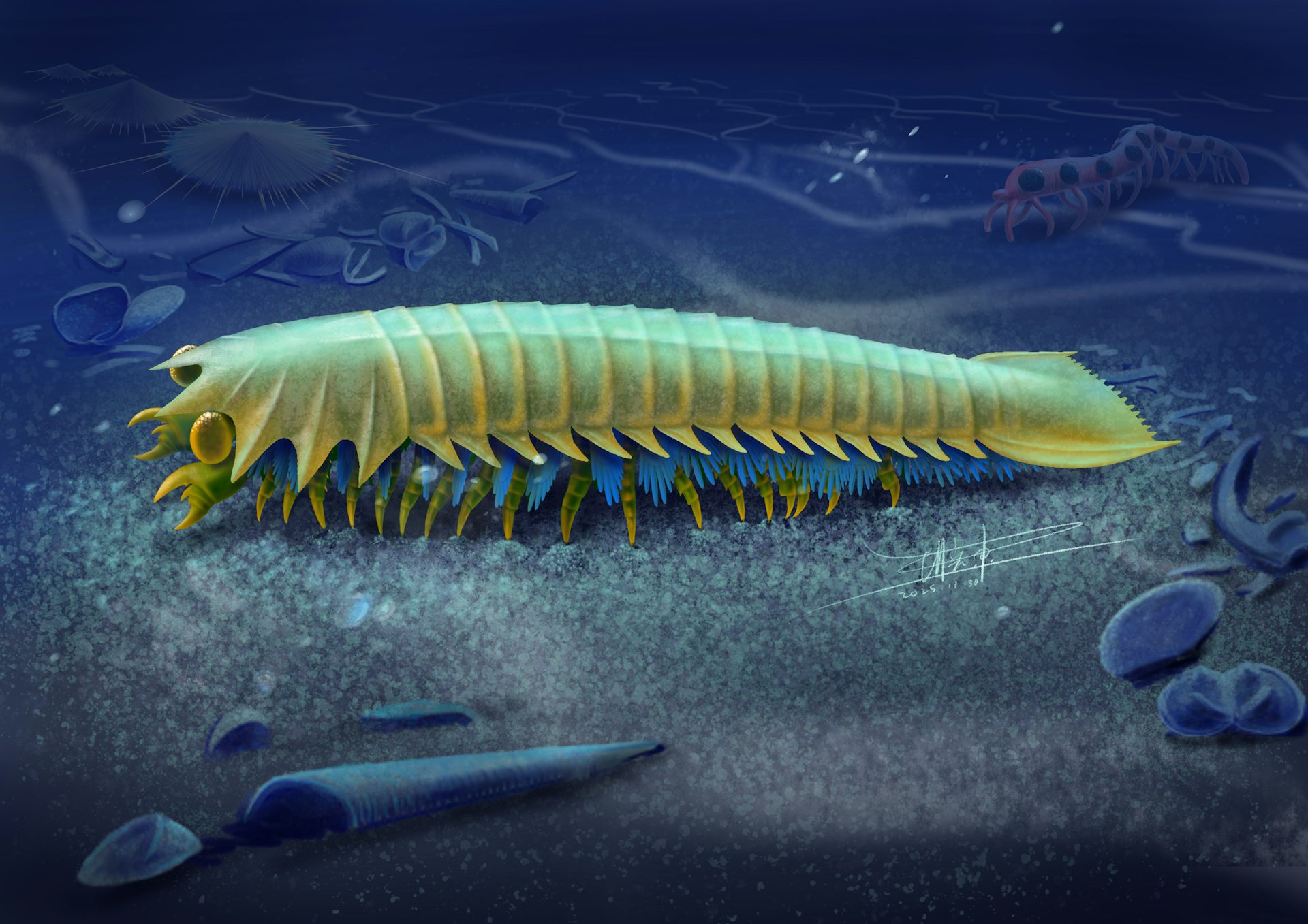
The 500 million year old shrimp-like Urokodia had pincer-like limbs emerging next to its eyes.
这种拥有虾状外形的、有五亿年历史的Urokodia,在眼睛旁边生出了一对钳子状的肢体。
The publicity posters for the 1955 cult monster movie Tarantula! displayed a giant spider rampaging across the Arizona desert and clutching a poor human victim in its viciously long fangs. The film captured our fear of spiders, their creepy crawly motion and the hideous way they stab their prey to death, injecting a lethal venom.
1955年邪典怪兽电影《蜘蛛女妖》的宣传海报展示了一只巨大的蜘蛛在亚利桑那沙漠中横行,用它凶猛的长牙紧抓着一个可怜的人类受害者。这部电影捕捉了我们对蜘蛛的恐惧、它们爬行的令人毛骨悚然的动作,以及它们刺杀猎物并注入致命毒液的可怕方式。
Spiders, like their cousins the scorpions, are some of nature’s most accomplished hunters. Our new research looks at remarkable fossils excavated from Yunnan, southern China. We have found evidence that helps reveal the earliest origins of fangs.
蜘蛛,像它们的表亲蝎子一样,是自然界最出色的捕食者之一。我们的新研究考察了从中国云南挖掘出的令人惊叹的化石。我们发现了有助于揭示牙齿最早起源的证据。

Spiders and scorpions are chelicerates, part of a large group of animals called arthropods. Arthropods are characterised by their jointed limbs and skeletons that grow on the outside of their bodies. It’s that skeleton you hear scrunching if you accidentally step on one.
蜘蛛和蝎子属于螯肢动物门,是大型节肢动物群的一部分。节肢动物的特征是它们具有关节状的附肢,以及生长在体表骨骼。如果你不小心踩到一只,就会听到那骨骼发出嘎吱作响的声音。
Chelicerates also include mites, ticks, horseshoe crabs and sea spiders, all with specialised limbs at the front of the animal called chelicerae. It’s the chelicerae that are used as pincers or fangs for eating or stabbing prey. If you’ve ever been bitten by a tick, it’s the saw-like chelicerae that drew blood and got stuck in your skin.
螯肢动物还包括螨虫、蜱虫、锹甲和海蜘蛛,所有这些动物的前部都有一个被称为螯肢(chelicerae)的特化附肢。用于进食或刺伤猎物的,就是这些螯肢,它们可以充当钳子或牙齿。如果你曾被蜱虫咬过,正是这种像锯子一样的螯肢吸出了血液并嵌入了你的皮肤。
Chelicerates are among the most successful animals to live on land and in the sea, numbering well over 100,000 species. Fossils show that their ancestors have been hunting on land for more than 400 million years.
螯肢动物是生活在陆地和海洋上最成功的动物之一,物种数量超过10万种。化石显示,它们的祖先已经在陆地上捕食了超过4亿年。
However, the earliest fossil evidence of chelicerates is not found on the land, but in the sea, in creatures that lived more than 500 million years ago during the Cambrian period. The Cambrian was a time of rapid evolution for animals that would one day lead to the amazing diversity of life in the oceans and on land. One of these Cambrian sea-creatures is called Urokodia, its name derived from the ancient Greek words for its shielded tail. It lived in the tropical seas that covered southern China about 518 million years ago.
然而,关于螯肢动物最早的化石证据并非来自陆地,而是来自海洋,这些生物生活于5亿多年前的寒武纪时期。寒武纪是动物快速进化的时期,最终导致了海洋和陆地上令人惊叹的生命多样性。这些寒武纪海生生物之一被称为Urokodia,其名称来源于古希腊语中指代其有盾牌状尾巴的词汇。它生活在大约5.18亿年前覆盖南中国的热带海域。
The beginnings of spider fangs
蜘蛛毒牙的起源
At first sight Urokodia – pictured at the top of this article – doesn’t seem like a contender for a distant relative of spiders or scorpions. It was a small animal 2-3 cm long with large eyes protruding on stalks from the front, and an elongate shrimp-like body, with jointed limbs strung from its underside. So, while Urokodia displays the tell-tale signs of arthropods, with its skeleton on the outside and jointed limbs, it doesn’t look much like a spider or a scorpion.
乍一看,乌罗科底(Urokodia)——如图所示的文章顶部图片——似乎不像是蜘蛛或蝎子的远亲。它是一种体长为2-3厘米的小动物,拥有从前部伸出的、带有柄的大眼睛,以及一个拉长的虾状身体,其腹面连接着关节肢。因此,虽然乌罗科底展示了节肢动物的典型特征,包括外骨骼和关节肢,但它看起来与蜘蛛或蝎子并没有太多相似之处。
But when we used X-rays to peer a little closer at the front end of Urokodia, we saw two pincer-like limbs emerging next to its eyes that are an ancient type of chelicerae. Some of the other legs of Urokodia bear finely layered structures that were probably used as gills for breathing in the sea. Modern aquatic chelicerates, like the horseshoe crab, have similar structures called “book gills” that literally look like the pages of a book.
但是,当我们使用X射线从更近的角度观察乌罗科底的前端时,我们看到了两对位于其眼睛旁、呈钳状突出的肢体,这是一种古老的螯肢类型。乌罗科底的其他一些腿部还带有精细分层的结构,这些结构可能曾用于在海中呼吸作为鳃。现代水生螯肢动物,如锹甲,具有类似的被称为“书本鳃”的结构,它们看起来就像书页一样。
Urokodia is an important link in the evolutionary chain, connecting forward to the incredible diversity of modern chelicerates like spiders, and also to other important Cambrian fossils, like Megachelicerax. That animal lived just a few million years after Urokodia in the tropical seas of ancient North America and its name means “big claw” honouring the awesome pair of chelicerae on its head.
乌罗科底是进化链上一个重要的环节,它向前连接到了蜘蛛等现代螯肢动物令人难以置信的多样性,同时也连接到了其他重要的寒武纪化石,例如巨螯类(Megachelicerax)。该动物生活在古北美洲的热带海域,比乌罗科底晚了仅仅几百万年,其名称意为“大钳”,以纪念它头部那对令人惊叹的螯肢。
Urokodia, like Megachelicerax, was almost certainly a specialised predator. These fossils also hint at links to another group of ferocious Cambrian hunters, including the half-metre-long shrimp-like Anomalocaris, one of the planet’s first apex predators. Those animals bore formidable frontal limbs for grasping and catching prey and a circular mouth with plates that could tear apart a victim’s body.
乌罗科底和巨螯类一样,几乎可以确定是一种专业的捕食者。这些化石还暗示了与另一群凶猛的寒武纪猎手之间的联系,其中包括半米长的虾状动物异目(Anomalocaris),它是地球最早的顶级掠食者之一。这些动物拥有强大的前肢用于抓取和捕获猎物,以及一个带有盘子的圆形口器,能够撕裂受害者的身体。
In Urokodia we see the beginnings of the specialised limbs that would one-day evolve into the deadly fangs of spiders. We also see the beginnings of the lineage that would eventually produce some of the most formidable predators that have ever lived – though mercifully none as large as the spider in Tarantula.
在乌罗科底身上,我们看到了最终会进化成蜘蛛致命毒牙的专业化肢体的开端。我们也看到了最终将产生历史上最可怕的掠食者之一的谱系的开端——尽管幸运的是,没有像“巨型蜘蛛”(Tarantula)那样巨大的个体出现。
Yu Liu receives funding from the Department of Science and Technology of Yunnan Province (202401BC070012) , and is further funded by the Yunnan Revitalization Talent Support Program and the Chinese Scholarship Council to support his 1-year academic sabbatical at the University of Leicester. He works at the Yunnan Key Laboratory for Palaeobiology, Yunnan University, Kunming, China.
刘宇来自云南省科学技术厅(202401BC070012)的资助,并获得了云南振兴人才支持计划和中国留学基金委员会的进一步资助,以支持他在莱斯特大学进行为期一年的学术休假。他在中国昆明云南大学云南重点古生物学实验室工作。
Lorenzo Lustri, Mark Williams, and Tom Harvey do not work for, consult, own shares in or receive funding from any company or organisation that would benefit from this article, and have disclosed no relevant affiliations beyond their academic appointment.
Lorenzo Lustri、Mark Williams和Tom Harvey不隶属于、不咨询、不持有或不从任何可能受益于本文的公司或组织获得资金,并且除了其学术任命外,没有披露任何相关的任职关系。